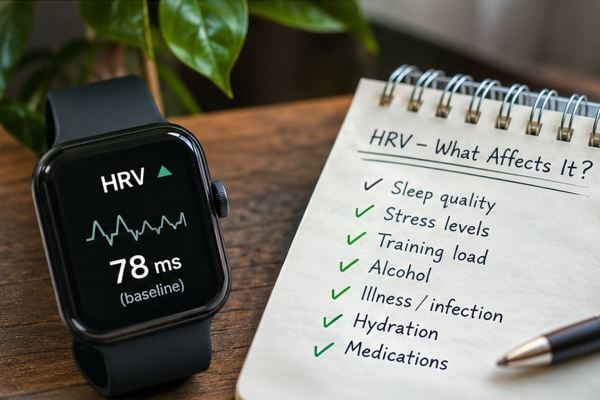
Heart rate variability, or HRV, is the beat-to-beat variation in the time between normal heartbeats. A higher HRV at rest often reflects stronger parasympathetic influence and greater flexibility in how the autonomic nervous system responds to changing demands. A lower reading can appear with poor sleep, hard training, alcohol, illness, dehydration, psychological stress, or simply normal day-to-day variation. The important point is that HRV is not a stress detector, recovery grade, or heart-health score by itself.
Consumer watches and rings have made HRV easy to track, but they have also made it easy to overinterpret. Different devices may use different sensors, sampling windows, and calculations. Your age, breathing, body position, time of day, medications, fitness, and even the way the device handles noisy data can change the number. HRV is therefore most useful as a personal trend measured under consistent conditions. A stable baseline, a meaningful deviation from that baseline, and the context around the change tell you far more than whether your number is “high” compared with someone else’s.
Table of Contents
- What Heart Rate Variability Is
- What Common HRV Metrics Mean
- What Raises and Lowers HRV
- How to Interpret Your Own Trend
- HRV for Training and Recovery
- How Accurate Wearables Are
- When HRV Is and Is Not Medically Useful
What Heart Rate Variability Is
Your heart does not normally beat like a perfectly spaced metronome. Even at a steady average rate of 60 beats per minute, the interval between one heartbeat and the next may be slightly longer or shorter. HRV measures those small changes in timing.
The variation is strongly influenced by the autonomic nervous system, which regulates functions you do not have to consciously control. Its sympathetic branch helps prepare the body for activity and challenge. Its parasympathetic branch supports rest, digestion, and recovery and can slow the heart through the vagus nerve. These systems constantly interact rather than switching on and off like separate buttons.
During quiet rest, especially with slow breathing, parasympathetic activity can create noticeable beat-to-beat variation. During intense exercise, acute stress, or illness, heart rate often rises and the intervals between beats become more uniform, so many HRV measures fall.
That does not mean “high HRV equals healthy” and “low HRV equals unhealthy” in every situation. HRV is affected by age, genetics, sex, posture, respiration, physical fitness, medications, alcohol, sleep, environmental conditions, measurement duration, and the specific metric being used. Research guidelines emphasize these methodological factors because they can materially alter the result.
The word “variability” can also be confusing. HRV is not the same as an irregular heartbeat. Normal HRV comes from small, organized changes in the interval between normal sinus beats. Atrial fibrillation and frequent premature beats can produce highly irregular intervals for a completely different reason. Good HRV software tries to identify and remove abnormal or noisy beats before calculating metrics, but consumer devices may not always do this perfectly.
HRV also differs from resting heart rate. A person can have the same resting pulse on two mornings but a different HRV because the pattern of intervals between beats changed. For a complementary measure, see what resting heart rate can say about fitness and recovery.
What Common HRV Metrics Mean
“HRV” is not one universal number. It is a family of calculations derived from heartbeat intervals. Two devices can both report HRV but use different metrics, so their values may not be directly comparable.
RMSSD
RMSSD stands for the root mean square of successive differences between normal heartbeat intervals. It gives more weight to short-term beat-to-beat changes and is widely used in sports and wearable tracking because it can be calculated from relatively short recordings. RMSSD is strongly influenced by parasympathetic modulation, especially at rest.
Many apps transform RMSSD with a natural logarithm because raw values can be highly skewed. If one platform shows milliseconds and another shows a logarithmic score, do not compare the numbers directly.
SDNN
SDNN is the standard deviation of normal-to-normal intervals. It reflects overall variability during the recording period. A five-minute SDNN and a 24-hour SDNN are not interchangeable because the longer recording captures circadian rhythms, activity, sleep, and other slow changes that cannot appear in a short sample.
Frequency-domain measures
Some analyses divide HRV into frequency bands, such as high-frequency and low-frequency power. These can be useful in research, but simple interpretations often go too far. In particular, the low-frequency/high-frequency ratio should not be treated as a direct gauge of “sympathetic versus parasympathetic balance.” Current methodological guidance warns that the underlying physiology is more complex.
For everyday tracking, the practical question is usually simpler: what metric does your device use, under what conditions does it measure it, and is the method consistent enough for you to follow your own trend?
What Raises and Lowers HRV
HRV responds to both long-term traits and short-term conditions. Some factors change your baseline gradually; others can shift the number overnight.
Common influences include:
| Factor | Typical effect or reason |
|---|---|
| Age | HRV generally declines with aging |
| Aerobic fitness | Often associated with higher resting vagal-related HRV |
| Sleep loss | Can reduce HRV or disrupt the usual overnight pattern |
| Heavy training | May temporarily lower HRV, especially when recovery is incomplete |
| Alcohol | Commonly lowers overnight HRV and raises resting heart rate |
| Illness or fever | Often lowers HRV as physiological stress rises |
| Psychological stress | Can lower some HRV measures, but responses vary |
| Slow breathing | Can change HRV substantially during the measurement itself |
| Dehydration and heat | May alter heart rate and autonomic responses |
| Medications | Beta blockers, stimulants, antidepressants, and others can affect HRV |
Body position matters too. A measurement taken lying down may not match one taken standing because the autonomic nervous system must respond to gravity and blood-pressure changes. Time of day also matters, which is why standardized morning or overnight measurements are often preferred for trend tracking.
Breathing is especially important. Heart rate naturally speeds slightly during inhalation and slows during exhalation, a phenomenon called respiratory sinus arrhythmia. If you deliberately breathe more slowly or deeply during one measurement than another, you can change HRV even if your overall recovery state has not changed.
This is why one unusually low morning should not trigger panic. Think about the previous 24–48 hours: sleep, alcohol, unusual exercise, illness symptoms, travel, heat exposure, emotional strain, and medications. A data point becomes useful when it fits a pattern.
Psychological stress deserves special nuance. Acute stress can reduce vagally mediated HRV in many people, but there is no one-to-one relationship between how stressed you feel and the number on your watch. Someone can feel mentally calm while physiologically strained by sleep loss or infection, or feel emotionally distressed while HRV remains near baseline. HRV is therefore not a lie detector for stress and should not be used to dismiss or validate emotional experience.
How to Interpret Your Own Trend
The most useful comparison is usually you versus your own recent baseline, measured with the same device and method. Population averages are much less helpful because normal HRV spans a wide range and decreases with age.
A practical approach is to establish at least two to four weeks of consistent measurements before making much of the trend. Overnight wearables can collect data automatically, while chest straps or validated camera-based systems may use a short morning recording. Whichever method you choose, consistency is more important than picking the “perfect” protocol.
Look for three things:
- Baseline: your typical range when you are sleeping, training, and feeling normally.
- Direction: whether the trend is stable, drifting upward, or drifting downward over days to weeks.
- Context: whether changes align with stress, illness, hard training, travel, poor sleep, or other known factors.
Suppose your usual nightly HRV is around 55–70 ms on a device that reports RMSSD-like values. A drop to 42 ms after a late night and two alcoholic drinks has a plausible explanation. If the number returns to baseline after two good nights of sleep, it may not mean anything more. If it remains depressed for a week along with fatigue, elevated resting heart rate, and reduced exercise tolerance, the pattern deserves more attention.
The reverse is also true. A sudden unusually high HRV is not automatically a sign of exceptional recovery. Measurement artifact, abnormal rhythm, or changes in breathing can produce unexpected values. Trend interpretation should never rely on direction alone.
Do not compare raw numbers across brands unless you know they use the same metric, recording length, filtering, and conditions. A watch value of 35 ms and a ring value of 50 ms may represent methodological differences rather than a physiological disagreement.
HRV for Training and Recovery
HRV can help organize training, but it works best as one input rather than an automatic command to train or rest. Sports research often uses morning RMSSD or overnight HRV to track autonomic responses to training. Higher-than-usual training stress can suppress vagally mediated HRV temporarily, while adequate recovery often allows it to return toward baseline.
This does not produce a perfect “readiness” signal. High-intensity interval exercise, long endurance work, travel, heat, emotional stress, and sleep loss can all change HRV. Some athletes also show paradoxical responses, including higher HRV during certain periods of accumulated fatigue. The relationship between autonomic markers and performance is not one-size-fits-all.
A sensible decision framework is to combine HRV with:
- Resting heart rate.
- Sleep quantity and quality.
- Muscle soreness and general fatigue.
- Mood and motivation.
- Performance during warm-up.
- Recent training load.
- Illness symptoms.
If HRV is low but you feel good and a warm-up feels normal, a planned session may still be appropriate. If HRV is low, resting heart rate is elevated, sleep was poor, and your warm-up feels unusually difficult, reducing intensity is more reasonable.
You can also compare HRV with heart rate recovery after exercise. The two measures overlap in their relationship to autonomic function but are not identical. HRV examines variability in beat timing, while heart rate recovery looks at how quickly pulse falls after exertion.
For most people, the fundamentals improve recovery more reliably than trying to “hack” HRV: regular sleep, a sustainable training load, enough food and fluids, limited alcohol, and stress management. If you are using heart-rate zones to structure exercise, a beginner guide to heart-rate training zones can help put HRV in a wider training context.
Slow-paced breathing and HRV biofeedback can deliberately increase oscillations in heart rate during the practice session. This can be useful as a relaxation or self-regulation technique, but the higher HRV seen while breathing slowly should not be confused with a permanently improved baseline. If you want to evaluate whether a breathing practice is helping recovery, compare resting measurements taken under the same normal-breathing conditions rather than comparing them with values recorded during the exercise itself.
How Accurate Wearables Are
Wearables can be useful for HRV trends, but accuracy depends on both hardware and conditions. Electrocardiography, or ECG, directly records the heart’s electrical activity and remains the reference method for measuring R-R intervals. Chest straps that detect electrical signals can approximate ECG timing well when contact is good.
Many watches and rings use photoplethysmography, or PPG. This optical method detects changes in blood volume at the skin rather than the heart’s electrical signal. At rest or during sleep, PPG-derived pulse intervals can track HRV reasonably well in some devices. Motion, poor fit, cold skin, tattoos, irregular rhythms, and signal-processing choices can reduce accuracy.
A 2024 umbrella review found that only a minority of commercially available wearable outcomes had been extensively validated, and accuracy varied by metric and device. A separate validation study of recent Apple Watch models found systematic differences from a chest-strap reference for serial HRV measurements. That does not make wearable HRV useless; it means the number should be treated as device-specific.
Another source of confusion is sampling. Some devices report an overnight average, while others take short samples only when you are still. A platform may also discard periods with poor signal quality. Because of those choices, two devices worn on the same night can legitimately produce different values even when both are functioning as designed.
The practical rules are simple:
- Use one device consistently when following a trend.
- Measure under similar conditions.
- Avoid comparing your raw number with someone using a different platform.
- Treat sudden implausible spikes or crashes as possible artifacts.
- Do not use a wearable HRV score to diagnose heart disease or an arrhythmia.
If a wearable repeatedly flags an irregular rhythm or you have palpitations, dizziness, chest pain, or fainting, the issue is not the HRV score itself. It is whether the heart rhythm needs medical evaluation. For symptom guidance, see when heart palpitations should be checked.
When HRV Is and Is Not Medically Useful
HRV is valuable in research and has clinical associations with cardiovascular and autonomic health, but a consumer reading is not a diagnostic test. There is no universal home HRV threshold at which a healthy person should seek emergency care. Clinical HRV analysis is usually performed with standardized recordings, artifact correction, defined metrics, and a clear medical or research question. A smartwatch recovery score does not reproduce that process.
A low reading without symptoms is usually best interpreted in context. Check for obvious explanations such as poor sleep, illness, alcohol, hard exercise, dehydration, or a change in measurement conditions. If the trend remains abnormal for you and you also notice fatigue, reduced exercise tolerance, persistent fast heart rate, or other symptoms, mention the pattern to a healthcare professional.
Seek medical care based on symptoms rather than the HRV number. Chest pain, fainting, severe shortness of breath, a sustained rapid or irregular heartbeat, or new neurologic symptoms require appropriate medical assessment whether HRV is high, low, or unavailable.
HRV should also not be used to change prescription medication without medical advice. Drugs that influence heart rate or autonomic function can change HRV, but that does not mean the medication is harmful or ineffective.
One more useful check is to compare HRV with other signals instead of reading it alone. A lower-than-usual HRV paired with a higher resting heart rate, poor sleep, unusual fatigue, and a drop in normal performance is more informative than an isolated low score. The reverse is also true: if HRV is lower for one night but you slept well, feel normal, and can train comfortably, the single reading may not deserve any action. This multi-signal approach reduces overreaction to measurement noise and keeps attention on patterns that matter.
The strongest use case for most healthy adults is modest: HRV can help you notice how your body responds to sleep, training, alcohol, travel, and illness when you measure it consistently. It is a trend signal, not a verdict. The number becomes more useful when you resist the urge to optimize every daily fluctuation and instead focus on repeated patterns that line up with how you feel and perform. If tracking the metric makes you anxious or encourages constant checking, it is reasonable to hide the score for a while and focus on sleep, activity, symptoms, and other behaviors you can actually act on.
References
- Guidelines for rigor and reproducibility of heart rate variability within human cardiovascular research 2026 (Review)
- Publication guidelines for human heart rate and heart rate variability studies in psychophysiology-Part 1: Physiological underpinnings and foundations of measurement 2024 (Guideline)
- Heart rate variability measurement and influencing factors: Towards the standardization of methodology 2024 (Review)
- Keeping Pace with Wearables: A Living Umbrella Review of Systematic Reviews Evaluating the Accuracy of Consumer Wearable Technologies in Health Measurement 2024 (Systematic Review)
- The Validity of Apple Watch Series 9 and Ultra 2 for Serial Measurements of Heart Rate Variability and Resting Heart Rate 2024
- Influence of physical post-exercise recovery techniques on vagally-mediated heart rate variability: A systematic review and meta-analysis 2023 (Systematic Review)
Disclaimer
This article is for general education and is not a diagnosis, medical-monitoring plan, or individualized training prescription. Consumer HRV values can be affected by device error, medications, illness, and many normal physiological factors. Seek medical care for concerning symptoms such as chest pain, fainting, severe shortness of breath, or a sustained abnormal heartbeat rather than relying on an HRV score.