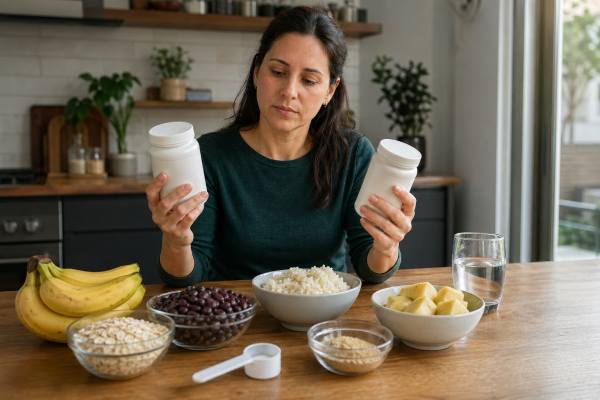
Inulin and resistant starch can help with weight loss, but not in the dramatic way supplement marketing often suggests. They are better understood as appetite-support and diet-quality tools than as direct fat burners. For some people, they modestly improve fullness, digestion, meal control, and blood sugar response, which can make a calorie deficit easier to sustain. For others, they mainly cause gas, bloating, and unrealistic expectations.
The real question is not whether these fibers are “good.” It is whether they help enough to matter in everyday weight management, especially when progress has slowed or maintenance feels harder than losing. That depends on the type of fiber, the dose, your gut tolerance, your overall diet, and whether hunger is actually the problem you need to solve.
Table of Contents
- What inulin and resistant starch actually are
- How they might help with weight loss
- What the research really shows
- When they are most likely to help
- Food sources, supplements, and dosing
- Side effects and who should be careful
- Should you try them or skip them?
What inulin and resistant starch actually are
Inulin and resistant starch are both fermentable carbohydrates that reach the large intestine instead of being fully digested in the small intestine. That is where they begin to overlap. Beyond that, they are not interchangeable.
Inulin is a type of fructan, often sourced from chicory root, Jerusalem artichokes, onions, garlic, leeks, asparagus, and some processed fiber products. It is commonly added to powders, bars, yogurts, and “gut health” supplements because it mixes fairly easily and acts as a prebiotic. That means it can be used by certain gut microbes, which then produce short-chain fatty acids and other byproducts that may affect satiety, bowel habits, and metabolic health.
Resistant starch is starch that resists digestion in the small intestine. It shows up naturally in foods like beans, lentils, oats, green bananas, and cooked-and-cooled potatoes or rice. It also appears in supplements such as raw potato starch, green banana flour, and certain formulated starch products. There are different types of resistant starch, but for everyday use the practical point is simple: some forms come from foods, some come from powders, and they do not all behave exactly the same way.
The biggest reason people confuse these fibers is that both are often marketed as “gut health” tools that can support weight control. That is true in a loose sense, but each has a different feel in practice. Inulin is usually more obviously fermentable and is more likely to trigger gas and bloating in sensitive people. Resistant starch can also cause GI symptoms, but many people find it easier to introduce through real foods rather than through a scoop of powder.
| Feature | Inulin | Resistant starch |
|---|---|---|
| Main type | Prebiotic fructan fiber | Starch that escapes digestion |
| Common sources | Chicory root fiber, onions, garlic, asparagus, supplement powders | Beans, oats, green bananas, cooled potatoes or rice, raw potato starch |
| Typical goal | Gut microbiota support, satiety, regularity | Satiety, glycemic support, microbiota support |
| Common downside | Gas and bloating, especially in sensitive guts | Bloating or discomfort if increased too fast |
| Best use case | Someone who tolerates fermentable fibers well and wants a simple add-in | Someone who prefers food-based strategies or gentler appetite support |
That difference matters because the better question is not “Which fiber is healthier?” but “Which one fits your body, habits, and actual obstacle to weight loss?”
How they might help with weight loss
Neither inulin nor resistant starch burns fat directly. Their value is indirect. They may help create conditions that make it easier to eat less without feeling as deprived.
One possible mechanism is satiety. Fermentable fibers can slow digestion, change gut signaling, and increase the production of short-chain fatty acids, which may influence appetite-related hormones and meal satisfaction. That does not mean a scoop of fiber automatically kills hunger, but it can nudge fullness in the right direction when the rest of the diet is already reasonably structured.
Another mechanism is lower energy intake. Some isolated fibers have been recognized for beneficial physiological effects such as reduced calorie intake or improved bowel regularity. In practice, this matters most when the fiber helps someone eat smaller portions naturally, delay snacking, or stay steadier between meals. That is why fiber usually works best when it supports a wider eating pattern built around daily fiber targets rather than when it is treated as a shortcut.
Resistant starch may also help by softening blood sugar swings after meals, especially when it replaces more rapidly digested starches. That can matter for people who feel hungrier after highly refined carb-heavy meals. Inulin is often discussed more for its prebiotic effects, but it may also affect appetite and bowel patterns in ways that make a deficit feel more manageable.
There is also a less glamorous benefit: regularity. Some people in a plateau are not dealing with true fat-loss failure at all. They are dealing with constipation, irregular bowel movements, poor diet quality, and the scale noise that comes with them. In that context, improving fiber intake may help the situation look clearer, even if it is not directly accelerating fat loss.
Still, there are limits. Fiber does not erase liquid calories, weekend overeating, underestimating portions, or a shrinking deficit near goal weight. It is a tool for leverage, not a substitute for the fundamentals. That is why it helps to think in meal terms too, such as whether you are reaching useful fiber targets per meal instead of only worrying about a supplement label.
A useful way to think about both inulin and resistant starch is this: they may help if the reason your diet is hard to sustain is hunger, low food quality, or poor meal structure. They will do much less if the real problem is inconsistency, alcohol, grazing, social eating, or a belief that “healthy” foods do not still count toward energy intake.
What the research really shows
The research is promising, but it does not justify miracle language.
For inulin-type fructans, the evidence points to small, not dramatic, effects. Recent pooled analyses suggest modest reductions in body weight, BMI, waist circumference, and sometimes fat mass, especially over several weeks. That matters, but it should be interpreted honestly. A change of around a kilogram is not meaningless, yet it is also not the kind of result that rescues a poorly matched diet or breaks a plateau by itself.
Resistant starch has a slightly more exciting headline because a 2024 human trial found meaningful weight loss and improved insulin resistance in adults with excess body weight over an eight-week period. That result is interesting and important, but one standout trial is not the same as universal proof. The dosage was substantial, the study group was specific, and real-world adherence is often less neat than research conditions.
This is where nuance matters. The research supports “may help” much more than “works.” It is reasonable to say these fibers can support appetite regulation, gut microbial shifts, glycemic control, or small improvements in anthropometrics. It is not reasonable to promise that they will produce obvious fat loss in everyone.
Another issue is that studies do not all use the same form, dose, duration, or patient population. Some use chicory inulin. Some use oligofructose-rich blends. Some use resistant starch from specific sources or in structured supplement protocols. Some measure body weight. Others focus more on metabolic markers, microbiota, laxation, or insulin sensitivity. That makes headlines easy and conclusions harder.
This is also why people often overread the literature. A fiber supplement that improves one marker in a study is not automatically the best supplement for your actual goal. If your plateau is being driven by underestimating calories, low protein, and weekend drift, the better lever may be high-volume eating during plateaus rather than another specialty powder. If your issue is appetite after weight loss, fiber may play a role, but it usually works best alongside broader satiety strategies for maintenance.
The fairest summary is this:
- inulin has the stronger body of evidence for modest average weight-management support
- resistant starch has intriguing human data and strong mechanistic appeal
- both seem more useful as helpers than as primary drivers
- neither has evidence strong enough to justify “fat loss supplement” marketing
That may sound less exciting than sales copy, but it is actually useful. It helps set a standard that matches reality: these fibers can improve the odds of sticking to a better diet, and that is often where their real value lies.
When they are most likely to help
Inulin and resistant starch are most likely to help when the obstacle is appetite, food quality, or digestive regularity, not when the obstacle is hidden calories or inconsistent adherence.
A good candidate is someone who eats a low-fiber diet, gets hungry quickly after meals, has poor satiety from refined foods, or struggles to stay regular in a calorie deficit. Another reasonable use case is someone near goal weight who is not failing because of lack of effort, but because the deficit has become smaller and the margin for error is tighter. In those situations, a small reduction in hunger or snacking pressure can matter.
They may also help people who want to make their eating pattern more “automatic.” A morning yogurt with added inulin, or a lunch built around beans and cooled potatoes, can support repeatable structure. That matters because plateaus are often behavioral long before they are metabolic. When things feel stalled, using a plateau decision tree can prevent you from blaming a lack of supplements for what is really a tracking, routine, or intake problem.
These fibers may be especially useful when:
- meals are low in beans, whole grains, fruit, vegetables, or legumes
- hunger rises after weight loss and makes maintenance feel fragile
- constipation or poor bowel regularity is making scale readings misleading
- highly refined meals leave you unsatisfied and hunting for snacks
- you want a gentler, food-first tool rather than another stimulant or appetite suppressant
They are less likely to help when:
- you already eat a high-fiber, high-protein diet
- you are frequently overeating on weekends or evenings
- alcohol, restaurant meals, or portion creep are the real issue
- bloating and gut sensitivity already make eating harder
- you expect the supplement to replace better meal planning
There is also a mindset issue worth pointing out. Fiber is often most helpful for people who see it as a “friction reducer,” not as a weight-loss weapon. That small framing change matters. Once you stop asking whether it melts fat and start asking whether it helps you eat like the kind of person who can sustain progress, the value becomes clearer.
For many people, appetite management after weight loss becomes harder than they expected. That is where these fibers sometimes earn their place, especially if they complement what is happening with increased appetite after weight loss rather than pretending hunger can be solved by willpower alone.
Food sources, supplements, and dosing
Food first usually beats supplements for long-term weight control. Whole foods bring water, chewing, meal volume, micronutrients, and better habit carryover. A supplement can add fiber, but it usually cannot recreate the fullness of actual food.
For inulin, common supplement forms include chicory root fiber powder, fiber blends, or snack products fortified with inulin. For resistant starch, common strategies include cooled potatoes, cooled rice, beans, lentils, oats, green banana flour, or raw potato starch. Food sources are often easier to fit into a sustainable routine because they naturally improve meal composition while adding fiber at the same time.
That said, supplements can be practical when convenience is the main issue. The most sensible approach is to start low and build slowly. Many people tolerate only small amounts at first.
A reasonable starting approach often looks like this:
- Start with a low dose.
For inulin, that may mean just a few grams. For resistant starch, it may mean a small serving from food or a partial scoop of powder. - Hold the dose steady for several days.
Do not increase it just because the package says more is better. - Take it with meals and enough fluid.
That often improves tolerance. - Change one thing at a time.
Do not add a new protein powder, probiotic, magnesium supplement, and fiber supplement all in the same week. - Judge the outcome by appetite, bowel comfort, and consistency.
A supplement that makes you miserable is not helping, even if it is “healthy.”
This is also where a food-based plan often wins. Adding beans to lunch, oats at breakfast, or cooled potatoes to dinner can support the same broader goal while improving meal quality. That fits much better with the everyday reality of foods that work in a calorie deficit than relying on a fiber powder to rescue otherwise weak meals.
If snacks are a trouble spot, improving your regular food pattern may do more than supplementing alone. In many cases, a better bridge strategy is pairing fiber with protein through practical high-fiber snacks rather than chasing the highest fiber number possible.
The most useful dose is not the biggest one you can survive. It is the one you can tolerate consistently enough for it to improve your overall eating pattern.
Side effects and who should be careful
The most common side effects are digestive: gas, bloating, cramping, rumbling, loose stools, or a feeling of pressure after meals. Inulin is especially known for this, particularly in people with IBS tendencies, FODMAP sensitivity, or a gut that already reacts badly to onions, garlic, or chicory-root-heavy products.
Resistant starch can also cause discomfort, especially if the dose rises too quickly, but some people tolerate it better than inulin. Others find the opposite. Tolerance is personal, which is why it is risky to assume a supplement is “gentle” just because it is marketed as natural.
People who should be more cautious include:
- those with IBS, frequent bloating, or strong FODMAP sensitivity
- those with inflammatory bowel disease during active flares
- those with bowel narrowing, major digestive disorders, or unexplained GI symptoms
- those taking diabetes medications who may need to watch glucose responses more closely
- those who are pregnant, breastfeeding, or using multiple supplements without clinician guidance
Another common problem is hidden product design. Fiber products often contain sweeteners, flavors, gums, probiotics, digestive enzymes, or other extras that may be causing the issue rather than the fiber itself. That is one reason it helps to read supplement labels carefully instead of focusing only on the front-of-pack promise.
Quality also matters. A simple fiber product from a reputable company is often easier to assess than a flashy “metabolism and gut reset” blend with ten add-ons and vague amounts. If you use supplements regularly, looking for third-party testing is a smart quality screen, even though it does not prove the product will help you lose weight.
One more practical warning: do not treat worsening bloating as proof the supplement is “working.” People sometimes assume intense fermentation means their microbiome is improving. Sometimes it just means the dose is too aggressive or the fiber is a poor fit.
A good rule is that mild, temporary adaptation can happen, but persistent discomfort is not a badge of progress. If your abdomen feels worse, your appetite gets more chaotic, or your food choices become narrower because the supplement is bothering you, the cost is probably higher than the benefit.
Should you try them or skip them?
For most people, inulin and resistant starch belong in the “maybe useful” category, not the “must have” category.
Try them if your diet is low in fiber, hunger is making adherence harder, you tolerate fermentable fibers reasonably well, and you want a structured tool that supports better meal control. Skip them, or at least lower your expectations, if you already eat plenty of fiber, your main issue is calorie drift rather than fullness, or you have a gut that reacts badly to fiber-heavy products.
If you are choosing between the two, the decision is less about which one is superior on paper and more about which one fits your real life. Inulin may suit someone who wants a simple supplement and tolerates prebiotic fibers well. Resistant starch may suit someone who prefers food-based strategies or wants to experiment with beans, oats, and cooled starches before buying powders.
The most honest answer to the headline question is this: yes, these fibers can help, but mostly by making the fundamentals easier. They do not bypass those fundamentals. They do not turn a maintenance-calorie diet into a deficit. They do not cancel weekend overeating. They do not fix poor sleep, low protein, or inconsistent meal structure.
What they can do is create a small but meaningful improvement in satiety, bowel regularity, and metabolic steadiness. In a long-term weight-loss or maintenance process, that may be enough to matter. Small advantages count when repeated daily.
If you want the simplest decision rule, use this one:
- choose food first when possible
- add fiber supplements only if they solve a specific problem
- start low, go slowly, and judge by tolerance and behavior
- keep expectations modest
- stop if the product creates more friction than it removes
That is not flashy advice, but it is the advice most likely to help. The people who get value from inulin or resistant starch are usually the ones who use them to reinforce an already sensible system, not the ones asking them to do the whole job.
References
- The effects of chicory inulin-type fructans supplementation on weight management outcomes: systematic review, meta-analysis, and meta-regression of randomized controlled trials 2024 (Systematic Review and Meta-analysis)
- Resistant starch intake facilitates weight loss in humans by reshaping the gut microbiota 2024 (RCT)
- The Prebiotic Potential of Inulin-Type Fructans: A Systematic Review 2022 (Systematic Review)
- Dietary Supplements for Weight Loss – Health Professional Fact Sheet 2022 (Fact Sheet)
- Questions and Answers on Dietary Fiber 2024 (FDA Guidance Page)
Disclaimer
This article is for general educational purposes only. Inulin and resistant starch can affect digestion, blood sugar response, and tolerance differently from person to person, so they are not a substitute for individualized medical, nutrition, or medication advice. If you have a digestive condition, diabetes, unexplained GI symptoms, or trouble tolerating fiber, speak with a qualified clinician before using fiber supplements.
If you found this article useful, consider sharing it on Facebook, X, or your preferred platform so others can make a more informed decision about inulin, resistant starch, and weight loss.