Low-calorie snacks can make weight loss easier when they prevent the kind of hunger that turns into overeating later. The best snack ideas under 200 calories are not just small. They are satisfying enough to bridge the gap between meals, curb cravings, and keep you from feeling like your calorie deficit is one long emergency.
This article breaks down what makes a snack useful for fat loss, how to choose options that keep you full, and which under-200-calorie snacks work best for different situations. You will also find practical sweet and savory ideas, a comparison table, and the common mistakes that make “healthy snacks” surprisingly unhelpful.
Table of Contents
- What makes a snack worth it
- How to choose under-200-calorie snacks
- Best high-protein snacks under 200 calories
- Best fiber and produce-based snacks
- Sweet snacks that still fit weight loss
- Savory snacks with crunch and salt
- When snacking helps and when it backfires
- Common snack mistakes in a calorie deficit
What makes a snack worth it
A good snack for weight loss does a job. It buys you time until your next meal, takes the edge off your hunger, or helps you avoid impulsive eating when you are busy, tired, or surrounded by tempting food. A bad snack does the opposite. It adds calories without doing much for fullness, then leaves you rummaging through the kitchen 30 minutes later.
That is why the best low-calorie snacks are not always the lowest-calorie foods. A 90-calorie snack that does not satisfy you can be less helpful than a 180-calorie snack that prevents a 500-calorie detour later. Under 200 calories is a useful guideline because it keeps snacks modest, but the real question is whether the snack improves appetite control.
In practice, the most useful weight-loss snacks tend to have one or more of these qualities:
- enough protein to slow hunger down
- enough fiber or food volume to make the snack feel substantial
- a clear portion size
- convenience that matches real life
- taste that is good enough to repeat
This is also why not everyone needs snacks. Some people do better with three larger meals and no nibbling in between. Others are more consistent when they plan one or two snacks into the day. A calorie deficit is easier to sustain when your eating pattern actually fits your schedule, which is one reason a simple calorie deficit approach works better than random restriction.
The context matters too. A small yogurt before an afternoon meeting can be helpful. A handful of nuts, then a protein bar, then “just a few crackers” while making dinner is a different story. Snacking is not automatically good or bad. It is useful when it is intentional.
A final point that many people overlook: snack quality matters because snacks are often where diets drift. Breakfast, lunch, and dinner may be planned. Snacks are where convenience, emotions, and habit take over. Choosing better options makes your whole day easier, especially if you already know which foods tend to work best in a calorie deficit.
How to choose under-200-calorie snacks
The easiest way to choose a low-calorie snack is to stop asking, “What can I eat for the fewest calories?” and start asking, “What will actually hold me over?” That shift usually leads to better choices.
A useful snack under 200 calories often follows one of three patterns:
- Protein-first snack
Best when you need staying power. Greek yogurt, cottage cheese, deli turkey, tuna, eggs, edamame, or a small protein shake fit here. - Produce plus something satisfying
Best when you want more volume. Fruit with yogurt, vegetables with hummus, or popcorn with a light cheese stick are simple examples. - Craving-controlled treat
Best when you want something sweet or crunchy but still need a portion that fits your goals. This might be frozen grapes, cocoa yogurt, or a measured serving of roasted chickpeas.
As a rough guide, a snack gets more filling when it includes at least one of these:
- Protein: often around 8 to 15 grams is enough to make a difference
- Fiber: often around 3 to 6 grams helps the snack last longer
- Volume: fruit, vegetables, popcorn, or soups make a small calorie budget feel bigger
- Texture: crunchy, chewy, or creamy snacks often feel more satisfying than foods you can inhale in four bites
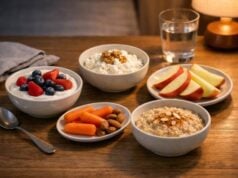
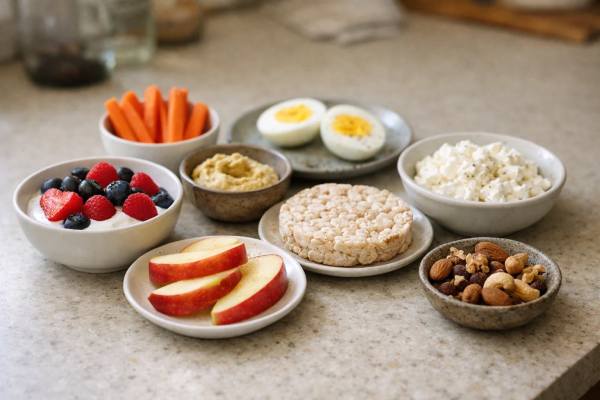
For many people, pairing protein and produce is the sweet spot. An apple by itself may not last long. An apple with cottage cheese or Greek yogurt usually works better. Baby carrots alone may feel like a chore. Baby carrots with hummus are more likely to feel like food.
This is also where label reading helps. Yogurts, granola bars, trail mixes, and “healthy” snack packs vary wildly. One brand’s 150-calorie yogurt may have 15 grams of protein and low added sugar. Another may be mostly sugar with only a token amount of protein. The calorie number matters, but the calorie number alone does not tell you how useful the snack will be.
If you struggle with constant hunger, it can help to look at your bigger daily pattern too. Many people snack aggressively because meals are too low in protein or too low in fiber. A closer look at protein intake for weight loss and daily fiber targets often explains why snacks feel impossible to control.
The practical goal is simple: choose snacks that feel like a small extension of a smart meal, not a random calorie event.
Best high-protein snacks under 200 calories
High-protein snacks are usually the most reliable choice when you need appetite control. They tend to work especially well in the late morning, late afternoon, or after exercise, when a carb-only snack can disappear fast.
The easiest versions are simple, repeatable, and not overly “diet” feeling. They also work well if you already know you do better with higher-protein snack options than with sweets or chips.
| Snack idea | Approx. calories | Why it works | Best for |
|---|---|---|---|
| Nonfat Greek yogurt with berries | 120–160 | High protein with extra volume from fruit | Afternoon hunger |
| Low-fat cottage cheese with cucumber or cherry tomatoes | 130–170 | Very filling for the calories | Salty cravings |
| Two hard-boiled eggs with raw vegetables | 150–180 | Portable, satisfying, and easy to portion | Work or travel |
| Edamame, lightly salted | 160–190 | Protein plus fiber in one snack | Long gaps between meals |
| Deli turkey roll-ups with mustard and pickle | 90–140 | High protein and very low calorie | Very tight calorie budgets |
| Tuna pouch with cucumber slices or rice crackers | 110–180 | Lean protein with a savory feel | Desk drawer snack |
| Light string cheese with an apple | 140–170 | Protein plus crunchy fruit | Balanced snack |
| Protein shake made with water | 120–180 | Fast and easy when convenience matters most | On-the-go days |
Greek yogurt is one of the strongest all-around choices because it is easy to portion, widely available, and adaptable. You can make it sweet with berries and cinnamon, or savory with everything seasoning and cucumber. Cottage cheese plays a similar role and tends to be more filling than people expect.
Eggs work well too, especially if you tend to snack because you need “real food.” A pair of eggs with crunchy vegetables feels much more substantial than a packaged 100-calorie snack pack. Edamame is another underrated option because it combines protein and fiber, which is a powerful combination when you are trying to stay full on fewer calories.
Protein shakes deserve a practical note. They are useful, especially on rushed days, but they are not automatically the best choice. Liquid snacks can feel less satisfying than foods you chew. They work best when convenience is the priority or when you need a bridge and truly do not have time for anything else. If you use them regularly, it helps to know which protein shakes fit weight loss best and which ones quietly turn into dessert.
Best fiber and produce-based snacks
Not every good snack needs to be protein-heavy. Sometimes the best answer is a high-volume snack that gives you crunch, chew, and a feeling of abundance. This is where produce-based snacks shine.
Fruit and vegetable snacks help because they make 100 to 200 calories feel bigger. That matters more than most people realize. Appetite is influenced by stomach stretch, eating time, texture, and visual portion size, not just by calorie math.
Some of the best examples include:
- apple slices with a measured tablespoon of peanut butter
- pear with a light cheese stick
- baby carrots, cucumbers, or bell peppers with hummus
- berries with a spoonful of Greek yogurt
- orange segments with cottage cheese
- celery with whipped cottage cheese or light cream cheese
- air-popped popcorn with fruit on the side
- roasted chickpeas in a measured portion
Fruit gets dismissed too often in weight-loss conversations, but it is one of the most useful snack categories because it is sweet, hydrating, and easy to pair with a more filling food. Apples, berries, citrus, and grapes are especially helpful because they are portable and naturally portion-friendly. If you want better variety, these fruit choices that fit a calorie deficit are a strong place to start.
Vegetables are best when you make them convenient and flavorful. Raw peppers, cucumbers, sugar snap peas, and cherry tomatoes are easier to snack on than a whole head of broccoli sitting untouched in the fridge. The dip matters too. A modest portion of hummus or yogurt-based dip can turn vegetables from a chore into a repeatable habit.
Roasted chickpeas deserve special mention because they solve a common problem: people want something crunchy, salty, and snack-like. Chickpeas provide that while also bringing fiber and a little protein. They are not magic, but they are more helpful than many chip-like snacks.
If fullness is your main issue, fiber can make an outsized difference. That is why many people do well with fiber-rich snacks for weight loss instead of treating fiber as something that only belongs at meals.
The most effective produce-based snacks usually pair freshness with structure. Fruit alone can work, but fruit plus protein often works better. Vegetables alone can work, but vegetables plus a satisfying dip are more realistic. The goal is not to build the lowest-calorie snack possible. It is to build the snack you will actually choose when hungry.
Sweet snacks that still fit weight loss
Sweet cravings are often where snacking goes off the rails. The problem is usually not wanting something sweet. The problem is choosing sweet foods that disappear instantly and wake up even more hunger.
The fix is not to ban sweet snacks. It is to choose sweets that have a little more structure. The best options give you sweetness plus protein, fiber, or volume.
A few of the most reliable ideas under 200 calories are:
- Greek yogurt with cocoa powder and berries
- frozen grapes or cherries
- cottage cheese with pineapple
- apple slices with cinnamon and a tablespoon of nut butter
- a chia-yogurt cup made with light yogurt
- a small homemade smoothie built around ice, berries, and Greek yogurt
- a couple of squares of dark chocolate with strawberries
- protein pudding made from a shake mixed thicker with Greek yogurt
Greek yogurt shows up again because it is unusually versatile. You can turn it into something that feels close to dessert without blowing through your calorie budget. Cocoa powder, cinnamon, vanilla extract, and berries go a long way. Frozen fruit is also excellent when you want something slow to eat. Frozen grapes in particular are simple, cheap, and surprisingly effective.
Portioning matters most with calorie-dense sweet foods. Nut butter, chocolate, granola, and dried fruit can all fit, but the margin for error is smaller. A spoonful becomes three. A “few” chocolate chips becomes a handful. That is why dessert-style snacks work better when the base is something bulky and filling, not just energy-dense toppings.
If a nightly sweet craving is your sticking point, you do not need to pretend it is not there. You need a better default. Many people do well by rotating a few sweet swaps that still fit weight loss rather than relying on willpower at 9 p.m.
The best sweet snack is the one that scratches the itch without turning into a full dessert spiral. That usually means keeping the portion obvious, the calories moderate, and the snack satisfying enough that you can move on.
Savory snacks with crunch and salt
Sometimes what you want is not sweetness. It is salt, crunch, and something that feels snacky in the classic sense. That is where many people default to chips, crackers, or handfuls of trail mix that are easy to overeat. The better move is to find savory snacks that still feel satisfying without becoming a 400-calorie side quest.
Air-popped popcorn is one of the best examples. It is bulky, crunchy, and usually low enough in calories that you can have a genuinely satisfying amount. Add a little salt, nutritional yeast, ranch seasoning, or smoked paprika and it becomes a real snack rather than “diet popcorn.” Measured portions still matter, especially once butter or oil gets involved, but plain popcorn is one of the easiest ways to get volume for relatively few calories.
Other strong savory options include:
- roasted chickpeas
- edamame with sea salt
- turkey roll-ups with mustard
- cottage cheese with pepper and tomatoes
- cucumber slices with tuna
- pickles with deli turkey
- a light cheese stick with whole-grain crackers
- mini caprese skewers with light mozzarella and tomatoes
Texture is a big deal here. Crunchy snacks slow eating down and create more satisfaction than soft foods you can swallow quickly. Salt can also make a snack feel more complete, which helps when you are trying not to rebound into a larger snack later.
This is also the category where convenience foods can actually help. Frozen edamame, single-serve hummus cups, pre-cut vegetables, tuna packets, and portioned popcorn are not less valid because they are easy. In real life, ease is often what makes a better choice happen.
If you like crisp foods, cooking method matters. Dry roasting, air frying, and using high-water vegetables can create a satisfying snack experience without needing a lot of oil. That is one reason crisp, lower-calorie staples from better frozen foods for weight loss can be surprisingly useful on busy days.
Savory snacks work best when they feel intentional rather than like leftovers from a party bowl. Put them on a plate, portion them clearly, and make them worth eating.
When snacking helps and when it backfires
Snacking helps when it solves a specific problem. It backfires when it becomes background eating.
A planned snack is often useful in these situations:
- you have more than four or five hours between meals
- you train in the afternoon and need a bridge
- dinner is late and you know you arrive home ravenous
- you do better with smaller eating occasions
- you are trying to prevent a predictable craving time
For example, a yogurt at 4 p.m. can be the reason dinner stays reasonable. An apple and cheese before a long commute can be the reason you do not destroy takeout the second you get home. In those cases, the snack is supporting the rest of the day.
Snacking usually backfires when it is driven by cues instead of need:
- eating because food is visible
- taking several small bites that never “count”
- snacking while distracted by screens
- grazing while cooking
- using snacks as procrastination or stress relief
This is especially common at night. Evening hunger can be real, but evening snacking is also where boredom, fatigue, and routine blur together. If nights are difficult, having a defined plan for late-night snacks that fit weight loss is far more useful than hoping the craving never shows up.
A good test is this: can you name the purpose of the snack before you eat it? “I need something to hold me until dinner” is a clear purpose. “I just keep walking into the pantry” is not.
Snacks should support your day, not fragment it. When they are timed and chosen with a little intention, they can improve consistency. When they become constant, unplanned eating, they quietly erase the calorie deficit you thought you had.
Common snack mistakes in a calorie deficit
Most snack problems are not caused by one “bad” food. They come from patterns that seem small but add up fast.
1. Choosing snacks that are too tiny to matter
A snack that is technically low-calorie but does not satisfy you often leads to a second snack. Then a third. One better snack is usually more useful than several weak ones.
2. Trusting health halos
Granola bites, smoothie shop snacks, protein cookies, nut blends, and dried fruit mixes can sound healthy while packing a lot more calories than expected. “Natural” does not mean light.
3. Free-pouring calorie-dense foods
Nut butter, nuts, granola, chocolate, trail mix, and crackers are easy to underestimate. These foods can fit a weight-loss plan, but only if the portion is intentional.
4. Drinking your snack too fast
Liquid calories can be practical, but they often do less for fullness than food you chew. Shakes are helpful tools, not automatic appetite solutions.
5. Keeping trigger snacks within arm’s reach
If the only easy option is chips, you will probably eat chips. Environment matters more than motivation in many snacking situations.
6. Letting snacks replace real meals too often
A quick snack can bridge meals. It should not regularly become lunch by accident unless that is your plan and it still meets your needs.
7. Forgetting that “under 200” is still not unlimited
Three under-200-calorie snacks can quietly become a full extra meal. Low-calorie snacks help when they are placed deliberately, not stacked mindlessly across the day.
One practical fix is to create a short list of default snacks you genuinely like and can repeat without much thought. Think three to five sweet options and three to five savory ones. That is enough variety for most people and far better than making fresh decisions while hungry.
The strongest snack strategy is not endless creativity. It is a small set of dependable choices that fit your calories, match your cravings, and help you stay consistent.
References
- Dietary Guidelines for Americans, 2020-2025 – Executive Summary in English 2020 (Guideline)
- Are Dietary Proteins the Key to Successful Body Weight Management? A Systematic Review and Meta-Analysis of Studies Assessing Body Weight Outcomes after Interventions with Increased Dietary Protein 2021 (Systematic Review and Meta-Analysis)
- Snacking Consumption among Adults in the United States: A Scoping Review 2023 (Scoping Review)
- Dietary fiber influence on overall health, with an emphasis on CVD, diabetes, obesity, colon cancer, and inflammation 2024 (Review)
- Protein, fiber, and exercise: a narrative review of their roles in weight management and cardiometabolic health 2025 (Review)
Disclaimer
This article is for general educational purposes only and is not a substitute for personal medical or nutrition advice. If you have diabetes, kidney disease, a history of disordered eating, food allergies, or take weight-loss medications, get individualized guidance before making major changes to your diet or snack pattern.
If this article helped, share it on Facebook, X (formerly Twitter), or any platform you prefer so others can use it too.