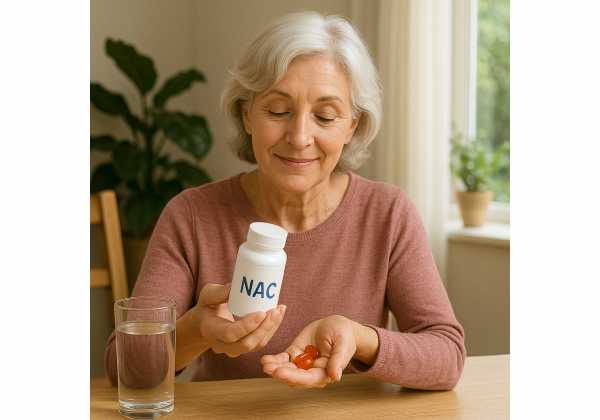
N-acetylcysteine, usually called NAC, is a supplemental form of the amino acid cysteine. Its main longevity interest comes from a simple job with wide effects: NAC helps the body make glutathione, one of its major internal antioxidant and detox compounds. That does not make NAC a proven life-extension supplement. It means NAC sits close to several aging-related systems, including redox balance, liver detoxification, mucus clearance, inflammation control, mitochondrial stress, and recovery from physical strain.
NAC deserves a careful look because it is both ordinary and powerful. It is sold as a supplement, used as a prescription medicine in some settings, and given in hospitals for acetaminophen overdose. For healthy aging, the best use is targeted: support resilience when oxidative burden is high, not blunt every stress signal the body uses to adapt.
Table of Contents
- What NAC Does in the Body
- Oxidative Stress, Glutathione, and Healthy Aging
- Detox Support Without the Hype
- What the Evidence Says About Resilience
- Who May Benefit, and Who Should Be Cautious
- Forms, Dosing, Timing, and Safety
- Building a Smarter NAC Plan
- Common Mistakes With NAC
What NAC Does in the Body
NAC is N-acetylcysteine, a modified form of cysteine. Cysteine is a sulfur-containing amino acid found in protein foods and used by the body to make glutathione. Glutathione is built from three amino acids: cysteine, glycine, and glutamate. Cysteine often limits how much glutathione the body makes, which is why NAC attracts attention.
After ingestion, NAC supplies cysteine and related sulfur compounds. These compounds help maintain thiols, which are sulfur-containing chemical groups that protect proteins, support detoxification reactions, and help cells respond to stress. NAC is not just a “direct antioxidant.” Much of its value comes from giving the body raw material for its own antioxidant network.
NAC also affects mucus. In thick airway secretions, disulfide bonds help mucus stay sticky and dense. NAC disrupts some of those bonds, which helps explain its medical use as a mucolytic, meaning a mucus-thinning agent. This action is separate from its glutathione role and explains why respiratory research makes up a large part of the NAC evidence base.
NAC has three main actions relevant to healthy aging:
- It supports glutathione production when cysteine supply is low or demand is high.
- It helps maintain redox balance, the controlled exchange between oxidants and antioxidants.
- It thins mucus and supports airway clearance in certain respiratory conditions.
Redox balance deserves special attention. Oxidants are not simply “bad.” Exercise, fasting, heat exposure, immune defense, and mitochondrial activity all create reactive molecules. In the right amount, those molecules tell the body to adapt. Problems arise when oxidative load overwhelms repair capacity, damages proteins and membranes, or drives chronic inflammation. This is why NAC fits best as a targeted resilience tool, not as a daily attempt to erase all oxidative stress. For a broader explanation of this balance, see redox balance and antioxidants.
NAC also intersects with NRF2, a cellular defense pathway that increases the body’s own antioxidant and detox enzymes. NAC does not work like sulforaphane or other compounds that more directly activate NRF2, but it supports some of the same defense systems by improving sulfur and glutathione availability. The larger lesson is the same as with NRF2 and cellular defense: the aim is to nudge protective capacity, not force the system harder every day.
Oxidative Stress, Glutathione, and Healthy Aging
Oxidative stress increases when the body produces more reactive oxygen and nitrogen species than it can safely control. Aging, chronic inflammation, smoking, air pollution, sleep loss, insulin resistance, infection, heavy alcohol intake, and high-intensity physical strain all raise oxidative load. The body uses several defenses, including enzymes such as superoxide dismutase, catalase, glutathione peroxidase, and glutathione reductase. Glutathione sits near the center of this network.
Glutathione exists in reduced and oxidized forms. Reduced glutathione helps neutralize reactive compounds and supports detoxification. After glutathione donates electrons, it becomes oxidized and must be recycled. A healthy glutathione system depends on enough amino acid building blocks, adequate micronutrients, mitochondrial health, and steady cellular energy.
NAC helps most when cysteine supply is the weak link. This situation becomes more likely when dietary protein is low, inflammation is high, acetaminophen exposure is excessive, chronic airway disease increases oxidative burden, or older adults have reduced glutathione synthesis. Glycine also matters. NAC supplies cysteine, but glutathione still needs glycine. That is one reason the research on GlyNAC for aging has drawn attention: pairing glycine with NAC addresses two building blocks instead of one.
Aging research often focuses on mitochondria because mitochondria produce energy and reactive molecules at the same time. When mitochondria become less efficient, they leak more reactive species, produce less ATP, and trigger inflammatory signals. NAC does not “rejuvenate” mitochondria by itself. It supports the redox environment around mitochondria, which helps cells handle stress more cleanly. In human research, NAC combined with glycine has shown stronger signals for older adults than NAC alone, especially in studies measuring glutathione deficiency, oxidative stress, inflammation, physical function, and mitochondrial markers.
The nuance matters. Oxidative stress is not a single disease or a single lab value. Many commercial “oxidative stress panels” are hard to interpret and rarely change clinical decisions. For most adults, better signals come from standard health markers and real-world function: fasting glucose, A1c, liver enzymes, kidney function, blood pressure, exercise tolerance, sleep quality, respiratory symptoms, and inflammatory markers when appropriate. If inflammation is part of the picture, hs-CRP and related inflammation markers offer more practical tracking than obscure antioxidant tests.
Food still comes first. Protein foods supply cysteine and methionine. Collagen-rich foods, gelatin, and some protein sources supply glycine. Vegetables, herbs, coffee, tea, cocoa, berries, and olive oil supply polyphenols that support endogenous defense pathways. NAC works best when these basics are present. It works poorly as a substitute for them.
Detox Support Without the Hype
NAC supports detoxification in a specific, biochemical sense. It helps the body make glutathione, and glutathione helps neutralize and conjugate reactive compounds. The clearest example is acetaminophen toxicity. In overdose, acetaminophen forms a toxic metabolite called NAPQI. Glutathione normally helps neutralize it. When glutathione runs out, NAPQI damages liver cells. Medical NAC replenishes glutathione and directly supports detoxification of that toxic metabolite.
That lifesaving medical use should not be confused with casual detox marketing. NAC does not erase the effects of heavy drinking, make smoking safer, remove all heavy metals, or “flush toxins” on command. It supports a real detox pathway, but that pathway has limits. The liver also needs calories, protein, B vitamins, minerals, sleep, and time. The kidneys, gut, lungs, skin, and immune system all take part in waste handling. NAC is one piece of that larger system.
A sensible detox frame looks like this:
| Claim | Better interpretation | Practical action |
|---|---|---|
| “NAC detoxes the liver.” | NAC supports glutathione-dependent detox reactions, especially when cysteine is limiting. | Use adequate protein, avoid excess alcohol, and treat high liver enzymes as a medical signal. |
| “NAC protects against acetaminophen.” | Medical NAC treats acetaminophen overdose under urgent care protocols. | Never self-treat overdose; seek emergency care immediately. |
| “NAC clears toxins.” | NAC supports one antioxidant and conjugation system; it does not replace exposure reduction. | Reduce smoke, solvents, alcohol excess, ultra-processed food, and unnecessary medications where possible. |
| “NAC fixes oxidative stress.” | NAC helps when glutathione demand is high, but sleep, diet, glucose control, and exercise drive the baseline. | Track health patterns, not just supplement intake. |
Detox also ties into metabolic health. Fatty liver, insulin resistance, visceral fat, and high triglycerides increase oxidative and inflammatory load. NAC does not replace weight loss when weight loss is needed, nor does it replace glucose control, protein adequacy, and movement. Someone with elevated ALT, AST, GGT, fasting insulin, or triglycerides needs a metabolic plan first. Supplements become add-ons only after the main drivers are addressed.
NAC also has an important medical boundary. If someone has taken too much acetaminophen, the right action is urgent medical evaluation, even if they have NAC capsules at home. Hospital protocols use specific oral or intravenous dosing schedules based on timing, blood levels, symptoms, and liver tests. Home supplement doses are not a safe substitute.
What the Evidence Says About Resilience
NAC has stronger evidence for certain clinical functions than for broad longevity claims. It is well established as a treatment for acetaminophen poisoning and as a mucolytic in selected respiratory settings. The healthy-aging question is narrower: does NAC support resilience in systems that often weaken with age?
Respiratory health has the most practical evidence. In chronic bronchitis and COPD research, NAC has been studied for mucus burden, symptoms, quality of life, and exacerbations. Recent meta-analyses show signals that oral NAC reduces exacerbations and improves symptoms in some chronic bronchitis and COPD populations. The effect is not uniform across all people and does not replace inhalers, smoking cessation, pulmonary rehab, vaccination, or medical diagnosis. It is most relevant for people with chronic mucus, frequent flare-ups, or clinician-confirmed airway disease.
Exercise research is more mixed. During strenuous exercise, the body produces reactive molecules that contribute to fatigue and muscle damage but also trigger adaptation. NAC supplementation has shown improvements in some performance and antioxidant markers in controlled trials, especially around high-intensity efforts. Still, daily antioxidant loading around every workout is not a smart default for longevity training. Training adaptations need some redox signaling. A person building fitness for healthspan should use NAC selectively, not as a way to blunt every exercise stress.
The GlyNAC research is especially relevant to aging. In older adults, combining glycine with NAC has improved markers related to glutathione deficiency, oxidative stress, mitochondrial dysfunction, inflammation, physical function, and other aging-associated measures in a randomized clinical trial. This does not prove lifespan extension. It does suggest that glutathione support becomes more interesting when both cysteine and glycine are addressed. Anyone considering that approach should also understand glycine’s role in longevity, sleep, collagen turnover, and metabolic health.
Metabolic and liver research is promising but not definitive for routine self-use. NAC has been studied in conditions involving insulin resistance, fatty liver, polycystic ovary syndrome, and inflammatory states. Results vary by population, dose, duration, and co-interventions. For general healthy aging, NAC belongs behind the higher-yield steps: resistance training, aerobic fitness, protein distribution, fiber, sleep regularity, blood pressure control, and glucose control.
The evidence supports a restrained conclusion: NAC is a plausible resilience supplement, especially when glutathione demand is high or cysteine intake is low. It is not a stand-alone longevity therapy. It works best as part of a plan that reduces avoidable stressors and strengthens repair capacity.
Who May Benefit, and Who Should Be Cautious
NAC fits some people better than others. The strongest candidates are those with a clear reason to support glutathione, mucus clearance, or oxidative stress resilience. The weakest candidates are healthy adults adding another capsule without a defined problem, measurement, or stopping point.
People who often consider NAC include:
- Adults with chronic mucus or chronic bronchitis patterns, especially when a clinician has evaluated the lungs.
- Older adults with low protein intake or signs of reduced resilience, especially when glycine and total protein also need attention.
- People exposed to higher oxidative burden from pollution, smoke exposure, heavy training blocks, poor sleep, or metabolic stress.
- Adults using NAC as part of a clinician-guided plan for respiratory, psychiatric, reproductive, or metabolic conditions.
- People exploring glutathione support who do not tolerate direct glutathione supplements.
NAC is less compelling when someone already has strong nutrition, good sleep, stable metabolic markers, no respiratory issues, and no clear oxidative stress burden. In that case, adding NAC often creates complexity without obvious benefit. A better next step might be improving VO₂max, muscle, blood pressure, glucose patterns, or sleep consistency.
Several groups should use caution or get medical guidance before taking NAC:
- People taking nitroglycerin or nitrate drugs, because NAC can intensify headache or blood pressure-lowering effects.
- People with asthma, bronchospasm, or reactive airway disease, especially with inhaled or high-dose forms.
- People with active peptic ulcers, severe reflux, or a history of gastrointestinal bleeding.
- Pregnant or breastfeeding adults, unless a qualified clinician recommends it.
- People with significant liver or kidney disease.
- People receiving chemotherapy, radiation, or complex immune therapies, because antioxidant timing can matter.
- Anyone preparing for surgery or taking multiple medications that require close monitoring.
NAC also has a regulatory quirk in the United States. It has been approved as a drug for specific uses, while NAC-containing products have also been sold as supplements for decades. The FDA has issued enforcement discretion guidance for certain NAC supplement products. That does not mean every NAC product is high quality. It means buyers should be selective: choose brands with third-party testing, clear labeling, realistic dosing, and no exaggerated disease claims.
Forms, Dosing, Timing, and Safety
NAC comes as capsules, tablets, powders, effervescent products, nebulized medical forms, and intravenous medical preparations. For wellness use, capsules and tablets are the most practical. Powders often smell sulfurous and taste unpleasant. That sulfur smell is normal, but a strong rotten odor, clumping, discoloration, or expired product should raise quality concerns.
Common supplement doses range from 600 mg to 1,200 mg per day. Many people start with 600 mg once daily. Some protocols use 600 mg twice daily. Respiratory studies often use longer durations, commonly several months. Short “detox blasts” of high doses are less sensible for healthy aging because glutathione support works through ongoing biology, not instant cleansing.
A cautious trial looks like this:
- Start with 600 mg daily for two weeks.
- Take it with food if nausea, reflux, or stomach discomfort occurs.
- Increase only if there is a clear reason, such as clinician guidance or a defined respiratory or oxidative-stress target.
- Reassess after 8 to 12 weeks.
- Stop if there is no clear benefit, side effects appear, or the original reason no longer applies.
Some people take NAC away from meals because amino acids compete for absorption. Others tolerate it better with food. Tolerance matters more than theoretical absorption for most users. NAC is not a supplement that requires a complicated timing ritual.
For exercise, timing deserves more care. Taking NAC before occasional unusually demanding sessions might help some people with fatigue or recovery. Taking high-dose NAC before every workout is less attractive for long-term adaptation. Exercise uses oxidative signals to build stronger mitochondria and antioxidant enzymes. A longevity training plan should let the body sense manageable stress, then recover. This principle overlaps with mitohormesis, where small stress signals lead to stronger cellular defenses.
Side effects are usually gastrointestinal: nausea, gas, loose stool, reflux, or a sulfur aftertaste. Headache occurs in some people. Oral NAC is very different from intravenous NAC, which is used medically and has a higher rate of infusion-related reactions. Inhaled NAC can trigger bronchospasm in susceptible people and belongs under medical supervision.
NAC combines poorly with vague supplement stacking. A person taking NAC, high-dose vitamin C, alpha-lipoic acid, glutathione, quercetin, resveratrol, sulforaphane, and multiple “detox” blends has no clear way to know what helps or harms. If mitochondrial support is the goal, compare NAC with more targeted options such as CoQ10 for cellular energy rather than taking everything at once.
Building a Smarter NAC Plan
A good NAC plan starts with a reason. “Longevity” is too broad. Choose a specific target: mucus burden, high oxidative load, low protein intake, recovery during a demanding training phase, or clinician-guided glutathione support. Then build the plan around that target.
The first layer is food. NAC supplies cysteine, but the body still needs enough total protein. Adults focused on healthy aging often do better when they distribute protein across meals instead of saving most of it for dinner. Protein supports muscle, immune function, detox enzymes, and glutathione synthesis. If appetite is low or muscle is declining, daily protein targets for longevity deserve more attention than NAC dose.
The second layer is glycine balance. Muscle meats are rich in methionine and cysteine but often lower in glycine compared with collagen-rich foods. Glycine comes from collagen peptides, gelatin, slow-cooked connective tissue, skin-on poultry, bone broth, and glycine supplements. Some people pair NAC with glycine because glutathione requires both. A simple approach is 600 mg NAC with 2 to 3 g glycine in the evening, though higher GlyNAC research doses should stay clinician-guided.
The third layer is reducing oxidative burden at the source. NAC cannot compensate for nightly alcohol, untreated sleep apnea, chronic sleep restriction, smoking, poorly controlled blood sugar, or intense training without recovery. Removing stressors saves more glutathione than adding supplements.
The fourth layer is tracking. Choose one or two outcomes before starting. Respiratory users might track cough frequency, mucus thickness, flare-ups, and exercise tolerance. Metabolic users might track fasting glucose, A1c, triglycerides, waist circumference, or energy after meals. Training-focused users might track session quality, soreness, resting heart rate, and heart rate variability. If nothing changes after a fair trial, NAC probably is not the missing piece.
A practical NAC decision table helps keep expectations grounded:
| Goal | Reason NAC is considered | Better first steps | NAC role |
|---|---|---|---|
| Respiratory mucus | Mucolytic and antioxidant actions | Medical diagnosis, smoking cessation, hydration, prescribed therapies | Adjunct, often longer-term |
| Glutathione support | Cysteine supply for glutathione synthesis | Adequate protein, glycine, micronutrients, sleep | Targeted support |
| Training recovery | Exercise-induced oxidative stress | Progressive training, calories, protein, deloads, sleep | Occasional or phase-based use |
| Liver resilience | Glutathione-dependent detox pathways | Limit alcohol, address fatty liver risk, review medications | Supportive, not protective license |
| Healthy aging | Oxidative stress and mitochondrial stress rise with age | Strength, aerobic fitness, metabolic control, sleep, nutrient-dense diet | Optional, based on need |
NAC also pairs well with a “less is more” supplement style. Use one change at a time. Keep dose moderate. Reassess. Supplements that affect redox biology deserve pauses, not autopilot.
Common Mistakes With NAC
The most common NAC mistake is treating it like an all-purpose shield. People use it to justify alcohol, poor sleep, smoke exposure, or excessive acetaminophen use. NAC does not make harmful inputs harmless. It supports repair systems that already have limits.
A second mistake is chasing high doses without a reason. More NAC does not automatically produce more glutathione or better outcomes. High intakes increase the risk of nausea, reflux, loose stool, headaches, and supplement fatigue. In redox biology, more antioxidant pressure is not always better. Cells need stress signals to adapt.
A third mistake is ignoring glycine and protein. NAC supplies cysteine, but glutathione synthesis needs glycine and glutamate as well. Older adults with low appetite, low muscle mass, or low protein intake often need better meals before they need more capsules. NAC without enough dietary protein is like bringing one brick to a construction site.
A fourth mistake is taking NAC right before every workout. Some athletes use NAC around specific events or demanding training blocks, but daily pre-workout use is not the default for longevity. Training works by creating a manageable stress signal. Blunting that signal every time risks weakening the adaptation the workout was meant to produce.
A fifth mistake is using NAC for chronic cough without evaluation. Long-term cough, wheezing, breathlessness, sputum, or repeated chest infections deserve proper assessment. NAC might help mucus handling, but it does not diagnose COPD, asthma, bronchiectasis, reflux-related cough, medication-related cough, or sleep apnea.
A sixth mistake is stacking NAC with multiple detox blends. Many blends combine NAC with milk thistle, alpha-lipoic acid, selenium, green tea extract, turmeric, and high-dose vitamins. That makes side effects harder to trace and benefit harder to measure. Single-ingredient NAC gives cleaner feedback.
A better NAC rule is simple: use it when the reason is clear, the dose is moderate, the basics are in place, and the review date is already chosen. NAC has real biochemistry and useful clinical history. Its longevity value comes from supporting resilience under the right conditions, not from being taken by everyone forever.
References
- N-Acetylcysteine 2025 (Review)
- Anti-Inflammatory and Anti-Oxidant Properties of N-Acetylcysteine: A Fresh Perspective 2024 (Review)
- N-acetylcysteine Treatment in Chronic Obstructive Pulmonary Disease (COPD) and Chronic Bronchitis/Pre-COPD: Distinct Meta-analyses 2024 (Systematic Review)
- Supplementing Glycine and N-Acetylcysteine (GlyNAC) in Older Adults Improves Glutathione Deficiency, Oxidative Stress, Mitochondrial Dysfunction, Inflammation, Physical Function, and Aging Hallmarks: A Randomized Clinical Trial 2023 (RCT)
- Influence of N-Acetylcysteine Supplementation on Physical Performance and Laboratory Biomarkers in Adult Males: A Systematic Review of Controlled Trials 2023 (Systematic Review)
- Guidance for Industry: Policy Regarding N-acetyl-L-cysteine 2022 (Guidance)
Disclaimer
This article is educational and does not replace care from a qualified health professional. NAC has medical uses, drug interactions, and condition-specific cautions, especially for acetaminophen overdose, lung disease, pregnancy, breastfeeding, surgery, and complex medication regimens. Speak with a clinician before using NAC for a medical condition or combining it with prescription drugs.