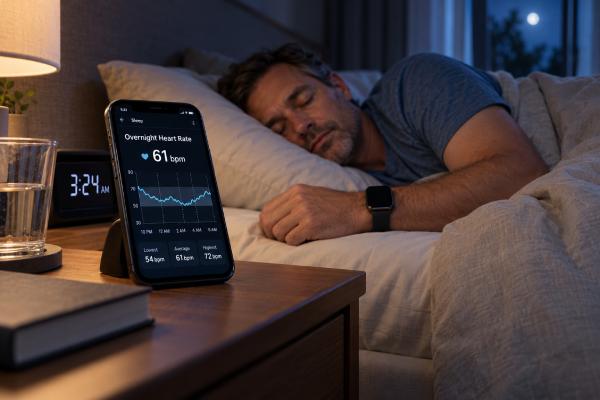
Heart rate usually slows during sleep, often reaching its lowest levels during deep non-REM sleep and rising again during REM sleep, brief awakenings, or movement. Many healthy adults spend substantial parts of the night in the 40s to 60s beats per minute, but there is no single “normal sleeping heart rate” that fits everyone. Your sleeping rate depends on your daytime resting pulse, age, fitness, medications, sleep stage, alcohol use, illness, temperature, and conditions such as sleep apnea. A wearable can be useful for spotting your personal overnight pattern, but it cannot diagnose an arrhythmia or sleep disorder from heart rate alone. The most useful signal is a sustained change from your usual baseline. One high night after alcohol, fever, poor sleep, or a hard workout may be temporary. A repeated rise over several nights, especially with loud snoring, gasping, daytime sleepiness, palpitations, chest pain, fainting, or unusual shortness of breath, deserves closer attention and may warrant medical evaluation.
Table of Contents
- What Happens to Heart Rate During Sleep
- What Range Is Normal While Sleeping?
- Common Reasons Sleeping Heart Rate Rises
- Sleep Apnea and Overnight Heart Rate Spikes
- How Alcohol, Exercise, and Recovery Affect the Night
- How to Use Wearable Data Without Overreading It
- When a Sleeping Heart Rate Needs Medical Attention
What Happens to Heart Rate During Sleep
Sleep is not one uniform state. Your brain and autonomic nervous system move through repeating stages, and heart rate changes with them.
During non-REM sleep—especially deeper stages—parasympathetic activity usually becomes more dominant. This is the “rest-and-digest” side of the autonomic nervous system. Blood pressure falls, breathing becomes more regular, and heart rate commonly drops below the person’s awake resting level.
REM sleep is different. Brain activity becomes more variable, dreams are common, and autonomic activity can become less stable. Heart rate may rise, fall, or fluctuate more from beat to beat. Brief awakenings, rolling over, coughing, or reacting to a dream can also produce short spikes.
That means a healthy overnight graph is not necessarily a perfectly flat line. A wearable may show a slow decline after sleep begins, lower values during deeper sleep, and intermittent bumps during REM or arousals. The exact pattern varies from night to night.
A lower sleeping heart rate often reflects normal physiology, particularly in people who exercise regularly. But the sleeping number should be interpreted alongside the awake resting rate. Someone who normally rests at 52 while awake may sleep in the low 40s. Someone whose awake resting rate is 78 may spend much of the night in the 60s. Both patterns can be normal if they are stable and the person feels well.
The relationship between sleep and heart health is broader than heart rate alone. Sleep duration, timing, regularity, continuity, architecture, and sleep disorders all influence cardiometabolic health. That is why one overnight pulse metric should not replace attention to overall sleep quality and heart health.
What Range Is Normal While Sleeping?
There is no universally accepted adult “normal sleeping heart rate” range because clinical reference ranges are usually defined for awake resting heart rate, not each sleep stage.
For most adults, the conventional awake resting range is 60 to 100 beats per minute. During sleep, the rate commonly falls below the daytime resting level. Many healthy adults will see overnight values in the 40s, 50s, or 60s, particularly during non-REM sleep. Well-trained endurance athletes may go lower.
A practical way to interpret your overnight number is to compare three things:
| What to compare | Why it matters |
|---|---|
| Your sleeping average versus your daytime resting rate | A lower night rate is generally expected. |
| Your current night versus your 2- to 4-week baseline | A persistent shift is usually more meaningful than a single night. |
| Your number versus symptoms | Dizziness, fainting, chest pain, breathing trouble, or marked fatigue can change the significance of a low or high rate. |
Do not treat a single minimum value as your “sleeping resting heart rate.” Wearables may record brief lows that last only seconds, and sensor errors can produce isolated outliers. The overnight average, median, or a stable low period is usually more useful than the single lowest number.
Likewise, a high maximum during sleep may simply reflect an awakening or movement. A spike from 52 to 88 for a minute is different from an average heart rate that remains 10 to 15 beats above your usual level for several nights.
Age also matters, but not in a way that allows a simple age-by-age sleep chart for adults. Fitness, medications, illness, and sleep quality often explain more day-to-day variation than age alone.
A normal-looking overnight pattern can also include a few short-lived changes that are not concerning by themselves. For example, your rate may fall steadily during the first sleep cycles, reach its lowest point in deeper non-REM sleep, and then become more variable toward morning as REM sleep becomes more prominent. Brief awakenings to use the bathroom, adjust bedding, or respond to noise can create spikes. If you roll over and the sensor temporarily loses contact, the device may also record a false dip or jump.
For this reason, avoid using one night’s “minimum heart rate” as a health target. A minimum of 38 for a few seconds has a different meaning from spending 30 minutes near 38, and both need to be interpreted in light of your daytime pulse, fitness level, medication use, and symptoms. A better metric is the stable overnight average combined with your usual daytime resting heart rate. If both are moving gradually in the same direction over weeks, the change is more likely to reflect a real shift in physiology than a sensor artifact.
Common Reasons Sleeping Heart Rate Rises
A higher sleeping heart rate usually means the body is under more physiologic or emotional load than usual. The cause can be temporary and harmless, but persistent changes deserve context.
Common short-term causes include:
- Fever or infection. Higher body temperature and immune activity raise metabolic demand.
- Dehydration. Lower circulating fluid volume can make the heart beat faster to maintain output.
- Alcohol. Even moderate evening drinking can raise nocturnal heart rate.
- Poor or fragmented sleep. Frequent arousals increase sympathetic activity.
- Stress or anxiety. Elevated sympathetic tone can persist into the night.
- Heat. A hot bedroom or heat exposure can raise cardiovascular workload.
- Pain. Pain can increase heart rate and disrupt sleep.
- Late heavy meals. Digestion and reflux symptoms may disturb sleep and raise pulse in some people.
- Stimulants. Caffeine, nicotine, some decongestants, ADHD medications, and other stimulants can affect the night depending on timing and sensitivity.
- Hard exercise. A demanding late workout or unusually heavy training load can keep heart rate elevated during early sleep.
Medical causes can include anemia, overactive thyroid, arrhythmias, heart or lung disease, and sleep-disordered breathing. Some medications raise heart rate; others, such as beta blockers, lower it.
When the cause is temporary, the rate often returns toward baseline after recovery. For example, if your typical sleeping average is 55 and it rises to 64 during a viral illness, then returns to 55 after you recover, the pattern fits a short-term stress response.
If your sleeping rate stays elevated for a week or more without an obvious reason, look at the broader picture: daytime resting rate, symptoms, sleep quality, alcohol, medication changes, and exercise load.
Sleep Apnea and Overnight Heart Rate Spikes
Sleep apnea can create repeated swings in heart rate rather than just one consistently high number. In obstructive sleep apnea, the upper airway repeatedly narrows or closes during sleep. Oxygen can fall, carbon dioxide can rise, and the brain triggers brief arousals to reopen the airway.
Each event can produce a burst of sympathetic nervous system activity. Heart rate may slow during the obstructive event and then accelerate with the arousal, creating a repetitive overnight pattern. Blood pressure also surges. Over time, sleep apnea is associated with hypertension, atrial fibrillation, heart failure, stroke, and other cardiovascular problems.
Heart rate alone cannot diagnose sleep apnea. A wearable may show frequent spikes, but those can also come from movement, dreams, sensor error, or other arousals.
Clues that strengthen the case for evaluation include:
- Loud habitual snoring
- Witnessed pauses in breathing
- Waking with choking or gasping
- Morning headaches
- Dry mouth on waking
- Excessive daytime sleepiness
- Resistant or poorly controlled high blood pressure
- Atrial fibrillation or other rhythm problems
- Repeated oxygen drops on a validated overnight test
If those features fit, a clinician may recommend a home sleep apnea test or laboratory sleep study. Treating sleep apnea can improve sleep quality and reduce repeated overnight stress on the cardiovascular system. More detail is available in the guide to sleep apnea symptoms and blood pressure.
Do not rely on a smartwatch’s sleep-stage labels to rule sleep apnea in or out. Consumer devices can be useful for trends, but formal diagnosis requires validated respiratory and oxygen measurements interpreted in the right clinical context.
How Alcohol, Exercise, and Recovery Affect the Night
Alcohol is one of the clearest modifiable reasons nocturnal heart rate rises. It can initially feel sedating, but its cardiovascular and sleep effects continue after you fall asleep.
A 2025 prospective smartwatch study of healthy adults found that moderate alcohol intake raised average nocturnal resting heart rate by about 3 beats per minute during the drinking period, with values moving back toward baseline afterward. A much larger 2026 real-world wearable study found a dose-related pattern: drinking more than a person’s usual amount was associated with higher nocturnal resting heart rate and lower heart rate variability, along with shorter sleep and less next-day activity.
The size of the increase varies by person and amount. If your wearable repeatedly shows a higher overnight heart rate after drinking, that pattern is physiologically plausible rather than necessarily a device error.
Exercise has a more complex effect. Regular aerobic training tends to lower resting and sleeping heart rate over the long term. But a hard workout can raise heart rate temporarily during the following night, especially if it is late, hot, long, or combined with dehydration and inadequate recovery.
Use your overnight rate as one recovery clue, not as a command. A single elevated night after a hard session does not prove overtraining. More meaningful warning signs are a persistent higher resting rate combined with declining performance, unusual fatigue, irritability, poor sleep, heavy legs, or repeated illness.
Hydration, carbohydrate replacement after long endurance exercise, and adequate sleep can all influence recovery. If dehydration is a likely factor, see how dehydration can raise heart rate.
Meal timing can also affect some people. A large late meal may increase digestive workload, body temperature, reflux, or awakenings. If you notice that your heart rate stays higher after very late dinners, test a simpler change: finish the largest meal earlier for several nights and compare your own trend rather than assuming a universal rule.
How to Use Wearable Data Without Overreading It
Wearables are best at showing patterns. They are less reliable when you treat one number as a diagnosis.
Optical wrist sensors estimate pulse by detecting blood-volume changes under the skin. Accuracy can be affected by loose fit, movement, cold skin, tattoos, sleeping position, poor sensor contact, and device algorithms. Different brands also define “resting,” “sleeping,” and “minimum” heart rate differently.
For cleaner comparisons:
- Wear the same device in the same position.
- Keep the band snug but comfortable.
- Compare nightly averages over at least one to two weeks.
- Note alcohol, illness, hard training, poor sleep, and medication changes.
- Confirm surprising awake readings by checking your pulse manually.
- Focus on repeated patterns, not isolated spikes or lows.
A simple personal baseline is often more informative than an internet chart. Suppose your 30-day sleeping average is 54 to 58. Three nights at 66 to 69 after a fever and dehydration are understandable. Three weeks at 66 to 69 with no obvious explanation are more worth investigating.
Also distinguish heart rate from heart rate variability, or HRV. Heart rate is beats per minute. HRV describes variation in the time between beats. They are related but not interchangeable. Consumer HRV values differ by device and measurement method, so compare your value mostly with your own previous data.
Sleep-stage estimates deserve similar caution. A device may classify light, deep, and REM sleep, but those stages are inferred rather than measured with the full brain, eye, muscle, breathing, and ECG signals used in polysomnography.
If you wake with palpitations and your watch shows an abnormal rhythm notification, the next useful step may be an ECG rather than staring at the overnight heart-rate graph. Guidance on irregular rhythm notifications can help clarify what consumer alerts can and cannot tell you.
When a Sleeping Heart Rate Needs Medical Attention
A sleeping heart rate becomes more concerning when it is persistently abnormal for you or occurs with symptoms.
Seek urgent medical care for chest pain or pressure, fainting, severe shortness of breath, new neurologic symptoms, or a sustained very fast or very slow pulse with significant weakness or confusion. Do not wait for a wearable to “confirm” a serious symptom.
Arrange a nonurgent medical evaluation when you notice:
- A persistent sleeping and daytime resting heart rate above your usual baseline with no clear explanation
- Repeated awake resting values over 100 beats per minute
- A very low pulse with dizziness, fainting, exercise intolerance, or unusual fatigue
- New irregularity or repeated palpitations
- Frequent overnight spikes plus loud snoring, gasping, or marked daytime sleepiness
- A major change after starting, stopping, or changing a medication
- A trend that persists despite recovery from illness, good hydration, and normal sleep
The evaluation depends on the pattern. A clinician may check an ECG, medication list, blood count, thyroid function, electrolytes, oxygen level, or sleep apnea risk. Intermittent rhythm symptoms may require a Holter or patch monitor.
The key is to avoid two opposite mistakes: ignoring a persistent change because it happened during sleep, or panicking over one strange wearable reading. Sleeping heart rate is most useful as a trend plus context. Stable lower rates in a fit, symptom-free person are often normal. Sustained changes, irregularity, or symptoms deserve a closer look.
References
- Multidimensional Sleep Health: Definitions and Implications for Cardiometabolic Health: A Scientific Statement From the American Heart Association 2025 (Position Statement)
- Sleep-Disordered Breathing and Cardiac Arrhythmias in Adults: Mechanistic Insights and Clinical Implications: A Scientific Statement From the American Heart Association 2022 (Position Statement)
- The Impact of Alcohol on Sleep Physiology: A Prospective Observational Study on Nocturnal Resting Heart Rate Using Smartwatch Technology 2025
- Real-world effects of alcohol on heart rate, sleep, and physical activity by age and sex 2026
- Sleep and Risk for Heart Disease and Stroke 2026 (Review)
- Obstructive Sleep Apnea and Cardiovascular Disease: A Scientific Statement From the American Heart Association 2021 (Position Statement)
Disclaimer
Sleeping heart rate varies with sleep stage, fitness, medications, alcohol, illness, and many other factors, and a consumer wearable cannot diagnose a rhythm or sleep disorder. Seek urgent care for chest pain, fainting, severe breathing difficulty, or other serious symptoms with an abnormal pulse. Persistent unexplained changes should be reviewed with a qualified clinician.