Plant sterols and stanols can lower LDL (“bad”) cholesterol by reducing how much cholesterol your intestine absorbs. For most adults trying to improve cholesterol, the useful dose is around 2 grams per day—far more than most people get naturally from ordinary foods. At that intake, studies commonly find an LDL reduction of roughly 7% to 12%, often within a few weeks. That makes sterols and stanols a practical add-on to a heart-healthy diet, especially when LDL is mildly or moderately elevated.
They are not a substitute for prescribed cholesterol medicine when medication is recommended, and they have not been proven in long-term trials to prevent heart attacks or strokes on their own. The biggest challenge is choosing a product that supplies an effective amount without adding too much saturated fat, sugar, or calories. It also matters who uses them: people with the rare disorder sitosterolemia should avoid extra phytosterols, and some other groups should check with a clinician first.
Table of Contents
- What Plant Sterols and Stanols Are
- How Much They Lower LDL Cholesterol
- Foods, Supplements, and Fortified Products
- How Much to Take and When
- Who Benefits Most and How They Fit Treatment
- Safety, Side Effects, and Who Should Avoid Them
- A Practical Plan for Using Them
What Plant Sterols and Stanols Are
Plant sterols and plant stanols are naturally occurring substances found in small amounts in vegetables, fruits, nuts, seeds, legumes, whole grains, and vegetable oils. Together, they are often called phytosterols. Their chemical structure resembles cholesterol closely enough that they can compete with cholesterol during digestion.
That competition is the reason they help lower LDL. In the small intestine, cholesterol has to enter mixed particles called micelles before it can be absorbed. Plant sterols and stanols displace some cholesterol from those particles and reduce the amount that reaches intestinal cells. The liver then responds to the smaller cholesterol supply by pulling more LDL particles from the bloodstream.
This is different from simply eating less cholesterol. Your intestine handles cholesterol from food and cholesterol released into bile by the liver. Sterols and stanols can interfere with absorption from both sources. That is why they can still have an effect even when a person already follows a reasonable diet.
Plant sterols and plant stanols work in similar ways. Stanols are saturated versions of sterols and are absorbed by the body even less readily. In practical use, both have a well-established LDL-lowering effect at adequate doses. If you want a deeper comparison of their differences, plant stanols versus sterols mainly comes down to chemistry, product form, and availability rather than a dramatic difference in expected LDL reduction.
It also helps to understand what they do not do. Their main effect is on LDL cholesterol and total cholesterol. They are not reliable tools for substantially raising HDL, lowering triglycerides, reducing blood pressure, or producing weight loss. For a broader picture of the lipid panel, LDL, HDL, and triglycerides each tell you something different about cardiovascular risk.
How Much They Lower LDL Cholesterol
The expected benefit is meaningful but modest. Across randomized trials and meta-analyses, about 1.5 to 3 grams of plant sterols or stanols per day commonly lowers LDL cholesterol by approximately 7% to 12%. Recent pooled research continues to show a dose-response relationship, with the most consistent practical benefit around 2 grams daily and somewhat larger average reductions as intake approaches about 3 grams.
For example, if your LDL is 150 mg/dL, a 10% reduction would be about 15 mg/dL, bringing it to roughly 135 mg/dL if everything else stayed the same. Someone starting at 110 mg/dL would expect a smaller absolute drop from the same percentage change.
The effect usually appears quickly. Cholesterol absorption changes as soon as the product is used consistently, and LDL can begin to fall within a couple of weeks. A reasonable time to judge the response is after about 4 to 8 weeks of regular intake, ideally with no major changes in other cholesterol treatments during that period.
Response varies from person to person. Dose, baseline LDL, food form, adherence, and individual cholesterol absorption all matter. People with higher starting LDL may see a larger drop in milligrams per deciliter even when the percentage reduction is similar.
Sterols and stanols should be viewed as one lever among several. Foods rich in soluble fiber, replacement of saturated fat with unsaturated fat, weight management when needed, and exercise can work alongside them. A diet built from several evidence-based strategies often produces a larger change than relying on one fortified food. For example, soluble fiber for cholesterol works through a different digestive mechanism and can complement phytosterols.
Importantly, lowering LDL with phytosterols is not the same thing as proving fewer heart attacks or strokes. Long-term randomized cardiovascular outcome trials of plant sterol or stanol products are lacking. Their role rests mainly on consistent LDL lowering and the established relationship between LDL exposure and atherosclerotic cardiovascular risk.
Foods, Supplements, and Fortified Products
Ordinary plant foods contain phytosterols, but usually not enough to reach a therapeutic dose by themselves. A typical mixed diet may supply a few hundred milligrams daily. Diets rich in plant foods can provide more, yet reaching 2 grams from unfortified foods alone would be difficult.
Natural sources still matter because they come packaged with fiber, unsaturated fats, potassium, vitamins, and other nutrients. Good sources include vegetable oils, nuts, seeds, whole grains, legumes, avocados, and many vegetables. But if your goal is the LDL-lowering dose studied in trials, you usually need a fortified product or supplement.
Common options include:
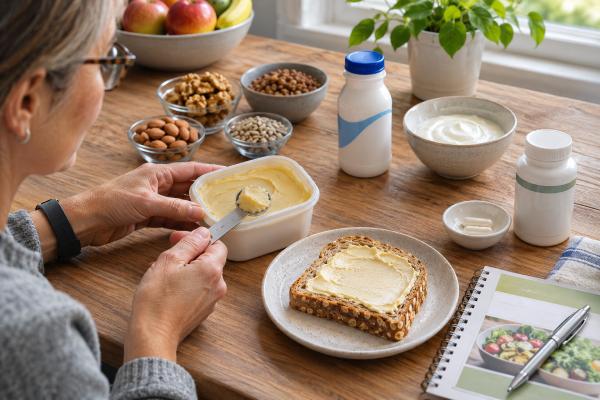
- Soft spreads or margarines fortified with plant sterol or stanol esters
- Fortified yogurt-style products or dairy alternatives
- Fortified drinks or mini-drinks
- Cereals, snack products, or other specialty foods with added phytosterols
- Capsules, tablets, or chewable supplements
The label matters more than the format. Look for the amount of plant sterols, plant stanols, or phytosterols per serving, not just a statement that the product “contains plant sterols.” Some products provide close to the full daily target in one serving, while others require two or more servings.
A fortified product can be useful only if the rest of its nutrition profile fits your goals. A spread that adds 2 grams of sterols but also encourages a large increase in calories is less helpful for someone trying to lose weight. A sweetened drink may add unnecessary sugar. A snack marketed for cholesterol can still contain substantial saturated fat or sodium.
That is why comparing plant sterol foods versus supplements should focus on effective dose, convenience, calories, added sugar, saturated fat, cost, and how reliably you will use the product. Supplements can deliver a precise dose without adding much food energy, while fortified foods may be easier to remember because they become part of a meal.
How to compare products without getting misled
Start with the active dose, then work outward. If one serving contains 400 mg of plant sterols, you would need five servings to reach 2 grams. A product that appears inexpensive per package may therefore cost more per effective daily dose than a concentrated alternative.
Next, check what comes with the sterols. A useful fortified food should fit the same eating pattern you would choose without the health claim. For a spread, compare saturated fat per serving. For yogurt, drinks, bars, or cereals, check added sugar and calories. If a product needs several servings a day, multiply those numbers by the number of servings you would actually use.
Supplements deserve the same scrutiny. Look for a clearly stated amount of plant sterols or stanols, reasonable serving size, and directions that make it possible to reach the intended daily dose. Avoid assuming that a large capsule count means a stronger product; the milligram amount is what matters.
Finally, think about adherence. The most effective format is one you can use consistently. If you never eat breakfast, a breakfast-only fortified food is a poor fit. If you dislike swallowing pills, a supplement bottle may sit unused. A realistic routine matters because phytosterols do not build up as a one-time treatment—the LDL-lowering effect depends on regular intake.
How Much to Take and When
For most adults using phytosterols to lower LDL, about 2 grams per day is a practical target. Studies show benefit at lower amounts, but the LDL effect generally becomes more useful as intake rises into roughly the 1.5-to-3-gram range. Going well above 3 grams daily is unlikely to produce a proportionally larger benefit and usually adds cost without a clear reason.
Use the actual phytosterol amount on the label. A product may list “plant sterol esters” by total compound weight while separately stating the amount equivalent to free plant sterols. Follow the serving information that specifically identifies the active plant sterol or stanol dose.
Taking them with meals is the most sensible approach because they work inside the digestive tract, where cholesterol and bile are present. Many clinical studies have used one or two daily servings with meals. Evidence does not show that an exact clock time—morning versus evening—is crucial.
A simple schedule might look like this:
- Choose a product that supplies about 1 gram per serving.
- Take one serving with breakfast and one with dinner, or follow the product directions for a single 2-gram daily serving.
- Use it consistently every day rather than only on days when you eat a high-cholesterol meal.
- Recheck your lipid panel after about 4 to 8 weeks if the purpose is to see whether it is helping.
Consistency matters because the effect depends on ongoing reduction of intestinal cholesterol absorption. LDL will generally drift back toward its previous level after you stop using the product.
Do not treat phytosterols as a license to ignore saturated fat. A diet high in butter, fatty processed meats, coconut oil, or other major saturated-fat sources can push LDL upward even if a sterol product is pulling it downward. If you are trying to make the entire diet work toward the same goal, foods that help lower cholesterol are a better foundation than adding a single specialty product to an otherwise unchanged diet.
Who Benefits Most and How They Fit Treatment
Plant sterols and stanols make the most sense for people who have elevated LDL and want an additional dietary tool. They may be useful when LDL is mildly or moderately high, when someone is working on lifestyle changes before a follow-up test, or as an add-on to medication under appropriate medical care.
They can also provide incremental lowering in people who take statins. The mechanisms are different: statins reduce cholesterol production in the liver, while phytosterols reduce intestinal cholesterol absorption. Clinical studies have found an additional LDL reduction when sterol- or stanol-enriched foods are added to statin therapy.
That does not mean a person should replace a statin, ezetimibe, or another prescribed drug with a supplement. Medication decisions depend on overall cardiovascular risk, LDL level, diabetes, kidney disease, family history, existing artery disease, and other factors. Someone with very high LDL or established cardiovascular disease often needs a much larger LDL reduction than phytosterols can provide.
If you have not yet clarified why your LDL is high, start there. Diet is only one cause. Genetics, hypothyroidism, certain medications, kidney disease, and other conditions can contribute. The discussion of high LDL causes and treatment is broader than any one food or supplement strategy.
It is also useful to set expectations. A 10% LDL reduction is worthwhile, but it will not turn an LDL of 200 mg/dL into a typical target range. In that example, a 10% drop would still leave LDL near 180 mg/dL. People with LDL at or above 190 mg/dL generally need prompt medical evaluation for severe hypercholesterolemia and possible familial causes rather than relying on dietary supplements alone.
Safety, Side Effects, and Who Should Avoid Them
Plant sterols and stanols are generally well tolerated at commonly used doses. Because very little is absorbed into the bloodstream, most of their action stays in the intestine. Some people may notice digestive symptoms from the food product or supplement ingredients, but major side effects are uncommon in trials.
One known effect is a small reduction in blood levels of some fat-soluble plant compounds, especially carotenoids such as beta-carotene. This is not usually considered clinically important, but it is a good reason to keep vegetables and fruit in the diet. Colorful produce—leafy greens, carrots, peppers, tomatoes, squash, berries, and citrus—helps maintain overall nutrient quality.
The major exception is sitosterolemia, a rare inherited disorder in which the body absorbs and retains excessive amounts of plant sterols. People with known sitosterolemia should avoid phytosterol-enriched foods and supplements unless specifically directed by a specialist. The condition can cause very high circulating plant sterols and premature cardiovascular disease.
Use extra caution or ask a clinician before taking concentrated phytosterol products if you:
- Are pregnant or breastfeeding
- Are considering them for a child or teenager
- Have an unexplained very high cholesterol level
- Have a known sterol-metabolism disorder
- Take multiple lipid-lowering medications and are changing your regimen
- Have a complex gastrointestinal or malabsorption condition
For healthy adults, evidence has not established that routine phytosterol use causes cardiovascular harm, but debate continues around whether elevated circulating plant sterols could matter in certain biological contexts. The key distinction is that ordinary supplementation raises blood phytosterol levels far less than sitosterolemia does. At the same time, long-term trials measuring heart attacks and strokes directly are not available, so claims should stay focused on the proven outcome: LDL lowering.
A Practical Plan for Using Them
If you want to try plant sterols or stanols, keep the experiment simple enough that you can tell whether it works. Start with a recent lipid panel, choose a product that delivers a clearly labeled effective dose, and keep the rest of your routine reasonably stable for several weeks.
A practical checklist is:
- Target about 2 grams per day. More is not automatically better.
- Take it with meals. One or two meal-linked servings are easy to maintain.
- Check the whole label. Avoid turning an LDL-lowering product into a source of excess sugar, saturated fat, sodium, or calories.
- Keep eating whole plant foods. Fortified sterols complement, rather than replace, fiber-rich foods and unsaturated fats.
- Do not stop prescribed medication on your own. Phytosterols are an adjunct, not an equivalent replacement.
- Recheck cholesterol in about 4 to 8 weeks. This gives enough time to see whether your LDL responds.
- Judge the result in context. A modest LDL reduction may be helpful, but the right target depends on your overall cardiovascular risk.
If you are making several lifestyle changes at once, the combined effect may be larger than any one strategy. Replacing saturated fat, adding soluble fiber, exercising regularly, and reaching a healthy weight can all contribute. The goal is not to chase one “cholesterol-lowering” ingredient; it is to build a routine that consistently reduces exposure to atherogenic lipoproteins over time.
Plant sterols and stanols are most useful when viewed that way: a well-studied, fairly predictable tool for lowering LDL by a modest percentage. Used at an effective dose and in the right person, they can strengthen a broader cholesterol plan without making the diet complicated.
References
- Efficacy of phytosterols for reduction of cardiometabolic risk factors: An umbrella review of systematic reviews and meta-analyses and updated dose-response meta-analyses of randomized trials 2026 (Meta-Analysis)
- Effects of phytosterol supplementation on lipid profiles and apolipoproteins: A meta-analysis of randomized controlled trials 2024 (Meta-Analysis)
- Health outcomes associated with phytosterols: An umbrella review of systematic reviews and meta-analyses of randomized controlled trials 2024 (Systematic Review)
- Use of phytosterol-fortified foods to improve LDL cholesterol levels: A systematic review and meta-analysis 2023 (Systematic Review)
- Phytosterols and Cardiovascular Risk Evaluated against the Background of Phytosterolemia Cases-A German Expert Panel Statement 2023 (Position Statement)
- Effects of phytosterol supplementation on lipid profiles in patients with hypercholesterolemia: a systematic review and meta-analysis of randomized controlled trials 2023 (Systematic Review)
Disclaimer
This article provides general educational information and is not a substitute for personalized medical advice. If you have very high LDL cholesterol, known cardiovascular disease, sitosterolemia, or take cholesterol-lowering medication, discuss phytosterol products with your healthcare professional before changing your treatment plan.