Plant sterols and stanols can lower LDL cholesterol when you get enough of them consistently. The most practical target is about 2 g per day, with evidence supporting roughly 1.5–3 g daily for a meaningful effect. At those intakes, LDL commonly falls about 7% to 12% within a few weeks. Ordinary vegetables, nuts, seeds, grains, and plant oils naturally contain phytosterols, but a normal diet usually provides only a few hundred milligrams per day—not the gram-level amount used for cholesterol lowering.
That is why therapeutic intake usually comes from sterol-fortified foods, supplements, or a combination. Fortified spreads, yogurt-style products, drinks, and some other foods have the longest evidence base, while capsules and tablets can be more convenient. The format matters less than reaching an effective plant sterol or stanol dose and taking it consistently with meals. Plant sterols are an add-on, not a replacement for statins or other prescribed cholesterol treatment when those medicines are indicated. This guide compares foods with supplements, explains label math, and shows how to build a realistic daily routine.
Table of Contents
- How Plant Sterols and Stanols Lower LDL
- What Daily Dose Works?
- Plant Sterol Foods vs Supplements
- How to Use Plant Sterols Every Day
- What Results to Expect
- Safety and Who Should Avoid Them
- How Plant Sterols Fit Into a Cholesterol-Lowering Plan
How Plant Sterols and Stanols Lower LDL
Plant sterols, also called phytosterols, are compounds found naturally in plant cell membranes. Their structure resembles cholesterol closely enough that they compete with cholesterol in the intestine. Plant stanols are closely related compounds produced by saturating plant sterols; both have similar LDL-lowering effects at practical doses.
During digestion, cholesterol must enter mixed particles called micelles before intestinal cells can absorb it. Plant sterols and stanols displace some cholesterol from those particles and reduce the amount that enters the body. More cholesterol then leaves through the stool. The liver responds by pulling more LDL particles from the bloodstream, which lowers circulating LDL cholesterol.
This mechanism is different from the way statins work. Statins reduce cholesterol synthesis in the liver, while plant sterols mainly reduce intestinal cholesterol absorption. Because the pathways differ, their effects can be additive. Plant sterols can also add a modest extra LDL reduction in people already taking a statin.
The same logic applies to other dietary tools. Soluble fiber traps bile acids and changes cholesterol handling through another pathway, so combining evidence-based dietary strategies can produce a larger effect than relying on one “cholesterol food.” The guide to soluble fiber for lowering LDL explains that approach.
Plant sterols do not meaningfully raise HDL, and triglyceride effects are small or inconsistent compared with their LDL effect. They should therefore be viewed as a targeted LDL-lowering tool rather than a general treatment for every abnormal lipid value.
The article on plant sterols and stanols for lowering cholesterol covers the mechanism and evidence in broader detail.
What Daily Dose Works?
For most adults using plant sterols specifically to lower LDL, about 2 g per day is a practical evidence-based target. Many professional recommendations and commercial fortified foods are designed around roughly 1.5–3 g daily.
Dose-response research shows that lower intakes can still have an effect. An updated 2026 umbrella review found measurable LDL reductions at doses as low as about 0.5–1 g per day. However, the effect becomes more useful as intake rises, and older large dose-response analyses found average LDL reductions of roughly 6% to 12% across intakes of about 0.6–3.3 g per day.
A useful way to think about dosing is:
| Daily plant sterol/stanol intake | What to expect | Practical meaning |
|---|---|---|
| Natural-food intake only | Usually a few hundred mg/day | Healthy diet contribution, but usually below a therapeutic dose |
| About 0.5–1 g/day | Small LDL reduction is possible | May help, but often below the usual cholesterol-lowering target |
| About 1.5–2 g/day | Consistent, clinically useful LDL lowering | Common target for fortified foods and supplements |
| About 2–3 g/day | Near the stronger part of the dose-response curve | Often lowers LDL roughly 7%–12% |
| Well above 3 g/day | Less additional benefit is expected | Usually not worth chasing unless a clinician recommends it |
More is not automatically better. The LDL response begins to flatten at higher intakes, so doubling a 2-g dose does not mean doubling the cholesterol reduction. A reasonable goal is to reach the studied range consistently rather than buying the highest-dose product available.
The word dose should refer to the actual amount of plant sterols or stanols, not the total weight of a spread, capsule, ester mixture, or food serving. Some products use plant sterol esters to improve solubility. Check the label for the amount that corresponds to active plant sterols/stanols per serving and follow the manufacturer’s serving instructions.
Plant sterols and plant stanols perform similarly overall. If you are deciding between them, product dose, convenience, food quality, and cost are usually more important than trying to identify a universally superior form. See plant stanols vs sterols for a closer comparison.
Plant Sterol Foods vs Supplements
Both fortified foods and supplements can lower LDL when they deliver an effective dose, but the evidence base and day-to-day experience differ.
Fortified foods
Most classic trials used foods enriched with plant sterols or stanols. Common formats include:
- Soft margarines and spreads.
- Yogurt or yogurt-style products.
- Milk or other dairy-style drinks.
- Fortified juices or beverages.
- Cereals, bars, and other specialty foods.
A 2023 systematic review of 125 studies found that phytosterol-fortified foods lowered LDL across a wide range of formats, with a greater effect at higher doses. Food format influenced the size of the response somewhat; spreads were among the most established delivery vehicles.
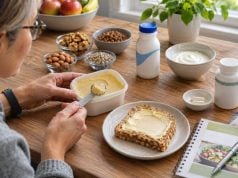
The advantage of a fortified food is that it naturally ties the dose to a meal, which is when plant sterols can compete with dietary and biliary cholesterol in the intestine. The disadvantage is that the food itself may add calories, saturated fat, sodium, or added sugar. A cholesterol-lowering ingredient does not automatically make the entire product heart-healthy.
For example, a sterol-fortified spread that replaces butter can be a useful swap if it is low in saturated fat. A sweetened fortified dessert that adds several hundred calories each day may undermine weight or glucose goals. Judge the whole food, not only the sterol claim.
Capsules and tablets
Supplements are easier for people who do not like fortified foods or who want a consistent dose without changing meals. A 2023 systematic review of randomized trials concluded that capsule and tablet phytosterols can help reduce LDL, although this format has been studied less extensively than fortified foods.
The main advantage is convenience. A clearly labeled supplement can provide 1.5–2 g daily without adding many calories. It may also be easier to travel with than refrigerated fortified foods.
The main limitation is label complexity. Some products require several capsules to reach the advertised daily dose. Others list a proprietary sterol blend or a serving size of two to four capsules. Compare grams of plant sterols/stanols per full daily dose, not the front-label capsule count.
Supplements also vary in independent quality testing. Look for transparent ingredient amounts and reputable manufacturing rather than assuming that “natural cholesterol support” means the product contains a clinically relevant phytosterol dose.
Natural foods are healthy but usually not enough for 2 g
Nuts, seeds, legumes, whole grains, avocado, vegetable oils, fruits, and vegetables naturally contain phytosterols. Those foods are valuable because they also provide fiber, unsaturated fats, potassium, vitamins, minerals, and other plant compounds. But ordinary portions usually do not add up to 2 g of phytosterols per day.
Do not respond by pouring large amounts of vegetable oil or eating excessive nuts simply to chase sterol milligrams. The calorie load would rise quickly. Natural phytosterols are a bonus within a healthy diet; fortified foods or supplements are the practical way to reach a therapeutic dose.
How to Use Plant Sterols Every Day
Consistency matters more than finding a perfect schedule. Because plant sterols work in the intestine during digestion, taking them with meals is a sensible default. Many products divide the daily amount across one or two main meals.
A simple routine might be:
- Choose a target. Aim for about 2 g/day unless your clinician or product instructions recommend a different amount.
- Calculate the real serving. If one serving provides 800 mg, you need 2.5 servings to reach 2 g; in practice, use the nearest labeled regimen rather than improvising fractional capsules.
- Pair it with regular meals. Take a supplement with breakfast and dinner, or use a fortified food at the meals where it naturally fits.
- Keep the rest of the diet stable initially. If you want to know whether sterols are helping, avoid changing six other major factors at the same time.
- Recheck LDL after several weeks. A lipid panel shows whether your personal response is meaningful.
Splitting the dose is not mandatory for everyone. The 2023 fortified-food meta-analysis did not find a clear difference based on the number of daily intakes, and some single-dose products still lower LDL. The practical rule is to follow the product directions and place the dose with a meal rather than taking it randomly on an empty stomach.
Example daily setups
Food-based plan: Use a labeled serving of sterol-fortified spread at breakfast and another measured serving with dinner if that provides about 2 g total. The spread should replace, not simply add to, butter or another calorie source.
Supplement plan: Take enough capsules or tablets to provide the labeled 1.5–2 g daily dose, divided with meals if the directions recommend it.
Mixed plan: A fortified yogurt providing 1 g plus a supplement providing another 1 g can work, provided the total is calculated correctly.
Avoid “dose creep.” If you eat a fortified food plus take a supplement, add the two amounts. Accidentally taking 4–5 g is unlikely to produce twice the LDL benefit.
Cost is easiest to compare per 2-g daily dose. A bottle with 120 capsules may look inexpensive, but if six capsules are required each day, it lasts only 20 days. Similarly, a fortified food may be a good value when it replaces something you already buy rather than becoming an extra item.
What Results to Expect
A realistic expectation is an LDL reduction of about 7% to 12% at a consistent daily intake near 2 g, although individual responses vary. Recent meta-analyses report average absolute LDL reductions around 10–13 mg/dL across mixed study populations, while people with higher starting LDL may see larger absolute changes.
For example, a 10% response would lower LDL:
- From 180 mg/dL to about 162 mg/dL.
- From 150 mg/dL to about 135 mg/dL.
- From 120 mg/dL to about 108 mg/dL.
That can be useful, but it may not be enough for someone with established cardiovascular disease or very high inherited LDL. Plant sterols should be judged by the size of the remaining treatment gap.
The effect usually appears within a few weeks because the mechanism changes cholesterol absorption rather than slowly remodeling arteries. A reasonable practical window is to use the chosen dose consistently for about 4–8 weeks, then repeat the lipid panel if the result will affect decisions. If LDL barely changes, check the dose, adherence, meal timing, and whether the product actually contains the labeled sterol amount before assuming you are a “nonresponder.”
Plant sterols can add to the LDL reduction from statins. The same is true when they are used as part of a broader diet rich in soluble fiber and unsaturated fats. However, clinical trials have mainly established their effect on LDL as a risk factor. Plant sterol products have not been tested in large outcome trials showing that the supplement itself prevents heart attacks or strokes independently of its LDL effect.
That distinction matters. Lower LDL is useful because decades of genetic, drug, and clinical-trial evidence show that reducing atherogenic LDL particles lowers cardiovascular risk. But a plant sterol yogurt should not be advertised mentally as if it had the same direct outcomes evidence as a statin. If you are unsure what LDL range you are trying to reach, see cholesterol levels and target ranges.
Safety and Who Should Avoid Them
Plant sterols and stanols are generally well tolerated at typical cholesterol-lowering doses. Some people develop mild digestive symptoms, but serious adverse effects are uncommon in trials.
They can slightly reduce blood levels of some carotenoids, especially beta-carotene, because these fat-soluble plant compounds share parts of the absorption process. This is not a reason to take high-dose carotenoid supplements. A better response is to eat a varied diet with colorful vegetables and fruits such as carrots, tomatoes, leafy greens, peppers, squash, and citrus.
The major exception is sitosterolemia, a rare inherited disorder in which the intestine absorbs far too much plant sterol and the body cannot eliminate it normally. People with sitosterolemia can develop very high circulating plant sterols, premature atherosclerosis, xanthomas, and blood-cell abnormalities. Sterol- and stanol-fortified products are inappropriate in this condition.
Sitosterolemia should be considered when a person has unusual childhood or early-adult hypercholesterolemia, tendon or skin xanthomas, unexplained hemolytic anemia or low platelets, or cholesterol that responds in an unusual way to absorption-blocking therapy. This is not something most supplement users need to screen for routinely, but anyone with a known diagnosis should specifically avoid therapeutic phytosterol products.
Pregnancy and breastfeeding are also situations for caution. Cholesterol metabolism changes during pregnancy, and there is usually no reason to start high-dose plant sterol supplementation without discussing it with the obstetric or primary-care team. Children with ordinary diets generally do not need fortified sterol products unless a pediatric lipid specialist recommends them.
If you take prescription lipid-lowering medicine, plant sterols usually do not create a major drug interaction, but tell the clinician what you use. The important issue is not a dangerous interaction; it is making sure all therapies are working toward the same LDL goal and that no one mistakes a modest dietary add-on for a substitute for indicated medication.
How Plant Sterols Fit Into a Cholesterol-Lowering Plan
Plant sterols work best as one piece of a layered LDL-lowering strategy. Their typical 7%–12% effect is meaningful, but diet quality, body weight, genetics, medication, and baseline risk determine whether that is enough.
A practical sequence is:
- Know the reason LDL is being lowered. Primary prevention in a low-risk adult is different from treatment after a heart attack or in familial hypercholesterolemia.
- Improve the dietary foundation. Replace saturated fat with unsaturated fats, eat more soluble fiber, choose minimally processed plant foods, and limit trans fat.
- Add about 2 g/day of plant sterols or stanols if an extra LDL reduction would be useful.
- Use medication when the expected dietary effect is too small. Statins, ezetimibe, bempedoic acid, and PCSK9-directed treatments can produce larger reductions when risk is high.
- Measure the response. Recheck LDL rather than assuming the percentage from a study will match your result exactly.
Food choices can often work together. Oats or psyllium add soluble fiber, nuts and olive oil can replace saturated fats, and a sterol-fortified spread can replace butter. The guide to the best foods for lowering cholesterol shows how to combine those changes without turning every meal into a supplement regimen.
If you already take a statin, do not lower the dose simply because you add plant sterols. If you take ezetimibe, which also reduces intestinal cholesterol absorption, the decision to add sterols depends on the remaining LDL gap and your clinician’s plan. A comparison of ezetimibe and statins can help clarify how medication effects differ from dietary add-ons.
The most useful way to use plant sterols is therefore very practical: choose a product you can take consistently, verify that it provides close to 2 g of active sterols/stanols per day, take it with meals, keep the rest of the heart-healthy diet in place, and check the LDL response. If the number remains far above the appropriate target, move to a stronger treatment strategy rather than escalating sterol products indefinitely.
Once you find a routine that works, keep the brand, dose, and meal pattern consistent until the next lipid test. That makes the result easier to interpret. If you change from a fortified food to capsules, verify the daily sterol amount again rather than assuming one serving of each format is equivalent.
References
- Efficacy of phytosterols for reduction of cardiometabolic risk factors: An umbrella review of systematic reviews and meta-analyses and updated dose-response meta-analyses of randomized trials 2026 (Umbrella Review and Meta-Analysis)
- Use of phytosterol-fortified foods to improve LDL cholesterol levels: A systematic review and meta-analysis 2023 (Systematic Review and Meta-Analysis)
- Phytosterol supplementation in capsules or tablets as adjunctive treatment for hypercholesterolemia: A systematic review of randomized controlled trials. 2023 (Systematic Review)
- Effects of phytosterol supplementation on lipid profiles and apolipoproteins: A meta-analysis of randomized controlled trials 2024 (Meta-Analysis)
- Factors Affecting Circulating Phytosterol Levels: Toward an Integrated Understanding of Atherogenicity and Atheroprotection by Dietary and Circulating Phytosterols 2025 (Review)
- LDL-cholesterol-lowering effect of plant sterols and stanols across different dose ranges: a meta-analysis of randomised controlled studies 2014 (Meta-Analysis)
Disclaimer
This article is for general education and does not replace individualized medical or nutrition care. Do not use plant sterol products as a substitute for prescribed cholesterol medication without discussing the change with a qualified clinician. People with sitosterolemia should avoid therapeutic plant sterol and stanol products, and pregnancy, breastfeeding, childhood use, or unusual inherited lipid disorders warrant professional guidance.