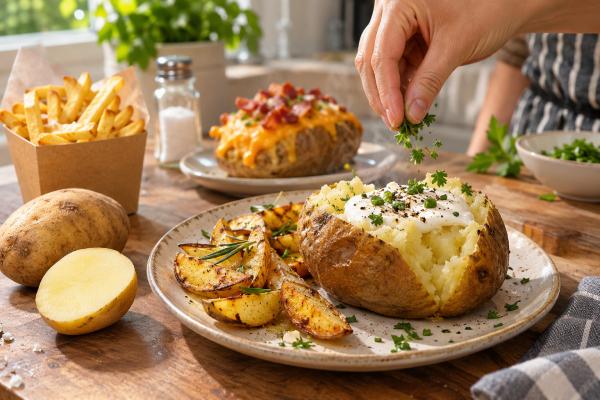
Potatoes can fit very well into a blood-pressure-friendly diet. A medium baked potato provides roughly 600 mg of potassium, and plain potatoes are naturally very low in sodium. The problem is usually not the potato itself—it is what happens during preparation. Frying, oversized portions, salty seasoning, processed cheese, bacon, gravy, and restaurant-style toppings can turn a potassium-rich staple into a high-sodium, high-calorie meal.
For most people with healthy kidneys, baked, boiled, roasted, or microwaved potatoes can be useful sources of potassium and filling carbohydrate. Research does not show that ordinary nonfried potato intake consistently raises hypertension risk, while fried potatoes tend to travel with a less favorable dietary pattern. Potatoes also have a relatively high glycemic impact in many forms, so portion size and meal composition matter if you have prediabetes or diabetes. The best approach is simple: keep the potato, improve the preparation, pair it with vegetables and protein, and control the sodium around it. Kidney disease is the major exception because high-potassium foods may need individual limits.
Table of Contents
- Why Potatoes Can Support Blood Pressure
- What Research Says About Potatoes and Hypertension
- The Preparation Mistakes That Change the Health Picture
- Best Ways to Cook and Serve Potatoes
- Portion Size, Blood Sugar, and Resistant Starch
- Kidney Disease and Potassium Safety
- A Blood-Pressure-Friendly Potato Checklist
Why Potatoes Can Support Blood Pressure
Potatoes are often treated as “just starch,” but nutritionally they are more than that. They provide potassium, vitamin C, vitamin B6, carbohydrate for energy, and some fiber, especially when the skin is eaten. A medium baked potato can provide around 600 mg of potassium, which is more than a medium banana.
Potassium matters because it helps the kidneys excrete sodium and supports normal blood-vessel function. Higher potassium intake tends to have the greatest blood-pressure benefit in people with hypertension and those who eat a lot of sodium. Potatoes can therefore make a meaningful contribution to a potassium-rich diet.
The key word is contribution. One potato does not lower blood pressure by itself, and it cannot erase a high-sodium diet. Its value comes from being one of several potassium-rich foods in an eating pattern built around vegetables, fruits, beans, lentils, dairy or alternatives, nuts, and minimally processed proteins.
For comparison, potassium-rich foods for blood pressure include lentils, beans, squash, leafy greens, dairy, soy foods, and fruit as well as potatoes. Variety makes it easier to raise potassium without depending on one food.
Plain potatoes are also naturally low in sodium. That gives you control over the sodium content when you cook at home. A boiled potato with herbs and olive oil can be very different from restaurant fries or a loaded baked potato containing several high-sodium toppings.
Potatoes are not uniquely protective, but they are affordable, widely available, filling, and easy to prepare. Those practical qualities matter because a healthy diet only works if it can be sustained.
The skin helps, but the potassium is not only in the skin
Keeping the skin can add fiber and texture, but peeling a potato does not remove all of its potassium. Much of the potassium is in the flesh, so a peeled baked or boiled potato can still contribute a substantial amount. This is useful for people who dislike the skin or need a softer texture.
The skin matters more for fiber than for making or breaking the potato’s potassium value. If you eat it, scrub the potato well before cooking. If you do not, compensate for fiber elsewhere in the meal with vegetables, beans, lentils, or whole grains.
Potato variety and size also affect the nutrient total. A very large russet can provide much more potassium—and far more carbohydrate—than a small red potato. That is another reason to think in servings rather than assuming every “one potato” is equivalent.
What Research Says About Potatoes and Hypertension
The research is more nuanced than headlines suggesting potatoes either cause or prevent high blood pressure. Observational studies often struggle to separate the potato from the way it is cooked and the foods eaten with it.
A 2025 systematic review and meta-analysis found that total potato intake was not significantly associated with hypertension when people with the highest intake were compared with those with the lowest. Nonfried potatoes were also not clearly associated with hypertension. Another 2025 analysis pooling several prospective cohorts similarly found no meaningful association between total potato intake and development of hypertension or cardiovascular disease.
That does not mean preparation is irrelevant. Earlier cohort research has often found less favorable associations for French fries and fried potato meals. Fried potatoes are commonly served with salt, processed meat, cheese, sauces, refined buns, or sugary drinks. They also absorb oil and are easy to eat in large portions. In this setting, “potato intake” can become a marker for the entire meal pattern.
A 2024 Nordic Nutrition Recommendations review reached a practical conclusion: moderate potato intake can be part of a healthy diet, but health effects vary substantially by cooking method, and fried potatoes should be limited.
Controlled feeding evidence is smaller. One short randomized trial in adults with prehypertension or hypertension compared potassium supplied by potatoes, French fries, or potassium gluconate within controlled diets. Overall end-of-treatment blood pressure did not differ significantly among treatments, although a secondary comparison suggested a larger systolic decline over time with baked or boiled potatoes than with the control diet. The study was small and short, so it should not be used to claim that potatoes are a treatment for hypertension.
The strongest conclusion is therefore not “eat potatoes to lower blood pressure.” It is that plain or minimally processed potatoes are compatible with a blood-pressure-friendly diet, largely because they supply potassium without much sodium when you control the preparation.
Observational studies also cannot fully separate cause from context. People who frequently eat fries may differ in body weight, activity, smoking, restaurant use, beverage choices, and overall diet from people who usually eat boiled or baked potatoes. Statistical adjustment helps, but it cannot remove every difference. That is why preparation-specific findings are best used as practical guidance rather than proof that one cooking method directly causes hypertension.
The Preparation Mistakes That Change the Health Picture
The cardiovascular profile of a potato can change dramatically between the produce aisle and the plate. Four mistakes account for most of the difference.
1. Turning the potato into a sodium delivery system
Salt is the biggest issue for blood pressure. Restaurant fries, seasoned wedges, chips, instant mashed potatoes, boxed potato mixes, and loaded baked potatoes can contain far more sodium than a plain potato.
A naturally low-sodium food becomes high-sodium when it is covered with seasoning salt, cheese sauce, bacon, gravy, ranch dressing, or other salty toppings. The potassium remains, but it does not cancel the sodium.
If sodium is a major target for you, the guide to salt, sodium, and high blood pressure is more important than trying to maximize one potassium-rich ingredient.
2. Making frying the default
Frying increases energy density because potatoes absorb oil. It can also create a food that is easy to overeat quickly, especially when served as a side to another calorie-dense meal.
Fried potatoes are not forbidden, but they should not be the main form in which you eat potatoes. Baked, boiled, microwaved, air-roasted, or oven-roasted potatoes give you much more control over sodium and added fat.
3. Treating toppings as nutritionally invisible
A baked potato can start at roughly 150 to 200 calories, depending on size, and then double or triple in energy after butter, sour cream, cheese, bacon, and creamy sauces. The toppings can also contribute more sodium than the potato itself.
Better toppings include plain Greek yogurt, herbs, salsa with modest sodium, black beans, chopped vegetables, scallions, olive oil, pepper, or a small amount of cheese rather than a large cheese sauce.
4. Letting the portion dominate the plate
A very large restaurant potato can equal several standard servings of starch. That matters for total calories and blood glucose, even if the preparation is otherwise healthy.
A practical plate gives the potato a supporting role: roughly one-quarter of the plate for the potato or other starch, one-quarter for protein, and about half for nonstarchy vegetables. Your needs may differ with body size and activity, but this framework keeps the meal balanced.
Best Ways to Cook and Serve Potatoes
For blood pressure, the best potato is one that keeps sodium modest and leaves room for other nutrient-dense foods.
Baked or microwaved: These methods need no added fat and preserve the potato as a simple base. Add herbs, pepper, yogurt, vegetables, or beans instead of relying on salty toppings.
Boiled: Boiling creates a soft potato that works in salads, soups, or as a simple side. Season after cooking so you can control the amount of salt. Potassium can leach into the cooking water, especially when potatoes are cut into smaller pieces, but boiled potatoes still contribute useful nutrients.
Oven-roasted: Toss chunks with a modest amount of olive or canola oil, garlic, paprika, rosemary, pepper, or other herbs. Roast until crisp rather than using a heavy salted coating.
Air-fried: An air fryer can create a crisp texture with much less oil than deep frying. The blood-pressure benefit depends on seasoning; air-fried potatoes coated in a large amount of salt are still high-sodium potatoes.
Mashed: Homemade mashed potatoes can be reasonable when made with milk, olive oil, or a modest amount of butter and controlled salt. Instant or restaurant mashed potatoes may contain much more sodium, so labels and portions matter.
A useful meal might combine a medium roasted potato with salmon, broccoli, and a tomato salad. Another option is a baked potato topped with no-salt-added beans, plain yogurt, and chopped vegetables. These meals use the potato’s potassium while adding protein, fiber, and other minerals.
Portioning also becomes easier when the potato is not the entire meal. If you are very active, a larger serving may fit comfortably. If you are trying to lose weight or manage post-meal glucose, a smaller potato with more nonstarchy vegetables may be more appropriate. The blood-pressure goal is not to force everyone into the same serving; it is to keep the preparation low in sodium and the overall plate balanced.
At restaurants, ask for toppings on the side and request little or no added salt when possible. A plain baked potato is one of the easier restaurant starches to customize, but loaded versions can contain large amounts of sodium before you add anything yourself.
The DASH grocery approach works well here: potatoes can sit comfortably alongside leafy greens, beans, fruit, low-fat dairy, whole grains, fish, and unsalted nuts.
Portion Size, Blood Sugar, and Resistant Starch
Blood pressure is not the only consideration. Potatoes can produce a relatively fast rise in blood glucose, depending on variety, cooking method, how soft they are cooked, and what is eaten with them. That matters if you have insulin resistance, prediabetes, or diabetes.
You do not necessarily need to avoid potatoes. A more useful strategy is to manage portion and pairing. Eating a moderate potato portion with protein, nonstarchy vegetables, and healthy fat usually creates a more balanced glucose response than eating a large plate of potatoes by itself.
Cooling cooked potatoes changes some digestible starch into resistant starch, which is less rapidly digested in the small intestine. Refrigerated potato salad or cooked-and-cooled potatoes that are later reheated can therefore have a somewhat different starch profile than freshly cooked hot potatoes.
This is not a magic trick. Cooling does not remove carbohydrate or calories, and it does not automatically turn a large serving into a low-glycemic food. It is one modest tool within portion control and meal composition. If you are interested in that mechanism, resistant starch from cooked-and-cooled potatoes also has implications beyond blood pressure.
People with prediabetes or diabetes may benefit from checking their own post-meal glucose response. The same potato serving can affect two people differently because of medication, insulin sensitivity, activity, sleep, and what else was eaten.
Do not let fear of carbohydrate push you toward a higher-sodium replacement. Swapping a plain potato for processed meat, salty crackers, or a refined low-carb snack may make the blood-pressure side of the meal worse even if the carbohydrate total falls.
Kidney Disease and Potassium Safety
The advice changes if your kidneys cannot excrete potassium normally. Potatoes are one of the higher-potassium staple foods, so they may need portion adjustment in people with chronic kidney disease and a history of hyperkalemia.
Do not assume that everyone with CKD must avoid potatoes completely. Potassium needs are individualized according to kidney function, blood-potassium results, medications, acid-base balance, diabetes, bowel function, and other factors. Some people can include small portions; others need stronger restriction.
Cooking technique can matter in kidney diets. Cutting potatoes into smaller pieces and boiling them in plenty of water can reduce their potassium content because some potassium moves into the water. The cooking water is then discarded. This may be useful under renal-dietitian guidance, but it is unnecessary for healthy adults trying to maximize potassium for blood pressure.
Medication also changes risk. ACE inhibitors, ARBs, spironolactone, eplerenone, and other potassium-sparing drugs can raise blood potassium, particularly when kidney function is reduced. Potassium salt substitutes and supplements can add concentrated exposure on top of high-potassium foods.
If you have normal kidney function, food potassium is usually handled safely. If you have CKD, heart failure, previous hyperkalemia, or take several potassium-raising medications, get individualized advice before deliberately increasing potatoes or other high-potassium foods.
A Blood-Pressure-Friendly Potato Checklist
Potatoes do not need a health halo, and they do not deserve a blanket warning. Their effect depends heavily on preparation and the meal around them.
Use this checklist when potatoes are on the menu:
- Choose baked, boiled, microwaved, or oven-roasted potatoes most often. Keep deep-fried forms occasional.
- Control the salt. Flavor with herbs, garlic, pepper, lemon, vinegar, paprika, cumin, or other spices before reaching for heavy seasoning blends.
- Watch the toppings. Use vegetables, beans, yogurt, or a measured amount of cheese instead of piling on bacon, cheese sauce, and gravy.
- Keep the portion proportional to the meal. A medium potato is very different from a giant restaurant potato plus fries on the side.
- Pair with protein and vegetables. This improves satiety, nutrient balance, and often the post-meal glucose response.
- Treat chips and fries as different foods nutritionally. They may start with potatoes, but added sodium, oil, and portion size change the result.
- Check kidney safety if relevant. High-potassium foods can be inappropriate when potassium excretion is impaired.
If your main goal is lowering blood pressure, keep the larger pattern in view. Evidence-based ways to lower blood pressure naturally include sodium reduction, exercise, weight management when needed, adequate sleep, limiting alcohol, and an overall heart-healthy diet.
Potatoes can support that pattern because they are potassium-rich, affordable, and filling. The simplest rule is to stop blaming the plain potato for what salt, frying, oversized portions, and processed toppings do to it. Prepare it like a whole food, pair it wisely, and it can be a useful part of a blood-pressure-friendly plate.
References
- Potato Intake and the Risk of Overweight/Obesity, Hypertension, Diabetes, and Cardiovascular Disease: A Systematic Review and Meta-analysis of Observational Studies 2025 (Systematic Review)
- Potato Consumption and Risk of Cardiovascular Disease in a Harmonized Analysis of Seven Prospective Cohorts 2025 (Cohort Analysis)
- Potatoes – a scoping review for Nordic Nutrition Recommendations 2023 2024 (Review)
- The Role of Diet in the Prevention of Hypertension and Management of Blood Pressure: An Umbrella Review of Meta-Analyses of Interventional and Observational Studies 2024 (Umbrella Review)
- Potassium – Health Professional Fact Sheet 2022 (Official Fact Sheet)
- Short-Term RCT of Increased Dietary Potassium from Potato or Potassium Gluconate: Effect on Blood Pressure, Microcirculation, and Potassium and Sodium Retention in Pre-Hypertensive-to-Hypertensive Adults 2021 (RCT)
Disclaimer
This article provides general nutrition education and is not a substitute for individualized medical advice. If you have chronic kidney disease, a history of high blood potassium, diabetes requiring specific carbohydrate management, or take medicines that affect potassium, ask your healthcare professional or dietitian how potatoes fit your plan.