A progesterone test measures the hormone that rises after ovulation and supports the uterine lining in early pregnancy. The result is useful only when matched to the reason for testing and the timing of the sample. For ovulation confirmation, blood is usually drawn about 6–8 days after ovulation, or roughly 7 days before the next expected period—not automatically on cycle day 21. A level above about 3 ng/mL generally supports recent ovulation, but no single value proves that the luteal phase is “strong,” predicts conception, or guarantees implantation. In pregnancy, progesterone usually increases, yet one low or high result cannot locate the pregnancy or determine viability with certainty. Symptoms, serial hCG, and ultrasound often matter more. Progesterone also fluctuates in pulses, varies among laboratories, and is altered by fertility medicines, supplements, and hormonal contraception. Understanding units, cycle timing, and medication exposure prevents a normal physiological result from being labeled as a deficiency.
- A mid-luteal progesterone result above about 3 ng/mL usually supports recent ovulation but does not prove normal fertility.
- Test about 6–8 days after ovulation or 7 days before the expected period; day 21 fits only some 28-day cycles.
- Low progesterone may reflect an early or late blood draw, delayed ovulation, no ovulation, or a normal short-term dip.
- A single pregnancy progesterone value cannot diagnose ectopic pregnancy or reliably determine whether a pregnancy will continue.
- Progesterone treatment, fertility drugs, and some hormonal products can make the result impossible to compare with an untreated cycle.
Table of Contents
- What Progesterone Does
- Why a Progesterone Test Is Ordered
- Best Time for Testing
- Understanding Ovulation Results
- Progesterone in Pregnancy
- High and Low Progesterone
- Preparation, Medications, and Related Tests
- Common Questions and Next Steps
What Progesterone Does
Progesterone is a steroid hormone made mainly by the corpus luteum after ovulation. The corpus luteum forms from the ovarian follicle that released the egg. Before ovulation, progesterone is usually low. After ovulation, LH supports the corpus luteum and progesterone rises.
Progesterone changes the endometrium from a growing, estrogen-stimulated lining into a secretory lining that can support implantation. It also thickens cervical mucus, raises basal body temperature slightly, and helps regulate uterine activity.
If pregnancy does not occur, the corpus luteum regresses after roughly two weeks. Progesterone and estradiol fall, the lining breaks down, and menstruation begins. If pregnancy occurs, hCG from the developing pregnancy rescues the corpus luteum. The placenta gradually becomes the main source of progesterone during the first trimester.
Progesterone is released in pulses rather than at a constant rate. A blood level can change several-fold within a few hours. This biological fluctuation is one reason a single result can confirm that progesterone production occurred but cannot grade the entire luteal phase.
Progesterone is different from progestins. Progesterone may refer to the natural hormone or bioidentical micronized progesterone used as medication. Progestins are synthetic compounds used in contraception, fertility care, endometrial protection, and other treatments. Many progestins are not measured as progesterone by standard laboratory assays.
The hormone also appears in smaller amounts from the adrenal glands and, during pregnancy, the placenta. After menopause, progesterone is usually low unless it is prescribed.
Progesterone receptors are present in the uterus, breasts, brain, and other tissues. This helps explain why the post-ovulation phase can bring sleepiness, breast fullness, bloating, or temperature change. These symptoms are influenced by several hormones and are not a reliable substitute for testing. Likewise, having no noticeable luteal symptoms does not mean ovulation failed.
The relationship between progesterone and bleeding is indirect. Estrogen grows the endometrium, while progesterone organizes and stabilizes it after ovulation. When ovulation does not occur for long periods, the lining may be exposed to estrogen without regular progesterone, leading to unpredictable shedding. This is clinically important in chronic anovulation, but a random low serum result does not determine endometrial thickness or cancer risk. Cycle history, ultrasound, and sometimes endometrial sampling answer those questions more directly.
Why a Progesterone Test Is Ordered
The test is most useful when it answers a defined question. Common reasons include:
- Confirming that ovulation probably occurred
- Evaluating irregular cycles or suspected anovulation
- Monitoring ovulation induction or assisted reproduction
- Investigating infertility with other tests
- Assessing selected early-pregnancy concerns
- Monitoring prescribed progesterone in specific fertility protocols
- Helping evaluate abnormal uterine bleeding in context
- Investigating rare adrenal or ovarian disorders as part of a larger workup
A progesterone result does not measure ovarian reserve. AMH, antral follicle count, age, and sometimes FSH provide different information about egg supply or expected response to stimulation. Progesterone also does not measure egg quality, fallopian tube openness, sperm health, or uterine anatomy.
In a person with predictable 21–35 day cycles, the history often already suggests regular ovulation. Testing may be unnecessary unless pregnancy is not occurring, treatment is being monitored, or the cycle pattern changes. In irregular cycles, a random “day 21” test can be misleading and may need to be tied to an LH surge or ultrasound.
Progesterone is sometimes included in broad wellness panels even when no clinical question exists. A low follicular-phase result is normal, and an unexpected number can create needless concern. The collection date and expected ovulation date should always appear beside the result.
A fertility hormone test panel may combine markers, but each one answers a different part of the fertility evaluation.
Best Time for Testing
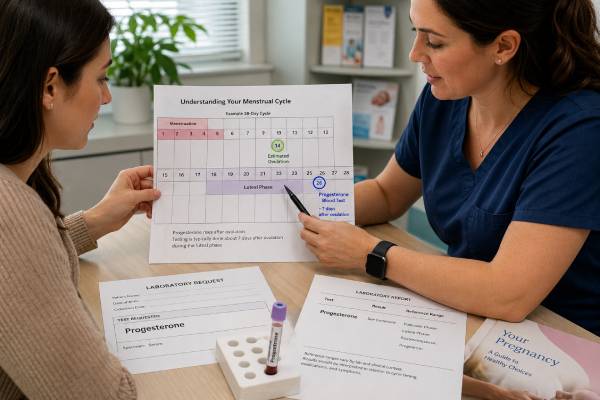
For ovulation confirmation, test during the mid-luteal phase—about 6–8 days after ovulation or approximately 7 days before the expected next period. Progesterone generally peaks during this window.
Cycle day 21 is appropriate only when ovulation occurred around day 14 of a 28-day cycle. Examples show why timing matters:
- A 24-day cycle with ovulation near day 10 may need testing around day 16–18.
- A 32-day cycle with ovulation near day 18 may need testing around day 24–26.
- A 40-day cycle with ovulation near day 26 may need testing around day 32–34.
Ovulation can be estimated with a urine LH kit, cervical mucus, basal body temperature, cycle history, or ultrasound. A positive urinary LH result usually precedes ovulation by about 1–2 days, but PCOS and other irregular ovulatory patterns can produce multiple surges. Temperature confirms the hormonal shift only after it has happened.
If the next period arrives earlier or later than expected, recalculate whether the sample was truly mid-luteal. A “low day 21” result after a day 19 LH surge was drawn too early. Repeating at the correct time may be more useful than diagnosing a hormone problem.
Fasting is usually not required for progesterone alone. The time of day is less critical than cycle timing, although pulsatile secretion means two samples on the same day can differ. Follow the fertility clinic’s exact schedule in medicated cycles because trigger injections, stimulation, egg retrieval, and transfer protocols change the expected timing.
Pregnancy-related testing can be drawn when clinically indicated rather than on a cycle day. In that setting, gestational age, symptoms, ultrasound findings, hCG trends, and progesterone treatment all influence interpretation.
The day 21 progesterone test guide provides a practical method for adapting the date to longer or shorter cycles.
Understanding Ovulation Results
Progesterone is commonly reported in ng/mL in the United States and nmol/L elsewhere. Multiply ng/mL by approximately 3.18 to convert to nmol/L. Always confirm the unit before comparing values.
A luteal progesterone result above about 3 ng/mL, or 9.5 nmol/L, is generally accepted as presumptive evidence of recent ovulation. It means a functioning corpus luteum produced progesterone. It does not prove that the follicle contained a healthy egg or that the cycle will result in pregnancy.
There is no universally accepted minimum serum progesterone value that defines a normal, fertile luteal phase in an untreated cycle. Cutoffs such as 5, 10, or 15 ng/mL may be used in particular clinics or treatment protocols, but they should not be applied as universal measures of “strong ovulation.” A natural pulse can move a result above or below these values within a short period.
| Result context | Likely interpretation | What matters next |
|---|---|---|
| Low before ovulation | Expected follicular-phase result | Confirm cycle timing |
| Above about 3 ng/mL at mid-luteal timing | Recent ovulation is likely | Do not use the number alone to grade fertility |
| Low at presumed mid-luteal timing | Mistimed draw, delayed ovulation, anovulation, or a transient dip | Review LH timing and repeat only if it will change care |
| High after fertility stimulation | Multiple corpora lutea or medication effect | Use protocol-specific interpretation |
When ovulation is uncertain, the result can be paired with ultrasound or a later period date. Serial ultrasound can show follicle growth and rupture. Repeated progesterone tests may describe a pattern, but even several measurements do not create a validated universal test for luteal phase deficiency.
Laboratory intervals can look confusing because they are often very broad. A report may list one follicular range, one luteal range, and separate ranges for each trimester of pregnancy. Those ranges are population descriptions, not personal targets. The same number can be appropriate in one phase and abnormal in another. Results near the lower edge of a luteal interval should not be labeled deficient without confirming the ovulation date and the laboratory’s assay.
Serum progesterone is measured by immunoassay in many laboratories, while some centers use mass-spectrometry methods. Assays can differ, especially at low concentrations. If a surprising result would lead to major treatment or imaging, repeating it in the same laboratory or confirming with a higher-specificity method may be reasonable. Small differences between two reports may reflect normal analytical variation rather than a real change in corpus luteum function.
A recurrent luteal interval shorter than about 10 days may deserve evaluation, particularly with infertility. Still, a short phase and a single low value do not prove one specific disorder. Thyroid disease, high prolactin, low energy availability, major stress, PCOS, reproductive aging, or poor follicular development may disrupt ovulation and secondarily reduce progesterone.
For the limitations of diagnosing luteal deficiency, see the luteal phase defect hormone test article.
Progesterone in Pregnancy
Progesterone normally rises in pregnancy, first from the corpus luteum and later mainly from the placenta. Reference ranges are broad and overlap between viable and nonviable pregnancies. Gestational age uncertainty and laboratory differences add further variation.
A very low single progesterone value in a symptomatic early pregnancy can make a viable pregnancy less likely, but it cannot determine where the pregnancy is located. Ectopic pregnancies can produce low, intermediate, or occasionally higher values. A high value also cannot guarantee a normal outcome.
For pregnancy of unknown location, serial hCG measurements and transvaginal ultrasound are the main tools. Major guidance advises against adding serum progesterone to serial hCG to diagnose viable intrauterine versus ectopic pregnancy. Symptoms take priority over a laboratory threshold.
Seek urgent care for a positive pregnancy test with:
- One-sided or severe pelvic pain
- Shoulder-tip pain
- Fainting, marked dizziness, or weakness
- Heavy bleeding
- Shortness of breath or collapse
These may indicate ectopic pregnancy or significant bleeding.
Progesterone supplementation is used in several distinct situations, including IVF luteal support and selected threatened-miscarriage care. Evidence and recommendations depend on pregnancy history, ultrasound confirmation, bleeding, and treatment protocol. A blood value should not be used to start, stop, or change prescribed progesterone without the treating clinician.
Treatment decisions also depend on the formulation. Micronized progesterone is structurally identical to endogenous progesterone, while progestins such as medroxyprogesterone acetate, norethindrone, or levonorgestrel have different pharmacology. A standard progesterone assay may not detect these progestins. Someone taking a progestin can therefore have a low serum progesterone result while still receiving a strong endometrial effect. This distinction is essential in contraception and menopausal hormone therapy.
Side effects of prescribed progesterone may include sleepiness, dizziness, bloating, breast tenderness, or local vaginal irritation. Oral micronized progesterone is often taken at night because of sedation. Intramuscular injections can cause soreness, while vaginal products may produce discharge. These effects do not prove that the dose is too high, and the absence of side effects does not prove inadequate absorption.
Vaginal progesterone can produce strong local uterine exposure with serum levels that do not look as high as expected. Oral, vaginal, and intramuscular routes have different absorption patterns. Comparing results across routes or clinics without protocol context can be misleading.
Progesterone testing is not a home pregnancy test. hCG in urine or blood confirms pregnancy. Once pregnancy is known, ultrasound and hCG trends answer questions that progesterone alone cannot.
High and Low Progesterone
“High” and “low” are meaningful only against cycle stage, pregnancy status, and treatment.
Low progesterone
Common explanations include:
- Normal pre-ovulation timing
- Blood drawn too early or too late in the luteal phase
- Delayed or absent ovulation
- Hypothalamic suppression from low energy availability, intense exercise, major stress, or illness
- PCOS-related irregular ovulation
- High prolactin or thyroid disease
- Reduced ovarian function or the menopausal transition
- Corpus luteum regression before menstruation
Symptoms such as spotting, mood changes, breast tenderness, and short cycles are not specific enough to diagnose low progesterone. Abnormal bleeding can also result from pregnancy, fibroids, polyps, infection, medication, or endometrial disease.
High progesterone
Higher values occur normally in the luteal phase and pregnancy. Fertility stimulation can produce more than one corpus luteum and a higher result. Prescribed progesterone may increase the measured level, depending on route and timing.
Less common causes include ovarian cysts that produce progesterone, adrenal disorders, or assay interference. A high result without symptoms is rarely interpreted in isolation. The clinician may confirm pregnancy status, review medicines, and repeat the test if the number does not fit the clinical picture.
A laboratory flag can be misleading when it compares a luteal sample with a follicular reference interval. Check which phase the report used and whether the lab knows the pregnancy or treatment status.
Preparation, Medications, and Related Tests
Before testing, record the first day of the last period, usual cycle length, LH surge date, fertility procedures, pregnancy status, and the exact time of the last progesterone dose. Do not stop prescribed medication unless instructed.
Products that can affect interpretation include micronized progesterone, vaginal suppositories or gels, injectable progesterone, progestin-containing contraception, menopausal hormone therapy, fertility stimulation drugs, hCG trigger injections, and some compounded creams. Over-the-counter creams may deliver inconsistent amounts and should be disclosed.
Biotin can interfere with some immunoassays. Ask the laboratory whether a supplement needs to be paused. Acute illness and major sleep or schedule changes can also shift ovulation timing even if they do not directly alter the assay.
Related tests depend on the question:
- Urine or serum hCG for pregnancy
- LH testing to estimate the ovulation window
- TSH and prolactin for irregular or absent ovulation
- FSH, estradiol, and AMH for selected ovarian-function or reserve questions
- Testosterone and DHEA-S when androgen excess suggests PCOS or another disorder
- Ultrasound to monitor follicles, assess pregnancy location, or investigate bleeding
- Serial hCG for early-pregnancy assessment
A progesterone result should not delay ultrasound or urgent examination when pregnancy symptoms are concerning.
Home urine tests sometimes measure pregnanediol glucuronide, often shortened to PdG, which is a progesterone metabolite. Several days of elevated PdG after an LH surge can support that ovulation probably occurred, and repeated urine readings may show a pattern that a single blood draw misses. However, urine concentration changes with hydration, collection time, kidney handling, and the product’s threshold. A home PdG result is therefore not interchangeable with serum progesterone, and it cannot diagnose a luteal phase disorder, confirm a viable pregnancy, or rule out ectopic pregnancy. People using these products should follow the collection instructions closely and share the full sequence of results—not only the highest value—if a clinician is helping assess ovulation.
Common Questions and Next Steps
Is 10 ng/mL the normal ovulation cutoff?
Not universally. A value above about 3 ng/mL supports recent ovulation. Some clinics use higher targets in specific treatment cycles, but one natural-cycle result below 10 does not prove a defective luteal phase.
Can progesterone tell me whether I am pregnant?
No. Use an hCG test to confirm pregnancy. Progesterone may add prognostic information in selected settings but cannot establish pregnancy location or outcome by itself.
Why did my result change so much?
Progesterone is pulsatile and cycle timing may differ. Laboratory method, blood-draw time relative to medication, and the number of ovulated follicles also matter. Large changes are not automatically laboratory errors.
Should I repeat a low result?
Repeat only when timing was uncertain or the answer will change management. First check the LH surge and next-period date. Random monthly repeats often add anxiety without clarifying the cause.
Can foods or supplements raise progesterone?
No food has been shown to correct an ovulation disorder by directly raising progesterone to a reliable therapeutic level. Adequate nutrition supports ovulatory health, but persistent irregular cycles require evaluation. Avoid unregulated hormone products.
The best next step after an abnormal result is to confirm timing, pregnancy status, and medication exposure. Then investigate the cause of irregular ovulation rather than treating the number alone. Fertility evaluation should also address age, tubes, uterus, and sperm factors when relevant.
For people not trying to conceive, repeated anovulation may still need treatment to protect the endometrium and control bleeding. Options can include combined hormonal contraception, a progestin-releasing intrauterine device, or scheduled oral progestogen, chosen according to health risks and preferences. These treatments are based on the cycle pattern and endometrial needs, not on achieving a particular serum progesterone concentration.
For people trying to conceive, management may focus on restoring or inducing ovulation. Correcting thyroid disease, high prolactin, inadequate energy intake, or medication effects can be more effective than adding progesterone alone. In anovulatory PCOS, ovulation-induction treatment addresses the missing ovulation that causes low progesterone. Luteal support may still be included in selected assisted-reproduction protocols, but it is not a substitute for releasing an egg.
References
- Progesterone Test — 2025, MedlinePlus laboratory test guide.
- Diagnosis and treatment of luteal phase deficiency: a committee opinion — 2021, American Society for Reproductive Medicine committee opinion.
- Fertility evaluation of infertile women: a committee opinion — 2021, American Society for Reproductive Medicine committee opinion.
- Ectopic pregnancy and miscarriage: diagnosis and initial management — 2026, National Institute for Health and Care Excellence guideline.
- Performance of single serum progesterone in the evaluation of symptomatic first-trimester pregnant patients: a systematic review and meta-analysis — 2022, systematic review and meta-analysis.
- Serum progesterone — 2025, MedlinePlus Medical Encyclopedia.
Disclaimer
This article provides general education and cannot diagnose an ovulation disorder, infertility, miscarriage, or ectopic pregnancy. Progesterone results require cycle timing, pregnancy status, medication history, symptoms, and the reporting laboratory’s range. Seek urgent care for severe one-sided pain, fainting, shoulder pain, or heavy bleeding when pregnancy is possible.