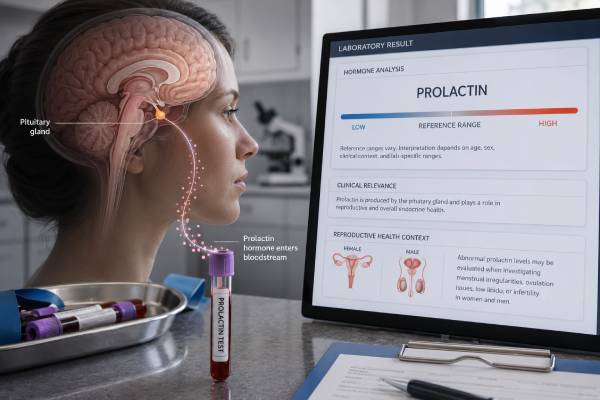
A prolactin blood test measures a pituitary hormone best known for stimulating breast milk production. Outside pregnancy and breastfeeding, persistently high prolactin can suppress the reproductive hormone axis, causing irregular or absent periods, low testosterone, reduced libido, erectile dysfunction, infertility, or unexpected milk discharge. A mildly elevated result is common and may be temporary because prolactin rises with stress, sleep, exercise, sex, nipple stimulation, pain, and even a difficult blood draw. Medications, pregnancy, hypothyroidism, kidney or liver disease, and macroprolactin can also raise the measured level. A prolactinoma is an important but not automatic explanation. Clinicians usually repeat a mild elevation under calmer conditions, review medications, exclude pregnancy and thyroid disease, and consider macroprolactin before ordering pituitary MRI. Markedly high levels, symptoms of a pituitary mass, or persistent unexplained elevation require more urgent assessment. Low prolactin is less common and is usually important only when it reflects broader pituitary dysfunction or inability to produce milk after childbirth.
- Mild prolactin elevation should usually be confirmed with a repeat test.
- Stress, sleep, exercise, sex, and nipple stimulation can temporarily raise prolactin.
- Pregnancy, medications, hypothyroidism, and macroprolactin are common explanations.
- High prolactin can suppress ovulation and testosterone production.
- A prolactinoma is diagnosed from the clinical, biochemical, and imaging pattern—not one result.
- Headache or vision changes with high prolactin need prompt evaluation.
Table of Contents
- What Prolactin Does
- Why a Prolactin Test Is Ordered
- How to Prepare and Repeat the Test
- Prolactin Normal Ranges
- Causes of High Prolactin
- Fertility and Pituitary Effects
- Low Prolactin, Treatment, and Next Steps
What Prolactin Does
Prolactin is produced by lactotroph cells in the anterior pituitary gland. Its best-established role is breast development and milk production after childbirth. During pregnancy, estrogen stimulates prolactin production. After delivery, suckling reduces hypothalamic dopamine—the main inhibitor of prolactin—allowing repeated prolactin surges that support lactation.
Prolactin also interacts with the reproductive axis. When it remains elevated, it can reduce pulsatile gonadotropin-releasing hormone from the hypothalamus. LH and FSH signaling then falls, which can reduce ovarian estradiol and progesterone or testicular testosterone. This is why high prolactin can cause anovulation, amenorrhea, low libido, vaginal dryness, erectile dysfunction, low sperm production, and infertility.
Secretion is naturally variable. Prolactin rises during sleep and is often highest in the early morning. It can increase with physical or emotional stress, exercise, sexual activity, nipple stimulation, pain, low blood sugar, and some meals. These short-term changes are why one mildly high result should not automatically lead to a tumor diagnosis.
Dopamine from the hypothalamus continuously restrains prolactin release. Medications that block dopamine—particularly several antipsychotic and anti-nausea drugs—can therefore raise prolactin. Damage to the pituitary stalk can also interrupt dopamine delivery and cause a moderate increase, known as the stalk effect.
Most prolactin circulates as a small biologically active molecule. Macroprolactin is a larger complex, often prolactin bound to an immunoglobulin. Some laboratory assays detect it even though it has less biological activity. A person may have a high reported total prolactin with few or no symptoms; laboratory screening for macroprolactin can prevent unnecessary imaging or treatment.
Why a Prolactin Test Is Ordered
A clinician may order prolactin when symptoms suggest reproductive suppression, inappropriate milk production, or a pituitary condition.
Common indications include:
- Irregular or absent menstrual periods
- Infertility or suspected anovulation
- Galactorrhea when not pregnant or breastfeeding
- Low libido, vaginal dryness, or painful intercourse
- Low testosterone, reduced facial hair growth, erectile dysfunction, or infertility in men
- Headaches, loss of peripheral vision, or other pituitary symptoms
- A pituitary mass found on imaging
- Monitoring a known prolactinoma or dopamine-agonist treatment
- Delayed puberty or unexplained hypogonadism
- Difficulty producing milk after delivery when pituitary injury is suspected
Galactorrhea does not always mean prolactin is high, and high prolactin does not always cause galactorrhea. Breast discharge can also result from medications, repeated stimulation, thyroid disease, pregnancy, duct conditions, or breast disease. Bloody, one-sided, or spontaneous discharge from a single duct requires breast evaluation rather than being assumed to be hormonal.
For infertility, prolactin is particularly useful when cycles are irregular or absent. Routine testing in every person with regular cycles is less informative, but many fertility panels include it because an elevation is treatable. An infertility hormone panel for women may pair prolactin with TSH, FSH, LH, estradiol, and ovarian reserve markers. In men, prolactin is usually most useful when testosterone is low, libido is reduced, or symptoms suggest pituitary disease.
Pituitary testing may include other hormones because a large lesion can affect more than prolactin. Morning cortisol, free thyroxine and TSH, IGF-1, LH, FSH, estradiol, or testosterone may be checked depending on symptoms. A pituitary hormone panel assesses the wider gland rather than treating prolactin in isolation.
How to Prepare and Repeat the Test
Prolactin can be drawn at any time, but a standardized sample improves interpretation. For a mild or unexpected elevation, clinicians often repeat the test in the morning, at least two to three hours after waking, after the person has rested quietly for 20–30 minutes. The exact protocol varies.
Before the test:
- Follow laboratory instructions about fasting; it is not always required.
- Avoid strenuous exercise, sexual activity, and nipple or breast stimulation beforehand when practical.
- Try to minimize pain and emotional stress before the draw.
- Tell the clinician about pregnancy possibility and breastfeeding.
- Provide a complete medication and supplement list.
- Do not stop psychiatric or anti-nausea medication without the prescribing clinician.
If needle stress is substantial, the laboratory may place an intravenous line and collect a repeat sample after rest. This can help distinguish stress-related elevation from persistent hyperprolactinemia.
Medication review is critical. Drugs that may raise prolactin include many antipsychotics, metoclopramide, domperidone, some antidepressants, opioids, verapamil, methyldopa, and estrogen-containing therapy. The size of the increase differs. A supervised switch or brief interruption may clarify the cause, but only when medically safe. Abruptly stopping an antipsychotic can be dangerous.
A persistent elevation is usually followed by pregnancy testing when relevant, TSH and free T4, kidney and liver assessment, and macroprolactin testing. Laboratories often use polyethylene glycol precipitation to estimate the biologically active monomeric prolactin. The macroprolactin test is especially useful when the number is high but symptoms are absent or mild.
The laboratory should also consider the “hook effect” when a very large pituitary tumor is present but prolactin appears only mildly elevated. Extremely high prolactin can saturate some immunoassays and produce a falsely low result; testing a diluted sample resolves this problem.
Prolactin Normal Ranges
Reference intervals differ by assay, sex, pregnancy status, and laboratory. Common adult ranges are approximately:
| Group | Approximate prolactin | Comment |
|---|---|---|
| Nonpregnant women | About 5–25 ng/mL | Some laboratories use a lower or higher upper limit |
| Men | About 3–20 ng/mL | Assay-specific range applies |
| Pregnancy | Substantially higher and rises across gestation | Nonpregnant ranges do not apply |
| Postpartum breastfeeding | Variable with feeding and time since birth | Large physiologic surges can occur |
Prolactin may be reported in ng/mL, µg/L, or mIU/L. Ng/mL and µg/L are numerically equivalent. Conversion to mIU/L depends on assay calibration, so the laboratory’s own conversion should be used; a rough factor near 21 is common but not universal.
The degree of elevation helps guide the differential diagnosis but is not perfectly specific. Mild elevations can result from stress, medication, hypothyroidism, PCOS-associated circumstances, macroprolactin, or a small prolactinoma. Higher values make a prolactinoma more likely, especially above about 200 ng/mL, but medications and assay issues still require review. Large nonfunctioning pituitary masses usually cause moderate elevation through stalk compression rather than the very high level of a large prolactinoma.
Values should be interpreted after excluding physiologic causes. A result marked high by a few points during an anxious afternoon draw is different from a repeatedly substantial elevation with absent periods and galactorrhea.
In pregnancy, prolactin measurement generally does not help monitor a known prolactinoma because physiologic levels rise and do not correlate reliably with tumor growth. Symptoms and visual assessment are more important.
Causes of High Prolactin
High prolactin, or hyperprolactinemia, has many possible causes.
Physiologic Causes
Pregnancy, breastfeeding, sleep, stress, exercise, sex, nipple stimulation, and pain can raise prolactin. These are normal responses. A pregnancy test is an early step when pregnancy is possible.
Medication Causes
Dopamine-blocking antipsychotics and anti-nausea medications are leading causes. Other medicines can increase prolactin through dopamine, serotonin, estrogen, or opioid pathways. The treatment decision balances symptoms and the importance of the medication. Sometimes observation is appropriate; sometimes a coordinated switch, dose adjustment, sex-hormone replacement, or specialist strategy is needed.
Hypothyroidism and Systemic Disease
Primary hypothyroidism increases thyrotropin-releasing hormone, which can stimulate prolactin. Treating the thyroid disorder usually corrects the elevation. Chronic kidney disease reduces clearance, and liver disease can alter hormone metabolism. Chest-wall injury, shingles, surgery, or repeated stimulation can activate neural pathways that increase prolactin.
Prolactinoma
A prolactinoma is a benign pituitary adenoma that secretes prolactin. Microprolactinomas are under 10 mm; macroprolactinomas are 10 mm or larger. Symptoms arise from hormone effects and, with larger tumors, pressure on surrounding structures. Headache and loss of side vision are concerning because the optic chiasm lies above the pituitary.
Prolactin level often roughly corresponds with tumor size, but exceptions occur. MRI with pituitary protocol is generally ordered after persistent elevation is confirmed and common causes are excluded, or sooner when neurologic symptoms or very high levels are present.
Stalk Effect and Other Pituitary Lesions
A non-prolactin-secreting mass can compress the pituitary stalk, reducing dopamine delivery and moderately raising prolactin. This distinction is important because a prolactinoma often shrinks with dopamine-agonist medication, while another tumor may require different management.
Macroprolactin and Assay Problems
Macroprolactin can cause a high laboratory result with limited biologic effect. The hook effect can cause a falsely modest result in the presence of a large prolactinoma. Laboratory communication resolves both issues.
Fertility and Pituitary Effects
Persistently high prolactin suppresses the hypothalamic-pituitary-gonadal axis. In people with ovaries, this may cause infrequent ovulation, amenorrhea, low estradiol, vaginal dryness, and infertility. In people with testes, it can lower LH-driven testosterone, reducing libido, erections, sperm production, muscle mass, and bone density.
The pattern often includes low or inappropriately normal LH and FSH rather than high values. This helps distinguish pituitary or hypothalamic suppression from primary ovarian or testicular failure, in which gonadotropins are usually elevated.
Long-standing hypogonadism can reduce bone mineral density. The 2023 Pituitary Society consensus recommends considering baseline bone assessment when prolonged hypogonadism or other osteoporosis risks are present. Restoring prolactin and sex-hormone function can improve bone health, though recovery may take time.
Dopamine agonists—most commonly cabergoline—are first-line treatment for most symptomatic prolactinomas because they lower prolactin, restore gonadal function, and shrink tumors. Bromocriptine is another option and has extensive pregnancy experience. Treatment often restores ovulation quickly, so contraception is needed when pregnancy is not desired.
Fertility plans should be discussed before conception. Most people with well-controlled microprolactinomas can pursue pregnancy with specialist guidance. Medication is often stopped once pregnancy is confirmed in selected cases, while people with larger or invasive tumors need individualized plans. Routine prolactin monitoring during pregnancy is not useful. New severe headache or vision change requires prompt assessment.
Surgery is an option when medication is not tolerated, resistance occurs, the tumor threatens vision, or an experienced multidisciplinary team identifies a favorable surgical situation. Modern consensus guidance recognizes surgery as a reasonable alternative for selected microprolactinomas and noninvasive macroprolactinomas, not only a last resort.
Low Prolactin, Treatment, and Next Steps
Low prolactin is rarely a problem by itself. It may be seen with dopamine-agonist treatment, some medications, or pituitary damage. The main clinical concern is failure to produce breast milk after childbirth when accompanied by other signs of pituitary insufficiency, such as severe fatigue, low blood pressure, low sodium, absent periods, low thyroid hormone, or low cortisol.
Sheehan syndrome can occur after severe postpartum bleeding causes pituitary injury. Inability to lactate may be an early clue. Because cortisol deficiency can be life-threatening, suspected postpartum pituitary failure requires urgent endocrine evaluation rather than simply trying to raise prolactin.
Next steps after a high result usually follow this sequence:
- Confirm the elevation when mild and unexpected.
- Exclude pregnancy and physiologic triggers.
- Review medications without stopping essential treatment abruptly.
- Check thyroid, kidney, liver, and macroprolactin when appropriate.
- Assess reproductive hormones and other pituitary functions.
- Order pituitary MRI when persistent unexplained elevation, a markedly high result, or mass-effect symptoms warrant it.
- Discuss treatment based on symptoms, tumor size, fertility goals, and bone health.
Seek urgent care for sudden severe headache, visual loss, double vision, confusion, fainting, or vomiting, particularly with a known pituitary tumor. These symptoms can indicate pituitary apoplexy or acute compression.
For a mild elevation without symptoms, ask for the exact value, units, reference range, collection conditions, medication review, and whether macroprolactin was assessed. That methodical approach is more accurate than assuming every high result is a prolactinoma.
The symptom pattern can provide clues about duration and severity. In women, high prolactin may first cause a shorter luteal phase or irregular ovulation, then progress to infrequent or absent periods as estradiol falls. In men, sexual symptoms and infertility may precede recognition because galactorrhea is less common. Children and adolescents may present with delayed puberty, growth concerns, or headaches rather than typical adult reproductive symptoms.
Macroprolactin deserves careful interpretation. If most measured prolactin is macroprolactin and the monomeric fraction is normal, treatment may not be needed in an asymptomatic person. However, macroprolactin can coexist with true monomeric hyperprolactinemia, so the post-precipitation result and laboratory interpretation matter. The presence of macroprolactin should not automatically end evaluation when symptoms or a pituitary lesion remain unexplained.
Medication-related hyperprolactinemia requires cooperation between clinicians. A psychiatrist, gastroenterologist, pain clinician, or primary prescriber may be able to choose a lower-prolactin alternative, but psychiatric stability and control of the original condition come first. Adding a dopamine agonist to counter an antipsychotic can worsen psychiatric symptoms in some cases and should be specialist-led. When the medication cannot be changed, management may focus on menstrual function, sex-hormone deficiency, fertility, and bone protection.
Pituitary MRI findings must be matched to the hormone result. Small incidental lesions are common, and a tiny nonfunctioning lesion may coexist with medication-induced elevation. Conversely, a large lesion with only modest prolactin should prompt consideration of stalk effect or the hook effect. Visual-field testing is used when a lesion approaches or compresses the optic pathways, even when the person has not noticed vision loss.
During dopamine-agonist treatment, prolactin often falls before a tumor has fully shrunk. Follow-up schedules depend on initial tumor size, symptoms, response, pregnancy plans, and medication tolerance. Cabergoline commonly causes nausea, dizziness, constipation, fatigue, or low blood pressure; taking it with food or at bedtime may help, but dose changes belong with the prescriber. Clinicians also ask about impulse-control symptoms, which are uncommon but important adverse effects of dopamine agonists.
After prolonged control, selected patients may try supervised withdrawal when prolactin is normal and the tumor has disappeared or markedly decreased. Recurrence is possible, so laboratory follow-up continues. Stopping medication independently can allow prolactin and tumor size to rise without immediate symptoms.
Bone and reproductive recovery should be assessed rather than assuming a normal prolactin solves every consequence. Menstrual cycles and testosterone may recover over weeks to months; fertility may return before regular cycles are obvious. Bone density improves more slowly, and additional osteoporosis risks may require separate care. In a person who does not desire pregnancy, contraception should be discussed as prolactin normalizes.
Prolactin results around the upper limit deserve particular restraint. A repeat value can normalize once pregnancy, recent breast stimulation, exercise, and acute stress are removed. Some laboratories automatically reflex to macroprolactin only above a specified concentration, so clinicians may need to request it when persistent symptoms and the total result do not align. Consistent units are essential when comparing reports because ng/mL and mIU/L use very different numbers.
A normal prolactin does not exclude every pituitary disorder. Headache, visual-field loss, unexplained low cortisol, low free thyroxine with an inappropriately normal TSH, or several low reproductive hormones may still justify a broader pituitary evaluation. Conversely, a mild isolated elevation with no symptoms and normal monomeric prolactin may need observation rather than repeated MRI. The full endocrine pattern and clinical course determine the next step.
A documented trend is especially helpful when symptoms evolve, medication changes, or pregnancy plans shift. Patients should keep copies of prior values, imaging reports, visual-field results, and treatment doses so a new clinician can distinguish stable disease from a new change.
Follow-up frequency should reflect the cause and severity rather than a fixed schedule used for every elevated result.
A follow-up plan should specify which symptoms require earlier contact, whether the next sample needs fasting or a morning draw, and whether treatment decisions depend on monomeric prolactin, imaging, visual fields, or additional pituitary hormones.
References
- Diagnosis and management of prolactin-secreting pituitary adenomas: a Pituitary Society international Consensus Statement 2023 (International Consensus Statement)
- Pituitary incidentaloma: a Pituitary Society international consensus guideline statement 2025 (International Consensus Statement)
- Consensus guideline for the diagnosis and management of pituitary adenomas in childhood and adolescence: Part 2, specific diseases 2024 (Consensus Guideline)
- Prolactin Levels 2025 (Patient Laboratory Resource)
Disclaimer
This article provides general education and does not replace medical diagnosis or treatment. Prolactin varies with stress, sleep, pregnancy, medication, and assay method; urgent assessment is needed for sudden severe headache, vision changes, or neurologic symptoms.