Queen of the Meadow, widely known as meadowsweet, is a graceful perennial herb with frothy cream-colored flowers and a long history in European herbal practice. It has traditionally been used for aching joints, feverish colds, sour stomach, heartburn-prone digestion, and irritated mucous membranes. What gives the plant its enduring reputation is a layered chemistry that includes salicylate-related compounds, flavonoids, tannins, and aromatic phenolics. Together, these constituents help explain why the herb has been valued both for mild pain support and for digestive comfort.
What makes Queen of the Meadow especially interesting is that it does not behave like a single-purpose remedy. It is not only a pain herb, and it is not only a stomach herb. In tea form, it can feel aromatic, gently astringent, and soothing, while tinctures and stronger preparations lean more toward anti-inflammatory support. That versatility is part of its appeal, but it also means the herb works best when matched carefully to the right symptom pattern. Used thoughtfully, it can be a practical short-term herbal option with a distinctly elegant profile.
Brief Summary
- Queen of the Meadow is most often used for minor articular pain and supportive care during common colds.
- It may also help irritated digestion, especially when heartburn and mild gastric inflammation are part of the picture.
- A traditional adult tea range is about 2.5 to 6 g of flowers daily, or 2 to 18 g of herb daily depending on the preparation.
- People with salicylate sensitivity, pregnancy, breastfeeding, or age under 18 should avoid self-treatment.
Table of Contents
- What Queen of the Meadow is and why it still matters
- Key compounds and how Queen of the Meadow may work
- Queen of the Meadow for digestion, heartburn, and gastric comfort
- Queen of the Meadow for minor pain, colds, and inflammatory discomfort
- How to prepare and use flowers, herb, teas, and tinctures
- Dosage, timing, and practical best practices
- Safety, side effects, interactions, and who should avoid it
What Queen of the Meadow is and why it still matters
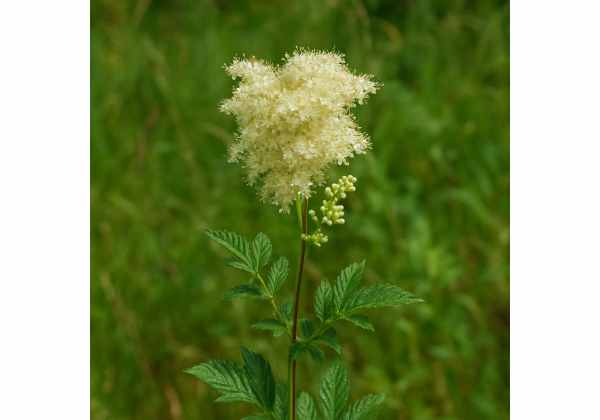
Queen of the Meadow is the medicinal flowering herb or flower of Filipendula ulmaria, a moisture-loving plant in the rose family that thrives in wet meadows, stream edges, marshy ground, and damp pastures. It is easy to recognize when in bloom: tall stems, divided leaves, and airy clusters of creamy flowers with a sweet, almond-like scent. In herbal use, the flowering tops and flowers are the main medicinal parts, while the root is far less commonly used in modern practice.
The herb has a long record in traditional European medicine, where it was valued for fever, rheumatic pain, digestive acidity, diarrhea, and urinary irritation. Over time, it also became associated with colds, joint aches, and inflamed mucous membranes. That range sounds broad, but it becomes easier to understand when you view the plant as a cooling, aromatic, mildly astringent herb that fits symptoms involving irritation, heat, looseness, and low-grade inflammatory discomfort.
Its continued relevance comes from the fact that it occupies a useful middle ground. Some herbs are mainly soothing. Others are mainly bitter. Others are mainly analgesic. Queen of the Meadow overlaps all three categories without belonging completely to any one of them. It can tone irritated tissue, gently support mild pain relief, and still feel light enough for tea use. That combination helps explain why the plant has remained popular among herbalists even though it is not backed by large modern clinical trials.
Another reason it still matters is that many people want herbs that feel both practical and gentle. Queen of the Meadow can fill that role when the complaint is modest and clearly defined. It is not a replacement for modern treatment of chronic inflammatory disease, severe reflux, or ongoing pain syndromes. It is better suited to the kinds of short-term problems older herbalists would have recognized immediately: an achy cold, a sour stomach after stress or irritation, or mild joint soreness that does not call for heavy intervention.
It is also a plant that rewards precision. Someone who takes it merely because it sounds pleasant may miss its best effects. Someone who chooses it because they have minor inflammatory discomfort, irritated digestion, or a cold with body aches is more likely to understand why the herb earned such a durable reputation.
In a broader herbal context, Queen of the Meadow often gets compared with meadowsweet’s wider medicinal tradition, and that comparison is helpful because it highlights the same core themes: salicylate-related activity, digestive usefulness, and elegant floral preparations. The essential point is that this herb still matters because it remains relevant to common everyday patterns of discomfort, especially when used with restraint and good judgment.
Key compounds and how Queen of the Meadow may work
The medicinal profile of Queen of the Meadow is more complex than its reputation as a “natural aspirin herb” suggests. Salicylate-related compounds are part of the picture, but not the whole story. The flowers and aerial parts also contain flavonoids, tannins, phenolic acids, and aromatic volatile compounds, all of which likely contribute to how the herb feels and functions in practice.
Among the most discussed constituents are salicylaldehyde and related salicylate precursors, along with flavonoids such as spiraeoside, rutin, hyperoside, and isoquercitrin. Tannins add a tightening, tissue-toning element, while the aromatic fraction contributes to the herb’s pleasant scent and likely some of its traditional role in warm infusions for colds and stomach discomfort.
This chemistry gives the plant several plausible actions:
- mild anti-inflammatory support
- gentle pain-easing effects
- antioxidant activity
- astringent action on irritated mucosa
- aromatic digestive support
- tissue-calming effects when irritation and excess secretions overlap
One important nuance is that the herb does not need to contain large free salicylate levels in tea form to be useful. Some of its benefits may depend on how compounds are transformed during digestion and metabolism, especially flavonoid glycosides that shift into different active forms in the body. This helps explain why a cup of the tea may feel helpful even when it does not resemble a pharmaceutical salicylate in any direct way.
The tannin component matters too. It gives the herb a slight dryness and a stronger grip on irritated tissue than many people expect from a floral remedy. That may be one reason it has been used historically for both gastric irritation and loose stools. Astringent herbs often reduce excessive secretion and help tone overreactive mucosa, which fits part of Queen of the Meadow’s traditional identity.
Its aromatic fraction also deserves more credit than it usually gets. The fragrance is not just pleasant. It helps define the sensory experience of the tea and may play a role in the plant’s historical use during colds and unsettled digestion. Herbal actions are not always reducible to one pathway, and Queen of the Meadow is a good example of that. It likely works through several overlapping mechanisms rather than one dominant effect.
A helpful comparison is willow bark as a more direct salicylate-centered pain herb. Willow is often thought of more clearly as an analgesic bark remedy. Queen of the Meadow shares some of that territory, but it also brings floral aromatics, mucosal action, and a gentler tea profile. That makes it more rounded, but also more dependent on matching the right preparation to the right complaint.
The best way to describe the herb’s chemistry is this: Queen of the Meadow is a polyphenol-rich, salicylate-related, aromatic and mildly astringent plant whose effects likely come from the combined action of multiple compounds rather than from one isolated constituent. That combined profile is what gives the herb its distinctive place in traditional medicine.
Queen of the Meadow for digestion, heartburn, and gastric comfort
One of the most enduring traditional uses of Queen of the Meadow is digestive support. It has long been used for sour stomach, heartburn-prone dyspepsia, mild gastric irritation, and digestive discomfort linked with inflammation rather than stagnation alone. This makes it different from a classic warming bitter or a simple soothing demulcent. It occupies a narrower but highly useful space between those categories.
The herb appears best suited to digestive patterns that involve some combination of these features:
- mild acidity
- upper-stomach irritation
- post-meal heaviness with inflammation
- sensitive mucosa
- loose, irritated digestion rather than dry constipation
This is where the plant’s mixed chemistry becomes especially relevant. The tannins may help tone and calm overactive, irritated tissue. The flavonoids and phenolic compounds may support inflammatory balance. The aromatic quality may make the tea more pleasant and easier to tolerate than harsher bitter herbs. Together, that gives the herb a reputation for settling “hot” digestive states without feeling overly aggressive.
It is important, however, to keep expectations realistic. Queen of the Meadow is not a proven treatment for peptic ulcers, bleeding gastritis, severe reflux, or chronic digestive disease. Traditional herbal use suggests it can be helpful in mild cases, especially when the complaint is short-term and clearly functional rather than structural. In that context, a properly prepared tea may feel supportive and calming.
Another reason the herb remains relevant here is that its digestive personality is not identical to that of stronger salicylate-rich plants. Many people assume that anything in this family of action must irritate the stomach. Queen of the Meadow often behaves differently in practice, especially as an infusion. It may feel gentler than expected, though that does not guarantee it will suit everyone.
For some people, it works best when sipped slowly rather than taken quickly. That slower pace fits both the herb and the complaint. Digestive herbs often work better when the body has time to respond to them as a whole experience rather than a quick dose. A warm floral infusion can calm the stomach, encourage a sense of ease, and reduce the perception of irritation in a way that is not fully captured by lists of active compounds.
This is one reason it can be conceptually paired with marshmallow for irritated digestive tissues. Marshmallow is more coating and demulcent. Queen of the Meadow is more aromatic and astringent. They do not replace each other, but they can help readers understand what kind of stomach pattern each herb fits.
The most honest summary is that Queen of the Meadow may help some types of irritated digestion, especially when acidity, sensitivity, and low-grade inflammation are involved. It is less appropriate when pain is severe, when bleeding is present, or when reflux is persistent enough to require proper diagnosis. In well-matched situations, though, it remains one of the more refined and thoughtful digestive herbs in traditional practice.
Queen of the Meadow for minor pain, colds, and inflammatory discomfort
Queen of the Meadow is also widely valued for minor articular pain, cold-related aching, and low-grade inflammatory discomfort. This is probably the most recognizable modern use of the herb, especially among readers who come to it expecting an alternative to salicylate-rich bark remedies.
In this role, the herb makes the most sense for:
- mild joint soreness
- weather-sensitive aches
- post-exertional discomfort
- early cold symptoms with body aches
- inflammatory discomfort that feels nagging rather than severe
The keyword here is minor. This is not an herb for intense pain, acute injury, or chronic inflammatory disease that needs medical management. It is most convincing when symptoms are modest and short-term. A warm tea or a measured tincture can offer a softer kind of support than a strong painkiller, and for some people that is exactly the point.
Its role in common-cold support follows the same logic. Traditional herbal systems often used Queen of the Meadow when a cold brought heaviness, a low feverish feeling, aching limbs, and a general sense of inflammation. The herb is not primarily a strong antimicrobial, and it is not the most intensely warming cold remedy. It is better understood as a cooling, aromatic support for the achy and irritated phase of a cold.
That makes it especially appealing in formulas or teas where the goal is comfort rather than brute force. It may be combined conceptually with elderflower in classic cold-support tea logic, where aromatic flowers help make the blend soothing, easy to drink, and appropriate for repeated short-term use.
Its pain-supportive use may also be broader than simple salicylate activity. The flavonoids and tannins likely contribute, and some of the herb’s effect may depend on how its compounds are metabolized after ingestion. That may help explain why Queen of the Meadow sometimes feels gentler, slower, and more diffuse than a person expects if they only know its reputation through aspirin comparisons.
Another helpful point is that not every person seeking pain support needs the strongest herb available. Some people are looking for something lighter: a tea for a day of stiffness, a gentle support during a cold, or a way to take the edge off minor inflammatory discomfort. Queen of the Meadow fits that niche well.
It is also a good reminder that traditional pain support is not always about numbing or suppressing sensation completely. Some herbs work by softening the inflammatory tone of a complaint rather than overpowering it. This plant often belongs to that category.
Used thoughtfully, Queen of the Meadow can be a practical herb for short-lived pain and cold-season aches. Used with unrealistic expectations, it can feel underwhelming. The difference usually lies in whether the person understands its lane. It is a refined support herb, not a heavy analgesic, and it tends to perform best when respected on those terms.
How to prepare and use flowers, herb, teas, and tinctures
Preparation matters a great deal with Queen of the Meadow. This is one of those herbs where the form shapes the experience almost as much as the plant itself. Flowers and flowering tops are both used, but they do not always behave identically. For most everyday purposes, the simplest and most traditional form remains the infusion.
Tea is especially well suited to this herb because it captures the floral, aromatic, and mildly astringent aspects that define much of its traditional value. A warm infusion can be sipped for irritated digestion, used more freely during an achy cold, or taken as a measured short-term support for mild inflammatory discomfort. This is not a case where tea feels weak compared with the “real” preparation. For many users, tea is the most authentic and useful form.
Common preparation types include:
- dried flowers for infusion
- dried flowering herb for infusion
- tincture of the flowering herb
- powders or capsules
- combination formulas for cold or digestive support
The best form depends on the reason for use. For digestion, tea is usually the clearest choice. For portability or short courses of joint discomfort, tincture may be more convenient. Powders and capsules are less expressive of the herb’s sensory qualities and may not be the ideal way to discover whether the plant suits you.
A few practical rules improve the odds of success:
- Use high-quality, fragrant dried herb or flowers.
- Cover the cup while steeping so the aromatic fraction is preserved.
- Avoid making the infusion excessively strong on the first try.
- Use fresh preparations rather than storing tea for extended periods.
- Match the form to the complaint instead of assuming every product is interchangeable.
This is also an herb that tends to reward moderation. A tea that is too weak may feel pretty but ineffective. A tea that is too strong can feel overly tannic, drying, or rough on a sensitive stomach. The aim is balance: enough body and aroma to matter, without turning the preparation into a harsh medicinal brew.
Because the herb is often associated with both pain and digestion, some readers are tempted to treat it as an all-purpose daily tonic. That is not its best use. Queen of the Meadow usually makes more sense as a targeted short-course herb rather than a permanent daily habit.
For some formulas, it can complement chamomile in gentle digestive or comfort-focused teas. Both herbs work well in infusion and can support irritated digestion, though Queen of the Meadow is more astringent and more closely tied to salicylate-related traditions.
Wild harvesting also deserves caution. The plant often grows in wet places, and those places may be polluted or agriculturally contaminated. Medicinal use requires a clean source, not simply a correct identification. A beautiful wild stand is not automatically a safe harvest site.
At its best, Queen of the Meadow is used simply: flowers or herb as tea, tincture when convenience matters, and short-term use for well-matched symptoms. That simplicity is part of its strength.
Dosage, timing, and practical best practices
Dosage for Queen of the Meadow is more clearly described in traditional European use than it is for many lesser-known herbs, but it still needs to be treated as traditional guidance rather than modern clinical proof. The plant has usable adult ranges, yet it remains wise to begin near the lower or middle end rather than taking the maximum amount immediately.
A practical adult framework commonly used in traditional herbal preparations includes:
- flowers as tea in the range of about 2.5 to 6 g daily
- flowering herb as tea in the range of about 2 to 18 g daily depending on how the dose is divided
- tincture of the herb often around 2 to 4 mL per dose, up to several times daily
These ranges are broad because products and preparations differ. That is why good practice matters more than a single large number.
A sensible dosing method is:
- Start with one moderate cup of tea or a lower-end tincture dose.
- Use it for a specific complaint rather than vague daily wellness.
- Reassess after one to three days in acute use.
- Keep the duration limited unless guided by a clinician.
- Stop if it causes irritation or clearly does not fit the condition.
Timing should reflect the goal. For gastric discomfort or heartburn-prone dyspepsia, tea may work best between meals or after meals. For minor articular pain, tea or tincture can be spaced through the day. For colds, it often makes sense as a repeated warm infusion during waking hours.
Duration matters as much as dose. Queen of the Meadow is not best understood as a perpetual daily tea. It is usually more appropriate for short courses tied to a clear need. A few days during a cold or a limited trial for mild digestive irritation fits the herb well. Long, indefinite use is harder to justify, especially when symptoms are chronic enough to deserve diagnosis.
Common mistakes include:
- taking it simply because it sounds gentle without matching it to a symptom pattern
- assuming more tea will create stronger pain relief
- stacking tincture, tea, and capsules all at once
- using it for severe symptoms that need medical care
- ignoring salicylate sensitivity because the herb comes as a tea
A useful contrast is ginger for more warming digestive and anti-nausea support. Ginger is heating, moving, and pungent. Queen of the Meadow is cooler, more floral, more astringent, and better suited to irritated inflammatory patterns than to cold sluggish digestion. Thinking in those contrasts helps prevent poor herb matching.
The most practical dosage advice is this: use the smallest amount that clearly helps, let the preparation fit the complaint, and remember that Queen of the Meadow is a short-course support herb rather than a long-term dependence herb. That mindset usually leads to better results than chasing the top end of a traditional range.
Safety, side effects, interactions, and who should avoid it
Queen of the Meadow is often well tolerated by healthy adults when used appropriately, but it is not suitable for everyone. The central safety issue is salicylate sensitivity. Anyone who reacts to aspirin or salicylate-containing products should avoid self-treatment with this herb. That is the clearest and most important exclusion.
Other groups who should avoid it without professional guidance include:
- people who are pregnant
- people who are breastfeeding
- children and adolescents under 18
- those with active ulcer bleeding or severe unexplained stomach pain
- people on complicated anticoagulant or antiplatelet regimens
- anyone relying on the herb instead of evaluation for chronic pain or persistent reflux
One reason safety can seem confusing is that Queen of the Meadow is milder in tea form than many people assume. It is not simply “herbal aspirin.” Still, milder does not mean irrelevant. The herb belongs in the salicylate-related category, and that means sensitivity, overlap with other products, and individual tolerance all matter.
Possible side effects are likely to be mild when they occur, but they may include:
- stomach irritation from overly strong preparations
- nausea
- a feeling of dryness or tannic heaviness
- poor symptom fit rather than true toxicity
- possible allergy-type reactions in sensitive individuals
Another important point is that absence of dramatic side effects does not equal proof of safety for long-term daily use. Traditional herbs often have acceptable short-term tolerability but little meaningful data for extended or repeated use over months. Queen of the Meadow is one of those herbs. It is best thought of as a symptom-matched short-course remedy.
This is also a herb where the condition being treated affects safety. A cup of tea for mild heartburn after irritation is one thing. Using it to ignore recurrent severe reflux, black stools, high fever, or long-standing inflammatory joint disease is something else. In those situations, the real problem is not the herb itself but delay in proper evaluation.
For some readers, it helps to compare the safety logic with white willow and similar salicylate-rich pain herbs. The overlap is real, but Queen of the Meadow often feels softer and more multi-purpose. Even so, caution remains appropriate in aspirin-sensitive individuals and in anyone who cannot safely experiment with salicylate-related plants.
The fairest conclusion is that Queen of the Meadow is reasonably appropriate for many healthy adults when used briefly and correctly, but it still deserves respect. It is not a casual floral tea for everyone, and it should not be used as a workaround for symptoms that need medical attention. Clear matching, modest dosing, and awareness of salicylate sensitivity are what make this herb both useful and responsible.
References
- Assessment report on Filipendula ulmaria (L.) Maxim., herba and Filipendula ulmaria (L.) Maxim., flos 2011 (Official Assessment Report)
- In Vitro Biotransformation and Anti-Inflammatory Activity of Constituents and Metabolites of Filipendula ulmaria 2023
- Variation in Phenolic Compounds, Antioxidant and Antibacterial Activities of Extracts from Different Plant Organs of Meadowsweet (Filipendula ulmaria (L.) Maxim.) 2023
- Insight into the Way the Content of Biologically Active Compounds in Meadowsweet Inflorescences (Filipendula ulmaria (L.) Maxim.) Is Shaped by Phytosociological Habitats 2021
- Antioxidant, anti-inflammatory and gastroprotective activity of Filipendula ulmaria (L.) Maxim. and Filipendula vulgaris Moench 2018
Disclaimer
This article is for educational purposes only and does not replace medical advice, diagnosis, or treatment. Queen of the Meadow is a traditional herbal medicine, not a proven substitute for standard care in chronic arthritis, significant reflux disease, peptic ulcer complications, persistent fever, or severe pain. Seek qualified medical advice if symptoms are strong, recurrent, worsening, or accompanied by bleeding, dehydration, breathing difficulty, or signs of allergy.
If you found this article helpful, please share it on Facebook, X, or another platform you prefer.