Red trillium, botanically known as Trillium erectum, is one of the most recognizable spring woodland flowers in eastern North America, but it also has a long herbal history under names such as beth root, birthroot, and wake-robin. Traditional medicine focused mainly on the rhizome and root, which were valued as strongly astringent, tissue-tightening remedies for excessive bleeding, menstrual complaints, sore mouths and throats, and topical applications on irritated skin. In older North American herbal systems, red trillium was especially known as a woman’s herb and as a remedy for passive hemorrhage.
That heritage gives the plant a serious medicinal reputation, but modern evidence is much thinner than the folklore. Researchers have identified steroidal saponins and glycosides in the root, which helps explain why the herb attracted medical interest, yet human clinical studies are still very limited. For that reason, red trillium is best approached as a traditional herb with plausible active chemistry, highly specific historical uses, and important safety and sustainability concerns. It is not a casual self-care plant, and it deserves careful, respectful handling.
Key Facts
- Red trillium is traditionally valued for astringent support in excessive menstrual or postpartum bleeding and for irritated mucous tissues.
- Its root contains steroidal saponins and glycosides that give the plant genuine pharmacological interest.
- A traditional strong infusion range is about 60 to 120 mL per dose.
- Pregnant or breastfeeding people and anyone with unexplained bleeding should avoid unsupervised use.
Table of Contents
- What Red Trillium Is and Why It Has Been Used
- Key Ingredients and What the Root Contains
- Red Trillium Health Benefits and What the Evidence Really Shows
- Medicinal Properties and Traditional Herbal Uses
- How Red Trillium Is Used in Herbal Preparations
- Dosage, Timing, and Practical Use Guidelines
- Safety, Side Effects, and Who Should Avoid It
What Red Trillium Is and Why It Has Been Used
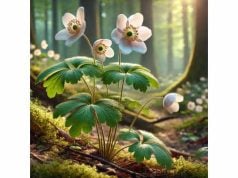
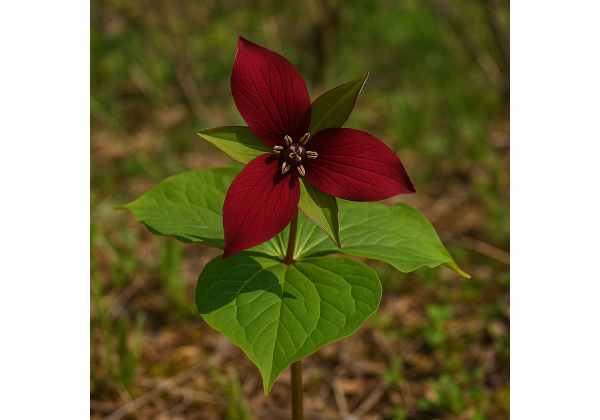
Red trillium is a perennial woodland herb native to eastern North America. It grows from a rhizome, sends up a single stem-like scape each spring, and bears the classic trillium pattern of three leaf-like bracts and one nodding flower. The flower is often deep red to maroon, though lighter shades occur. Because the blossoms can have a carrion-like scent, the plant is also sometimes called stinking Benjamin. That smell attracts flies, which help pollinate it in its forest habitat.
Medicinally, the most important part has traditionally been the underground rhizome and root. The leaves and whole plant also appear in older folk use, but when historical texts refer to beth root or birthroot, they usually mean the root of Trillium erectum or closely related species. This is important because the plant’s medicinal action is generally described as much stronger and more astringent than the gentle appearance of the flower would suggest.
Older North American herbal practice gave red trillium a narrow but serious role. It was used when tissues were lax, bleeding was persistent, or secretions were excessive. In women’s health especially, it was considered a uterine tonic and an astringent for heavy menstrual bleeding, postpartum bleeding, and certain discharges. It was also given for coughs, bleeding from the lungs or urinary tract in older materia medica, and externally for ulcers, insect bites, and inflamed tissues. These uses grew out of observation and long tradition, not modern clinical testing.
That distinction matters. Red trillium is not a common kitchen herb, not a general tonic, and not something most people should harvest casually. It belongs to the category of older practitioner herbs that were once respected enough to appear in dispensatories, but that have not been followed by much contemporary human research. This means the historical record is richer than the clinical record.
The plant also raises ethical questions that many herbal articles ignore. Because the medicinal part is the rhizome, harvesting the herb usually kills the plant. Woodland trilliums are not fast, weedy species that bounce back quickly. Even when a species is not globally rare, careless digging can damage local populations and reduce spring forest diversity.
A useful way to think about red trillium is this:
- it is historically important
- it is chemically active
- it is narrowly traditional rather than broadly proven
- it should be sourced with care
Readers interested in other classic North American woodland medicinals may also find traditional woodland root herbs helpful for context, since they raise some of the same questions about potency, proof, and sustainability.
Key Ingredients and What the Root Contains
Red trillium’s medicinal reputation rests mainly on the chemistry of the rhizome and root. While historical herbalists described the plant in terms of taste and action, modern phytochemical studies have shown that the root contains steroidal saponins and steroidal glycosides, along with related constituents that likely contribute to its traditional astringent and uterine reputation. This does not mean every traditional claim is proven, but it does show that the herb contains more than vague “plant energy.”
The most important chemical group in red trillium is its steroidal saponins. These compounds are common in a number of medicinal roots and are often biologically active. In species of Trillium, researchers have isolated multiple steroidal constituents from underground parts, and species-specific work on Trillium erectum has confirmed that the plant contains distinct steroidal saponins and glycosides. Historically, older texts also referred to an acrid principle called trilline or trillin, thought to be related to saponin-like activity.
These constituents matter because they help explain several older observations:
- the root tastes acrid and strongly astringent
- it seems to affect mucous membranes and secretions
- it developed a reputation for uterine and hemostatic support
- it was considered medicinally active in relatively small amounts
In addition to saponins and glycosides, historical descriptions mention tannin, starch, fixed oil, and other supporting plant compounds. Tannins are especially relevant because they help account for the herb’s traditional astringency. When an herb is described as tightening tissues, checking excessive discharge, or helping passive bleeding, tannin-rich or tannin-like effects often play a role. Red trillium’s combination of saponin activity and astringent character is part of what made it distinctive in older herbal practice.
It is also worth understanding what the chemistry does not prove. Laboratory identification of compounds does not automatically confirm effectiveness for menstrual bleeding, childbirth, cough, or ulcers in modern clinical settings. Phytochemistry gives plausibility, not guaranteed outcomes. Many herbs with strong traditional reputations have active molecules but still lack the sort of human evidence needed to support precise medical claims.
So the most honest way to describe red trillium’s ingredients is this:
- The root is chemically active.
- Steroidal saponins and glycosides are central to its identity.
- Astringent compounds likely contribute to tissue-tightening effects.
- The chemistry supports historical interest, but not automatic proof.
This is why red trillium should not be framed as a casual wellness herb. Its ingredients point toward real activity, which is exactly why dosage and safety matter.
For readers who want a comparison with another classic astringent herb used more often on the skin and mucous tissues, witch hazel and its astringent profile offer a useful contrast.
Red Trillium Health Benefits and What the Evidence Really Shows
The likely health benefits of red trillium are easiest to understand when tradition and evidence are kept separate. Traditional herbals describe the plant as an astringent, uterine tonic, expectorant, and supportive remedy for various kinds of bleeding. Modern science, however, does not yet give strong human confirmation for most of these uses. The result is a familiar herbal pattern: strong historical confidence, plausible chemistry, and limited contemporary proof.
The benefit with the strongest traditional support is control of passive or excessive bleeding. In older North American practice, red trillium was used for heavy menstrual bleeding, postpartum bleeding, and other non-traumatic hemorrhagic states. This reputation is so strong that names like birthroot and beth root became part of the plant’s identity. Still, it is important to be precise: this is a historical and practitioner-based use, not a clinically validated recommendation for modern emergencies or complex gynecologic conditions.
A second likely benefit is tissue tightening in relaxed or overly secretory states. This helps explain why the herb was also used for leucorrhea, chronic mucus discharge, and certain throat or respiratory complaints. Astringent herbs often become relevant when tissues seem boggy, lax, or weepy rather than dry and sharply inflamed. Red trillium appears to have belonged in that category.
A third possible area is topical support. Folk use includes poultices or local applications for ulcers, stings, irritated skin, and inflamed tissues. That does not prove that red trillium is a modern wound-healing standard, but it does fit the herb’s astringent and toning profile.
A fourth possible benefit is respiratory support, especially where older practitioners saw cough with weakness, irritation, or bleeding tendency. Again, this belongs more to the herbal record than to modern evidence.
A realistic summary of evidence looks like this:
- traditional use strongly supports red trillium as an astringent herb
- phytochemistry supports the idea that the root is active
- species-specific laboratory studies confirm relevant compounds
- modern human trials are largely absent
- any strong disease-treatment claims go beyond the evidence
This matters because internet articles often overstate old herbs in one of two ways. Some flatten them into vague “anti-inflammatory” or “immune” plants. Others present nineteenth-century uses as if they were confirmed by current medicine. Red trillium deserves better than both extremes. It is not a useless relic, but it is also not a scientifically settled remedy for uterine bleeding, labor support, or lung hemorrhage.
The most practical conclusion is that red trillium may still have a place in informed traditional herbalism, especially where astringency is desired, but it is not the herb to choose when a reader wants a well-studied, evidence-rich treatment. When menstrual support is the broader goal rather than a highly specialized astringent herb, yarrow and related menstrual herbs often provide an easier comparison point.
Medicinal Properties and Traditional Herbal Uses
Red trillium’s traditional medicinal identity is unusually focused. In classical herbal terms, it was not mainly valued as a nutritive, calming, or aromatic herb. It was valued for what it did to tissues. Historical descriptions repeatedly emphasize astringency, uterine support, and usefulness in excessive discharge or bleeding. That makes it a herb of tone and restraint rather than expansion or stimulation.
Among Indigenous and early North American uses, the plant’s role in women’s health stands out most clearly. Root tea and root preparations were used for menstrual problems, to aid labor, and in relation to childbirth. Later Eclectic and American herbal texts expanded that use into menorrhagia, metrorrhagia, leucorrhea, and postpartum bleeding. The plant’s very common names reflect this medical reputation. Birthroot became beth root, and both names point toward obstetric and gynecologic use.
The herb was also used for respiratory and mucous membrane complaints. Older texts list cough, asthma-like difficulty breathing, bronchial weakness, and mucous discharges among the indications. This makes sense if one remembers that many astringent herbs were used when tissues were overly relaxed and secretions excessive. Red trillium was not a soft demulcent like slippery elm. It was chosen when the herbal goal was to tighten, tone, and restrain.
Traditional external uses are just as interesting. Preparations of the root, and sometimes the whole plant or leaves in old folk practice, were applied to ulcers, tumors, insect bites, inflamed tissues, and sore skin. While these uses are historically documented, they belong to a different medical era and should not be treated as substitutes for modern wound care or diagnosis.
The classic medicinal properties attributed to red trillium include:
- astringent
- tonic
- antiseptic in older terminology
- expectorant
- uterine tonic
- topical vulnerary-style support in traditional use
One of the reasons red trillium lasted in herbal memory is that it was considered specific. In traditional medicine, a specific herb is one chosen for a recognizable pattern rather than for vague wellness support. Red trillium was often selected when there was passive bleeding, lax tissue tone, or troublesome discharges. That kind of specificity makes an herb memorable, but it can also encourage overconfidence when the surrounding clinical system is gone.
A balanced interpretation today is to respect the old use without copying it uncritically. The plant clearly belonged to the women’s health and astringent materia medica of North America. It also had enough activity to remain in dispensatories. But old texts do not replace modern assessment, especially where pregnancy, childbirth, or serious bleeding are involved.
For readers comparing traditional women’s herbs with different levels of evidence and safety complexity, black cohosh and its reproductive-health tradition provide a useful contrast.
How Red Trillium Is Used in Herbal Preparations
Red trillium is traditionally used as a root medicine, not primarily as a flower or leaf herb. This alone changes the way it should be approached. Roots are often stronger, denser, and more astringent than aerial parts, and they usually require different preparation methods. In older practice, the root was made into strong infusion, decoction-style preparations, tinctures, and topical applications such as poultices or washes.
The strongest traditional form appears to have been infusion or strong tincture rather than casual tea. This is an important distinction because red trillium is sometimes confused with gentle meadow herbs simply because it is beautiful. In reality, it belongs with roots that were taken in measured medicinal doses. Historical texts describe a strong infusion as one of the most common forms of administration, which fits the herb’s long use in bleeding and tissue-toning contexts.
Tincture is another logical preparation because it concentrates the active root constituents and makes small doses possible. This is especially useful for herbs that are strong, drying, or historically used in precise ways. A tincture can also be incorporated into formulas more easily than a bulky decoction.
Traditional ways red trillium has been used include:
- Strong infusion for internal astringent support
- Tincture for smaller, more concentrated dosing
- Poultice or local application in older external practice
- Combined formulas for women’s health or mucous tissue support
This last point matters. Red trillium was not always used alone. In skilled practice, strongly astringent herbs are often blended with soothing, demulcent, or balancing herbs to prevent over-drying. An overly tight, drying formula can be as unhelpful as one that is too weak. This is one reason experienced herbalists often think in patterns rather than single-herb slogans.
The herb is also unusual because of sustainability. Since the medicinal part is the rhizome or root, harvesting often destroys the plant. That means responsible use depends heavily on cultivated or ethically sourced material rather than impulsive wild collection. This is not just an ecological footnote. It directly affects whether the herb can be recommended with integrity.
A modern reader should therefore think of red trillium as a narrow, historically specific root medicine. It is not an everyday grocery-store herb. It is not something to forage because it looks medicinal. And it is not an herb that becomes safer simply because it is taken as tea instead of tincture.
If the goal is soothing irritation rather than tightening tissues, a gentler mucosal herb such as slippery and soothing throat herbs may make more sense than red trillium’s sharper astringent profile.
Dosage, Timing, and Practical Use Guidelines
Red trillium dosage is one of the clearest examples of how historical and modern herbal practice differ. There is no well-established modern clinical dose based on randomized trials. What exists instead is historical dosage from Eclectic and older American dispensatory literature. That kind of information is still useful, but it should be presented as traditional guidance rather than modern medical consensus.
Historically, the most common internal range was:
- strong infusion: about 2 to 4 fluid ounces per dose, or roughly 60 to 120 mL
- strong tincture of the fresh root: about 1 to 20 drops
- powdered root: about 1 drachm in older literature
These figures sound precise, but they come from older medical practice, not from current clinical trials. That means they should be interpreted cautiously. A modern reader should not assume that a nineteenth-century dose is automatically appropriate today, especially for pregnancy-related, bleeding-related, or chronic conditions.
Timing depends on the intended use. In historical practice, red trillium was used when astringency or tissue support was needed rather than as a daily tonic. That suggests short-term or situational use was more typical than long-term continuous use. For example, in formulas directed toward excessive menstrual bleeding, the herb would generally be used around the symptomatic window rather than indefinitely. Likewise, throat or mucous uses tended to be tied to active need.
A practical modern interpretation would be:
- Red trillium is best treated as a short-term, purpose-driven herb.
- Small doses are more appropriate than aggressive self-experimentation.
- Modern unsupervised use should be more conservative than older texts imply.
- Pregnancy, postpartum, and bleeding situations require professional judgment.
Another important guideline is sourcing. Since the rhizome is the medicinal part, dose is not the only practical question. Ethical sourcing matters just as much. If the plant has been dug from the wild without conservation awareness, the cost is more than personal. It is ecological. Many woodland herbs reproduce slowly and are easily damaged by root collection.
One more caution belongs here: dosage should not be separated from fit. Red trillium is not a broad “health herb.” It is a specific, drying, astringent plant. People who already have dry constitutions, constipation, pronounced tissue irritation, or uncertain diagnosis may do poorly with it even at modest doses.
So the best dosage advice is measured and conditional. Historical ranges exist, but modern use should be restrained, specific, and preferably supervised when the intended target is bleeding, labor, or gynecologic symptoms. If someone needs a gentler digestive or mucosal herb without this level of obstetric tradition and risk, marshmallow and other demulcent herbs often fit much more comfortably.
Safety, Side Effects, and Who Should Avoid It
Safety is the most important part of any modern red trillium article because the plant’s strongest traditional uses involve pregnancy, childbirth, and bleeding. Those are not areas where self-prescribing should be casual. Even if an herb has a long history, that does not make it appropriate for unsupervised use in situations that may become urgent or complicated.
The first and clearest caution is pregnancy. Red trillium’s traditional reputation as a childbirth herb is precisely why pregnancy is a major warning category. Historical use includes menstrual and labor-related applications, which means the plant may influence uterine activity in ways that make unsupervised use inappropriate. Pregnant people should not use red trillium except under qualified professional supervision.
The second major caution is unexplained bleeding. Although the herb is traditionally associated with controlling passive bleeding, a person with heavy menstrual bleeding, postpartum bleeding, blood in urine, coughing blood, or persistent spotting needs medical evaluation, not just herbal experimentation. Astringent tradition is not a substitute for diagnosis.
A third concern is irritation and overdose. Historical descriptions emphasize the root’s acrid, astringent nature. In practical terms, that suggests the herb may cause stomach upset, throat irritation, or excessive drying if used inappropriately or too strongly. Sensitive skin may also react badly to local applications.
People who should generally avoid unsupervised use include:
- pregnant or breastfeeding people
- children
- anyone with unexplained uterine, urinary, or respiratory bleeding
- people with severe gastrointestinal sensitivity
- those using the herb in place of medical care after childbirth
- anyone harvesting wild plants without certain identification and ethical sourcing
It is also wise to remember that red trillium is not a standardized modern supplement. Different preparations may vary, and older herb names such as beth root sometimes blur species boundaries. That increases the need for caution in buying, dosing, and identifying the material.
One more safety issue is ecological rather than personal. Harvesting the rhizome usually kills the plant. Even when a population is not formally endangered, local overharvesting can damage slow woodland communities. Ethical use therefore includes asking whether the herb truly needs to be chosen at all. In many cases, a more sustainable and better-studied herb may be more appropriate.
The safest modern conclusion is straightforward: red trillium belongs to experienced herbal tradition, not casual experimentation. It has a real medicinal history and real phytochemistry, but also real reasons for restraint.
References
- Red Trillium (Trillium erectum L.) | US Forest Service 2023
- Bioactive Steroids and Saponins of the Genus Trillium 2017 (Review)
- Steroidal glycosides from the underground parts of Trillium erectum and their cytotoxic activity 2008
- Steroidal saponins from the roots of Trillium erectum (Beth root) 2009
- Trillium.—Bethroot. | Henriette’s Herbal Homepage 1898 (Historical Materia Medica)
Disclaimer
This article is for educational purposes only and is not a substitute for medical advice, diagnosis, or treatment. Red trillium is a traditional herb with limited modern clinical evidence and significant cautions around pregnancy, childbirth, and unexplained bleeding. Do not use it to self-treat obstetric, gynecologic, urinary, or respiratory bleeding, and do not harvest it from the wild unless you are certain of identification and local conservation ethics.
If this article was useful, please consider sharing it on Facebook, X, or any other platform you prefer.