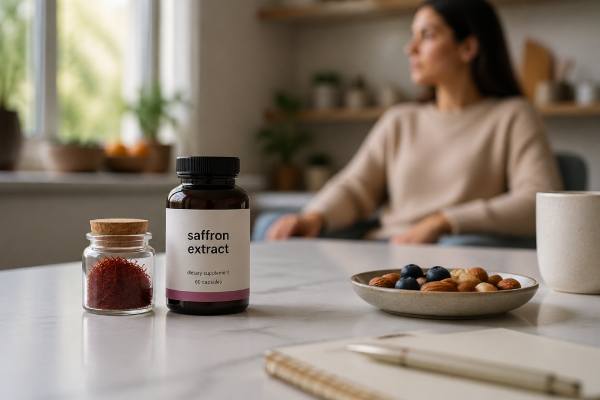
Saffron is one of those supplements that sounds almost too elegant to be taken seriously for weight loss. But the question behind the hype is reasonable: can saffron actually reduce appetite, cut down snacking, and make it easier to stay in a calorie deficit? The most balanced answer is that it may help some people with appetite control and unplanned eating, but the effect is usually modest, the research is still limited, and it is not a substitute for the foundations of weight management.
That matters most for people stuck in a frustrating middle phase: progress has slowed, cravings are louder, and staying consistent feels harder than starting. In that setting, a supplement that slightly improves satiety or reduces snack-driven calories can seem appealing. Here is what saffron may do, what the studies actually show, how to use it more carefully, and where it fits realistically in a plateau or maintenance plan.
Table of Contents
- What saffron may and may not do
- How saffron could affect appetite and snacking
- What the research actually shows
- Where saffron fits during plateaus and maintenance
- Dose forms and how to choose a product
- Side effects, interactions, and who should be cautious
- How to test saffron without misreading your results
What saffron may and may not do
Saffron is better understood as a possible behavior support supplement than as a true fat-loss agent. That distinction matters. People often hear “helps with weight loss” and assume more calories burned, faster metabolism, or dramatic scale changes. That is not what the better saffron studies suggest.
The more plausible benefit is narrower: saffron may help some people feel less pulled toward unplanned eating, especially snack-type eating driven by appetite, low mood, food reward, or the simple habit of reaching for something between meals. If that happens often enough, calorie intake can come down without the person feeling as deprived. Over time, that can support weight loss or make maintenance easier.
That is very different from saying saffron “melts fat,” “boosts metabolism,” or works like a prescription anti-obesity drug. The evidence does not support those claims. In fact, one of the most useful ways to think about saffron is this: it might change the friction of dieting more than the mechanics of fat loss. If it makes it easier to say no to the handful of daily extras that erase a deficit, it can be helpful. If your main issue is low activity, inaccurate tracking, heavy weekend eating, or a calorie target that no longer fits your body size, saffron is unlikely to move the needle much.
This is why supplement marketing around saffron often overshoots the science. A few small or moderately sized trials can be turned into claims that sound much more certain than they are. If you are already wary of exaggerated promises, the same filtering skills used for weight loss claims and red flags apply here too.
Another helpful comparison: saffron is often placed in the same broad conversation as stimulant-free appetite suppressants, but even within that category it should be viewed as a modest option. The upside is that it is not a stimulant and does not carry the same expectations as caffeine-heavy “fat burners.” The downside is that the average effect, when it exists, is usually subtle rather than dramatic.
The right expectation is not “this will make me lose weight.” The right expectation is closer to “this might slightly reduce appetite-driven snacking or improve adherence, and that could help if my real problem is consistency.”
How saffron could affect appetite and snacking
Researchers do not have one fully settled explanation for saffron’s weight-related effects, but the leading ideas are centered on satiety, food reward, and mood-related eating rather than raw energy expenditure.
One proposed pathway is that saffron or its active compounds may influence neurotransmitter systems involved in mood and appetite, especially serotonin-related signaling. That does not mean saffron works like an antidepressant or appetite medication in a clinical sense. It means researchers think some of its small appetite-related effects may be partly behavioral. A person who feels slightly calmer, less reward-seeking, or less driven to snack may eat less without consciously trying much harder.
That mechanism would make sense for a very common real-world pattern: people do not always overeat because they are physiologically hungry. They snack because they are bored, stressed, restless, low on energy, or mentally fatigued. A supplement that slightly lowers that background urge could be useful, even if it does nothing special to resting metabolism.
This is also why saffron may be more relevant for some people than others. It may be more useful when the main issue is:
- frequent unplanned snacking
- afternoon or evening food drift
- low-level cravings that wear down adherence
- emotionally flavored appetite rather than true meal hunger
- maintenance phases where “food noise” starts creeping back in
It may be less useful when the main issue is:
- very large portions at meals
- regular restaurant overeating
- liquid calories
- poor sleep and recovery
- an activity drop that reduced calorie needs
- inaccurate tracking or portion creep
In practice, the best candidate for saffron is often someone who says, “I can eat decent meals, but I keep getting pulled into random snacks.” That is a different problem from, “I never feel full after meals,” or, “My calorie target is too aggressive and I am constantly starving.”
It is also worth separating appetite from emotional eating. A supplement might slightly reduce snack drive, but it usually does not solve the deeper pattern behind emotional eating triggers. The same is true when people describe the constant mental pull of food after dieting; sometimes that is closer to food noise after dieting than to simple hunger.
So saffron’s role, if it has one, is probably supportive rather than transformative. It may make the gap between intention and action a little smaller. That can matter, especially when progress has stalled because several “little bites” per day have started to add up. But it should be viewed as a nudge, not a solution.
What the research actually shows
The saffron research on weight management is interesting, but it is not clean, simple, or strong enough to justify big promises. The studies vary widely in design, population, supplement form, dose, and duration. Many last only 8 to 12 weeks. Some use saffron extract, others use isolated compounds such as crocin, and some study people with obesity plus another health condition rather than the general population.
That makes one point especially important: results from one saffron trial do not automatically translate to every supplement on the shelf.
Even so, a few themes show up repeatedly. Appetite and snacking effects are more convincing than major weight-loss effects. Some studies report reduced snacking frequency, better appetite ratings, or modest improvements in waist circumference or body composition. But body weight and BMI results are far less consistent, and the average effect is small when it appears at all.
| Question | What research suggests | Practical takeaway |
|---|---|---|
| Does saffron reduce snacking? | Some trials suggest it can reduce snack frequency and increase satiety, especially in people prone to unplanned eating. | This is the most plausible benefit, but the evidence base is still small. |
| Does it cause meaningful weight loss on its own? | Usually no major effect. Weight changes, when seen, tend to be modest and inconsistent across studies. | Do not expect a supplement-only result that is visible week to week. |
| Does it help waist circumference or body composition? | Some analyses and trials show small improvements, but not reliably enough to treat as a guaranteed outcome. | Useful to think of as a possible adherence aid, not a body recomposition shortcut. |
| Does mood matter? | Possibly. Some researchers think better mood regulation may partly explain reduced snack drive in some users. | Saffron may fit better for stress-driven or reward-driven eating than for purely physical hunger. |
A few practical interpretations make the evidence easier to use:
- The best-known positive findings often come from small studies, so they can sound more impressive than they are.
- More recent meta-analyses are better at showing the bigger picture, and that bigger picture is mixed rather than dramatic.
- Waist circumference or appetite ratings may improve even when the scale barely changes.
- Specific groups, such as adolescents with obesity or adults with cardiometabolic problems, may respond differently from a general dieting population.
That last point matters for search intent. Someone reading about saffron often wants to know, “Will this help me get unstuck?” The evidence says it might help a little if the reason you are stuck is snack-driven calorie creep, but it is much less likely to help if you are already eating accurately and your plateau is coming from a smaller deficit, a lower body weight, water retention, or reduced daily movement.
In other words, saffron is more promising as a consistency aid than as a direct answer to “I am doing everything right and the scale will not move.” That problem often has better explanations than a missing supplement.
Where saffron fits during plateaus and maintenance
This is where saffron becomes more practically interesting. In early weight loss, large calorie cuts or obvious changes in food quality can create clear progress. Later on, the problem is often smaller and more stubborn: grazing returns, weekends get looser, appetite feels louder, and the deficit disappears without any one huge mistake. That is the environment where a modest appetite-control supplement could, in theory, help.
The key is using saffron for the right job.
It may make sense when:
- your main issue is habitual snacking, not major overeating at meals
- you notice more urges to pick after dinner than true hunger
- you are in maintenance and want help keeping “extra” calories from creeping back in
- you are transitioning out of a stricter diet and want support while keeping structure
- appetite feels louder, but you do not want a stimulant-based product
It makes much less sense when:
- you are still eating highly calorie-dense foods in large portions
- you are not tracking anything and have no idea where the extra calories are coming from
- your plateau is likely due to lower energy expenditure after weight loss
- you are sleeping poorly, drinking heavily, or moving less than before
- you are hoping a supplement will compensate for inconsistent habits
One honest way to frame saffron is that it may help with the sort of plateau caused by “small leaks.” Think of the daily handful of nuts, extra dessert bites, afternoon vending machine habit, or nightly snack drift that seems minor but slowly closes the gap between maintenance and deficit. That is very different from a true physiological plateau.
This is why saffron pairs better with a behavior plan than with wishful thinking. If evening eating is the issue, combine it with a more deliberate strategy for late-night snacking and plateaus. If appetite has simply become harder to manage after weight loss, it belongs inside a broader approach to long-term hunger management after weight loss.
A useful insight here is that many people do not need less food in general. They need fewer unplanned calories. That is why a supplement that slightly lowers random snacking can look surprisingly effective in the right person, even if it would do almost nothing for someone whose meals are already oversized or whose weekends routinely erase the week.
For maintenance, the bar is lower. You do not need a supplement to produce visible fat loss to be worthwhile. If it helps you keep your average intake more stable, it may be useful. But it still has to earn its place. A supplement that costs a lot, works only a little, and does not survive real-life stress or travel is not a durable solution.
Dose forms and how to choose a product
One of the biggest problems with saffron supplements is that “saffron” can mean several different things on a label. Some products use whole saffron powder, some use a standardized extract, and some focus on one constituent such as crocin. Those are not interchangeable from a research standpoint, even if they are marketed as if they are.
That is one reason the evidence feels messy. When people say “saffron works” or “saffron does nothing,” they may be talking about different compounds, different doses, and different study populations.
In clinical research, common trial lengths are often around 8 to 12 weeks, and daily doses vary. Many commercial products cluster around relatively modest daily extract doses, but the label details matter more than the front-of-bottle promise. A good product should clearly tell you:
- the botanical name, Crocus sativus
- the amount per serving
- whether it is a standardized extract
- the exact ingredients, not just a “proprietary blend”
- whether there is third-party testing or quality verification
This is not a supplement to buy casually from the most dramatic ad. Saffron is an expensive botanical, and high price alone does not prove quality. Look for a straightforward label, realistic claims, and a company that gives enough detail to make the product auditable. The same principles used when learning how to read supplement labels apply here, and independent quality checks matter even more with premium plant extracts. That is where third-party testing becomes useful.
Another practical point: culinary saffron and saffron supplements are not the same thing. Cooking with saffron is fine, but it is not a realistic way to recreate the doses or forms used in most trials. On the other hand, taking more capsules because saffron is “natural” is not smart either.
A simple buying checklist helps:
- Pick one saffron-only product rather than a blend stuffed with unrelated ingredients.
- Avoid products that promise “rapid fat burning” or dramatic metabolism effects.
- Choose a dose that matches the label instructions rather than improvising.
- Keep everything else stable while you test it, so you can tell whether it helps.
- Reassess after a set period instead of rebuying automatically.
The goal is not to find the “strongest” saffron. It is to find whether a well-made, clearly labeled product produces a noticeable benefit in your own eating behavior.
Side effects, interactions, and who should be cautious
Saffron is often presented as gentle and well tolerated, and in many short-term studies that is mostly true. But “usually well tolerated” is not the same as “risk free,” especially once saffron is concentrated into supplement form.
The safest way to think about it is this: culinary use and supplement use are not equivalent. Regular food amounts are one thing. Repeated daily extract doses are another. The short-term research is more reassuring than alarming, but it is still limited, especially for long-term use, for combinations with other supplements, and for people with more complex medical histories.
Possible issues to think about include:
- individual intolerance or digestive discomfort
- headache, dizziness, or a “not quite right” response even if trials report good average tolerance
- unpredictable effects when combined with other mood-related or appetite-focused supplements
- medication interactions in people taking prescription treatments
- a false sense of safety because it is plant-based
Caution is especially sensible if you:
- are pregnant, trying to become pregnant, or breastfeeding
- take antidepressants or other psychiatric medications
- use blood thinners, antiplatelet medication, or have a bleeding disorder
- have bipolar disorder or a history of major mood instability
- already take multiple supplements aimed at mood, hunger, sleep, or energy
- are managing diabetes or other conditions that already affect appetite and weight
In those situations, getting clinician input first is the smarter move. The same applies if you are already using prescription options for weight management. Combining strategies is not automatically wrong, but it should be thoughtful.
This is also a good place to emphasize something many supplement articles skip: a modest benefit is not worth chasing if it creates noise in the rest of your routine. If a product gives you nausea, worsens your appetite rhythm, makes meals feel irregular, or encourages you to rely on capsules instead of structure, it is not helping.
A reasonable rule is to stop early if you feel worse, not to push through because you paid for the bottle. And if appetite feels unusually high, mood changes noticeably, or your weight is changing in a way that does not make sense, it may be more useful to talk to a doctor before changing your plan further rather than layering supplement after supplement.
How to test saffron without misreading your results
The easiest way to fool yourself with saffron is to judge it by day-to-day scale movement. That is the wrong metric for a supplement whose main potential effect is appetite and snack control. If saffron helps, the first changes are more likely to show up in behavior than in body weight.
A better 3-step test looks like this:
- Define the target behavior first.
Pick one measurable pattern you want to change, such as evening snack frequency, number of unplanned eating episodes per week, or how often you feel pulled into sweets after dinner. - Keep the rest of your routine stable.
Do not start saffron at the same time as a new meal plan, a detox, a step challenge, and a six-day gym program. If everything changes at once, you will learn nothing. - Track outcomes that match the claim.
If the promise is less appetite and less snacking, track hunger ratings, snack frequency, and consistency with your meal plan. The scale matters, but it is a lagging indicator.
This is a good place to use lighter-touch tools such as tracking without counting calories if full logging feels excessive. You can also lean on non-scale markers such as appetite stability, fewer “I blew it” eating episodes, and calmer evenings. Over a few weeks, some of those changes may show up as better scale trends, but the real test is whether eating feels easier and more consistent.
It also helps to use the right comparison window. Give it enough time to show a pattern, not just a reaction. Appetite-related supplements are not judged well after three days. But they also should not get infinite grace. If you have taken a well-chosen saffron product for several weeks and you do not notice any clear reduction in snack drive, cravings, or adherence problems, that is useful information. You probably do not respond strongly enough for it to matter.
The most honest success standard is not “Did I lose five pounds because of saffron?” It is “Did this make it easier to follow the plan I already know works?” If the answer is no, move on. If the answer is yes, and the benefit is large enough to justify the cost and effort, it may deserve a place in your routine.
Just keep perspective. Many people will get a bigger return from consistent meals, higher-protein snacks, better sleep, and less friction in the home food environment than from any supplement. Saffron may help at the margins. The margins matter, but they are still the margins.
References
- Satiereal, a Crocus sativus L extract, reduces snacking and increases satiety in a randomized placebo-controlled study of mildly overweight, healthy women 2010 (RCT)
- A placebo controlled randomized clinical trial of Crocus sativus L. (saffron) on depression and food craving among overweight women with mild to moderate depression 2020 (RCT)
- The effects of saffron supplementation on cardiovascular risk factors in adults: A systematic review and dose-response meta-analysis 2022 (Systematic Review and Meta-Analysis)
- The Effect of Saffron Kozanis (Crocus sativus L.) Supplementation on Weight Management, Glycemic Markers and Lipid Profile in Adolescents with Obesity: A Double-Blinded Randomized Placebo-Controlled Trial 2023 (RCT)
- Effects of saffron (Crocus sativus L.) supplementation on cardiometabolic Indices in diabetic and prediabetic overweight patients: a systematic review and meta-analysis of RCTs 2024 (Systematic Review and Meta-Analysis)
Disclaimer
This article is for general educational purposes only and is not a substitute for medical advice, diagnosis, or treatment. Because saffron is a dietary supplement that may interact with medications or be inappropriate in some situations, especially during pregnancy or with complex medical conditions, discuss it with a qualified clinician before using it regularly.
If you found this article useful, please share it on Facebook, X, or any platform where it might help someone else make a more informed decision.