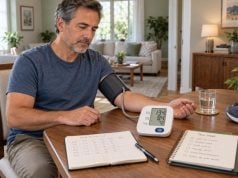
Stress eating can affect heart health when it repeatedly pushes you toward large portions, sugary drinks, salty snack foods, alcohol, or highly processed meals. But the answer is not a stricter diet. Severe restriction often makes the cycle harder by adding hunger, guilt, and “all-or-nothing” thinking to an already stressful situation. A better approach is to reduce the triggers that make overeating more likely, keep meals regular and satisfying, and build a few non-food ways to handle stress.
Research shows that stress can modestly increase overall food intake and shift choices toward less nutritious foods. Emotional-eating interventions—including cognitive-behavioral strategies, mindful eating, and self-regulation skills—can help, although no single method works for everyone. For heart health, the goal is not perfect eating. It is a repeatable pattern that includes vegetables and fruit, whole grains, beans, nuts, fish or other healthy proteins, unsaturated fats, and less added sugar, excess sodium, and heavily processed food most of the time.
Table of Contents
- What stress eating is and why it happens
- How stress eating can affect heart health
- Why restrictive dieting can backfire
- A five-step plan to break the cycle
- Build meals that make stress eating less likely
- What to do during a stress-eating urge
- When to get more support
What stress eating is and why it happens
Stress eating means eating in response to stress, tension, sadness, boredom, anger, exhaustion, or another emotional state rather than primarily because of physical hunger. It can range from grabbing a snack after a difficult meeting to regularly eating large amounts late at night after holding yourself together all day.
This behavior is common because eating can provide fast relief. Highly palatable foods—especially combinations of sugar, refined starch, fat, and salt—can feel rewarding when the brain is under strain. Stress hormones may also change appetite and food motivation. At the same time, stress can reduce planning capacity, disrupt sleep, and make convenient foods more appealing.
A large systematic review of healthy adults found that stress was associated with a small increase in overall food intake, a small increase in less healthy foods, and a small decrease in healthier foods. The average effect was not huge, which matters: stress does not make everyone overeat. Some people lose appetite. Others eat normally during a crisis but overeat later when the pressure drops.
The pattern usually becomes a problem when it is frequent, feels hard to control, or becomes the main way you cope. It is also more likely to repeat when physical hunger is mixed into the situation. Skipping breakfast and lunch, then facing an emotionally difficult evening, creates two powerful drivers at once: emotional stress and biological hunger.
Stress itself also affects cardiovascular health through pathways that go beyond food. If you want the broader picture, chronic stress and heart disease risk explains how stress can influence blood pressure, sleep, inflammation, and health behaviors.
How stress eating can affect heart health
An occasional stress snack is unlikely to harm your heart. The concern is the repeated pattern that can develop over months or years. If stress eating regularly adds excess calories, refined carbohydrates, saturated fat, sodium, or alcohol, it can contribute to weight gain, higher triglycerides, higher blood pressure, worse glucose control, and poorer overall diet quality.
The connection is usually indirect rather than immediate. For example, one salty takeout meal may raise water retention and temporarily affect blood pressure, but hypertension develops from a larger mix of genetics, body weight, sodium sensitivity, activity, sleep, medication, and long-term eating patterns. Likewise, dessert after a stressful day does not “cause” high triglycerides, but frequent excess sugar and calories can push triglycerides upward over time.
Stress eating can also crowd out foods that protect cardiovascular health. When chips, pastries, fast food, or sweet drinks become default choices, people often eat fewer vegetables, fruits, whole grains, legumes, nuts, fish, and other minimally processed foods. The heart-health cost therefore comes from both what gets added and what gets displaced.
The American Heart Association emphasizes an overall dietary pattern rather than rigid rules about individual foods. A heart-supportive pattern prioritizes vegetables and fruit, whole grains, healthy protein sources, liquid plant oils, and minimally processed foods while limiting added sugar, excess sodium, and alcohol. That flexible pattern fits well with a nonrestrictive approach because it leaves room for preference, culture, and occasional treats.
If stress eating often centers on sweet foods or drinks, added sugar and heart risk can help you identify the biggest sources without trying to eliminate every sweet food.
Why restrictive dieting can backfire
After overeating, the instinct to “make up for it” can be strong: skip the next meal, cut out carbohydrates, ban favorite foods, or slash calories. That strategy may feel disciplined, but it can set up the next episode.
Restriction creates physical hunger, and hunger makes food cues more powerful. It also creates psychological scarcity. When a food is labeled forbidden, eating it can trigger a “I already blew it” response that turns one cookie into an evening of overeating. The next day brings more restriction, and the cycle repeats.
A more useful response is to return to normal eating at the next meal. If you ate more than planned at night, breakfast does not need to be a punishment. It can simply be a regular meal with protein, fiber, and enough food to prevent extreme hunger later.
Replace food rules with flexible guardrails
Flexible guardrails give structure without creating a pass/fail system. Examples include:
- Eat three meals most days, with a snack when the gap between meals is long.
- Include a protein source at meals.
- Put a fruit or vegetable on the plate when practical.
- Keep satisfying foods you enjoy rather than banning them.
- Serve snack foods into a bowl or plate instead of eating automatically from a large package.
- Keep alcohol separate from stress relief whenever possible.
These are not moral rules. They are environmental and behavioral supports. Missing one does not require compensation.
Why “healthy all day, overeating at night” is so common
Many people who describe themselves as stress eaters are also unintentionally under-eating earlier in the day. Breakfast may be coffee, lunch may be a small salad, and by evening the body is genuinely short on energy. Stress then lands on top of physical hunger, making highly palatable foods especially compelling.
Try a simple experiment for one week: eat a real lunch that contains protein, carbohydrate, produce, and some fat, and add an afternoon snack if dinner is several hours away. Examples include yogurt with fruit and nuts, an apple with peanut butter, hummus with whole-grain crackers, or leftovers from lunch. If evening urges become less intense, that tells you restriction—not a lack of willpower—was part of the pattern.
This matters for heart health because regular nourishment can reduce the swing between deprivation and overeating. It also makes it easier to choose foods based on long-term goals rather than immediate hunger. The strategy is especially useful if stress eating happens after work, after late meetings, or once household responsibilities finally quiet down.
Research on emotional-eating interventions supports this broader focus. A 2023 systematic review found that interventions aimed at emotional eating produced modest improvements, with cognitive-behavioral approaches showing particular promise. A newer review of behavior-change techniques found that goal setting, reviewing outcomes, feedback, values, and self-regulation were among the techniques associated with better results. That is very different from simply telling people to “use more willpower.”
A five-step plan to break the cycle
The most effective strategy is usually to work on the moments before, during, and after stress eating rather than concentrating only on the food itself.
- **Find your predictable trigger.** For one week, notice when the urge appears. Common patterns include late afternoon, after children go to bed, after conflict, during work deadlines, or while watching television. You do not need to count calories. Record the time, the emotion, how hungry you were, and what happened just before eating.
- **Prevent extreme hunger.** If the urge repeatedly hits at 8 p.m. after a light lunch, add a more substantial lunch or afternoon snack. Solving the biological hunger component often makes the emotional component easier to manage.
- **Create a two-minute pause.** Before automatically eating, do something brief that interrupts momentum: make tea, step outside, wash your face, breathe slowly, or write one sentence about what you are feeling. The pause is not a test of whether you “deserve” food. You can still eat afterward.
- **Choose deliberately.** If you still want the food, portion it, sit down, and eat it with attention. Deliberate eating tends to be more satisfying than standing in the kitchen while scrolling or working.
- **Return to normal at the next meal.** Do not skip meals to compensate. Ask what would make the next stress episode easier: more sleep, a planned snack, fewer trigger foods in sight, a conversation, or a different coping tool.
This process turns stress eating into information instead of evidence that you have failed. Over time, patterns become easier to predict and modify.
Use the pattern log to change one pressure point at a time. If most episodes happen after long gaps without food, start with meal timing. If they follow conflict or work overload even when you are physically full, test a non-food coping option before changing what is in the pantry. If eating happens mainly because snacks are visible while you work or watch television, change the environment. Matching the response to the trigger is usually more useful than adding stricter rules.
If stress itself is the main driver, pair food strategies with stress-management habits. The article on stress reduction for blood pressure covers practical options such as breathing, movement, sleep, and social connection.
Build meals that make stress eating less likely
A satisfying meal is one of the simplest protections against reactive eating. Aim for a combination of protein, high-fiber carbohydrate, produce, and a source of unsaturated fat. This mix tends to digest more slowly and gives meals enough volume and satisfaction to last.
| Part of the meal | Examples | Why it helps |
|---|---|---|
| Protein | Beans, lentils, fish, yogurt, eggs, tofu, chicken | Supports fullness and muscle maintenance |
| High-fiber carbohydrate | Oats, barley, brown rice, whole-grain bread, potatoes, beans | Provides steady energy and fiber |
| Produce | Vegetables, fruit, frozen produce, soups | Adds volume, potassium, fiber, and micronutrients |
| Unsaturated fat | Olive oil, nuts, seeds, avocado | Adds flavor and satisfaction |
Convenience matters. Stressful weeks are not the time to rely on elaborate meal preparation. Keep “assembly meals” available: canned beans plus microwavable brown rice and salsa; yogurt with oats, fruit, and nuts; whole-grain toast with eggs and tomatoes; frozen vegetables added to soup; or a bagged salad paired with fish, chicken, tofu, or lentils.
The goal is to make the heart-supportive choice easier, not to prove you can resist every convenience food. Frozen vegetables, canned beans, pre-cut produce, and lower-sodium packaged foods can be practical tools.
If highly processed snacks are the main trigger, changing the environment can help without banning them. Buy smaller packages, store them out of immediate sight, and keep equally convenient alternatives nearby. For a deeper look at how processing relates to cardiovascular risk, see ultra-processed foods and heart health.
Plan for pleasure on purpose
A nonrestrictive plan should include enjoyable foods. If dessert matters to you, have dessert sometimes—preferably as a planned part of eating rather than something consumed secretly after a day of restriction. Planned enjoyment reduces the sense that every treat is a diet violation.
You can also pair pleasure with nourishment. Chocolate with nuts, ice cream with fruit, or chips alongside a sandwich and vegetables are still enjoyable foods, but the meal around them is more satisfying than the snack alone.
What to do during a stress-eating urge
The urge to eat is not an emergency, and it does not need to be fought aggressively. Think of it as a signal that deserves a quick check.
Ask three questions:
- Am I physically hungry? Signs include stomach hunger, low energy, irritability, or the sense that several different foods would satisfy you.
- What emotion or situation is present? Stress, loneliness, anger, fatigue, procrastination, and boredom often feel different once named.
- What would help for the next 10 minutes? Food may be one option, but so might a walk, shower, music, a phone call, stretching, breathing, or finishing a small task that is creating tension.
Mindful eating can help some people by increasing awareness of hunger, fullness, and automatic eating. A 2024 meta-analysis found benefits for several “mindless” eating behaviors, but effects on emotional eating itself were smaller and less consistent. That nuance matters. Mindfulness is a tool, not a cure.
If you choose to eat, remove distraction for the first few minutes. Sit down, notice the taste and texture, and check whether the food is actually providing the comfort you expected. Sometimes it will. Sometimes you will realize the urge was more about exhaustion than hunger. Either outcome gives useful information.
Sleep also matters. Short or poor-quality sleep can make appetite regulation harder and increase the appeal of energy-dense foods. If evenings are your danger zone, improving sleep timing may be more effective than creating stricter food rules. See sleep habits that support heart health and appetite for practical strategies.
When to get more support
Self-help strategies are reasonable for mild, occasional stress eating. More support is appropriate when eating feels out of control, causes significant distress, leads to repeated compensatory restriction, or interferes with daily life.
Talk with a healthcare professional, registered dietitian, or mental-health clinician if you regularly eat unusually large amounts with a sense that you cannot stop, hide eating from others, feel intense shame afterward, or use vomiting, laxatives, fasting, or excessive exercise to compensate. Those can be signs of an eating disorder and deserve specific assessment rather than a weight-loss plan.
Support can also help when stress is driven by depression, anxiety, trauma, caregiving burden, financial pressure, or a difficult work environment. In those situations, focusing only on food misses the main problem. Cognitive-behavioral therapy and related psychological approaches can help people develop alternative coping skills and change rigid thinking around food.
For heart health, success should be measured broadly. A useful plan may reduce stress-eating episodes, improve meal regularity, increase vegetables and fiber, lower alcohol intake, improve sleep, and make blood pressure or triglycerides easier to manage—even if weight changes slowly or not at all.
The central idea is to make the healthy pattern easier to return to. You do not need to “start over Monday,” earn food with exercise, or compensate after a difficult night. Eat the next normal meal, learn from the trigger, and adjust one part of the environment or routine. Repetition of that response is what gradually breaks the cycle over time.
It can also help to define one or two non-food signs of progress. Maybe you pause before eating more often, keep regular meals during stressful weeks, drink less alcohol after hard days, or recover from an episode without restricting the next morning. Those changes are meaningful because they weaken the cycle even before your weight, blood pressure, or lab values change.
References
- Emotional Eating Interventions for Adults Living With Overweight and Obesity: A Systematic Review and Meta-Analysis of Behaviour Change Techniques 2025 (Systematic Review)
- Effects of mindfulness-based interventions on obesogenic eating behaviors: A systematic review and meta-analysis 2024 (Systematic Review)
- Emotional Eating Interventions for Adults Living with Overweight or Obesity: A Systematic Review and Meta-Analysis 2023 (Systematic Review)
- ‘Mindful eating’ for reducing emotional eating in patients with overweight or obesity in primary care settings: A randomized controlled trial 2023 (RCT)
- Stress and eating behaviours in healthy adults: a systematic review and meta-analysis 2022 (Systematic Review)
- 2021 Dietary Guidance to Improve Cardiovascular Health: A Scientific Statement From the American Heart Association 2021 (Position Statement)
Disclaimer
This article provides general education and is not a substitute for individualized medical, nutrition, or mental-health care. If you have recurrent loss-of-control eating, compensatory behaviors, significant distress around food, or a diagnosed eating disorder, seek care from a qualified clinician rather than starting a restrictive diet. Heart-health advice may also need to be individualized for diabetes, kidney disease, or other medical conditions.