A urine nitrite test is a rapid dipstick test that looks for nitrite produced when certain bacteria convert naturally occurring urinary nitrate. A positive result strongly supports the possibility of a bacterial urinary tract infection (UTI), especially when a person has typical symptoms such as burning, urgency, or frequent urination. However, a negative nitrite result does not rule out a UTI. Some common urinary bacteria do not make nitrite, and even nitrite-producing bacteria may test negative if urine has not remained in the bladder long enough. Diet, urine concentration, vitamin C, test-strip storage, and collection quality can also affect results. Nitrite is therefore best interpreted with leukocyte esterase, microscopic white blood cells, symptoms, and—when needed—a urine culture. In people without urinary symptoms, a positive nitrite test does not automatically mean antibiotics are needed because asymptomatic bacteriuria is common in some groups and is usually managed differently from symptomatic infection.
- A positive urine nitrite result usually means nitrate-reducing bacteria are present and makes a bacterial UTI more likely when symptoms fit.
- A negative nitrite result cannot exclude UTI because some organisms do not make nitrite and frequent urination can prevent nitrite from accumulating.
- Bacteria generally need about 4 hours in the bladder for the nitrite reaction to become reliably positive, so first-morning urine can improve sensitivity in some settings.
- Nitrite plus leukocyte esterase is more informative than either marker alone, but urine culture may still be needed for pregnancy, recurrent or complicated infection, kidney infection, or treatment failure.
- Fever, flank pain, vomiting, pregnancy, severe illness, or rapidly worsening urinary symptoms warrant prompt medical assessment rather than home dipstick interpretation alone.
Table of Contents
- What the Nitrite Test Measures
- What a Positive Nitrite Result Means
- Why a Nitrite Test Can Be Negative With UTI
- Nitrite, Leukocyte Esterase, and Urine Culture
- False-Positive and False-Negative Results
- Collection, Timing, and Preparation
- When Follow-Up or Urgent Care Is Needed
What the Nitrite Test Measures
The nitrite pad on a urine dipstick detects nitrite, a chemical that can form when bacteria in the urinary tract reduce nitrate. Nitrate comes largely from the diet and is normally present in urine. Many common gram-negative UTI organisms, including Escherichia coli, have enzymes that convert nitrate to nitrite.
A routine result is usually reported as negative or positive. Unlike pH or specific gravity, nitrite is not normally interpreted as a graded concentration with a universal target range. In a fresh, properly collected sample, a positive reaction is considered abnormal and suggests bacteriuria, meaning bacteria are present in the urine.
The test is useful because it is fast and relatively specific. It is not a direct bacterial count and cannot identify the organism. It also cannot determine whether bacteria represent a symptomatic infection, colonization, or contamination. Those distinctions require symptoms, sample quality, and sometimes culture.
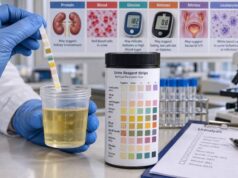
The chemistry behind the strip also explains why a positive result can be powerful but a negative result is weaker. Most nitrite pads use a color reaction based on nitrite coupling with chemicals on the reagent area. Only a small amount is needed to create a visible color change, so when the right organism has been sitting in nitrate-containing urine for long enough, the test can be quite specific. But if any part of that chain is missing—no nitrate, no nitrate-reducing enzyme, not enough bladder time, or chemical interference—the pad may stay negative despite infection.
Nitrite should therefore be thought of as a rule-in clue more than a rule-out test. The exact sensitivity and specificity vary by population, collection method, organism mix, and study design. Performance in healthy adult women with classic cystitis symptoms is not automatically the same as performance in children, older adults, catheterized patients, or people with complicated urinary disease.
The chemistry has three practical requirements. For the dipstick to turn positive, there must be enough nitrate in the urine, the organism must be able to reduce nitrate, and urine must stay in the bladder long enough for nitrite to accumulate. That is why timing and organism type matter so much.
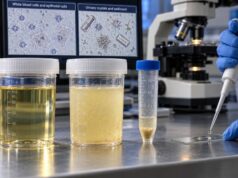
A positive nitrite result often appears alongside other findings on a urinalysis for UTI, including leukocyte esterase, white blood cells, and sometimes microscopic bacteria.
What a Positive Nitrite Result Means
A positive nitrite result means nitrate-reducing bacteria are likely present in the urine. In someone with new urinary symptoms, that substantially increases the likelihood of a bacterial UTI.
Typical lower UTI symptoms include:
- burning or pain with urination;
- urinary urgency or frequency;
- passing small amounts often;
- lower abdominal or bladder discomfort;
- new blood in the urine in some cases.
When nitrite is positive and these symptoms are present, clinicians may diagnose uncomplicated cystitis based on the overall clinical picture. In other situations, they may send a culture before choosing treatment.
A positive result is especially meaningful because nitrite tends to be more specific than leukocyte esterase. Specificity refers to how well a test avoids turning positive in people who do not have the target finding. That does not mean every positive nitrite result equals a UTI, but it makes bacterial involvement more plausible than a nonspecific inflammatory marker alone.
Common nitrate-reducing uropathogens include many Enterobacterales, such as E. coli, Klebsiella, and Proteus. These organisms account for a large share of bacterial UTIs. The test does not tell which one is present, and nitrite intensity does not reliably estimate bacterial load or infection severity.
A positive nitrite result in someone with no urinary symptoms needs more caution. Bacteria can live in the urinary tract without causing a symptomatic infection, a condition called asymptomatic bacteriuria. Treating asymptomatic bacteriuria is generally not beneficial for most nonpregnant adults. Pregnancy and certain invasive urologic procedures are important exceptions where culture-based detection and management can matter.
In older adults and people with long-term urinary catheters, bacteriuria is particularly common. A positive dipstick should not be used by itself to explain nonspecific symptoms such as fatigue, confusion, or falls.
Pregnancy is another situation in which the dipstick has limits. Screening for asymptomatic bacteriuria during pregnancy is based on urine culture rather than nitrite alone because missing clinically important bacteriuria matters and dipstick sensitivity is not high enough for reliable screening. In symptomatic pregnancy, a nitrite-positive sample supports infection, but culture is usually important for confirmation and antibiotic selection.
In children, a positive nitrite result can be quite helpful because false positives are relatively uncommon when the sample is fresh and properly collected. A negative result is less reassuring in infants and toddlers, who empty their bladders frequently and may not provide the four-hour incubation time needed for nitrite production. Collection method also strongly affects interpretation because bag specimens can be contaminated.
Why a Nitrite Test Can Be Negative With UTI
A negative nitrite test means nitrite was not detected, not that bacteria are definitely absent. This is one of the most important limits of urine dipsticks.
Several mechanisms can produce a true UTI with negative nitrites.
The organism may not make nitrite
Not all urinary pathogens have nitrate reductase. Enterococcus species are a classic example. Some other organisms also produce little or no detectable nitrite. A UTI caused by one of these bacteria can therefore remain nitrite-negative from start to finish.
The bladder incubation time may be too short
Bacteria usually need roughly four hours in the bladder to convert enough nitrate to nitrite for the dipstick to detect it. Frequent urination can shorten that window. This is common in people who already have urgency and frequency, and it is one reason nitrite sensitivity is lower in young children and other frequent voiders.
A first-morning sample may improve nitrite detection because urine has often remained in the bladder longer overnight. It is not required in every case, and a symptomatic person should not delay needed care just to obtain a morning sample.
There may not be enough urinary nitrate
The reaction depends on nitrate being available. Diet influences nitrate intake, and very low nitrate availability can reduce nitrite formation. This is one reason the test is not perfectly sensitive even for bacteria that can reduce nitrate.
The urine may interfere with the reaction
Very concentrated urine, high vitamin C exposure, and certain chemical conditions can suppress or alter the color reaction. Test strip brand and handling also matter.
Because of these limits, a negative nitrite test should be interpreted alongside urine leukocyte esterase, symptoms, and microscopy. A symptomatic person can still have a UTI when nitrite is negative but leukocyte esterase and white blood cells are positive.
Nitrite, Leukocyte Esterase, and Urine Culture
Nitrite and leukocyte esterase provide complementary information. Nitrite points toward bacterial nitrate reduction. Leukocyte esterase points toward white blood cell activity and inflammation.
| Nitrite | Leukocyte esterase | Typical interpretation |
|---|---|---|
| Positive | Positive | UTI is more likely if symptoms are compatible |
| Positive | Negative | Bacteriuria remains possible; repeat testing, microscopy, or culture may clarify |
| Negative | Positive | UTI is still possible; inflammation or a non-nitrite-producing organism may be present |
| Negative | Negative | UTI becomes less likely, but persistent or high-risk symptoms still need evaluation |
The combination of negative nitrite and negative leukocyte esterase is more useful for lowering the probability of UTI than either result alone. Yet no dipstick pattern replaces clinical judgment in every population.
A urine culture can identify the organism and quantify growth. Culture is especially useful when infection is recurrent, severe, complicated, associated with pyelonephritis, occurs during pregnancy, affects someone with important urinary tract abnormalities, or fails to improve with initial treatment.
Culture may also help when dipstick findings conflict with symptoms. For example, a symptomatic patient with strongly positive nitrite but little leukocyte esterase may have an early infection, a sample issue, altered immune response, or another explanation. Conversely, marked leukocyte esterase with negative nitrite may reflect a non-nitrite-producing UTI or sterile inflammation.
Nitrite is not the same as a bacterial count
A positive nitrite pad does not mean the culture will necessarily exceed a specific colony-forming-unit threshold. Dipstick chemistry and culture measure different things. Colony counts also need to be interpreted in context because lower counts can be clinically meaningful in symptomatic patients, while higher counts can represent asymptomatic bacteriuria or contamination depending on the situation.
False-Positive and False-Negative Results
Nitrite testing is simple, but preanalytic and chemical factors can create misleading results.
False-positive nitrite results
A false positive can occur when the strip turns positive even though clinically meaningful nitrate-reducing bacteriuria is not present. Causes include:
- contamination of the specimen;
- a urine sample left standing long enough for bacteria to multiply after collection;
- dipsticks exposed to air or moisture before use;
- some strongly colored medications, including phenazopyridine, interfering with visual interpretation;
- reading the test outside the manufacturer’s specified time window.
The most important safeguard is using a fresh, properly collected sample and correctly stored strips.
False-negative nitrite results
Common causes include:
- organisms that do not reduce nitrate;
- urine remaining in the bladder for less than about four hours;
- low urinary nitrate availability;
- high specific gravity;
- vitamin C or other reducing substances;
- early infection with low bacterial burden;
- very dilute urine in some situations.
A false-negative result is clinically more common than many people expect. For this reason, “nitrite negative” should never be translated automatically into “no UTI.”
Home dipsticks introduce additional variation. Lighting, timing, expired strips, humid storage, and subtle color matching can all affect interpretation. If symptoms are significant or persistent, a laboratory urinalysis and clinical assessment are more reliable than repeating multiple home tests.
A mismatch can sometimes be solved by simply repeating the test under better conditions. For example, a nitrite-positive sample that sat at room temperature for several hours before testing is less trustworthy because bacterial growth can occur after collection. A fresh specimen that is promptly analyzed is much more useful. Conversely, a negative result obtained after very frequent voiding may be less informative than a properly collected first-morning sample if the clinical situation is stable enough to wait.
Collection, Timing, and Preparation
No fasting is usually required for a nitrite test. The key preparation is obtaining a fresh specimen with as little contamination as possible.
For a clean-catch midstream sample:
- Wash your hands and follow the clinic or laboratory’s cleansing instructions.
- Start urinating into the toilet.
- Collect the middle part of the stream in the sterile container.
- Avoid touching the inside of the cup or lid.
- Close the container and return it promptly.
If a culture is planned, careful technique is particularly important because skin or genital bacteria can create mixed growth. A clean-catch urine culture sample is designed to reduce this problem.
Fresh testing matters because bacteria can multiply after collection and change nitrate to nitrite in the cup, creating a misleading result. If immediate analysis is not possible, the specimen should be stored according to laboratory instructions, often with refrigeration for a limited period.
Tell the clinician about current antibiotics, urinary antiseptics, high-dose vitamin C supplements, phenazopyridine, pregnancy, recent urologic procedures, or a urinary catheter. These details can change how the result is interpreted and whether culture is needed.
In infants and young children, bag specimens have a high contamination risk for culture. A positive screening dipstick may require confirmation with a more reliable collection method, such as catheterization, depending on age and clinical risk.
When Follow-Up or Urgent Care Is Needed
A nitrite result should guide the next step, not replace it. Follow-up is appropriate when symptoms and dipstick results do not match, when symptoms persist, or when the person belongs to a group in which missed infection carries more risk.
Contact a clinician for evaluation if:
- urinary burning, frequency, or urgency persists despite a negative nitrite test;
- nitrite is positive but you have no clear UTI symptoms;
- symptoms recur soon after treatment;
- there is a history of resistant bacteria or repeated UTIs;
- the patient is pregnant, male, immunocompromised, or has known urinary tract abnormalities;
- a catheter is present and new systemic or urinary symptoms develop.
A UTI test panel may combine dipstick findings, microscopy, culture, and susceptibility testing when a broader evaluation is appropriate.
Seek prompt or urgent medical care for fever, chills, flank or back pain, vomiting, marked weakness, confusion, or rapidly worsening symptoms. These features can suggest kidney infection or systemic illness. Pregnancy with urinary symptoms also deserves timely assessment because infection can have greater consequences for both the pregnant patient and fetus.
Do not start leftover antibiotics solely because a home nitrite strip turns positive. The right treatment depends on whether symptoms truly represent infection, the person’s risk factors, local resistance patterns, allergies, kidney function, and sometimes culture results. Unnecessary antibiotics can cause side effects and contribute to antimicrobial resistance.
Likewise, do not ignore strong UTI symptoms because the nitrite pad is negative. A dipstick is a probability tool. The clinical pattern, leukocyte esterase, microscopic white blood cells, and culture can provide the missing information when the nitrite result is incomplete.
References
- Office-Based Urinalysis: A Comprehensive Review 2022 (Review)
- Diagnostic value of different urine tests for urinary tract infection: a systematic review and meta-analysis 2022 (Systematic Review)
- Clinical effectiveness of point of care tests for diagnosing urinary tract infection: a systematic review 2024 (Systematic Review)
- Rapid and accurate testing for urinary tract infection: new clothes for the emperor 2025 (Review)
- Accuracy of leukocyte esterase and nitrite tests for diagnosing bacteriuria in older adults: a systematic review and meta-analysis 2026 (Systematic Review)
- Diagnostic tests for urinary tract infections and antimicrobial resistance—a reality check between diagnostic innovation and implementation: a critical narrative review 2026 (Review)
Disclaimer
This article is for general educational purposes and does not diagnose or treat a urinary tract infection. A positive or negative nitrite result should be interpreted with symptoms, other urinalysis findings, collection quality, and urine culture when appropriate. Seek prompt medical care for fever, flank pain, vomiting, pregnancy with urinary symptoms, severe illness, or rapidly worsening symptoms.