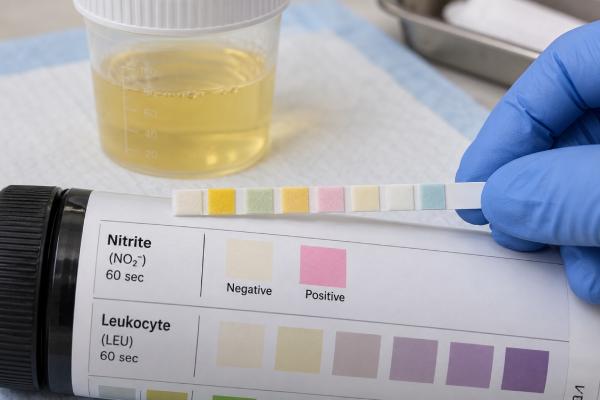
A urine nitrite test is a rapid dipstick test that can support the diagnosis of a bacterial urinary tract infection (UTI). A positive result occurs when certain bacteria convert naturally occurring urinary nitrate into nitrite. Because many common UTI bacteria can do this, positive nitrite in a person with typical urinary symptoms is a meaningful clue. A negative result, however, does not rule out infection. Some bacteria do not make nitrite, urine may not have stayed in the bladder long enough, and diet or urine chemistry can affect the reaction. Nitrite is usually interpreted together with leukocyte esterase, white blood cells, symptoms, and sometimes urine culture. It tells you that nitrate-reducing bacteria may be present; it does not identify the species, determine antibiotic susceptibility, or show whether infection is limited to the bladder or involves the kidneys.
- Positive urine nitrite strongly supports bacteriuria when the sample and symptoms fit, but culture may still be needed.
- Negative nitrite does not exclude UTI because some pathogens do not produce nitrite and frequent urination can prevent nitrite buildup.
- Nitrite plus leukocyte esterase is more informative than nitrite alone because the two markers reflect bacteria and inflammation.
- The urine usually needs time in the bladder for bacteria to convert nitrate to nitrite, so first-morning urine can improve detection in some settings.
- Fever, flank pain, vomiting, pregnancy, recurrent infection, or treatment failure warrants clinical assessment even if a dipstick is negative.
Table of Contents
- What the nitrite test measures
- What a positive nitrite result means
- Why nitrite can be negative with UTI
- Nitrite and leukocyte esterase together
- Sample timing and test accuracy
- When a urine culture is needed
- How to act on the result
- Common nitrite test questions
What the nitrite test measures
Urine naturally contains nitrate derived partly from food. Certain bacteria possess nitrate reductase enzymes that convert nitrate to nitrite while urine sits in the bladder. A reagent strip detects the nitrite produced by that bacterial metabolism. The reaction is typically reported simply as positive or negative.
Many gram-negative urinary pathogens, including most Escherichia coli, Klebsiella, and Proteus strains, can produce nitrite. These organisms cause a large share of bacterial UTIs. A positive nitrite result therefore has useful specificity for bacteriuria. It is not a direct bacterial count, however, and it cannot tell which species is present.
Several recognized urinary pathogens may yield negative nitrite tests. Enterococcus species do not reliably reduce nitrate to nitrite, and some other gram-positive organisms behave similarly. Even nitrate-reducing bacteria can produce a negative test if urine has not remained in the bladder long enough.
The nitrite pad is only one element of the urinalysis used for UTI. Leukocyte esterase and urine white blood cells estimate inflammation, while microscopy may show bacteria or red blood cells. Culture, when indicated, determines whether viable organisms grow and can identify them.
A common misunderstanding is that nitrite measures dietary nitrite or kidney function. It does neither. The test is designed as a proxy for bacterial nitrate reduction in urine. A positive result should therefore be interpreted in the context of urinary symptoms and sample quality.
What a positive nitrite result means
A positive nitrite result means the urine contains detectable nitrite, usually because nitrate-reducing bacteria have been present in the bladder. In a person with new dysuria, frequency, urgency, or suprapubic discomfort, this substantially raises the likelihood of bacterial cystitis.
It still does not prove that every detected bacterium is causing symptoms. Asymptomatic bacteriuria can produce positive nitrite, especially in older adults, people with urinary tract abnormalities, and some catheterized patients. If there are no urinary or systemic symptoms, treatment decisions follow different rules than they do for symptomatic UTI.
The strength of color on a dipstick is generally not used as a severity scale. A positive pad does not tell whether there are 10,000 or 100,000 CFU/mL, whether infection has reached the kidneys, or whether a person is becoming septic. Severity is determined by symptoms and clinical signs such as fever, flank pain, vomiting, low blood pressure, tachycardia, or altered mental status.
A positive nitrite result can help clinicians choose whether further testing is necessary. In uncomplicated cases with classic symptoms, treatment may sometimes be based on clinical assessment and dipstick findings. In complicated infection, recurrent UTI, pregnancy, pyelonephritis, or treatment failure, a urine culture provides much more actionable information.
If a culture is sent, collect urine before antibiotics when practical. Antibiotics can reduce bacterial growth and make the culture negative even though the dipstick or symptoms suggested infection.
Why nitrite can be negative with UTI
A negative nitrite result is common even in true UTI. The most important reason is biological: not every uropathogen produces nitrite. The second is timing. Bacteria need time in the bladder to convert nitrate, and frequent urination can shorten that interval.
This timing issue helps explain why first-morning urine sometimes improves nitrite detection. Overnight, urine typically remains in the bladder longer. In someone with severe urgency who urinates every hour, even nitrate-reducing bacteria may not have enough time to generate a detectable amount.
Diet can matter because nitrate is the substrate for the reaction. A very low-nitrate intake could theoretically reduce nitrite formation. Urine chemistry and specimen handling can also influence strip performance. Vitamin C may interfere with some nitrite reactions, depending on the test system.
A false-negative result is more likely when bacterial concentration is low, infection is early, or urine is very dilute. Conversely, a false-positive can occur if a specimen sits too long at room temperature and bacteria multiply after collection, or if the strip is mishandled or contaminated.
Negative nitrite should therefore answer only one narrow question: no nitrite was detected under the conditions of this sample. It should not be translated into “no UTI.” If leukocyte esterase or WBCs are positive and symptoms fit, infection can still be likely. If all urinalysis markers are negative, UTI becomes less likely but remains possible in selected patients.
This is why the leukocyte esterase result is often considered alongside nitrite rather than after it.
Nitrite and leukocyte esterase together
Nitrite and leukocyte esterase provide complementary information. Nitrite is a bacterial metabolism marker; leukocyte esterase is an inflammation marker. Their combination is generally more useful than either alone.
| Nitrite | Leukocyte esterase | What it often suggests |
|---|---|---|
| Positive | Positive | Bacterial UTI is more likely when symptoms are compatible |
| Positive | Negative | Bacteriuria may be present; consider timing, symptoms, and culture |
| Negative | Positive | Inflammation is present; UTI remains possible, including from nitrite-negative organisms |
| Negative | Negative | UTI is less likely, though not fully excluded |
A positive nitrite/positive leukocyte esterase pattern is compelling in a symptomatic patient because it links a bacterial clue with a host inflammatory response. A nitrite-positive but leukocyte-negative result may occur early, with limited inflammation, or because of a technical issue. It can also reflect bacteriuria without symptomatic infection.
Leukocyte-positive/nitrite-negative urine is common. It can represent UTI from an organism that does not make nitrite, insufficient bladder dwell time, or a nonbacterial inflammatory process. Microscopic WBC counts and culture can clarify the picture.
In older adults, positive dipstick tests are less specific because asymptomatic bacteriuria and pyuria are common. Current evidence supports caution about diagnosing UTI from dipsticks alone in this population. New localized urinary symptoms or systemic signs should drive the decision to test and treat.
No dipstick pattern replaces clinical assessment in a person who appears acutely ill. A patient with fever and flank pain may need culture, blood tests, and treatment even if nitrite is negative.
Sample timing and test accuracy
For a laboratory sample, a clean-catch midstream specimen is commonly used. Begin urinating, then collect the middle portion into the sterile cup without touching its inside. This reduces contamination from skin and genital flora. Refrigeration or preservative may be needed if transport to the laboratory is delayed.
For a home test, follow the manufacturer’s timing precisely. The nitrite pad is read at a specified number of seconds after wetting. Reading too early or too late can produce an incorrect interpretation. Check the expiration date and keep strips dry with the container closed.
Hydration affects concentration. Drinking a very large volume of fluid immediately before testing may dilute bacterial and inflammatory markers. At the other extreme, concentrated urine can intensify some dipstick reactions. There is usually no need to intentionally dehydrate; just avoid unusual fluid loading solely to “prepare” for a test unless instructed.
When nitrite testing is being used to increase the chance of detecting bacteriuria, a sample after several hours of bladder retention can be useful. First-morning urine naturally provides this in many people. But symptomatic patients should not painfully hold urine simply to improve a dipstick result.
Menstrual or vaginal contamination does not directly create bacterial nitrite in the same way as a urinary infection, but contamination can make the overall urinalysis harder to interpret. If a result is unexpected and the sample was difficult to collect cleanly, repeating it may be appropriate.
Some laboratories use automated readers rather than visual color comparison, improving consistency. The underlying limitation remains the same: the nitrite reaction depends on bacterial type, nitrate availability, and time in the bladder.
When a urine culture is needed
Urine culture becomes more important when the consequences of choosing the wrong antibiotic are higher or when the diagnosis is uncertain. Common examples include suspected kidney infection, recurrent UTI, complicated UTI, pregnancy, infection in men, urinary tract abnormalities, recent resistant organisms, recent antibiotics, catheter-associated infection, and symptoms that fail to improve.
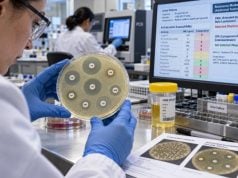
Culture can identify bacteria that do not produce nitrite. It also quantifies growth and may provide susceptibility results. Those features make culture a better confirmatory test than repeated dipsticks when the clinical course is atypical.
If a culture returns with mixed flora, the sample may be contaminated and need repeating. If it grows a single uropathogen at a meaningful colony count, the result supports infection when symptoms fit. Lower colony counts can still be significant in symptomatic people, so the old “100,000 CFU/mL or nothing” rule is too rigid.
Molecular tests can detect bacterial DNA more rapidly and may detect organisms missed by standard culture. However, higher analytical sensitivity can also detect colonizing organisms or DNA that is not causing disease. For that reason, molecular detection is not automatically a better answer to an unclear dipstick.
The best sequence is usually to start with the clinical syndrome, use urinalysis for rapid probability adjustment, and send culture when it will meaningfully influence diagnosis or antibiotic choice.
How to act on the result
If nitrite is positive and you have classic urinary symptoms, contact a clinician if you need treatment, if symptoms are significant, or if you have risk factors for complicated infection. A positive result is useful information, but it does not identify the organism or show which antibiotic will work.
If nitrite is positive without symptoms, do not assume antibiotics are necessary. Ask whether the finding could be asymptomatic bacteriuria and whether your situation is one of the specific settings in which treatment is recommended.
If nitrite is negative but you have burning, urgency, or frequency, look at the rest of the urinalysis. Positive leukocyte esterase or elevated WBCs may still support UTI. Persistent symptoms may justify culture or evaluation for vaginal infection, sexually transmitted infection, stones, or other causes.
Seek urgent medical assessment for fever with flank pain, repeated vomiting, shaking chills, confusion, severe weakness, low blood pressure, or rapidly worsening symptoms. Pregnant patients with urinary symptoms and people with known urinary obstruction or severe immune suppression should also have a lower threshold for professional evaluation.
A nitrite test is best viewed as a specific bacterial clue rather than a pass/fail infection test. Positive results can be highly useful; negative results need context. The result becomes clinically meaningful only after it is combined with symptoms, white-cell markers, and culture when appropriate.
Common nitrite test questions
Can a nitrite test be positive without symptoms?
Yes. Bacteria can be present in urine without causing symptomatic infection, a condition called asymptomatic bacteriuria. In that setting, a positive nitrite test reflects bacterial metabolism but does not establish that antibiotics are beneficial. Whether treatment is recommended depends on the clinical situation rather than the strip alone.
Does a stronger pink color mean a worse infection?
No. Dipstick color intensity is not a validated severity scale. A very positive nitrite pad cannot tell whether infection is limited to the bladder or has reached the kidneys, and a weak result does not prove a mild infection. Severity is assessed from symptoms, vital signs, examination, and sometimes blood tests or imaging.
Can antibiotics make nitrite negative?
They can. Effective antibiotics can reduce the number of viable nitrate-reducing bacteria, lowering nitrite production. This is another reason urine is ideally collected before treatment when doing so will not delay necessary care.
Why is my culture positive when nitrite is negative?
The organism may not produce nitrite, the urine may have had a short bladder dwell time, the bacterial concentration may have been low, or the dipstick may have been affected by chemistry or handling. Culture detects growth by a different mechanism, so discordant results are expected in some true infections.
Can food or supplements change nitrite results?
Diet provides nitrate, the starting material bacteria convert to nitrite, but normal dietary variation rarely makes the test interpretable on its own. Vitamin C can interfere with some reagent-strip reactions and may contribute to a false-negative result. Do not stop prescribed supplements or change your diet solely to manipulate a dipstick; instead, tell the clinician or laboratory about relevant medicines and supplements if results repeatedly conflict with symptoms.
References
- Accuracy of leukocyte esterase and nitrite tests for diagnosing bacteriuria in older adults: a systematic review and meta-analysis 2026 (Systematic Review)
- Performance of Urinalysis Parameters in Predicting Urinary Tract Infection: Does One Size Fit All? 2024 (Review)
- The EFLM European Urinalysis Guideline 2023 2024 (Guideline)
- Urinary Tract Infections: Core Curriculum 2024 2024 (Review)
- Revisiting approaches to and considerations for urinalysis and urine culture reflexive testing 2021 (Review)
Disclaimer
This article provides general information about urine nitrite testing and does not replace individual medical advice. Dipstick results must be interpreted with symptoms, other urinalysis findings, and risk factors. Seek urgent medical care for severe symptoms such as fever with flank pain, persistent vomiting, confusion, or signs of sepsis.