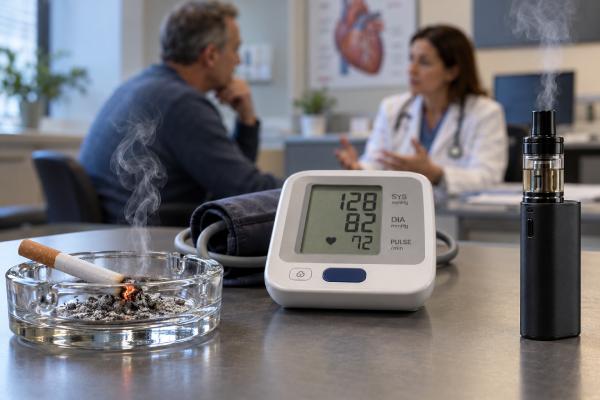
For heart health, smoking combustible cigarettes is the more dangerous choice. Decades of evidence show that cigarette smoke causes coronary heart disease, heart attack, stroke, peripheral artery disease, and sudden cardiac death. Vaping generally exposes users to fewer combustion-related toxic chemicals than smoking, so a person who already smokes may reduce some toxic exposure by switching completely to e-cigarettes. But “less harmful than smoking” does not mean harmless. Most vapes deliver nicotine, and their aerosol can contain ultrafine particles, metals, flavoring chemicals, and other substances that may affect blood vessels, blood pressure, heart rate, inflammation, and clotting. Long-term cardiovascular outcome data for vaping are also much less mature than the evidence for smoking. The most important distinction is therefore not “safe versus unsafe,” but “very well-established high risk versus a newer product with meaningful cardiovascular concerns and more uncertainty.” For people who do not use tobacco or nicotine, starting either is a step in the wrong direction.
Table of Contents
- The Bottom Line: Smoking Is Riskier, but Vaping Is Not Safe
- Why Cigarette Smoking Damages the Heart So Strongly
- How Vaping Can Affect the Heart and Blood Vessels
- What Studies Show When Vaping and Smoking Are Compared
- Why Dual Use Can Undermine Harm Reduction
- If You Smoke, Is Switching to Vaping Better Than Continuing?
- The Best Choice for Heart Health
The Bottom Line: Smoking Is Riskier, but Vaping Is Not Safe
If the question is strictly whether smoking or vaping is worse for cardiovascular health, combustible cigarette smoking carries the more established and generally greater risk. Burning tobacco creates a complex mixture of gases and particles that repeatedly injure the cardiovascular system. Cigarette smoking is causally linked to atherosclerosis, coronary heart disease, heart attack, stroke, peripheral artery disease, abdominal aortic aneurysm, and sudden cardiac death. The Centers for Disease Control and Prevention estimates that smoking increases the risk of coronary heart disease and stroke several-fold compared with not smoking.
Vaping avoids tobacco combustion, which matters. E-cigarette aerosol generally contains fewer toxic chemicals than cigarette smoke, and studies of people who switch completely from smoking to vaping sometimes show improvements in short-term vascular measures. That is the strongest reason researchers and regulators distinguish vaping from smoking rather than treating the products as identical.
The comparison becomes misleading, however, when “lower risk” is translated into “low risk.” E-cigarette aerosol is not clean air. Nicotine-containing vapes can acutely increase heart rate and blood pressure. Laboratory and human studies have identified effects on endothelial function, oxidative stress, autonomic balance, and vascular stiffness—processes relevant to cardiovascular disease. For a deeper look at those mechanisms, see vaping and heart health risks.
The practical hierarchy is straightforward:
- Lowest cardiovascular risk: do not smoke or vape.
- For a current smoker: quitting all combustible tobacco is the most important step.
- If a smoker switches: complete substitution with a noncombustible product may reduce exposure to many toxicants compared with continued smoking, but it does not eliminate cardiovascular risk.
- Dual use: smoking and vaping together should not be assumed to provide meaningful heart protection.
That framework is more useful than trying to assign a single percentage to how much “safer” vaping is, because products, use patterns, prior smoking history, and long-term evidence vary substantially.
Why Cigarette Smoking Damages the Heart So Strongly
The cardiovascular danger from cigarettes comes from more than nicotine. Combustion produces carbon monoxide, oxidant chemicals, particulate matter, volatile organic compounds, and many other toxic substances. With repeated exposure, several damaging pathways occur at the same time.
Blood vessel lining injury
The endothelium—the thin cellular lining inside arteries—helps regulate vessel relaxation, clotting, and inflammation. Cigarette smoke impairs endothelial function and reduces the availability of nitric oxide, a molecule needed for normal artery relaxation. When this lining is repeatedly injured, arteries are more likely to become stiff, inflamed, and susceptible to atherosclerosis.
Greater tendency to form clots
Smoking activates platelets and alters blood coagulation. This makes the blood more prone to thrombosis. If a clot suddenly forms on top of a ruptured plaque in a coronary artery, the result can be a heart attack. A similar process in an artery supplying the brain can cause an ischemic stroke.
Faster atherosclerosis
Smoking promotes inflammation, oxidative stress, lipid abnormalities, and damage to artery walls. These changes accelerate the formation and progression of plaque. The effect is especially important in people who already have other risk factors such as high LDL cholesterol, diabetes, or hypertension.
Carbon monoxide and reduced oxygen delivery
Carbon monoxide from cigarette smoke binds to hemoglobin far more strongly than oxygen does. That reduces the blood’s oxygen-carrying capacity while the heart may simultaneously be working harder because of nicotine-driven sympathetic stimulation. This combination can increase strain on the cardiovascular system, particularly in people with coronary disease.
Nicotine-related stimulation
Nicotine triggers catecholamine release, which can raise heart rate, constrict blood vessels, and temporarily increase blood pressure. People interested in this specific pathway can also read about nicotine and blood pressure.
These mechanisms help explain why even relatively low cigarette consumption is not benign. Cardiovascular risk does not decline in a simple straight line with the number of cigarettes smoked. Cutting down can be a useful step toward quitting, but it should not be mistaken for eliminating the cardiovascular harm of smoking.
The good news is that stopping smoking produces meaningful cardiovascular benefits. Improvements begin well before the excess risk has fully returned toward that of a never-smoker. The changes after cessation are covered in more detail in what happens to heart disease risk after quitting smoking.
How Vaping Can Affect the Heart and Blood Vessels
E-cigarettes heat a liquid rather than burn tobacco. That removes many combustion products, but it creates a different aerosol containing substances whose concentrations depend on the device, liquid, power setting, coil, flavorings, and user behavior. The cardiovascular concern is therefore a mixture of nicotine effects and non-nicotine aerosol exposure.
Nicotine can increase cardiovascular workload
Most e-cigarettes contain nicotine, and some modern products can deliver it efficiently. Nicotine stimulates the sympathetic nervous system. Soon after use, heart rate and blood pressure may rise. A 2025 systematic review and meta-analysis found that acute e-cigarette exposure increased heart rate and both systolic and diastolic blood pressure compared with non-use. In direct acute comparisons, heart rate increases were generally smaller with e-cigarettes than with cigarettes, while blood-pressure differences between the products were less consistent.
These short-term changes are not the same as proving that vaping will cause a future heart attack. They are nevertheless biologically relevant because repeated sympathetic stimulation can be undesirable in people with hypertension, arrhythmias, coronary disease, or other cardiovascular vulnerabilities.
Aerosol can affect endothelial function
Vape aerosol may contain ultrafine particles, carbonyl compounds, metals from heating elements, and flavoring-related chemicals. Experimental research suggests that exposure can increase oxidative stress and impair normal endothelial responses. Endothelial dysfunction is an early feature in the development of cardiovascular disease, although translating short laboratory studies into an exact long-term clinical risk remains difficult.
Autonomic effects may influence rhythm
The autonomic nervous system helps control heart rate and rhythm. Studies of vaping have reported changes in heart-rate variability and other markers of autonomic balance. Nicotine can also increase circulating catecholamines. These findings create plausible concern for arrhythmias, but the long-term clinical risk of serious rhythm disorders from exclusive vaping is still less certain than it is for smoking.
Product differences complicate the evidence
A cigarette is not a perfectly uniform exposure, but e-cigarettes are even more variable. Nicotine concentration, device power, aerosol temperature, flavorings, puff duration, and frequency can all change what reaches the lungs and circulation. A study of one older low-power device may not apply cleanly to a newer disposable product with high nicotine delivery.
This variability is one reason researchers are cautious about declaring a fixed cardiovascular risk ratio for “vaping.” It is also why the absence of decades of outcome data should not be interpreted as proof of safety. E-cigarettes are simply much newer than combustible cigarettes.
What Studies Show When Vaping and Smoking Are Compared
Current evidence points in a consistent general direction—smoking appears more harmful—but the precision of the comparison is limited. Smoking has decades of prospective epidemiology, mechanistic research, and clinical outcome data. Vaping has a shorter observation period, rapidly changing products, and substantial confounding because many adults who vape previously smoked or still smoke.
A useful way to compare the evidence is by outcome rather than by a single “risk score.”
| Cardiovascular issue | Cigarette smoking | Vaping |
|---|---|---|
| Long-term causal evidence for cardiovascular disease | Strong and extensive | Still developing |
| Heart attack and stroke | Clearly increases risk | Possible/increased associations in some studies; causality less certain |
| Blood pressure and heart rate | Acute increases; chronic cardiovascular harm well established | Acute increases, especially with nicotine |
| Endothelial dysfunction | Well established | Demonstrated in multiple experimental studies, but long-term meaning is still being defined |
| Combustion toxicants and carbon monoxide | High exposure | Much lower or absent for many combustion products |
| Nicotine exposure | Common and addictive | Common and can be high, depending on product and use |
| Best option for a never-user | Do not start | Do not start |
A 2025 systematic review directly comparing e-cigarettes and traditional cigarettes concluded that both were associated with adverse cardiovascular outcomes, while traditional cigarettes generally posed the higher overall threat. Another 2025 review found acute vaping increased heart rate and blood pressure compared with non-use, while some measures were more favorable among vapers than smokers.
A 2025 network meta-analysis also found higher odds of composite cardiovascular disease among current e-cigarette users, cigarette smokers, and dual users compared with non-users. In that analysis, cigarette and dual use were associated with myocardial infarction and stroke, while the estimates for exclusive e-cigarette use were less conclusive. Importantly, the authors emphasized that much of the available evidence was cross-sectional. Cross-sectional studies can identify associations but cannot reliably establish whether vaping preceded the cardiovascular disease or whether prior smoking explains part of the relationship.
That limitation matters because many exclusive vapers are former smokers. If someone smoked for 20 years and then switched to vaping, a heart attack five years later cannot automatically be attributed solely to vaping. Conversely, adjusting inadequately for smoking history could hide or exaggerate a true vaping effect.
For consumers, the appropriate conclusion is not that vaping has been proven safe. It is that the evidence supporting smoking as a major cardiovascular hazard is far stronger, while vaping appears to carry cardiovascular effects and possible long-term risk that have not yet been measured with the same certainty.
Why Dual Use Can Undermine Harm Reduction
Many people do not switch completely from cigarettes to e-cigarettes. Instead, they vape in some situations and continue to smoke in others. This pattern is called dual use. From a cardiovascular perspective, it can defeat much of the intended harm-reduction benefit.
The problem is that cardiovascular harm from cigarette smoke can occur at relatively low levels of exposure. Smoking fewer cigarettes may reduce some toxic exposure, but it does not make the remaining cigarettes harmless. If vaping simply fills the intervals between cigarettes, total nicotine intake may stay high while the person continues to receive combustion-related toxins.
Observational data also do not suggest that dual users form a low-risk group. In the 2025 network meta-analysis described above, dual use was associated with higher odds of composite cardiovascular disease than non-use, and it was also associated with myocardial infarction and stroke. Those estimates should be interpreted cautiously because of study-design limitations, but they provide no basis for treating dual use as cardiovascular protection.
Dual use can also make dependence more persistent. A person who cannot smoke indoors may vape indoors, smoke outside, and maintain nicotine exposure throughout the day. That may reduce the natural breaks in nicotine use that sometimes help people recognize dependence and work toward cessation.
For someone trying to move away from cigarettes, the key target is therefore zero combustible cigarettes, not merely fewer cigarettes plus vaping. If vaping is being used as a transition strategy, it should have a defined purpose: eliminate smoking completely and then, when feasible, address ongoing nicotine dependence rather than settling indefinitely into both products.
People who are reducing smoking because they are worried about heart disease may find it useful to review the heart-health recovery timeline after smoking cessation. The cardiovascular gains are tied to stopping smoke exposure, not to preserving a small daily cigarette habit.
If You Smoke, Is Switching to Vaping Better Than Continuing?
For an adult who currently smokes and would otherwise continue smoking, completely replacing cigarettes with e-cigarettes can reduce exposure to many harmful chemicals created by combustion. Public-health agencies recognize this potential distinction. It is the reason a discussion about vaping for a current smoker is different from a discussion about vaping for a never-smoker.
But several qualifications are important.
Complete switching matters
The potential exposure reduction depends on stopping cigarettes, not adding vaping to smoking. Continuing even intermittent cigarette use preserves exposure to combustion products and their cardiovascular effects.
“Authorized to market” is not the same as “approved to quit smoking”
In the United States, the FDA has authorized certain e-cigarette products for marketing through its tobacco regulatory pathway. That does not mean those products are FDA-approved medications for smoking cessation. E-cigarettes have not been approved as smoking-cessation drugs. Proven cessation options include behavioral support and FDA-approved medications such as nicotine replacement therapy, varenicline, and bupropion when appropriate for the individual.
The best cessation method is one that gets smoking to zero
People differ in what helps them quit. Some adults report successfully moving from cigarettes to nicotine e-cigarettes, and trials have examined vaping as a cessation tool. In clinical care, however, a person with cardiovascular disease, pregnancy, complex medication use, or strong nicotine dependence should discuss options with a clinician rather than assuming a vape is automatically the best strategy.
A practical quit plan often combines a firm target, management of withdrawal, identification of smoking triggers, and follow-up. If weight gain is a concern, strategies for quitting smoking without unwanted weight gain can help keep the focus on cardiovascular benefit without replacing cigarettes with restrictive dieting or another risky behavior.
For someone who has never smoked, none of the harm-reduction logic applies. Starting to vape introduces nicotine addiction and aerosol exposure where there was previously no tobacco-related exposure to reduce.
The Best Choice for Heart Health
For cardiovascular health, the safest endpoint is neither smoking nor vaping. Cigarettes remain the more dangerous product because their cardiovascular harms are large, causal, and supported by decades of evidence. Vaping avoids combustion and may reduce exposure to many toxic chemicals when it completely replaces cigarettes, but it still exposes the cardiovascular system to nicotine and aerosol constituents, and its long-term risk is not fully known.
If you currently smoke, the priority is to stop combustible tobacco. Do not let uncertainty about the “perfect” quitting method become a reason to keep smoking. A clinician, pharmacist, or tobacco-cessation service can help match treatment to your dependence level, previous quit attempts, medications, and medical history. If you have established coronary disease, a prior stroke, peripheral artery disease, an arrhythmia, or poorly controlled blood pressure, professional guidance is especially worthwhile.
If you currently vape but do not smoke, switching to cigarettes would increase exposure to combustion toxins and is not a sensible cardiovascular strategy. Instead, consider reducing and ultimately stopping vaping, particularly if the product contains nicotine. Gradual tapering, changing routines around triggers, and evidence-based support for nicotine dependence can make that goal more manageable.
If you use both products, prioritize getting cigarettes to zero. Dual use should be treated as an unfinished transition, not as a stable “safer” state.
Finally, seek urgent medical care for symptoms that could indicate a cardiovascular emergency—especially new chest pressure or pain, severe shortness of breath, fainting, sudden weakness or numbness on one side, or a sudden severe neurologic change. Whether a person smokes, vapes, uses both, or uses neither, those symptoms deserve prompt assessment rather than self-diagnosis.
References
- Comparing E-Cigarettes and Traditional Cigarettes in Relation to Myocardial Infarction, Arrhythmias, and Sudden Cardiac Death: A Systematic Review and Meta-Analysis 2025 (Systematic Review)
- Cardiovascular health effects of vaping e-cigarettes: a systematic review and meta-analysis. 2025 (Systematic Review)
- Electronic cigarettes and cardiovascular diseases: An updated systematic review and network meta-analysis. 2025 (Systematic Review)
- Cardiopulmonary Impact of Electronic Cigarettes and Vaping Products: A Scientific Statement From the American Heart Association 2023 (Position Statement)
- Health Effects of Cigarettes: Cardiovascular Disease 2024
- E-Cigarettes (Vapes) 2025
Disclaimer
This article is for general educational purposes and is not a substitute for individualized medical advice, diagnosis, or treatment. If you have cardiovascular disease, significant symptoms, or questions about nicotine or smoking-cessation medicines, discuss them with a qualified health professional. Call emergency services for symptoms that may indicate a heart attack, stroke, or other medical emergency.