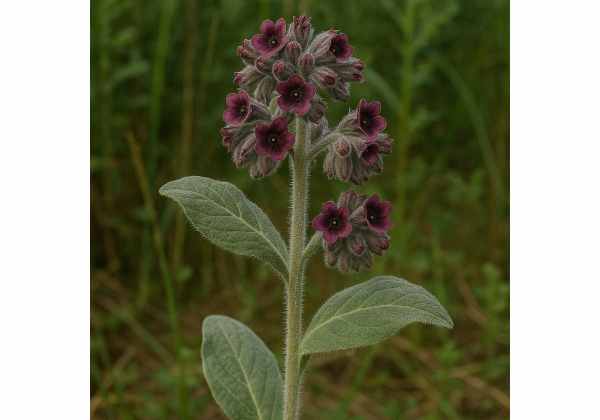
Velvet Bur, discussed here as Cynoglossum officinale, is better known in many botanical and herbal references as houndstongue. It is a soft-haired biennial in the borage family, recognized by tongue-shaped leaves, reddish flowers, and burr-like fruits that cling to clothing or animal fur. Historically, the plant was used in folk medicine for wounds, coughs, irritation, and as a soothing external herb. That history explains why people still search for its benefits today.
The modern picture is more complicated. Velvet Bur contains pyrrolizidine alkaloids, a group of compounds strongly associated with liver toxicity and long-term safety concerns. Because of that, this is not an herb to approach casually, and it is not one of the safer traditional plants for home experimenting. The most helpful way to understand Velvet Bur is to separate its old reputation from today’s safety standards. It may have noteworthy medicinal properties on paper, but the risk profile changes the practical decision. For most readers, the key question is not only what it may do, but whether it is wise to use at all.
Essential Insights
- Velvet Bur has a long folk history for wound care and cough support, but modern human evidence is very limited.
- Its most important active compounds are pyrrolizidine alkaloids, which help explain both traditional activity and major safety concerns.
- No self-care oral dose is recommended; for PA-containing medicinal products, adult exposure is generally kept below 1.0 µg/day of toxic unsaturated pyrrolizidine alkaloids as a safety ceiling rather than a wellness dose.
- Avoid use during pregnancy or breastfeeding, in children, with liver disease, and on broken skin.
Table of Contents
- Velvet Bur in botanical and historical context
- Key ingredients and active compounds
- Potential health benefits and what the evidence shows
- Traditional and practical uses
- Dosage preparation and practical use
- Side effects interactions and who should avoid it
- Velvet Bur verdict for modern herbal use
Velvet Bur in botanical and historical context
Velvet Bur belongs to the Boraginaceae family, the same broader plant family that includes several traditional medicinal herbs as well as some plants known for problematic alkaloids. Botanically, Cynoglossum officinale is a biennial. In its first year it usually forms a basal rosette of gray-green, softly hairy leaves. In its second year it sends up upright flowering stems, often reaching moderate height, followed by rough burr-like nutlets that easily hitchhike on fur and fabric. That clinging seed structure helps explain the “bur” part of the common search term.
The species is native to parts of Europe and western Asia and has spread into other temperate regions. It grows in dry grasslands, roadsides, disturbed soils, field edges, and open places where its rough texture and seed habit make it easy to notice. Its leaves feel velvety, but the plant’s chemistry is far less gentle than its surface.
Historically, the plant built a reputation as an astringent, soothing, and externally useful herb. Old folk records and ethnobotanical mentions connect it with poultices, creams, washes, and decoctions for minor wounds, burns, skin irritation, cough, diarrhea, and painful swelling. Some traditions also described it as mildly calming or sedating. These uses fit the older herbal pattern of assigning one plant several roles based on taste, texture, and visible effect rather than on controlled clinical testing.
That old reputation still matters, but it should be handled carefully. First, historical use does not prove modern effectiveness. Second, with Velvet Bur there is an added complication: part of the herb’s biological activity comes from compounds that also create meaningful toxicity risk. In other words, this is not a case where a plant is merely under-researched. It is a plant whose chemistry forces a different standard of caution.
It is also worth noting that traditional references sometimes blur species boundaries within the Cynoglossum genus. When people read that “Cynoglossum” was used for wounds, cough, or inflammation, the record is not always a clean one-to-one match with Cynoglossum officinale. That does not erase its history, but it does mean the evidence base is patchier than many popular herb summaries suggest.
So, the right starting point is simple: Velvet Bur is a real medicinal plant in historical terms, but it is not a routine wellness herb for modern self-care. Its story is better understood as a blend of folk use, interesting plant chemistry, and unusually important safety limits.
Key ingredients and active compounds
When people search for the “key ingredients” in Velvet Bur, the answer has to begin with pyrrolizidine alkaloids, usually shortened to PAs. These are the most important compounds in the safety discussion and probably the most relevant compounds in the plant’s pharmacological profile. In houndstongue, reported PAs include compounds such as heliosupine, echinatine, acetylheliosupine, and related alkaloids. These are not harmless background constituents. They are central to why the plant can act on living tissue and central to why it can damage it.
The most important thing to know about these alkaloids is how they behave in the body. On their own, they are not the whole problem. After ingestion, the liver can metabolically activate certain unsaturated PAs into highly reactive pyrrolic intermediates. Those metabolites can bind to proteins and DNA, disrupt cell function, and contribute to liver injury, fibrosis, and long-term genotoxic risk. That mechanism is why so many safety discussions around Velvet Bur sound more severe than discussions around ordinary culinary herbs.
Beyond PAs, Velvet Bur likely contains other constituents that help explain its historical uses. These may include:
- Mucilage-like soothing components that can lend a softening feel to topical or traditional demulcent preparations
- Tannins and astringent phenolics that may help explain old wound-wash and skin-tightening uses
- Minor phenolic acids and other secondary metabolites with antioxidant or antimicrobial potential in laboratory settings
- Fatty, resinous, and structural plant compounds that affect texture, extraction behavior, and shelf stability
This mix matters because it explains why the plant attracted attention in older herbal practice. A rough, hairy herb with astringent, soothing, and mildly bioactive properties can easily become part of local wound care or cough care traditions. But in modern reading, the PA fraction outweighs the charm of that traditional profile.
That is the real interpretive rule for Velvet Bur: the “active” part is also the risky part. With some herbs, the key compounds mainly support the case for standardized extracts and careful dosing. With Velvet Bur, the key compounds support a much more cautious conclusion. Standardization does not automatically solve the problem, because there is still no broadly accepted way to treat the whole plant as a casual daily-use herb. Even sophisticated analysis of PA-containing plants focuses heavily on detection, reduction, and exposure control rather than on promoting enthusiastic use.
This is also why homemade preparations are especially problematic. A tea, decoction, tincture, salve, or poultice made from wild or garden-collected plant material can vary widely in alkaloid content depending on season, plant age, plant part, growing conditions, and extraction method. Young growth may differ from mature growth, and root-based preparations may differ from leaf-based ones. That variability makes Velvet Bur a poor candidate for kitchen-counter herbalism.
In practical language, the plant’s chemistry tells a clear story. Velvet Bur contains compounds with enough biological power to have inspired traditional medicinal use, but the same chemistry also creates enough uncertainty and risk that modern use has to be much more conservative than old herbal lore suggests.
Potential health benefits and what the evidence shows
This section needs honesty more than hype. Velvet Bur has a record of traditional use and some biologically plausible actions, but it does not have a strong body of modern human clinical evidence. The most accurate way to discuss benefits is to separate three levels of evidence: traditional reputation, laboratory possibility, and real-world proof.
The traditional benefit claims usually fall into a few recurring groups:
- Soothing irritated skin or minor wounds
- Calming coughs and throat irritation
- Reducing mild pain, swelling, or local inflammation
- Acting as an astringent for weepy or inflamed tissue
- Offering mild antimicrobial or protective effects in topical use
These claims are not random. They fit the herb’s older medicinal identity and the likely contribution of its tannins, mucilage-like components, and alkaloids. In addition, broader research on Cynoglossum species shows that extracts can demonstrate anti-inflammatory, antimicrobial, acetylcholinesterase-related, or receptor-binding activity in preclinical settings. That tells us the genus is pharmacologically interesting.
But “interesting” is not the same as “proven.” For Velvet Bur specifically, there is no convincing modern evidence base showing that self-treatment with the plant meaningfully improves cough, wounds, pain, digestion, or skin conditions in a way that outweighs safety concerns. That gap is especially important because the plant is not merely unproven; it is unproven while also carrying a real toxicology burden.
The area where people may feel most tempted is topical use. Astringent and soothing plants often make intuitive sense for minor skin issues, and Velvet Bur does have a folk record in this direction. Still, when a plant contains problematic alkaloids, the decision shifts. If the goal is minor skin comfort, a safer option such as calendula usually makes more practical sense for home use.
The same logic applies to internal uses. Old references may describe Velvet Bur for cough, loose stools, or general irritation. Yet none of these uses now has the kind of modern evidence that would justify recommending routine oral use of this species. Once liver toxicity enters the picture, the standard becomes much higher.
So what can reasonably be said in favor of Velvet Bur?
- It has authentic historical medicinal use.
- It contains biologically active compounds that may account for those old observations.
- It remains relevant to pharmacognosy and toxicology because it shows how a traditional herb can be both medicinally active and clinically problematic.
That is a worthwhile kind of value, but it is not the same as a green light for self-prescribing. Readers looking for a clear benefit summary should take away this distinction: Velvet Bur may have medicinal potential, especially in the historical and pharmacological sense, but current evidence does not support casual therapeutic use, and its risk profile sharply limits the situations in which it could be considered sensible.
In modern herbal decision-making, that usually means the “benefit” of knowing Velvet Bur lies more in avoiding preventable misuse than in adding it to a home remedy shelf.
Traditional and practical uses
Velvet Bur’s uses are best understood as a mix of older external applications and older internal folk remedies that have not carried comfortably into modern practice. Traditional sources describe several main patterns.
Externally, the plant was used in poultices, creams, leaf applications, or washes for:
- Minor wounds
- Burns
- Swellings
- Bruises
- Irritated skin
- Painful local inflammation
These uses make sense in the context of premodern medicine. An herb with a slightly sticky, softening, astringent, and biologically active profile would naturally be tried on damaged or inflamed tissue. Some traditions also applied leaves directly, while others favored root-based preparations.
Internally, older herbal practice linked Velvet Bur with:
- Coughs and chest irritation
- Diarrhea or loose stools
- General gastrointestinal irritation
- Mild calming or sedative effects
- Painful conditions where a “soothing” herb was desired
Again, these uses reflect a historical pattern, not a modern endorsement. The problem is that internal use exposes the liver more directly to the plant’s toxic alkaloids. That is why many modern herb references either discourage internal use outright or mention it only to explain why it fell out of favor.
There is also an important modern distinction between “traditional use” and “practical use today.” Practical use today asks a harder question: if someone wants this outcome now, is Velvet Bur the right plant to choose? In most cases, the answer is no.
For example:
- For cough support, modern readers are usually better served by herbs with a stronger safety tradition, such as horehound.
- For skin support, there are better-tolerated topical herbs with a wider margin of safety.
- For minor bruising or swelling, non-PA herbs and standard supportive care are usually more rational options.
- For digestive distress, safer demulcents, bitters, or clinically appropriate treatment are preferable.
That does not make the old uses meaningless. It simply means they belong more to herbal history than to first-line home care.
There is one more practical lesson here. Some people assume that “external only” automatically means safe. With Velvet Bur, that assumption is too simple. Skin absorption appears lower than oral absorption, but lower is not the same as irrelevant. Intact skin matters. Duration matters. Product composition matters. Broken skin raises the stakes. Homemade extracts make dose prediction poor.
So the modern uses of Velvet Bur are really limited to two safe-minded purposes. The first is educational: understanding how traditional plants can carry both therapeutic and toxic properties. The second is highly restricted professional use, if any, under a safety framework that takes PA exposure seriously.
For most readers, the best practical use of this knowledge is not to prepare Velvet Bur, but to recognize why an old herbal remedy may no longer be a wise one.
Dosage preparation and practical use
The most responsible dosage advice for Velvet Bur is unusual but clear: there is no evidence-based self-care oral dose that can be recommended for the whole herb. That is not because no one ever used it. It is because the plant’s pyrrolizidine alkaloids create too much toxicological concern for casual internal dosing.
That point deserves emphasis. Old herbal books may mention teas, decoctions, powders, or tinctures. Modern readers should not treat those as usable dosage instructions. With Velvet Bur, folk dosage and responsible dosage are not the same thing.
What can be discussed more safely is exposure control.
A modern safety-minded framework looks like this:
- Do not self-dose orally.
Avoid homemade teas, capsules, tinctures, and decoctions made from Velvet Bur root or leaf. - Do not assume “small amounts” are harmless.
Chronic low-level exposure to problematic alkaloids can still matter, especially when use is repeated. - If a PA-containing medicinal product is under professional consideration, think in terms of PA exposure, not raw herb weight.
A commonly cited adult safety ceiling for toxic unsaturated PAs in medicinal products is under 1.0 µg/day. That is a regulatory exposure limit, not a recommended therapeutic dose of Velvet Bur. - Topical use is not a free pass.
Any use should be limited to intact skin, short duration, and products with known quality controls. Broken skin, large surface areas, occlusion, and repeated use all make self-experimentation less defensible. - Children require stricter caution.
Exposure ceilings scale down with body weight, which is one more reason this is a poor herb for family use.
From a preparation standpoint, the biggest problem is unpredictability. Different extraction methods can pull different amounts of alkaloids and other compounds from plant material. Alcohol, hot water, plant age, drying method, and plant part all influence what ends up in the final preparation. That means two homemade “same herb” products can differ substantially.
This is why Velvet Bur is a poor fit for the usual herbal questions such as “How many cups per day?” or “Should I take the tincture before meals?” Those questions work well for safer herbs. If the goal is digestive stimulation, a classical bitter like gentian is the more rational herb to discuss in dose terms. With Velvet Bur, the practical question is not how to optimize a dose but how to avoid unnecessary exposure.
Timing and duration matter too. The older toxicology literature on PA-containing herbal medicines makes repeated exposure a special concern. A one-time low exposure is not the same as a daily ritual over weeks or months. Because there is no reliable home standardization, “start low and go slow” is not an adequate safety strategy here.
So the dosage summary is straightforward. Velvet Bur is not an herb for do-it-yourself oral dosing. For topical exposure, only a narrow, professionally supervised, intact-skin, short-term frame is even arguable. For routine home care, the better answer is almost always to choose a safer plant or a standard medical approach matched to the problem.
Side effects interactions and who should avoid it
Velvet Bur’s side effects are not limited to mild stomach upset or temporary skin irritation. Its most important risk is liver toxicity linked to pyrrolizidine alkaloids. That one fact should shape every other safety decision.
Potential problems include:
- Liver inflammation and injury
- Hepatic sinusoidal obstruction or veno-occlusive type damage
- Fatigue, abdominal discomfort, nausea, or poor appetite
- Dark urine or jaundice in more serious cases
- Longer-term fibrotic or genotoxic concern with repeated exposure
- Skin irritation or sensitization in some users
- Added risk when used on damaged skin or in poorly characterized preparations
The interaction question is also important, even though Velvet Bur is not a mainstream supplement with a long list of formal interaction studies. The main concern is additive stress on the liver or increased formation of toxic metabolites. That makes caution especially important with:
- Other potentially hepatotoxic herbs or drugs
- Heavy alcohol use
- Existing liver disease
- Products that induce liver enzymes
- Unlabeled multi-herb remedies where exposure is hard to calculate
Pregnancy and breastfeeding deserve a firm avoid recommendation. Even when a formal human study is lacking, a PA-containing plant does not belong in this category of casual experimentation. Children should also avoid it, both because body-size-adjusted exposure is lower and because the margin for dosing error is smaller.
People who should avoid Velvet Bur entirely include:
- Anyone pregnant or breastfeeding
- Children and adolescents unless a qualified clinician is directing care
- Anyone with hepatitis, cirrhosis, fatty liver with active liver injury, or unexplained abnormal liver tests
- Anyone using other liver-stressing medicines
- Anyone planning internal use outside professional supervision
- Anyone wanting to apply it to open wounds, ulcers, or broken skin
There is also a broader herbal lesson here. The same type of caution often comes up with other PA-containing botanicals such as comfrey. These are not ordinary safety conversations about “some people may get mild reflux.” They are deeper toxicology conversations about how to keep exposure as low as reasonably achievable.
Warning signs that would require prompt medical evaluation after exposure include jaundice, severe abdominal pain, swelling, vomiting, unusual fatigue, confusion, or dark urine. Anyone who has used a PA-containing herb regularly and then develops new liver-related symptoms should not wait for the problem to settle on its own.
In practical terms, Velvet Bur sits in a category where the safety section is more decisive than the benefit section. That is not common for every herb, but it is appropriate here. If a plant’s main active compounds are the same ones driving meaningful toxicity concern, the safest recommendation is usually restraint rather than clever dosing.
Velvet Bur verdict for modern herbal use
Velvet Bur is a good example of why herbal medicine needs both respect for tradition and respect for toxicology. The plant clearly has a medicinal history. It was not imagined into use. People valued it for wounds, coughs, soothing applications, and local discomfort because it did something observable. Its chemistry helps explain that history.
But modern herbal judgment asks a second question: is this still a wise choice now that we understand more about its risks? For Velvet Bur, that answer is usually no.
The modern verdict is not that the herb is useless. It is that its potential usefulness is overshadowed by a safety profile that makes better options easier to justify. If the goal is soothing intact skin, there are gentler choices. If the goal is bruise care, many people reach first for arnica on intact skin. If the goal is cough or digestive support, there are herbs with a much wider margin of comfort and much less toxicological baggage.
That makes Velvet Bur more valuable as a teaching herb than as a home remedy. It teaches three worthwhile lessons:
- Traditional use does not guarantee modern suitability.
- Active compounds can explain both benefits and harms.
- A plant can be genuinely medicinal and still be a poor choice for self-treatment.
For clinicians, researchers, and serious herbal students, Velvet Bur remains interesting because it sits at the intersection of ethnobotany, phytochemistry, and safety regulation. For the average reader, though, the practical conclusion is simpler. This is not the herb to experiment with when safer alternatives exist for the same goals.
If you came here looking for a new daily herb, Velvet Bur is probably not it. If you came looking for a clear understanding of its medicinal properties, uses, dosage, and safety, the clearest answer is that its traditional reputation is real, its chemistry is potent, its benefits remain weakly supported in modern human evidence, and its safety concerns are strong enough to place it firmly in the “use extreme caution or avoid” category.
That may sound less romantic than old herb lore, but it is a more useful conclusion for modern readers trying to make sound health decisions.
References
- Cynoglossum officinale L. | Plants of the World Online | Kew Science 2026 (Botanical Reference)
- Traditional uses, phytochemistry, pharmacology, toxicity and clinical application of traditional Chinese medicine Cynoglossum amabile: a review 2024 (Review)
- Extracting and Analyzing Pyrrolizidine Alkaloids in Medicinal Plants: A Review 2020 (Review)
- Use of herbal medicinal products containing toxic, unsaturated pyrrolizidine alkaloids (PAs) – Scientific guideline | European Medicines Agency (EMA) 2021 (Guideline)
- Pyrrolizidine Alkaloids as Hazardous Toxins in Natural Products: Current Analytical Methods and Latest Legal Regulations 2024 (Review)
Disclaimer
This article is for educational purposes only and does not replace medical advice, diagnosis, or treatment. Velvet Bur is a PA-containing plant with meaningful safety concerns, especially related to liver toxicity. Do not use it internally, topically on broken skin, or during pregnancy or breastfeeding without qualified medical or pharmacognostic guidance. If you have liver disease, take prescription medicines, or develop symptoms such as jaundice, dark urine, severe abdominal pain, or unusual fatigue after herbal exposure, seek medical care promptly.
If you found this article useful, please share it on Facebook, X (formerly Twitter), or your preferred platform so others can make safer, better-informed herbal decisions.