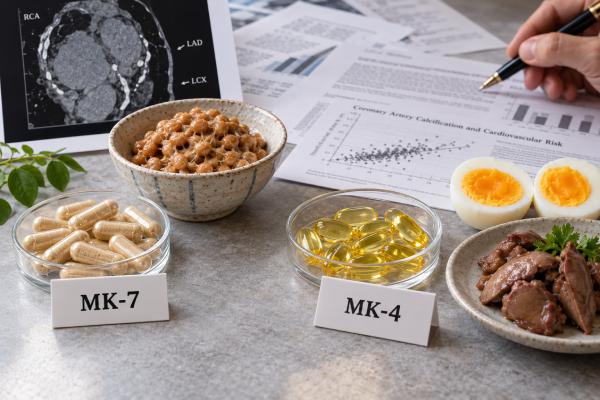
Vitamin K2 is often promoted as a way to “keep calcium out of the arteries,” but the human evidence is more limited than the marketing suggests. Vitamin K is required to activate matrix Gla protein, a natural inhibitor of mineral deposition in blood-vessel walls. That mechanism makes vitamin K2 biologically interesting, especially the forms menaquinone-7 (MK-7) and menaquinone-4 (MK-4). However, improving a vitamin K–dependent blood marker is not the same as proving that a supplement reverses coronary calcium or prevents heart attacks. Most cardiovascular trials have used MK-7, while MK-4 has been studied more extensively for bone-related uses and at very different doses. Recent randomized trials and meta-analyses show mixed results for vascular calcification: some analyses suggest slower progression in selected groups, while others find no meaningful change on CT imaging. For most people, vitamin K2 should be viewed as an unproven cardiovascular supplement rather than a treatment for calcified plaque, and it requires special caution with warfarin and other vitamin K antagonist drugs.
Table of Contents
- Why Vitamin K2 Is Linked to Calcification
- MK-7 vs MK-4: What Is Actually Different?
- What Clinical Trials Show About Artery Calcification
- Can Vitamin K2 Reverse Coronary Calcium?
- Food, Supplements, and Dosing
- Safety and Drug Interactions
- What to Do If You Have Artery Calcification
Why Vitamin K2 Is Linked to Calcification
Vitamin K is a fat-soluble vitamin best known for its role in blood clotting, but several vitamin K–dependent proteins work outside the liver. One of the most important for vascular research is matrix Gla protein, or MGP.
MGP is produced in blood-vessel walls and can inhibit calcification when it has undergone vitamin K–dependent carboxylation. When vitamin K availability is low, more MGP remains in an inactive form. A commonly measured marker, dephosphorylated-uncarboxylated MGP, or dp-ucMGP, rises when extrahepatic vitamin K status is poorer.
This creates a plausible chain of reasoning:
- Vitamin K is needed to activate MGP.
- Active MGP helps inhibit vascular mineralization.
- Vitamin K supplementation lowers inactive dp-ucMGP.
- Therefore, supplementation might slow vascular calcification.
The first three points are well supported. The fourth is where uncertainty begins. Lowering a biomarker does not guarantee that CT-detectable calcium will shrink, that calcified plaque will become less dangerous, or that cardiovascular events will fall.
Arterial calcification is also more complex than calcium simply “going to the wrong place.” It is an active biological process influenced by aging, kidney disease, diabetes, inflammation, phosphate balance, smoking, blood pressure, lipoproteins, and the behavior of vascular smooth-muscle cells. Once calcification is visible, treating the underlying atherosclerotic risk remains the priority.
If a scan has already found calcium, understanding a coronary artery calcium score is more clinically useful than assuming a supplement can dissolve it.
MK-7 vs MK-4: What Is Actually Different?
Vitamin K2 is not one molecule. It is a family of menaquinones named by the length of their side chain. MK-4 and MK-7 are the forms most often discussed in supplements, but they differ in origin, pharmacokinetics, and the amount used in clinical research.
| Feature | MK-7 | MK-4 |
|---|---|---|
| Common dietary association | Fermented foods, especially natto | Animal foods; also formed in tissues from other vitamin K forms |
| Time in circulation | Longer | Shorter |
| Typical cardiovascular research dose | Often measured in mcg per day | Far less commonly studied for vascular outcomes |
| Evidence for slowing artery calcification | Mixed; several randomized trials exist | Insufficient direct cardiovascular trial evidence |
| Proven superiority for heart outcomes | No | No |
Why MK-7 is used more often in cardiovascular trials
MK-7 remains in the circulation longer than MK-4 and can affect vitamin K–dependent biomarkers at relatively small daily doses. That makes once-daily dosing convenient and allows researchers to document a strong reduction in dp-ucMGP.
A lower dose in micrograms does not mean MK-7 is automatically “stronger” in every tissue. MK-4 is handled differently by the body and is present in many tissues. It has also been used pharmacologically at much higher doses in some countries for osteoporosis. Those dosing traditions should not be directly compared with supplement doses of MK-7.
There is no good evidence that MK-7 beats MK-4 for removing arterial calcium
Marketing often presents MK-7 and MK-4 as if head-to-head cardiovascular trials have established a winner. They have not. The available evidence is too different in population, dose, duration, and outcome to support a claim that one form is superior for reversing coronary calcification.
MK-7 currently has more relevant clinical evidence for vascular endpoints, but “more studied” is not the same as “proven effective.” MK-4 remains biologically important, yet direct evidence for its effect on coronary calcium is sparse.
What Clinical Trials Show About Artery Calcification
The most useful evidence comes from randomized controlled trials that measure calcification on imaging rather than only blood biomarkers.
A 2023 systematic review and meta-analysis of randomized trials concluded that vitamin K supplementation may slow coronary artery calcification overall. The pooled result looked favorable, but the trials were small, heterogeneous, and included different forms of vitamin K and different populations. The authors emphasized the need for larger, better-designed studies.
A separate 2023 systematic review focused on people with chronic kidney disease, a population at especially high risk for vascular calcification. Vitamin K supplementation clearly lowered biochemical markers of vitamin K deficiency, but imaging outcomes did not show a convincing reduction in vascular or valvular calcification. This distinction is important: the supplement did what it was expected to do biochemically, yet that did not consistently translate into visible structural change.
More recently, a randomized trial of MK-7 in people with symptomatic coronary artery disease examined two years of supplementation. This type of study is particularly relevant because it asks whether long-term MK-7 changes progression of coronary artery calcium in people who already have established atherosclerotic disease. The existence of a large, well-controlled trial is a step forward, but one trial cannot establish that vitamin K2 should become standard treatment for calcification.
Across the evidence base, three patterns are fairly consistent:
- MK-7 reliably improves vitamin K status markers such as dp-ucMGP.
- Effects on CT-measured vascular calcification are inconsistent.
- Evidence that vitamin K2 prevents heart attack, stroke, or cardiovascular death is not established.
That is why major cardiovascular prevention guidelines do not currently recommend vitamin K2 supplements as standard therapy for coronary calcification.
What dp-ucMGP can and cannot tell you
The blood marker dp-ucMGP is useful in research because it responds strongly to vitamin K intake. A high value generally indicates that more MGP remains uncarboxylated and inactive. When MK-7 is given, dp-ucMGP usually falls substantially, showing that the supplement reached a vitamin K–dependent pathway.
What the marker cannot do is tell you how much calcium is inside your coronary arteries, whether a plaque is stable, or whether a supplement has lowered your future heart-attack risk. There is no widely used clinical dp-ucMGP target that cardiologists use to guide routine prevention. Testing is therefore uncommon outside research and specialized settings.
This distinction matters because supplement advertisements often present a lower dp-ucMGP level as proof that arteries are being “decalcified.” It is better interpreted as evidence of improved vitamin K status. Whether that biochemical change eventually produces a meaningful imaging or clinical benefit is a separate question that still needs stronger trials.
Why results may differ between study populations
Vitamin K trials often include very different groups: healthy adults, people with diabetes, patients with chronic kidney disease, or people who already have coronary artery disease. Their baseline risk and mineral metabolism are not the same. A person receiving dialysis, for example, can have major disturbances in phosphate, calcium, vitamin D, and parathyroid hormone that accelerate vascular calcification through pathways that are not present in a healthy middle-aged adult.
Study duration also matters. Arterial calcification develops over years, yet many trials last months rather than several years. A supplement can rapidly change a blood biomarker while structural changes on CT remain too small to detect. At the same time, longer follow-up does not guarantee benefit; it simply gives a fairer chance to observe a slow biological effect.
Finally, baseline vitamin K status may influence response. Someone who already eats a vitamin K–rich diet may have less room for a supplement to change vitamin K–dependent proteins than someone with lower intake or impaired absorption. These differences help explain why a pooled meta-analysis can look modestly favorable even when individual trials are neutral.
That uncertainty is a reason to focus on absolute cardiovascular risk rather than a single nutrient. If LDL or ApoB, blood pressure, smoking, diabetes, or inactivity is driving risk, improving those factors has a much stronger evidence base than trying to optimize a vitamin K biomarker.
Can Vitamin K2 Reverse Coronary Calcium?
There is no solid clinical evidence that vitamin K2 reverses an established coronary artery calcium score. Claims that K2 “decalcifies arteries” go beyond what randomized trials have demonstrated.
This does not mean the biological mechanism is false. It means the endpoint matters. A supplement may improve MGP carboxylation without shrinking a calcified plaque that has developed over decades.
Coronary calcium is also not identical to “dangerous soft plaque.” Calcification often increases as atherosclerotic plaques mature, and effective statin therapy can sometimes increase plaque calcification while reducing cardiovascular events. That can sound paradoxical, but calcium can represent a more stable, healed component of plaque. The goal of treatment is therefore not simply to chase a lower calcium number.
Why repeating calcium scans is not a supplement test
People sometimes start K2 and plan another coronary calcium scan in a year to see whether it “worked.” That strategy has problems:
- Calcium scores usually change slowly.
- Normal measurement variability can affect the result.
- Progression can occur despite effective risk reduction.
- There is no validated target rate of calcium change for judging a supplement.
- Repeated CT adds radiation exposure and cost.
A calcium score is most useful for refining cardiovascular risk and guiding preventive treatment, not as a short-term scorecard for supplements.
If calcification has been found, the bigger questions are whether LDL or ApoB is adequately controlled, blood pressure is at target, smoking is absent, diabetes is managed, and physical activity and diet support long-term risk reduction. An ApoB test can sometimes add useful information about atherogenic particle burden when standard cholesterol values do not tell the whole story.
Food, Supplements, and Dosing
Vitamin K1 is abundant in leafy green vegetables. Vitamin K2 comes from several foods, especially fermented products and certain animal foods. Natto, a fermented soybean food, is particularly high in MK-7. Cheese and some other fermented foods contain varying amounts of longer-chain menaquinones. MK-4 is present in smaller amounts in foods such as egg yolk, poultry, and some meats, and the body can also form MK-4 in tissues from other vitamin K forms.
For most people, there is no established cardiovascular intake target specifically for vitamin K2. Dietary reference intakes for vitamin K are generally based on total vitamin K needs for normal coagulation, not on a proven dose for preventing vascular calcification.
Supplement doses are not interchangeable
Commercial MK-7 products often contain roughly 90 to 200 mcg per serving, while cardiovascular trials have used a range of doses, including higher amounts in some studies. MK-4 supplements may contain anything from microgram amounts to milligram amounts. These are not equivalent dose systems.
Do not assume that multiplying the dose produces a stronger anti-calcification effect. Once vitamin K–dependent proteins are sufficiently carboxylated, more supplementation may not create additional clinical benefit. The optimal dose for cardiovascular prevention has not been established.
Vitamin D plus K2 is not a proven artery-cleaning combination
Another common claim is that vitamin D “puts calcium in the blood” while K2 “directs it to the bones.” This is a simplified marketing model. Vitamin D and vitamin K both participate in calcium and bone physiology, but human calcium regulation is controlled by multiple hormones, the kidneys, intestines, and skeleton.
People who need vitamin D should use an appropriate dose based on diet, sun exposure, medical history, and laboratory testing when indicated. Adding K2 solely to prevent vitamin D from “calcifying the arteries” is not supported by strong clinical evidence.
Safety and Drug Interactions
The most important safety issue is anticoagulation with a vitamin K antagonist, especially warfarin. These drugs work by interfering with vitamin K recycling. A sudden change in vitamin K intake can change the drug’s anticoagulant effect and alter the INR.
If you take warfarin, do not start, stop, or substantially change vitamin K supplements without discussing it with the clinician or anticoagulation service managing your medication. Consistency of vitamin K intake is often more important than trying to avoid every vitamin K–containing food.
The interaction does not apply in the same way to direct oral anticoagulants such as apixaban, rivaroxaban, edoxaban, or dabigatran, but anyone taking a blood thinner should still review supplements with a clinician. For a broader overview, see common blood thinners and safety issues.
Other points to consider:
- Supplements can vary in purity and actual dose.
- Pregnancy and breastfeeding require individualized guidance.
- Chronic kidney disease changes mineral metabolism and cardiovascular risk, so self-treating vascular calcification with supplements is especially inappropriate.
- A supplement should not replace statins, blood-pressure medication, diabetes treatment, smoking cessation, or other proven therapies when those are indicated.
Vitamin K2 has generally been well tolerated in clinical studies, but “no known toxicity at common doses” is not the same as “proven benefit for everyone.” The risk-benefit calculation is different when a supplement has uncertain cardiovascular effectiveness.
What to Do If You Have Artery Calcification
If coronary or aortic calcification has been found on imaging, treat it as a reason to clarify overall cardiovascular risk rather than as a reason to search for a calcium-removing supplement.
A practical plan usually includes:
- Review the imaging result in context. A calcium score has different implications depending on age, sex, symptoms, and other risk factors.
- Know your atherogenic cholesterol burden. LDL cholesterol, non-HDL cholesterol, and sometimes ApoB help guide treatment.
- Control blood pressure. Home readings can help identify persistent hypertension outside the clinic.
- Address smoking or nicotine use. Stopping tobacco produces far stronger evidence-based risk reduction than adding K2.
- Manage glucose and diabetes. High blood sugar accelerates vascular disease.
- Exercise regularly. Aim for a sustainable combination of aerobic and resistance exercise unless medical limitations require a tailored plan.
- Use a heart-supportive diet. A Mediterranean or DASH-style pattern emphasizing vegetables, legumes, whole grains, nuts, fish, and unsaturated fats has much stronger outcome evidence than vitamin K2 supplements.
If you are curious about K2, discuss it as an optional supplement with uncertain cardiovascular benefit, not as a replacement for proven prevention. People with established coronary disease, chronic kidney disease, valve disease, or anticoagulant use deserve individualized advice.
The clearest summary is this: vitamin K2 has a real biological role in activating proteins that inhibit calcification, and MK-7 has the most direct supplement research for vascular outcomes. But current evidence does not prove that MK-7 or MK-4 reverses arterial calcium, prevents heart attacks, or should be routinely prescribed for people with a high calcium score. The strongest heart-protection strategy remains aggressive control of established cardiovascular risk factors. For most people, that means putting proven treatment first and treating vitamin K2, if used at all, as a secondary and still uncertain addition.
References
- Two Years of Menaquinone-7 Supplementation and Coronary Artery Calcification: A Randomized Clinical Trial 2026 (RCT)
- Vitamin K supplementation and vascular calcification: a systematic review and meta-analysis of randomized controlled trials 2023 (Systematic Review)
- Effects of vitamin K supplementation on vascular calcification in chronic kidney disease: A systematic review and meta-analysis of randomized controlled trials 2023 (Systematic Review)
- The biological responses of vitamin K2: A comprehensive review 2023 (Review)
- Vitamin K2 in Health and Disease: A Clinical Perspective 2024 (Review)
Disclaimer
This article provides general health information and does not replace medical advice. Do not start vitamin K2 supplements without clinician guidance if you take warfarin or another anticoagulant, have chronic kidney disease, or are being treated for cardiovascular disease. Artery calcification should be managed in the context of your full cardiovascular risk profile.