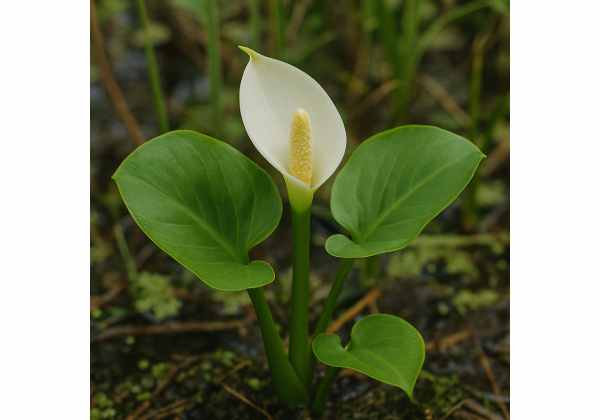
Water arum, botanically known as Calla palustris, is a marsh-loving plant of northern wetlands that is also called bog arum or wild calla. At first glance, it looks gentle and ornamental: glossy heart-shaped leaves, a white spathe, and a dense greenish flower spike rising from shallow water. Yet this is one of those herbs where the safety story matters as much as any traditional benefit story. Historical records describe carefully prepared uses for soreness, swelling, respiratory complaints, and even famine food, but the modern evidence base is thin and the fresh plant is clearly irritant and toxic. Rather than treating water arum as a casual home remedy, it is better understood as a culturally interesting wetland plant with a narrow margin for error. A helpful article on this herb therefore needs to do two things at once: explain its traditional place and make very clear why unsupervised use is a bad idea.
Key Insights
- Historical use points mainly to soreness, swelling, and a few respiratory complaints, but modern proof of benefit is limited.
- Traditional records also describe heavily processed preparations, not casual fresh-plant use.
- Safe self-care oral dose: 0 g fresh plant; no evidence-based unsupervised medicinal dose is established.
- Children, pregnant or breastfeeding people, pets, and foragers without expert guidance should avoid it.
Table of Contents
- What water arum is and why it stands apart
- Key ingredients and why they matter
- Water arum health benefits and what the evidence actually says
- Traditional uses, food history, and preparation context
- Water arum dosage and why there is no routine self-care amount
- Side effects, common mistakes, and poisoning risks
- Who should avoid it and what to consider instead
What water arum is and why it stands apart
Water arum is a small rhizomatous perennial in the arum family, a plant group well known for unusual flower structures and for irritant calcium oxalate crystals. It grows in bogs, swamps, pond margins, slow streams, and other wet habitats across northern North America, Europe, and Asia. Its leaves are thick, waxy, and distinctly heart-shaped, while the flower is made of a white spathe surrounding a greenish spadix covered with tiny flowers. Later in the season, bright red fruits develop, which can make the plant look more inviting than it actually is.
One reason this species deserves careful treatment is that it is often approached as if it were a simple medicinal marsh herb. It is not. Water arum belongs in the category of plants that have documented traditional use but demand informed handling. Older ethnobotanical records describe use by Native American communities for snakebites, swelling, and soreness, while Gitksan records describe medicinal preparations that required long boiling and cultural knowledge. That is a very different picture from “safe to try at home.”
It also stands apart because its most practical modern value may not be medicinal at all. In gardens and restored wetland landscapes, it is appreciated as a native-looking aquatic ornamental. In that setting, its appeal lies in habitat fit, appearance, and ecological character rather than in daily therapeutic use. That distinction matters because many readers searching for “health benefits” expect a profile like chamomile, ginger, or nettle. Water arum is not in that class. It is better thought of as a historically used but risky plant whose fresh tissues can irritate the mouth, throat, and digestive tract.
A balanced way to introduce water arum is this: it is real, it is interesting, it has a traditional record, but it is not a beginner herb. Its story is valuable precisely because it shows how traditional plant knowledge depended on correct identification, season, preparation, and restraint. Without that context, the plant’s attractive appearance can mislead people into underestimating its hazards.
Key ingredients and why they matter
When people read “key ingredients” in an herb profile, they often expect a list of friendly compounds linked to clear wellness effects. Water arum is more complicated. The most important substances associated with its action are not soothing mucilage or pleasant essential oils, but irritant plant defenses. Fresh water arum contains calcium oxalate crystals, often discussed in the aroid family as needle-like structures called raphides.
That crystal story matters because it explains much of the plant’s immediate toxicity. In broad plant biology, calcium oxalate crystals are thought to help with calcium regulation, defense against herbivory, and other structural or physiological roles. In practical human terms, they help explain the classic burning, stinging, swelling, and pain that can follow exposure to certain arum-family plants. Water arum fits that pattern.
Traditional literature also describes the plant as containing irritant compounds alongside oxalate crystals. Older descriptions use slightly different language depending on the source, but they agree on the main point: the fresh plant is harsh, especially on the mouth and throat. This is why older cultural uses repeatedly emphasize processing. The preparation was not a decorative ritual. It was the difference between a handled medicine and a painful poison exposure.
At the same time, the rhizome contains starch, which helps explain why some northern traditions used it in times of scarcity after elaborate detoxifying preparation. That starch content does not make the plant inherently safe. It simply means that, under survival conditions and with specific knowledge, the underground parts could be transformed from dangerous raw material into emergency food. Modern readers should not confuse that survival history with an endorsement of routine consumption.
So the medicinal properties of water arum are best framed honestly. Historically, it was seen as a strong plant that could be used when prepared correctly. Chemically and practically, however, its most distinctive properties are irritant and defensive. That is why the modern conversation around water arum should begin with toxicology and only then move to traditional benefit claims.
Water arum health benefits and what the evidence actually says
The fairest way to discuss water arum’s health benefits is to separate traditional claims from modern clinical confidence. Traditional records do mention benefits. Historical sources describe Native American use for snakebites, swelling, and soreness. Gitksan documentation records earlier reports of decoctions used for eye cleansing, bleeding from the lungs or mouth, short breath, influenza, and a spring tonic context. Those are real historical uses, and they deserve mention.
But historical use is not the same as established evidence. Modern human clinical literature does not show water arum to be a well-supported herb for swelling, respiratory discomfort, pain, or infection. The strongest modern literature linked to this plant and its family is toxicological and botanical, not therapeutic. That means the “benefits” section should be read as a record of what people believed the plant could do when expertly prepared, not as proof that it belongs in a modern self-care routine.
Still, traditional claims usually cluster around a few themes:
- external or internal use for soreness and swelling
- use in selected respiratory complaints
- ritual or tonic use in spring
- highly processed emergency-food use of the rhizome in scarcity settings
These themes make sense within a cultural framework in which strong plants were handled with precision and respect. They do not suggest that fresh leaves, stems, berries, or casual teas are wise.
There is also a practical question beneath the benefits discussion: if a reader wants throat soothing, mild digestive support, or skin comfort, is water arum the right herb to explore first? For most people, no. Plants with gentler chemistry and better modern safety profiles are more appropriate starting points. Someone interested in mucosal soothing, for example, would usually be better served by marshmallow root than by an aroid with clear irritant potential.
So what should a reader take away from the benefits question? Water arum has traditional medicinal significance, but its reputation is historical, specialized, and overshadowed by safety concerns. Its most defensible modern “benefit” may actually be educational: it reminds us that not every plant with a medicinal past is suitable for modern home experimentation.
Traditional uses, food history, and preparation context
Water arum becomes more understandable when you look at how older communities used it. This was not a plant people casually nibbled because it looked wholesome. It was a plant that entered medicine or food only through knowledge-heavy preparation. That preparation could involve gathering at a particular season, selecting certain plant parts, drying or grinding the rhizome, leaching, or boiling for long periods. In other words, the tradition itself contains a warning label.
One of the most striking examples is its history as a famine food in northern Europe. Historical reviews of eighteenth-century Sweden describe the root of bog arum, Calla palustris, as a plant used in northern Sweden for bread during crop failures, and note that its rhizomes were employed in times of shortage. This is historically important, but it should not be romanticized. Famine foods are often records of hardship, not models for everyday wellness.
The Gitksan record adds even more detail. It describes gathering the creeping stem and buds in early spring and states that the plant’s irritating substances were rendered harmless by prolonged boiling. In that account, fresh stems were boiled for six hours for a medicinal preparation, and the text warns that undercooked medicine would irritate the throat while raw calla could cause severe oral and throat irritation with swelling and difficulty swallowing. That is one of the clearest examples of why context is everything with this plant.
Traditional use therefore teaches three practical lessons.
- Processing was central, not optional.
The plant’s danger was understood by those who used it. - Use depended on cultural knowledge.
The same plant could be food, medicine, or poison depending on preparation. - Historical use does not equal modern recommendation.
Today, most people do not need to rely on risky wetland plants for food or medicine.
This is also where comparison helps. A reader searching for digestive or respiratory plant support is usually not looking for a survival ethnobotany case study. For mild digestive discomfort, a better modern option is often peppermint, which has a clearer evidence base and far less ambiguity around safe use.
Water arum’s traditional uses are worth respecting, but respect includes recognizing limits. The old record tells us the plant can be transformed. It does not tell us that modern readers should try to transform it themselves.
Water arum dosage and why there is no routine self-care amount
This is the section many readers skip to first, and with water arum it is the section that needs the clearest answer. There is no established evidence-based self-care oral dose for water arum in modern practice. No standard adult tea dose, capsule range, tincture schedule, or beginner-friendly gram amount could be responsibly recommended here.
That is why the safest self-care dosage range is simple:
- Fresh plant by mouth: 0 g
- Fresh juice or homemade tincture: 0 mL
- Berries for casual tasting: 0 pieces
That may look unusual in an herb article, but in this case it is the most honest and useful dosing guidance. Water arum is not like chamomile, ginger, or fennel, where practical home dosage ranges are widely discussed. Its record depends on highly specific traditional preparation, not casual self-administration.
Could someone argue that historical preparations count as dosage information? In a narrow ethnobotanical sense, yes. Traditional records mention boiling fresh stems for six hours in a medicinal context. But that is not the same as a general dosage recommendation, because it does not create a validated modern protocol for safety, concentration, or outcome. It shows process, not a consumer-ready regimen.
The same caution applies to famine-food history. Knowing that rhizomes were once dried, ground, leached, or boiled does not tell a modern reader how to make them safe in a kitchen. Variation in plant part, maturity, environment, and preparation could matter. Even small mistakes could turn an interesting experiment into a painful poisoning event.
A more useful way to think about dosage here is decision-making:
- If you are considering water arum for wellness, choose a safer herb instead.
- If you are studying it academically, treat dosage records as historical data, not consumer advice.
- If exposure has already happened, focus on symptom severity and medical advice, not on trying to “balance” the dose afterward.
For topical use, the same principle applies. There is no routine over-the-counter style dose or frequency that can be recommended for home use. A plant with clear irritant chemistry does not become simple just because it is external.
Side effects, common mistakes, and poisoning risks
The side effects of water arum are not subtle. Fresh exposure can cause immediate burning in the mouth, tongue, lips, or throat; painful swallowing; swelling; drooling; and gastrointestinal upset. Some sources also describe skin and mucous membrane irritation, and official plant references warn that severe swelling can occur. In a sensitive person or after a larger exposure, the airway issue is the part that matters most.
Common mistakes tend to follow a predictable pattern.
- assuming a wetland native plant must be gentle
- tasting berries or rhizomes out of curiosity
- copying historical preparation without traditional knowledge
- treating “long boiling” as a guaranteed safety method
- using the plant as a topical folk remedy on already damaged tissue
- leaving it where children or pets can chew it
Another mistake is treating all plant traditions as if they transfer directly into modern herbal self-care. They do not. Many traditional systems included expert gatherers, inherited handling rules, and a social structure around who prepared what. Removing the plant from that context while keeping only the attractive “natural remedy” idea is exactly how people get hurt.
Symptoms that deserve urgent attention include trouble breathing, marked mouth or throat swelling, persistent vomiting, severe pain, or signs that a child has chewed the plant. Even when a case begins as “just a bite,” swelling in the mouth or throat should never be minimized.
There is also a mindset issue worth naming. Readers sometimes think, “I will only use a tiny amount.” With water arum, that is not a dependable safety strategy because the problem is not only systemic dosing. Local tissue contact itself can be painful and damaging. That is why “small taste” is still a bad plan.
For people seeking a soothing skin herb, water arum is also the wrong instinctive choice. A gentler, better-known option such as calendula makes far more sense than experimenting with a plant whose fresh chemistry is already known for irritation.
Who should avoid it and what to consider instead
The avoidance list for water arum is broad, and that alone tells you something important about the plant’s place in modern use.
People who should avoid it include:
- children
- pregnant people
- breastfeeding people
- anyone with a history of severe oral, throat, or esophageal sensitivity
- anyone who forages without expert plant identification
- people trying homemade detoxification or wild-food experiments
- households with pets that may chew foliage
The reason is straightforward: the plant’s main well-documented action in fresh form is irritation, not gentle support. There is no modern therapeutic necessity that justifies casual exposure for most readers.
As for drug interactions, the published discussion is much thinner than it is for common medicinal herbs. The main concern is not a classic liver-enzyme interaction or a long list of known contraindicated medicines. The main concern is local toxic irritation and unpredictable self-preparation. That said, anyone with a swallowing disorder, major gastrointestinal sensitivity, or compromised oral tissues has even less reason to experiment.
For most readers, the better question is not “How can I use water arum safely?” but “What safer plant matches the goal I actually have?” That shift usually leads to better choices:
- for soothing irritated tissues, consider plantain leaf or marshmallow
- for mild digestive discomfort, think peppermint or ginger
- for mild skin support, calendula or aloe are usually more sensible
Water arum remains worth learning about because it sits at the border of medicine, food history, and toxicology. It shows how a plant can be both culturally useful and objectively risky. In modern self-care, though, the practical conclusion is clear: admire it, study it, preserve its cultural history, but do not treat it like an everyday herbal remedy.
References
- Poisoning due to ornamental plants belonging to the Araceae family: Review of botanical and toxicological aspects relevant for clinical practice 2024 (Review)
- Calcium Oxalate Crystals, the Plant ‘Gemstones’: Insights into Their Synthesis and Physiological Implications in Plants 2023 (Review)
- Peasant Food Provision Strategies and Scientific Proposals for Famine Foods in Eighteenth-Century Sweden 2024 (Review)
- Calla palustris (Bog Arum, Swamp Lily, Water Arum, Water-dragon, Wild Calla, Wild Dragon) | North Carolina Extension Gardener Plant Toolbox 2025
- GITKSAN TRADITIONAL MEDICINE: HERBS AND HEALING 1988 (Ethnobotanical Study)
Disclaimer
This article is for educational purposes only and is not medical advice, diagnosis, or treatment. Water arum has documented toxic and irritant properties, and there is no established self-care medicinal dose for unsupervised use. Do not ingest, prepare, or apply this plant as a remedy without qualified professional guidance and expert botanical identification. Seek urgent medical help or contact a poison center if exposure causes mouth or throat burning, swelling, trouble swallowing, vomiting, or breathing difficulty.
If this article was useful, please consider sharing it on Facebook, X, or your preferred platform.