Water parsnip, Sium suave, is a wetland plant in the parsley family that sits at an unusual crossroads of food tradition, folk medicine, and botanical caution. In parts of North America, its roots were eaten and recorded in Indigenous plant use, while in Chinese herbal contexts the whole plant has been associated with dispersing cold, easing headache, and lowering blood pressure. At the same time, it is not a mainstream medicinal herb with a clear supplement profile or strong modern clinical evidence.
That tension is what makes the plant worth understanding carefully. Water parsnip belongs to a family known for aromatic compounds, coumarins, and other bioactive constituents, and species-level research suggests it contains chemically active fruit compounds as well. Yet the plant is also easy to confuse with highly poisonous look-alikes, especially water hemlock. That means any discussion of its benefits must stay grounded in identification, preparation, and evidence limits.
This guide explains what Sium suave is, what is known about its key ingredients and medicinal properties, where its traditional uses come from, why no standard dose exists, and why safety deserves as much attention as potential benefit.
Quick Overview
- Water parsnip has a real ethnobotanical history as both a food root and a traditional medicinal plant.
- The strongest benefit claims are traditional digestive, headache, and mild respiratory or circulatory uses rather than proven modern clinical effects.
- No validated medicinal dose in mg or mL has been established for stand-alone use.
- Anyone unsure of identification, and especially foragers near water hemlock habitat, should avoid self-use.
Table of Contents
- What water parsnip is and why identification comes first
- Key ingredients and medicinal properties of Sium suave
- Potential health benefits and their realistic strength
- Traditional and modern uses of water parsnip
- Dosage, timing, and why no standard range exists
- Safety, side effects, and who should avoid it
- How to source it carefully and avoid common errors
What water parsnip is and why identification comes first
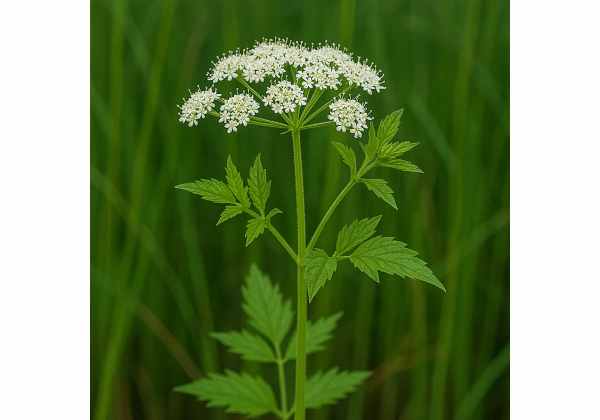
Sium suave, commonly called water parsnip or hemlock waterparsnip, is a perennial wetland herb in the Apiaceae family. It grows in swamps, marshes, shallow water, ditch margins, wet meadows, and similar habitats across parts of North America and Asia. Its white umbrella-like flower clusters, ribbed stems, and divided leaves place it in the same broad family as many familiar aromatic plants, including other Apiaceae plants such as celery. That family link helps explain why water parsnip has a history of food and medicinal use, but it should never be used as a shortcut to assume safety.
The most important fact about water parsnip is not its folklore. It is the identification problem. This species resembles several toxic relatives and habitat neighbors, especially water hemlock. In practice, that means the margin for error is much smaller than it is with better-known kitchen herbs. Even when a source notes that the roots were traditionally eaten, modern cautions often add that the plant is best left alone because a mistake could be severe.
That caution changes how the plant should be discussed. With many herbs, the first question is what it may help. With water parsnip, the first question is whether the plant is correctly identified at all. If that answer is uncertain, the rest of the conversation should stop there.
Botanically, Sium suave is a true species rather than a vague folk label, and that matters because common names can blur important differences. Some sources use “water parsnip” loosely for wetland Apiaceae plants, while herbal markets may confuse this species with other medicinal roots. In fact, modern molecular work has shown that Sium suave can appear in medicinal markets as an adulterant for other herbs, which is another reminder that botanical accuracy is not optional.
There is also an interpretive problem in online writing. Broad claims about “water parsnip benefits” often combine ethnobotanical food use, genus-level chemistry, and medicinal traditions from different places without distinguishing the strength of each line of evidence. That is how useful caution gets lost. Water parsnip has a legitimate traditional record, but it is not a standardized contemporary supplement with well-defined dosing and widely accepted clinical outcomes.
So the best way to begin is with three simple truths:
- it is a real ethnobotanical and historically used plant
- it belongs to a chemically interesting medicinal family
- it demands more identification caution than most herbs discussed for self-care
Those three points frame the rest of the article. Water parsnip deserves respect, but it also deserves limits, and those limits begin with naming the right species and recognizing how easily wetland Apiaceae can be mistaken for something far more dangerous.
Key ingredients and medicinal properties of Sium suave
The phrase “key ingredients” sounds straightforward, but in Sium suave it requires restraint. This is not one of the heavily studied herbs with a well-known signature compound, a standardized extract, and a large body of pharmacology. Species-specific phytochemical mapping remains limited. What can be said with reasonable confidence is that water parsnip belongs to a plant family rich in volatile aromatic compounds, coumarins, and related secondary metabolites, and that accessible species-level work has identified furanocoumarin activity in its fruits.
One of the most useful older studies examined the localization of furanocoumarins in the fruits of several plants, including Sium suave. The findings suggested that the fruits carried furanocoumarins on their surface, while the internal fruit tissues of Sium suave had relatively low levels compared with some other species tested. That matters because furanocoumarins are biologically active compounds with a long history of pharmacologic interest across the Apiaceae family. They can influence how plants defend themselves, and in some herbs they are relevant to skin sensitivity and medicinal activity.
Beyond that specific finding, genus- and family-level research points toward the sort of chemistry water parsnip is likely to share with related plants: aromatic fractions, coumarin-type constituents, and other phenolic compounds that help explain why Apiaceae species have so often entered traditional medicine. But it would be misleading to pretend that Sium suave is chemically understood at the level of fennel’s better-described aromatic profile or other mainstream herbs in the same family.
That limited chemical map shapes how its medicinal properties should be described. The most defensible description is not “strongly proven” or “broadly therapeutic.” It is “traditionally valued, chemically active, and incompletely characterized.” Historically, that activity was interpreted in ways common to aromatic herbs: dispersing cold, easing headache, supporting circulation, and helping certain forms of discomfort. In practical modern language, those old labels suggest a plant thought to be warming, stimulating, and somewhat clearing rather than deeply nutritive or adaptogenic.
A cautious list of medicinal properties would include:
- aromatic and pungency-adjacent family chemistry, though milder than classic spice herbs
- coumarin and furanocoumarin relevance in the fruits
- possible circulatory and headache-related traditional action
- ethnobotanical value as both a food root and a medicinal root in some cultures
- incomplete modern pharmacologic characterization
This is where overstatement often happens. Because the plant belongs to a family full of interesting compounds, some writers leap from family chemistry to specific health claims. That step is too large. Water parsnip likely contains meaningful bioactive constituents, but the available evidence supports a careful medicinal profile, not a broad one.
A fair conclusion is that Sium suave is chemically active enough to justify ethnobotanical and botanical interest, but not chemically mapped well enough to support confident supplement-style promises. Its medicinal properties are plausible, traditional, and biologically credible, yet still surrounded by uncertainty in ways that better-known herbs are not.
Potential health benefits and their realistic strength
When readers search for health benefits, they usually want a direct answer: what does this herb do, and how well does it work? With water parsnip, the honest answer has to separate traditional use from modern proof.
The strongest support comes from tradition, not clinical trials. In Chinese medicinal records summarized in modern reviews, Sium suave has been associated with dispersing cold, relieving headache, and decreasing blood pressure. In North American ethnobotanical records, the roots were eaten and used medicinally in specific ways. These are meaningful signals. A plant is not remembered across regions for no reason. But tradition points toward possibilities; it does not, by itself, establish therapeutic reliability.
That means the most realistic benefit categories are these:
Headache and “wind-cold” style relief.
This is one of the clearer traditional themes. In older herbal language, “dispelling cold” often referred to easing discomfort linked to chill, congestion, or surface-level aches. A modern reader can interpret this as a traditional use for certain headache and upper-respiratory patterns rather than as proof of a general pain remedy.
Digestive and warming support.
Plants in the parsley family are often used to stimulate digestion, reduce stagnation, or warm the system gently. Water parsnip likely inherited part of that reputation, especially where the roots were also used as food. Still, unlike better established digestive herbs, it does not have a modern clinical evidence base for indigestion, bloating, or nausea.
Mild circulatory or blood-pressure interest.
The Chinese folk use record that mentions lowering blood pressure is intriguing, but it should be handled carefully. There are no solid modern human trials showing that Sium suave is an effective antihypertensive herb. At best, this is a traditional lead for future study.
Localized pain support in ethnobotanical use.
Some records describe crushed root applications for pain associated with injury. That suggests topical folk use, not a proven modern analgesic treatment.
By contrast, these claims remain weak or speculative:
- disease-prevention claims
- detox claims
- standardized anti-inflammatory claims
- cardiovascular treatment claims
- neurologic claims strong enough to justify self-treatment
This is a useful place for comparison. A herb like dandelion with a clearer modern digestive and diuretic profile can be discussed with more confidence because its food use, research interest, and safety tradition align better. Water parsnip does not offer that same clarity. Its possible benefits are interesting, but they are not evenly supported.
So how should readers interpret the benefit question?
The best summary is:
- The plant has a credible traditional record.
- Its family chemistry makes those traditions plausible.
- The modern human evidence is thin.
- Safety and identification concerns lower its suitability for self-experimentation.
That means water parsnip is better understood as a historically important and chemically interesting plant than as a proven everyday remedy. Its benefits are not imaginary, but they are also not well enough established to justify casual wellness claims. For most readers, that balanced view is far more useful than a long list of unranked promises.
Traditional and modern uses of water parsnip
Water parsnip has lived in two overlapping roles: as a food plant and as a folk medicinal plant. Understanding both helps explain why it still appears in herb discussions even though it is not a common modern supplement.
In North American ethnobotanical use, the roots were a meaningful food in some communities. They were eaten when correctly identified, and that food use matters because it distinguishes the plant from species that were never safely incorporated into regular subsistence. The roots were not merely emergency calories. They were part of a practical relationship with wetland plant knowledge. Some medicinal uses were also recorded, especially involving the roots.
In Chinese folk medicine, the whole plant appears under a medicinal frame rather than a food one. There, it has been described as useful for dispersing cold, relieving headache, and decreasing blood pressure. This is important because it shows the plant was not only regionally known, but also interpreted through a different medical system. When the same species appears in both ethnobotanical and medicinal contexts, it suggests a wider human recognition of value, even if the precise use-pattern changes from one culture to another.
Modern uses are narrower and more cautious.
The plant is sometimes discussed in:
- native plant education
- ethnobotanical documentation
- wetland ecology
- medicinal-market authentication research
- traditional-use overviews of Apiaceae plants
What it is not commonly used as today is just as revealing. It is not a major tea herb. It is not a standardized capsule ingredient with a well-defined label claim. It is not a common tincture on reputable retail shelves. And it is not a plant most responsible herbalists recommend for casual foraging, precisely because of the risk of confusion with toxic look-alikes.
That makes water parsnip different from culinary Apiaceae herbs that move easily between kitchen and remedy use. Coriander, fennel, dill, and related plants can be discussed as both foods and medicinal plants without immediately raising a red flag. Water parsnip cannot. Even when a source acknowledges edible roots, it often pairs that note with a warning that the plant is best avoided unless identification is certain.
One more modern use deserves attention: substitution and adulteration. Molecular studies have shown that Sium suave can appear in medicinal markets as a substitute or adulterant for other herbs. That matters for two reasons. First, it confirms the plant continues to circulate in medicinal channels. Second, it shows how easily plant identity problems can lead to inconsistent effects and safety uncertainty.
A realistic account of water parsnip’s uses therefore looks like this:
- traditional food root in selected Indigenous settings
- traditional folk medicinal use, especially root-based
- Chinese folk medicinal use of the whole plant
- modern relevance in identification and market-authenticity work
- limited present-day role in self-care herbalism
That profile is neither dismissive nor romantic. It gives the plant its due while also recognizing that many historic herbs are more important as records of human knowledge than as direct templates for unsupervised modern use.
Dosage, timing, and why no standard range exists
This is the point where many herb articles become too confident. Water parsnip does not justify that kind of certainty. There is no well-established modern stand-alone dosage range for Sium suave in the way one might find for a common tea herb or standardized botanical extract.
That absence is not accidental. It reflects the state of the evidence.
First, there are no well-known contemporary clinical trials that translate its traditional use into a repeatable medicinal dose for the general public. Second, traditional use was not standardized in modern extract language. It involved roots or whole-plant use within specific cultural settings, not capsules listing milligrams of active constituents. Third, the safety and identification concerns are serious enough that “start low and see how you feel” is not a responsible dosing strategy.
This does not mean the plant was never taken internally. It clearly was, both as food and in some folk medicinal forms. But historical use and modern dosing guidance are not the same thing.
The most accurate dosage framework is therefore negative but useful:
- no validated oral extract range in mg has been established
- no standard tea or decoction volume in mL is widely accepted for modern use
- no evidence-based duration of use has been established
- no timing protocol before meals, after meals, or bedtime has been validated
What can be said instead?
For food use, the roots were historically eaten when confidently identified and properly handled. That places water parsnip closer to a culturally known wild edible than to a standardized medicinal product. For medicinal use, older records indicate that roots or whole-plant preparations were used traditionally, but without the kind of modern dose precision needed for safe public guidance.
This is why water parsnip should not be approached like ginger, which has clearer culinary and supplemental dosing patterns. Ginger can be discussed in grams, teas, extracts, and timing strategies with some confidence. Water parsnip cannot.
A practical reader may ask what to do with such limited dose information. The best answer is straightforward:
- Do not invent a dose from general family similarity.
- Do not rely on vague internet instructions.
- Do not convert “traditional use” into a modern supplement plan.
- Do not use plant-part uncertainty as if it were a minor issue.
- If professional use is ever considered, it should begin with verified identification and expert supervision.
That may sound unsatisfying, but it is actually the most helpful answer. Good dosing advice is not simply a number. It is a number backed by identity, preparation, context, and tolerability. Water parsnip does not yet offer that package.
So the real dosage conclusion is this: historical use exists, but a safe, validated, modern self-care dosage does not. For an herb with identification risks and only limited modern medicinal characterization, that is exactly the conclusion readers need.
Safety, side effects, and who should avoid it
Safety is the defining issue with water parsnip. Not because the plant is automatically as dangerous as the most toxic members of its family, but because confusion around it can be dangerous enough to overshadow any possible benefit.
The largest risk is misidentification. Water parsnip grows in wet habitats where highly poisonous species, especially water hemlock, may also occur. Those plants can resemble one another closely enough that inexperienced foragers should not attempt to collect them for food or medicine. In real-world use, this is the main reason many cautious plant sources say that even though the roots were historically eaten, the plant is best left alone.
The second safety issue is uncertain chemical and dose response. Because there is no standard preparation and no validated medicinal dosing range, side-effect prediction is weaker than it is for better-studied herbs. That alone argues against casual self-use.
The third issue is photoreactive family chemistry. Water parsnip fruits have been studied for furanocoumarin localization. That does not automatically mean ordinary contact will cause a skin reaction, but it does remind us that this is not chemically inert plant material. In the Apiaceae family, such compounds deserve respect.
Potential side effects or problems may include:
- digestive upset from inappropriate internal use
- skin sensitivity concerns with plant contact in susceptible people
- inconsistent effects from poorly identified plant material
- much more serious risk if the wrong species is collected
Who should avoid it completely?
- anyone without expert-level plant identification skills
- pregnant or breastfeeding people
- children
- people seeking a do-it-yourself wild medicinal plant
- anyone with a history of severe plant allergies or photosensitivity
- anyone taking herbs or medicines that already complicate blood pressure or neurologic stability
Even experienced herbal users should step carefully here. Water parsnip is not a plant where confidence should come from a few pictures online or a passing resemblance to edible roots. Nor is it a plant to buy casually if the label fails to list the Latin name and plant part. Market confusion has already been documented, and that makes loose sourcing especially problematic.
This is one reason it belongs in the same broad caution category as other safety-first herbs that require more respect than experimentation. The issue is not whether every use is harmful. The issue is that the consequences of a mistake can be outsized.
A responsible safety summary is therefore simple:
- food history does not equal universal safety
- medicinal history does not equal modern self-care suitability
- family resemblance to toxic plants raises the bar for use
- when identity is uncertain, avoidance is the safest choice
For readers who came looking for a quick herbal recommendation, that may feel restrictive. But with water parsnip, good safety advice is supposed to feel a little restrictive. That is what keeps the plant in the realm of careful knowledge rather than careless trial.
How to source it carefully and avoid common errors
Most errors with water parsnip happen long before anyone thinks about benefits or dosage. They happen at the level of naming, buying, and assumptions.
The first mistake is assuming that a common name is enough. It is not. “Water parsnip” can be used loosely in conversation, and plant sellers or content writers may not always distinguish species carefully. For this plant, the full Latin name Sium suave should always be the starting point.
The second mistake is trusting wild collection based on appearance alone. Wetland Apiaceae are not beginner plants. If a source praises the edible history of the roots but glosses over the danger of look-alikes, that is a warning sign. A trustworthy source should mention the identification problem early, not as an afterthought.
The third mistake is assuming that presence in herbal markets means correct identity. Molecular authentication work shows that Sium suave has appeared in medicinal markets as an adulterant or substitute for other herbs. That means sourcing problems are not theoretical. They are documented.
The fourth mistake is treating traditional use as a license for modern experimentation. Traditional knowledge deserves respect, but it existed within systems of place-based skill, plant familiarity, and seasonal judgment. Lifting a plant out of that context and using it like a generic supplement removes the safeguards that made the original knowledge usable.
A responsible sourcing checklist looks like this:
- Confirm the Latin name, not just the common name.
- Confirm the plant part being sold.
- Avoid wild-harvest use unless identification is expert and local.
- Be skeptical of products that make broad wellness claims without botanical detail.
- Avoid any product that blurs food use and medicinal use without preparation specifics.
There is also a mindset error worth avoiding: looking for reasons to use the plant instead of reasons to verify it. With water parsnip, that order should be reversed. Verification comes first. Desire for benefit comes second.
If a reader wants a practical rule, it is this: the more a source sounds casual about water parsnip, the less trustworthy it probably is. Reliable discussions of this plant usually sound measured, because the plant demands it.
In the end, careful sourcing may lead some readers to decide not to use the herb at all. That is not a wasted conclusion. It is often the right one. Water parsnip remains valuable as an ethnobotanical plant, a wetland species, and a reminder that medicinal knowledge begins with correct identity. Sometimes the wisest use of an herb is understanding it well enough to know when not to use it.
References
- Apiaceae Medicinal Plants in China: A Review of Traditional Uses, Phytochemistry, Bolting and Flowering (BF), and BF Control Methods 2023 (Review). ([PMC][1])
- Plastome evolution in the genus Sium (Apiaceae, Oenantheae) inferred from phylogenomic and comparative analyses 2023 (Phylogenomic Study). ([PMC][2])
- Sium suave 2021 (Extension). ([tnyards.utk.edu][3])
- Molecular Authentication of the Medicinal Species of Ligusticum (Ligustici Rhizoma et Radix, “Gao-ben”) by Integrating Non-coding Internal Transcribed Spacer 2 (ITS2) and Its Secondary Structure 2019 (Authentication Study). ([PMC][4])
- Autofluorescence Reveals Different Histological Localizations of Furanocoumarins in Fruit of Some Umbelliferae and Leguminosae 1993 (Plant Chemistry Study).
Disclaimer
This article is for educational purposes only and does not replace medical advice, diagnosis, or treatment. Water parsnip is not a routine self-care herb, and the main risk is incorrect identification, especially near poisonous wetland look-alikes. Do not forage, prepare, or self-dose this plant unless identification is expert and the intended use is professionally guided. People with medical conditions, those taking prescription medicines, pregnant or breastfeeding people, and parents considering use for children should seek qualified clinical advice first.
If you found this article useful, please consider sharing it on Facebook, X, or another platform you prefer.