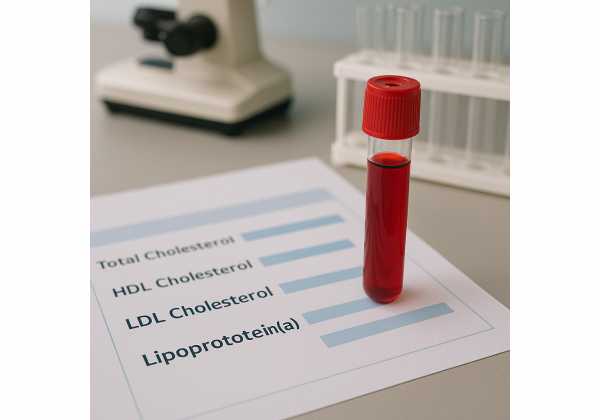
Lipoprotein(a), usually written as Lp(a) and pronounced “L-P-little-a,” is one of the most overlooked cardiovascular risk markers in preventive health. It is mostly inherited, usually stable for life, and does not appear on a standard cholesterol panel unless it is ordered separately. High Lp(a) raises the lifetime risk of heart attack, stroke, peripheral artery disease, and calcific aortic valve stenosis even when LDL cholesterol looks acceptable.
The practical message is simple: most adults should know their Lp(a) level at least once. A high result does not mean disease is inevitable, and a low result does not erase the need for healthy habits. It changes how seriously to manage the risks you can control, especially ApoB, LDL cholesterol, blood pressure, smoking, insulin resistance, inflammation, and family screening. Lp(a) is not a lifestyle score. It is a genetic risk signal that helps sharpen a long-term prevention plan.
Table of Contents
- What Lp(a) Is and Why It Matters
- Who Should Test Lp(a)
- How to Get Tested and Which Units Matter
- How to Read Lp(a) Results
- What High Lp(a) Means for Longevity
- What to Do If Lp(a) Is High
- Family Testing and When Children Should Be Checked
- Lp(a)-Lowering Drugs: What Is Promising but Not Settled
- A Practical Lp(a) Action Plan
What Lp(a) Is and Why It Matters
Lp(a) is a cholesterol-carrying particle in the blood. It looks like an LDL particle, but with an added protein called apolipoprotein(a), or apo(a), attached to apolipoprotein B-100. That extra apo(a) part changes the behavior of the particle.
LDL particles help drive plaque buildup in artery walls. Lp(a) does that too, but it also carries oxidized phospholipids, which are inflammatory fat-related molecules. This makes Lp(a) important for two overlapping reasons: it contributes to atherosclerosis, and it appears especially relevant to calcification of the aortic valve.
In everyday terms, Lp(a) is a “hidden inherited cholesterol risk.” It is hidden because a standard lipid panel reports total cholesterol, LDL cholesterol, HDL cholesterol, and triglycerides, but usually not Lp(a). It is inherited because the LPA gene strongly controls the level. Diet, weight loss, fasting, exercise, and supplements usually do not lower it in a meaningful or predictable way.
That last point often frustrates health-conscious people. Someone can eat well, train consistently, keep a healthy weight, and still have high Lp(a). The result is not a failure of discipline. It is closer to family history written into a blood marker.
Lp(a) matters in longevity because cardiovascular disease is not only a late-life issue. Artery plaque develops over decades. A person with high Lp(a) has a stronger reason to reduce all other sources of cardiovascular stress earlier, rather than waiting for a borderline risk score in later life.
Lp(a) also fills a common blind spot. Some people have a heart attack or need a stent despite “normal cholesterol.” In a portion of those cases, the missing pieces include ApoB particle burden, family history, blood pressure, diabetes risk, smoking history, kidney disease, inflammation, or high Lp(a). That is why Lp(a) works best as part of a broader risk picture, not as a standalone verdict.
For a fuller lipid picture, Lp(a) pairs well with ApoB and non-HDL cholesterol, because ApoB reflects the number of artery-entering particles across LDL, VLDL remnants, IDL, and Lp(a).
Who Should Test Lp(a)
Most adults should test Lp(a) once. Current lipid guidance has moved toward broad adult testing because high Lp(a) is common, inherited, and easy to miss. Testing once is usually enough because adult levels tend to stay fairly stable.
Testing is especially important when any of the following apply:
- A parent, sibling, or child had a heart attack, stroke, stent, bypass surgery, or peripheral artery disease at a young age.
- There is a family history of “bad cholesterol,” early cardiac death, or unexplained cardiovascular disease.
- You have had cardiovascular disease despite LDL cholesterol that did not look very high.
- You have familial hypercholesterolemia or very high untreated LDL cholesterol.
- You have aortic valve stenosis, especially at a younger age or without an obvious explanation.
- You have a borderline or intermediate cardiovascular risk score and need better risk clarification.
- You are deciding how aggressively to lower ApoB or LDL cholesterol.
- You are planning a long-term prevention strategy in your 30s, 40s, or 50s.
The “once in adulthood” approach is useful because a high result changes the intensity of prevention. It does not automatically mean medication, imaging, or procedures. It means the risk discussion gets more serious and more personalized.
A person with high Lp(a), high ApoB, high blood pressure, insulin resistance, and a smoking history has a very different risk profile from a person with high Lp(a), low ApoB, excellent blood pressure, no diabetes, no smoking, and a zero coronary artery calcium score. The Lp(a) number matters, but the surrounding risk environment matters too.
Lp(a) testing also helps explain risk in people who appear healthy by standard measures. A lean, active adult with good triglycerides and HDL cholesterol still benefits from knowing Lp(a), especially when family history is suspicious.
The test is not reserved for older adults. Earlier testing gives more time to act on modifiable risks. A 35-year-old with high Lp(a) has decades to keep ApoB, blood pressure, glucose, body composition, sleep, and smoking exposure under tight control. That is far more valuable than discovering high Lp(a) after plaque has already caused symptoms.
How to Get Tested and Which Units Matter
Lp(a) is a simple blood test. It does not require fasting, although it is often ordered with a lipid panel that may be fasting or nonfasting depending on the clinician’s preference and local lab rules.
Ask specifically for “lipoprotein(a)” or “Lp(a).” Do not assume it is included in your cholesterol panel. In many lab systems, it is a separate order.
The best report uses nmol/L, which counts the number of Lp(a) particles more directly. Some labs report mg/dL, which measures particle mass. Both units are still used, but they are not cleanly interchangeable because Lp(a) particles vary in size from person to person. A simple conversion factor gives only a rough estimate.
That matters because two people with the same mg/dL result may not have the same particle number. For this reason, many lipid experts prefer nmol/L when available.
A clean test plan looks like this:
- Order Lp(a) once with a standard lipid panel and ApoB if available.
- Prefer a lab that reports Lp(a) in nmol/L.
- Record the exact unit because 50 mg/dL and 50 nmol/L do not mean the same thing.
- If the result is unexpectedly high or the unit is unclear, repeat it once using a reliable lab.
- Avoid overinterpreting a result drawn during major illness, severe inflammation, pregnancy, major kidney changes, or unstable thyroid disease.
Lp(a) does not need frequent tracking the way LDL cholesterol, ApoB, A1c, blood pressure, or body weight often do. After one clear result, repeat testing is mainly useful when the first result was borderline, the lab method was unclear, a major medical state may have distorted the value, or a specific Lp(a)-lowering therapy becomes available and needs monitoring.
A good Lp(a) workup often includes related markers rather than repeated Lp(a) tests. ApoB, non-HDL cholesterol, LDL cholesterol, triglycerides, blood pressure, A1c, fasting glucose, kidney markers, smoking status, and family history all change the meaning of the result. If insulin resistance is part of the risk picture, A1c, fasting glucose, and fasting insulin give more context than Lp(a) alone.
How to Read Lp(a) Results
Lp(a) risk rises on a continuum. There is no magic line where risk suddenly appears. Still, practical ranges help people understand what the number usually means.
| Reported Lp(a) | Common interpretation | What it usually means in practice |
|---|---|---|
| <75 nmol/L or <30 mg/dL | Lower Lp(a)-related risk | Lp(a) is unlikely to be a major risk driver, but standard cardiovascular prevention still matters. |
| 75–124 nmol/L or 30–49 mg/dL | Intermediate or gray zone | Risk depends more on the full picture: ApoB, blood pressure, family history, glucose control, smoking, and imaging when appropriate. |
| ≥125 nmol/L or ≥50 mg/dL | High | Lp(a) becomes a meaningful risk-enhancing factor and usually justifies tighter control of other cardiovascular risks. |
| ≥250 nmol/L or roughly ≥100 mg/dL | Very high | Risk attention should intensify, especially when ApoB, LDL cholesterol, family history, or existing plaque is also present. |
| ≥430 nmol/L or roughly ≥180 mg/dL | Extremely high | This level deserves specialist-level discussion, especially with early family disease, aortic stenosis, or established ASCVD. |
The mg/dL values in this table are practical reference points, not exact conversions. A report in nmol/L should be interpreted in nmol/L. A report in mg/dL should be interpreted in mg/dL. Avoid converting back and forth as if the units were glucose or cholesterol units.
A high Lp(a) result does not diagnose blocked arteries. It identifies inherited risk. The next question is not “How do I lower Lp(a) tomorrow?” The better question is “How much total cardiovascular risk do I have, and which levers deserve more aggressive control?”
A useful interpretation includes these details:
- Age and sex
- Personal history of heart attack, stroke, stent, bypass surgery, peripheral artery disease, or aortic stenosis
- Family history of early cardiovascular disease
- ApoB, LDL cholesterol, non-HDL cholesterol, triglycerides, and HDL cholesterol
- Blood pressure, including home readings when possible
- Diabetes, insulin resistance, kidney disease, inflammatory disease, and smoking
- Coronary artery calcium score or other imaging when appropriate
For some people, a coronary artery calcium score helps clarify whether high inherited risk has already translated into visible calcified plaque. CAC is not a universal next step after high Lp(a), but it is often useful when treatment intensity is uncertain.
What High Lp(a) Means for Longevity
High Lp(a) matters because it adds lifelong pressure to the arteries and aortic valve. The higher the level, the greater the concern, especially when it combines with other risks.
The main outcomes linked to high Lp(a) include:
- Coronary artery disease, including heart attack
- Ischemic stroke
- Peripheral artery disease
- Calcific aortic valve stenosis
- Higher residual risk in some people already treated for LDL cholesterol
Aortic valve stenosis deserves special attention. This condition happens when the valve between the heart and the aorta becomes stiff and narrowed. Lp(a) is one of the strongest inherited blood markers associated with calcific aortic valve disease. People with very high Lp(a) and symptoms such as exertional chest pressure, breathlessness, fainting, or a new heart murmur need medical evaluation, not lifestyle troubleshooting.
For longevity, high Lp(a) changes priorities in three ways.
First, it makes “good enough” lipid control less convincing. If ApoB or LDL cholesterol is above target, high Lp(a) adds pressure to lower it. Statins do not meaningfully lower Lp(a), and in some people they slightly raise it, but they still reduce cardiovascular events by lowering LDL-related risk. A high Lp(a) result is not a reason to avoid proven LDL-lowering therapy when it is otherwise indicated.
Second, it makes blood pressure control more important. High blood pressure injures artery walls and increases stroke risk. When high Lp(a) is present, untreated or poorly measured blood pressure becomes a bigger missed opportunity. Accurate home blood pressure measurement often reveals patterns that office readings miss.
Third, it shifts the focus from short-term risk to lifetime risk. Many middle-aged adults have a low 10-year risk score because they are not old enough for the calculator to look alarming. High Lp(a) argues for a longer view. Prevention should start before symptoms, not after a stress test, stent, or valve problem.
High Lp(a) also affects how family history is interpreted. If several relatives had early cardiovascular disease, high Lp(a) may explain part of that pattern. If no one in the family has had events, the result still matters, but it should be interpreted with the rest of the risk picture.
What to Do If Lp(a) Is High
There is no approved everyday medication used solely to lower Lp(a) and prove fewer cardiovascular events in the general high-Lp(a) population. That does not make the test useless. It makes the plan more focused: reduce total risk around Lp(a).
Lower ApoB and LDL cholesterol more seriously
The most practical response to high Lp(a) is tighter control of ApoB-containing particles. ApoB is the better “particle count” marker, while LDL cholesterol estimates cholesterol mass. In high-risk prevention, clinicians often focus on ApoB, LDL cholesterol, or non-HDL cholesterol targets depending on the guideline and patient profile.
The right target depends on personal risk. Someone with established ASCVD and high Lp(a) usually needs much lower ApoB and LDL cholesterol than someone with high Lp(a) but no plaque, no diabetes, normal blood pressure, and no smoking history.
Therapies used to reduce LDL-related risk include statins, ezetimibe, PCSK9 inhibitors, bempedoic acid, and inclisiran, depending on risk level, treatment response, tolerance, access, and clinical setting. PCSK9 inhibitors also tend to lower Lp(a) modestly, often around 20–30%, but their main proven value remains major LDL and ApoB reduction.
Control blood pressure, glucose, and smoking exposure
High Lp(a) is not very responsive to lifestyle, but cardiovascular risk is. This distinction matters. You do not walk, lift, sleep, or eat vegetables to “fix” Lp(a). You do those things to reduce the number of other hits your arteries take over decades.
The highest-value habits are familiar but powerful:
- Do not smoke, vape nicotine, or live with heavy secondhand smoke exposure.
- Keep blood pressure in a healthy range with accurate measurement and treatment when needed.
- Build meals around minimally processed foods, fiber-rich plants, adequate protein, and unsaturated fats.
- Train both aerobic fitness and strength.
- Treat diabetes, insulin resistance, kidney disease, sleep apnea, and inflammatory conditions early.
- Maintain enough sleep and recovery to keep blood pressure, glucose, and appetite regulation steadier.
Inflammation is not the main explanation for every high-Lp(a) case, but chronic inflammatory disease can raise overall cardiovascular risk. When risk remains unclear, markers such as hs-CRP and other inflammation markers can add context.
Do not chase unproven supplement fixes
Niacin can lower Lp(a), but it has not shown convincing cardiovascular outcome benefits when added to modern lipid therapy, and side effects limit its use. It is not a routine Lp(a) solution.
Fish oil, garlic, bergamot, plant sterols, fiber, and similar options may improve certain lipid patterns in some people, but they do not reliably solve high Lp(a). Supplements should not distract from ApoB control, blood pressure treatment, diabetes prevention, smoking avoidance, and family screening.
Aspirin is more nuanced. Some studies suggest people with high Lp(a) or certain LPA-related genetic patterns may benefit more from aspirin, but bleeding risk is real. Do not start aspirin for Lp(a) without a clinician-guided discussion that includes age, ulcer history, bleeding risk, kidney disease, other medications, and overall cardiovascular risk.
Consider imaging when the result changes the decision
Imaging is most useful when it changes the plan. A CAC score can help decide how aggressive to be in primary prevention. Carotid ultrasound, coronary CT angiography, stress testing, or echocardiography belong in more specific clinical situations.
For aortic stenosis concerns, echocardiography is the key test. Symptoms, a murmur, or known valve disease should guide that decision.
Family Testing and When Children Should Be Checked
Lp(a) runs in families. If your result is high, first-degree relatives should consider testing. First-degree relatives include parents, siblings, and children. This is called cascade screening: one person’s result helps identify risk in the family before disease appears.
Family testing is especially important when high Lp(a) appears alongside early heart disease. “Early” usually means before age 55 in men or before age 65 in women, though any unusually young event deserves attention.
A family testing plan can be simple:
- Share the exact Lp(a) value and unit with relatives.
- Encourage adult first-degree relatives to test once.
- Ask relatives to record whether their lab reports nmol/L or mg/dL.
- Combine the result with their own ApoB, LDL cholesterol, blood pressure, glucose status, and smoking history.
- Repeat only when the first test was unclear, borderline, or taken during a medical state that may distort the result.
Children do not need universal Lp(a) testing in every family, but testing makes sense when a parent has very high Lp(a), familial hypercholesterolemia, or early ASCVD. Pediatric testing should be handled with a clinician who understands inherited lipid risk and avoids turning a child’s lab result into anxiety without a plan.
Family history is not always obvious. Some families have limited medical records, relatives who died suddenly without a clear diagnosis, or events labeled as “old age” even when they happened in midlife. High Lp(a) can help explain these patterns and create a prevention opportunity for younger relatives.
Lp(a) also has a genetics connection, but routine consumer genetic testing does not replace the blood test. The blood level is the clinically useful result. Genetic information can add context in selected cases, especially when broader inherited risk is being reviewed. For a wider view of what is and is not actionable, see genetics in longevity.
Lp(a)-Lowering Drugs: What Is Promising but Not Settled
Lp(a) treatment is changing quickly. Several investigational therapies sharply lower Lp(a) by targeting apo(a) production or Lp(a) assembly. The major categories include antisense oligonucleotides, small interfering RNA therapies, and oral small molecules.
Examples under study include pelacarsen, olpasiran, lepodisiran, zerlasiran, and muvalaplin. Some have lowered Lp(a) by large percentages in phase 1 or phase 2 trials. This is scientifically exciting because older options either did not lower Lp(a) enough, were not practical for broad use, or lacked outcome proof.
The key unanswered question is not whether these drugs lower Lp(a). Several clearly do. The key question is whether lowering Lp(a) with these drugs reduces hard outcomes such as heart attack, stroke, cardiovascular death, need for revascularization, or progression of aortic valve disease, with acceptable long-term safety.
That distinction matters. A biomarker can move in the right direction before outcome data prove that patients live longer or avoid events. For Lp(a), the biology and genetics strongly suggest causality, but clinical outcome trials still need to confirm the size of benefit, the best candidates, the best treatment threshold, dosing, safety, cost-effectiveness, and access.
Until those results are available and therapies are approved for routine use, high Lp(a) management remains risk reduction around the marker. The near-term plan is not passive waiting. It is aggressive control of the proven levers while the drug pipeline matures.
Lipoprotein apheresis is a special case. In some countries and specific high-risk situations, apheresis is used for very high Lp(a), often with established cardiovascular disease and other lipid disorders. It is invasive, time-intensive, and not a general solution for most people with high Lp(a).
A Practical Lp(a) Action Plan
Lp(a) becomes useful when it leads to clear next steps. The goal is not to collect a rare biomarker. The goal is to prevent avoidable cardiovascular disease.
Use this plan:
- Test once. Ask for Lp(a), preferably reported in nmol/L, along with a lipid panel and ApoB if available.
- Save the exact result and unit. Do not rely on memory. Record “125 nmol/L” or “50 mg/dL,” not just “high.”
- Place the result in context. Review ApoB, LDL cholesterol, non-HDL cholesterol, triglycerides, blood pressure, A1c, kidney function, smoking status, family history, and any signs of existing plaque or valve disease.
- Repeat only when useful. A second test is reasonable when the first result was unexpected, borderline, reported in an unfamiliar way, or drawn during a major illness or unstable medical condition.
- Treat modifiable risk with more urgency. High Lp(a) strengthens the case for lower ApoB and LDL cholesterol, better blood pressure control, diabetes prevention, smoking avoidance, exercise, and weight management when needed.
- Consider CAC or other imaging when it changes treatment. Imaging is not required for every high Lp(a) result, but it helps when the decision about medication intensity remains uncertain.
- Tell first-degree relatives. High Lp(a) is family information. Parents, siblings, and adult children should know they may benefit from testing.
- Avoid false reassurance and panic. Low Lp(a) does not make someone immune to heart disease. High Lp(a) does not guarantee disease. The result is a risk enhancer, not a destiny marker.
- Revisit the topic as therapies evolve. New Lp(a)-lowering drugs may change practice if outcome trials show fewer cardiovascular events and acceptable safety.
A useful way to think about Lp(a) is “inherited risk that raises the price of ignoring other risks.” You cannot choose your Lp(a) level. You can choose how early and how seriously to manage the risks that surround it.
For longevity, that is the real value of the test. It uncovers hidden lifetime cardiovascular risk while there is still time to act.
References
- A Focused Update to the 2019 NLA Scientific Statement on Use of Lipoprotein(a) in Clinical Practice 2024 (Scientific Statement)
- Lipoprotein(a) in atherosclerotic cardiovascular disease and aortic stenosis: a European Atherosclerosis Society consensus statement 2022 (Consensus Statement)
- High lipoprotein(a): Actionable strategies for risk assessment and mitigation 2024 (Review)
- 2025 Focused Update of the 2019 ESC/EAS Guidelines for the management of dyslipidaemias 2025 (Guideline)
- ACC/AHA issue updated guideline for managing lipids, cholesterol 2026 (Guideline News Release)
- Lepodisiran – A Long-Duration Small Interfering RNA Targeting Lipoprotein(a) 2025 (RCT)
Disclaimer
This article is educational and does not replace care from a qualified clinician. Lp(a) results should be interpreted with personal history, family history, medications, blood pressure, lipid markers, glucose status, and overall cardiovascular risk. Do not start, stop, or change lipid-lowering medication, aspirin, or other treatment based only on an Lp(a) result without medical guidance.