Blood pressure is one of the most useful at-home health signals because it reflects the daily load placed on arteries, the heart, kidneys, brain, and eyes. A single clinic reading often misses the pattern. Home readings show whether pressure stays controlled during ordinary mornings, evenings, meals, work stress, sleep routines, and medication schedules.
Accurate home measurement also prevents two common errors: treating a falsely high office reading as sustained hypertension, and missing high blood pressure that looks normal in the clinic. The value comes from a clean average, not from reacting to one number. A good monitor, correct cuff size, steady technique, and a simple schedule turn scattered readings into a reliable cardiovascular biomarker.
For longevity, the aim is sustained vascular protection over decades. Blood pressure that stays in a healthy range reduces strain on large arteries, protects small vessels in the brain and kidneys, and gives lifestyle changes a clear feedback loop.
Table of Contents
- Why Home Blood Pressure Matters for Longevity
- Choose a Monitor That You Can Trust
- Prepare and Position for Accurate Readings
- Use a Simple Measurement Schedule
- Understand Your Home Blood Pressure Average
- Turn Numbers Into Longevity Actions
- When Home Readings Need Medical Follow-Up
- Make Tracking Useful Without Becoming Obsessive
Why Home Blood Pressure Matters for Longevity
Home blood pressure shows the pressure your blood vessels handle during normal life. That makes it more useful than a single rushed clinic reading when you want to understand long-term cardiovascular load.
Blood pressure is written as systolic over diastolic, such as 122/76 mm Hg. Systolic pressure is the top number and reflects pressure during the heartbeat. Diastolic pressure is the bottom number and reflects pressure between beats. Both matter, but systolic pressure becomes especially important with age because arteries often stiffen over time.
High blood pressure harms the body quietly. It increases the workload of the left ventricle, damages artery walls, accelerates plaque-related risk, and stresses tiny vessels in the brain, kidneys, and retina. Over years, this contributes to stroke, heart failure, kidney disease, cognitive decline, and vascular dementia risk. Blood pressure control sits alongside lipids, glucose, body composition, fitness, and sleep as a core healthspan marker.
Home measurement improves the signal in three ways.
First, it uses repeated readings. Blood pressure changes from minute to minute. A clean seven-day home average gives a more stable picture than one office number.
Second, it reduces the white-coat effect. Some people read high in medical settings because of stress, pain, movement, or rushed measurement. Home readings help identify when clinic pressure overstates everyday pressure.
Third, it reveals masked hypertension. Some people look normal in the clinic but run high at home, during workdays, or overnight. Masked hypertension deserves attention because the arteries still experience the higher pressure.
Home blood pressure also pairs well with other longevity markers. For example, high blood pressure together with high ApoB, insulin resistance, low fitness, sleep apnea, kidney markers, or central adiposity signals a stronger need for prevention. If cardiovascular risk is part of the picture, lipid markers such as ApoB and non-HDL cholesterol help place blood pressure in a wider risk context.
Home readings do not replace clinical care. They improve it. A clinician still needs to consider medications, kidney function, diabetes, pregnancy, frailty, dizziness, atrial fibrillation, and the full cardiovascular risk profile. The home log gives that conversation better data.
Choose a Monitor That You Can Trust
A validated upper-arm cuff monitor is the best default choice for home blood pressure. Many devices are sold as blood pressure monitors, but not every model has passed formal accuracy testing.
Choose an automatic cuff-style device that measures at the upper arm. Wrist devices are more sensitive to position errors because the wrist must stay exactly at heart level. Finger devices are not reliable enough for routine blood pressure decisions. Smartwatches and cuffless wearables remain less dependable for medical blood pressure tracking unless they have been specifically validated for that use and calibrated as directed.
The cuff matters as much as the monitor. A cuff that is too small falsely raises readings. A cuff that is too large gives misleading results in the other direction. Measure the midpoint of your bare upper arm and match it to the cuff’s printed range. Common adult cuffs cover about 22–32 cm, while larger arms often need 32–42 cm or a wide-range cuff.
Before buying, look for these features:
- Upper-arm measurement
- Independent validation for clinical accuracy
- Cuff size that fits your arm circumference
- Memory storage for at least 60 readings
- Ability to average readings
- Simple display with systolic, diastolic, and pulse
- Irregular heartbeat alert, especially if you have palpitations or known rhythm issues
- Power adapter option if battery changes lead to missed readings
Bring the monitor to a medical visit at least once. A nurse, pharmacist, or clinician can compare your device reading with a properly measured clinic reading and check your technique. This does not “calibrate” most consumer devices in a technical sense, but it reveals major problems, wrong cuff size, and common positioning errors.
Replace a home monitor when readings become erratic, the cuff no longer inflates properly, the tubing cracks, the display fades, or the device has been used for many years without a reliability check. Keep the cuff clean and stored loosely. Do not fold the bladder sharply inside the cuff.
A validated monitor is especially important if home readings drive medication changes. Inaccurate devices lead to overtreatment, undertreatment, anxiety, and false reassurance. Accuracy comes before app features.
Prepare and Position for Accurate Readings
Proper technique often changes the reading by 5–20 mm Hg. That difference is large enough to move someone from “controlled” to “high,” or from “high” to “normal.” Technique is part of the test.
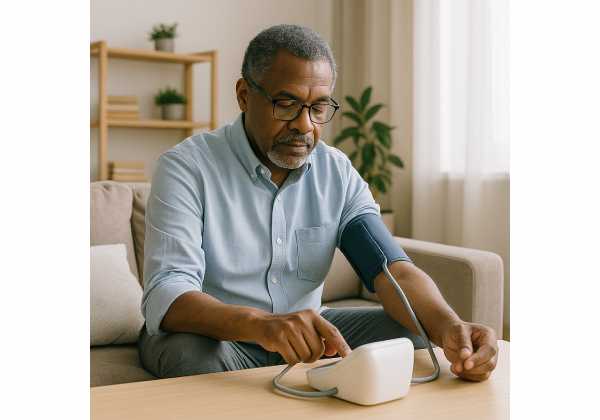
Use the same basic setup each time. Measure in a quiet room, seated, with the cuff on bare skin. Rest for five minutes before pressing start. During that rest, avoid talking, scrolling stressful messages, walking around, or multitasking.
The most accurate home position looks simple:
- Sit with your back supported.
- Keep both feet flat on the floor.
- Do not cross your legs.
- Rest the arm on a table.
- Keep the cuff at heart level.
- Place the cuff on bare skin, not over clothing.
- Keep the cuff’s artery marker aligned with the inside of the arm if the cuff has one.
- Stay silent and still during the reading.
Avoid caffeine, nicotine, vigorous exercise, and a hot shower for at least 30 minutes before measurement. Empty your bladder first. A full bladder raises blood pressure in some people. Measure before meals when possible, or use the same timing each day so your average stays comparable.
Do not measure immediately after an argument, bad news, rushing upstairs, heavy lifting, or a cold plunge. Those readings show a stress response, not resting blood pressure. They still reveal how your body reacts, but they should not go into the standard resting average.
Common technique errors
Several errors create falsely high readings. A dangling arm increases pressure because the cuff sits below heart level. Crossing the legs raises pressure in many people. Talking during the reading adds noise. A cuff over clothing, especially thick fabric, distorts the result. Measuring too soon after sitting down captures the pressure of recent movement.
Other mistakes create confusion rather than a simple false high. Switching arms randomly, changing from morning to afternoon measurement, using a wrist cuff sometimes and an upper-arm cuff other times, or taking readings only when anxious makes the log hard to interpret.
Use one arm for routine tracking. At first, measure both arms on one or two occasions. If one arm regularly reads higher, use that arm and tell your clinician. A consistent difference between arms deserves clinical attention, especially if the systolic gap is large.
What to do with a surprising reading
One high reading does not define your blood pressure. Stay seated, check your position, breathe normally, and repeat the reading after one to two minutes. If the second reading is much lower, the first was likely affected by movement, stress, cuff placement, or normal variability.
Do not keep measuring ten times until the number improves. That habit trains anxiety and produces a messy log. Two readings per session are enough for most home protocols. Use the average, not the most comforting number.
Use a Simple Measurement Schedule
A seven-day schedule gives a reliable home baseline. Take two readings in the morning and two in the evening, one minute apart, for seven days. Average the readings after discarding the first day if your clinician uses that method. Even without discarding day one, the full week gives far better information than occasional checks.
Morning readings work best before caffeine, breakfast, exercise, and blood pressure medication unless your clinician tells you otherwise. Evening readings work best before dinner or at least several hours after exercise and alcohol. Use times that fit your real life. Consistency beats perfection.
A standard baseline week looks like this:
| Situation | Schedule | How to use the result |
|---|---|---|
| New baseline | Two morning and two evening readings for 7 days | Average the readings and share them with your clinician |
| Medication change | Repeat the 7-day schedule after the medication reaches steady use | Compare the new average with the previous average |
| Stable, controlled pressure | Measure a few days per month or as advised | Confirm the trend without daily checking |
| New symptoms | Measure during symptoms if safe, then follow clinical advice | Look for very high, very low, or irregular pulse patterns |
| Possible white-coat or masked hypertension | Use home readings and consider 24-hour monitoring | Confirm whether pressure is truly high outside the clinic |
The average matters more than the day-to-day swings. A morning of 138/84 after poor sleep followed by several days around 122/76 means something different from a steady week of 138/84. The first pattern points to a trigger. The second points to sustained pressure.
Ambulatory blood pressure monitoring offers a deeper look when home and clinic readings disagree, when nighttime pressure is suspected, or when treatment decisions remain unclear. A 24-hour monitor measures during daytime activity and sleep, which helps identify nocturnal hypertension and non-dipping patterns. Those patterns are important because nighttime blood pressure often predicts cardiovascular and brain risk strongly. For more on that distinction, see ambulatory and nighttime blood pressure monitoring.
Home monitoring frequency should match the decision in front of you. During a baseline week, measure carefully. During stable months, measure less often. During medication titration, follow the schedule set by your clinician. Daily measurement forever is rarely necessary for a calm, accurate plan.
Understand Your Home Blood Pressure Average
Your home blood pressure average is the number to track. A single reading reflects the moment. An average reflects your usual resting pressure.
Different guidelines use different categories and treatment targets, and clinicians tailor targets to age, cardiovascular risk, kidney disease, diabetes, medication tolerance, dizziness, fall risk, and frailty. Still, the ranges below give a practical way to understand most home averages in adults.
| Home average | Plain meaning | Usual next step |
|---|---|---|
| Below 120/80 mm Hg | Healthy range for many adults | Maintain habits and recheck periodically |
| 120–129 systolic and below 80 diastolic | Elevated systolic pressure | Improve lifestyle levers and watch the trend |
| 130–134 or 80–84 mm Hg | Borderline to mildly high, depending on guideline and risk profile | Review overall cardiovascular risk and repeat a clean baseline week |
| 135/85 mm Hg or higher | Common home threshold used to support hypertension diagnosis in many settings | Discuss confirmation and treatment planning with a clinician |
| 160/100 mm Hg or higher | Clearly high if repeated correctly | Seek timely medical guidance |
| 180/120 mm Hg or higher | Severely elevated | Repeat after resting; urgent care is needed if it persists or symptoms occur |
Many longevity-minded adults aim for a home average under 130/80 mm Hg when it is safe and tolerated. Some high-risk adults benefit from lower systolic targets under medical supervision. Lower is not always better for every person. Very low pressure with dizziness, fainting, falls, weakness, or poor kidney tolerance needs review.
Diastolic pressure also deserves nuance. A diastolic number in the 80s often supports lifestyle changes and risk review. A very low diastolic pressure, especially in older adults with coronary artery disease, needs individualized care because the heart receives much of its blood flow between beats.
Pulse pressure, the gap between systolic and diastolic pressure, adds context. A reading of 150/70 has a pulse pressure of 80, which often reflects stiffer arteries in older adults. A reading of 128/88 has a different pattern, with more diastolic load. The treatment conversation differs.
Blood pressure also interacts with brain aging. Long-term hypertension damages small vessels and contributes to white matter changes, silent infarcts, stroke risk, and cognitive decline. Sustained control in midlife is one of the most practical ways to protect vascular brain health. The connection is covered more fully in hypertension and brain longevity.
Turn Numbers Into Longevity Actions
Home blood pressure works best when each trend leads to a clear action. The action does not always mean medication. It often means better measurement, better sleep, less sodium, more potassium-rich foods, improved fitness, weight reduction where needed, less alcohol, or treatment for sleep apnea.
Start with the average and the pattern. Ask four questions:
- Is the seven-day average above the agreed target?
- Are morning readings consistently higher than evening readings?
- Are readings high after poor sleep, alcohol, late meals, pain, or stress?
- Are readings high despite good technique and repeated measurement?
Lifestyle changes lower blood pressure through different routes. Sodium reduction reduces fluid-related pressure in salt-sensitive people. Potassium-rich foods support vascular tone, but people with kidney disease or certain medications need clinician guidance before pushing potassium high. Aerobic training improves endothelial function and arterial flexibility. Resistance training supports insulin sensitivity and body composition. Weight loss lowers pressure when central adiposity is part of the driver. Alcohol reduction often lowers evening and next-morning readings.
Food patterns matter. A Mediterranean-style or DASH-style pattern emphasizes vegetables, fruit, beans, lentils, intact grains, nuts, seeds, yogurt or other minimally processed dairy if tolerated, fish, and olive oil. It reduces highly processed salty foods, processed meats, and frequent refined carbohydrate loads. For a nutrition-focused view, dietary patterns for blood pressure and healthy aging connect the food choices with practical meals.
Fitness changes also show up in the log. Zone 2 aerobic work, brisk walking, cycling, swimming, and incline walking often lower resting pressure over weeks to months. Strength training helps when programmed well, but breath-holding and maximal straining can spike pressure during lifts. People with uncontrolled hypertension should get medical guidance before heavy lifting, high-intensity intervals, sauna, cold plunges, or aggressive heat exposure.
Central adiposity is a strong blood pressure driver because visceral fat promotes insulin resistance, inflammation, sympathetic nervous system activation, and kidney sodium retention. Waist-to-height ratio gives a simple home signal that pairs well with blood pressure. A practical guide to waist measurements and waist-to-height ratio helps track that risk without relying only on scale weight.
Kidney health belongs in the conversation. The kidneys help regulate fluid balance, sodium handling, and blood vessel tone. High blood pressure damages kidney filters, and kidney disease raises blood pressure. A basic longevity-oriented check often includes eGFR and urine albumin-to-creatinine ratio. Those markers are explained in kidney health testing for healthy aging.
Medication is a tool, not a failure. When home averages remain high after accurate measurement and lifestyle work, medication lowers risk. Many people need more than one medication class because blood pressure has several drivers. Low-dose combinations often work better and cause fewer side effects than pushing one drug to a high dose. Medication decisions should consider age, kidney function, electrolytes, diabetes, gout, pregnancy plans, heart disease, side effects, and drug interactions.
When Home Readings Need Medical Follow-Up
Repeated high home readings deserve medical review, especially when the average stays at or above 135/85 mm Hg or when readings exceed the target already set by your clinician. Do not wait months if readings are clearly high, rising, or paired with other risk factors.
Seek urgent help for blood pressure around 180/120 mm Hg or higher if it remains high after five minutes of quiet rest, especially with chest pain, shortness of breath, severe headache, confusion, weakness, numbness, vision changes, fainting, severe back pain, or trouble speaking. Those symptoms raise concern for a hypertensive emergency, stroke, heart strain, or another serious condition.
Very low readings also need attention when symptoms occur. Lightheadedness on standing, fainting, falls, confusion, unusual fatigue, or weakness can signal overtreatment, dehydration, bleeding, infection, medication effects, or rhythm problems. A low number without symptoms is less concerning, but repeated systolic readings below about 90–100 mm Hg should be discussed if they are new.
Several patterns deserve a clinician’s help:
- Clinic readings high, home readings normal
- Clinic readings normal, home readings high
- Morning readings much higher than evening readings
- Large swings without a clear reason
- Repeated irregular heartbeat alerts
- Systolic pressure high while diastolic pressure stays low
- Blood pressure rising after starting a new medication
- New high readings with headaches, snoring, poor sleep, or weight gain
- Persistent readings above target despite taking medication correctly
Sleep apnea is a common hidden driver. Clues include loud snoring, witnessed pauses in breathing, morning headaches, dry mouth, nighttime urination, daytime sleepiness, and resistant hypertension. Treating sleep apnea improves more than blood pressure; it supports energy, metabolic health, and brain health. The basics are covered in sleep apnea testing and treatment.
Secondary hypertension means high blood pressure caused by another condition or medication. It is more likely when hypertension starts suddenly, appears at a young age, becomes severe, resists three medications, or comes with low potassium, kidney abnormalities, episodic sweating and palpitations, or sudden worsening. Possible causes include kidney artery narrowing, primary aldosteronism, sleep apnea, thyroid disease, medication effects, stimulant use, and excess alcohol.
Do not adjust prescription medication based only on one home reading unless your clinician gave a specific plan. A safe plan uses averages, symptoms, pulse, medication timing, and risk factors.
Make Tracking Useful Without Becoming Obsessive
Blood pressure tracking should make life calmer, not smaller. The best system turns readings into decisions while avoiding constant checking.
Use short tracking blocks. A seven-day baseline, a seven-day check after a treatment change, and occasional maintenance checks give enough information for most people. Continuous daily checking often increases anxiety and creates noise. More data is not always better data.
Record the details that explain the number. A useful log includes date, time, systolic, diastolic, pulse, arm used, medication timing, and notes such as poor sleep, alcohol, pain, travel, illness, or unusual stress. Keep notes brief. The aim is pattern recognition, not a diary of every sensation.
A simple note format works well:
- 7:10 a.m., before coffee and medication, 126/78, pulse 62
- Slept 5 hours, salty restaurant dinner last night
- Second reading after 1 minute: 123/77
After a week, look for the average and repeated triggers. If salty meals raise next-morning pressure by 8–12 mm Hg, you have useful feedback. If poor sleep raises systolic pressure but it normalizes after recovery, sleep becomes a prevention lever. If readings stay high even during calm weeks, the issue is sustained pressure, not just stress.
Do not chase perfect numbers. Blood pressure is a living signal. It rises during movement, emotion, cold exposure, pain, full bladder, and exertion. Healthy physiology includes rises and falls. The longevity concern is sustained resting pressure, exaggerated patterns, and total risk over time.
Share clean summaries with clinicians. A one-page average is more useful than screenshots of dozens of readings. Include the seven-day morning average, evening average, overall average, highest reading, lowest reading, symptoms, and current medication timing. This helps avoid rushed decisions based on isolated numbers.
Pair blood pressure with a small set of related markers. Resting heart rate, body weight trend, waist-to-height ratio, sleep quality, exercise minutes, alcohol intake, sodium-heavy meals, eGFR, urine albumin, A1c, fasting glucose, and ApoB add context. Too many metrics dilute attention. Choose the few that guide action.
A useful home blood pressure routine has a rhythm: measure carefully, average honestly, act on the pattern, and then stop checking until the next planned window. That rhythm protects both vascular health and peace of mind.
References
- 2025 AHA/ACC/AANP/AAPA/ABC/ACCP/ACPM/AGS/AMA/ASPC/NMA/PCNA/SGIM Guideline for the Prevention, Detection, Evaluation, and Management of High Blood Pressure in Adults 2025 (Guideline)
- 2024 ESC Guidelines for the Management of Elevated Blood Pressure and Hypertension 2024 (Guideline)
- Hypertension Canada guideline for the diagnosis and treatment of hypertension in adults in primary care 2025 (Guideline)
- 2021 European Society of Hypertension practice guidelines for office and out-of-office blood pressure measurement 2021 (Guideline)
- How to find and use validated blood pressure measuring devices 2023 (Review)
- Final Report of a Trial of Intensive versus Standard Blood-Pressure Control 2021 (RCT)
Disclaimer
This article is educational and does not replace care from a qualified health professional. Blood pressure targets and treatment plans should be individualized, especially for people with cardiovascular disease, kidney disease, diabetes, pregnancy, dizziness, frailty, medication side effects, or very high readings. Seek urgent medical help for severely elevated blood pressure with symptoms such as chest pain, shortness of breath, weakness, confusion, severe headache, or vision changes.