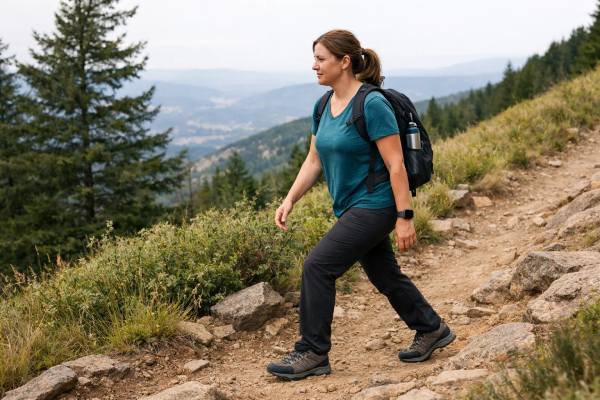
Hiking can be an excellent tool for weight loss because it combines steady calorie burn, low-to-moderate joint impact, and a level of enjoyment that many people find easier to stick with than gym cardio. It is often more demanding than a normal walk because of hills, uneven ground, longer duration, and sometimes extra load from water, food, or gear.
That does not make hiking a magic shortcut. It works best as part of a bigger fat-loss plan that includes a manageable calorie deficit, regular weekly movement, and enough recovery to keep going. This guide breaks down how many calories hiking can burn, the real benefits beyond the calorie number, how to hike safely for fat loss, and a simple weekly plan you can actually follow.
Table of Contents
- Can hiking help you lose weight
- How many calories does hiking burn
- Why hiking works so well
- Who hiking suits best
- How to hike for better results
- 4-week hiking plan
- Mistakes that limit progress
Can hiking help you lose weight
Yes, hiking can help you lose weight, and for many people it is one of the most practical ways to do it.
At a basic level, hiking supports fat loss the same way other forms of cardio do: it raises your total energy expenditure. But hiking has a few extra strengths that make it especially useful in real life. It tends to last longer than many gym sessions, it often feels less repetitive than indoor cardio, and it can be scaled up or down by adjusting distance, terrain, elevation, pace, and pack weight.
That matters because adherence is often the deciding factor. A workout only helps if you keep doing it. Many people can force themselves through a hard machine session for a week or two, then lose interest. Hiking often feels less like punishment and more like an activity, which can make it easier to repeat consistently.
It is also a good fit for people who do not enjoy running. Compared with running, hiking is usually easier on the joints, more manageable for heavier bodies, and less intimidating for beginners. Compared with flat walking, it is often more demanding because of incline, uneven surfaces, and longer time on your feet.
Still, the most important point is this: hiking helps create the energy deficit, but it does not replace nutrition. If food intake quietly climbs to match or exceed what you burned, weight loss can stall. That is why hiking works best when paired with a realistic eating strategy rather than a “I hiked, so I earned anything” mindset.
Another reason hiking can be effective is that it blends exercise and extra daily movement. A single hike can add a meaningful number of steps, minutes of moderate activity, and time spent standing instead of sitting. That combination can be more useful than short, all-out workouts that leave you wiped out and less active for the rest of the day.
Hiking is also flexible. You can use it in different ways depending on your current level:
- As a beginner cardio option done once or twice a week
- As a longer weekend session that complements shorter weekday workouts
- As your main form of cardio while you build a broader routine
- As a low-impact alternative when harder training feels unsustainable
If your current baseline is mostly sedentary, hiking may feel like a major step up from normal activity. If you already walk regularly, it can be the more challenging next layer. In that sense, hiking often sits between ordinary walking and more intense endurance training. It can also pair well with a foundation of regular walking for weight loss and a broader understanding of which forms of exercise help most with fat loss.
The key is not to treat every hike like a competition. Hiking helps weight loss most when it becomes something you can do often enough to matter.
How many calories does hiking burn
Hiking can burn a significant number of calories, but the exact amount varies widely. The biggest factors are body weight, hiking pace, trail steepness, terrain, total time, and whether you are carrying a pack.
That means there is no single calorie number that applies to everyone. A flat, easy trail for 45 minutes is not the same as a two-hour uphill hike with rocky footing and a daypack.
As a rough rule, hiking usually burns more than an easy walk on flat pavement and less than hard running per minute. But because hikes often last longer, total calorie burn for the session can be substantial.
| Body weight | Easier hike | Moderate hike | Steeper or more vigorous hike |
|---|---|---|---|
| 150 lb | 260 to 330 | 350 to 450 | 500 to 650 |
| 180 lb | 310 to 400 | 420 to 540 | 600 to 780 |
| 210 lb | 360 to 470 | 490 to 630 | 700 to 900 |
These are estimates, not promises. Real-world hiking is messy in the best possible way. Stops for photos, trail conditions, heat, altitude, switchbacks, and steep descents all affect actual output.
A few things push calorie burn upward:
- more body mass
- longer total duration
- steeper climbs
- uneven terrain
- faster pace
- carrying a daypack
- using poles on climbs
- less stopping
A few things lower it:
- long breaks
- very easy terrain
- short routes
- slow pace
- mostly downhill routes
- frequent standing rest
The common mistake is to focus only on the hourly number. For fat loss, the bigger question is often total weekly hiking volume. One 90-minute moderate hike may matter more than a very intense but short burst you rarely repeat.
It also helps to understand where hiking fits compared with similar activities. Flat urban walking is usually easier to recover from and easier to do daily. Hiking tends to burn more per session when the trail includes elevation or rough terrain. Carrying a daypack can move it even closer to the effort of activities like rucking for fat loss. If you want a broader sense of how hiking compares with other cardio options, a reference point on calories burned by common exercises can help.
There is another subtle point here: calorie trackers often struggle with hiking. Wrist wearables may misread elevation, trail irregularity, and stop-start patterns. So it is smart to treat device numbers as rough guides rather than exact values. When in doubt, trust the longer trend: Are you hiking consistently? Is your weekly activity higher? Is your body weight or waist size moving in the right direction over time?
That matters more than whether one watch says you burned 487 calories and another says 561.
Why hiking works so well
Hiking helps weight loss partly because it burns calories, but its real value goes beyond the calorie number.
First, hiking is often easier to sustain psychologically than indoor cardio. A trail gives you scenery, variation, and a sense of destination. That can make time pass faster and reduce the mental drag that causes many people to abandon treadmill or bike sessions. In practice, people often move longer when the environment feels engaging.
Second, hiking builds cardiovascular fitness without necessarily feeling like formal training. Over time, climbs that leave you winded become manageable. Your recovery improves. Longer outings feel less intimidating. That improved fitness can spill into the rest of the week, making other movement easier too.
Third, hiking uses more than just your heart and lungs. Uneven terrain challenges the lower body, core, and stabilizing muscles in ways flat ground does not. A trail with gradual climbs can work your glutes, calves, and hips much more than a standard neighborhood walk. That does not replace strength training, but it adds a useful layer of whole-body demand.
Fourth, hiking can support consistency by improving mood. Many people find outdoor activity more mentally refreshing than indoor exercise. That matters for long-term fat loss because better mood, lower stress, and a stronger weekly routine can improve adherence across food, sleep, and exercise habits.
There is also a practical benefit: hiking often turns into a bigger movement day overall. You may walk before the trail, on the trail, after the trail, and stay generally more active during the outing. That can make a hiking day different from a gym day where you exercise for 30 minutes and then sit for most of the rest of the day.
Here is what makes hiking especially useful:
- It can feel enjoyable enough to repeat.
- It is easy to scale from beginner to advanced.
- It usually adds meaningful steps and active time.
- It can be social without being highly competitive.
- It works for many people who dislike high-impact exercise.
That said, hiking is not perfect. Weather, trail access, and time can be barriers. A long weekend hike does not fully replace the value of moving during the rest of the week. And if the route is too difficult too soon, soreness and recovery demands can backfire.
That is why hiking works best as part of a wider plan rather than as the only thing you do. Many people do well with one or two hikes per week plus shorter weekday cardio, daily steps, and some strength training. If you want to understand the aerobic effort side more clearly, hiking often falls into the same broad range as steady moderate cardio, especially on longer conversational-pace trails. It also pairs well with a more intentional weekly structure like a balanced workout schedule for weight loss.
In other words, hiking works so well not because it is magical, but because it blends calorie burn, challenge, enjoyment, and repeatability unusually well.
Who hiking suits best
Hiking can suit a wide range of people, but it is not equally easy for everyone right away.
It tends to work especially well for:
- people who enjoy being outdoors
- people who get bored with indoor cardio
- beginners who want a more interesting form of walking
- people with enough base fitness to stay on their feet for 45 to 120 minutes
- those trying to increase weekly calorie burn without running
It can also be an excellent middle ground for people who want more than casual walking but are not ready for running, jumping, or high-intensity intervals.
Still, some people need a slower on-ramp.
You may want to start more cautiously if you:
- have significant knee, ankle, or foot pain
- have poor balance or a strong fear of uneven terrain
- are carrying a lot of extra body weight and get very sore from longer walks
- have heart, lung, or metabolic conditions that affect exertion tolerance
- take medications that affect hydration, heart rate, or heat tolerance
That does not mean hiking is off-limits. It usually means the trail choice matters more. Many people start with flatter dirt paths, gravel routes, or park loops before moving into steeper or more technical terrain.
A smart beginner progression often looks like this:
- Start with flatter, shorter routes.
- Focus on time, not pace.
- Hike at an effort where you can still speak in short sentences.
- Add elevation only after easy terrain feels comfortable.
- Use poles or better footwear if footing feels unstable.
Footwear matters more than people expect. You do not always need heavy boots, especially on easier trails, but you do need shoes with grip, comfort, and enough support for the distance. Soreness in the arches, calves, or knees often comes from doing too much, too soon in shoes that are not right for the trail.
Warm-up and recovery matter too. A brief prep routine before the hike can improve comfort on climbs and descents:
- easy walking for 5 minutes
- ankle circles
- calf raises
- bodyweight squats
- leg swings if you tolerate them well
For people with knee issues or a low-impact requirement, hiking is often still possible, but route selection becomes essential. Gentler surfaces and modest inclines usually work better than steep descents and rocky trails. If joint comfort is your biggest concern, it may help to compare hiking with other joint-friendly cardio options. A simple pre-hike routine from a mobility and recovery guide can also help reduce that stiff, awkward first mile feeling.
As for safety, see a clinician before starting harder hikes if you have chest pain with exertion, unexplained dizziness, severe breathlessness, or any condition that makes exercise riskier. Bring water, tell someone your route on less populated trails, and do not treat a weight-loss goal as a reason to ignore basic trail safety.
How to hike for better results
Hiking for weight loss works best when you make it intentional without turning it into misery.
The first principle is simple: choose a hike you can actually repeat. A route that leaves you wrecked for three days is usually less useful than one that challenges you but still allows consistent weekly activity.
Use effort, not ego
A productive hiking pace is usually one where breathing is clearly elevated but still controlled. On easier terrain, you may be able to talk in full sentences. On climbs, you may need shorter phrases. That is fine. You do not need to “redline” the whole hike for it to help with fat loss.
Progress one variable at a time
The safest ways to make hiking more effective are:
- hike a little longer
- choose a slightly hillier route
- reduce the number of long breaks
- hike a bit more briskly on flatter sections
- add a second hike that week
Do not increase distance, steepness, pack weight, and pace all at once.
Use the terrain strategically
A useful hiking pattern is:
- easy first 10 minutes
- steady middle section
- strongest effort on the main climb
- controlled descent
- easy final cooldown
This gives you a more structured workout without needing intervals on a watch.
Do not ignore food and hydration
Longer hikes can make people feel they earned a huge post-hike meal. That is one of the most common reasons hiking does not lead to the expected fat-loss result. The answer is not to under-eat during long outings. It is to keep the full day in perspective.
For hikes under about 60 to 90 minutes, many people only need water and their normal meals. For longer hikes, especially in heat, you may need fluids, electrolytes, and a snack. Good options are simple and portable:
- fruit
- yogurt before leaving
- a protein bar
- trail mix in a controlled portion
- a sandwich for longer hikes
Try to finish the day feeling refueled, not ravenous. Many people do better when the post-hike meal includes protein, produce, and a reasonable carb source rather than a pure “reward meal.” A practical starting point is to build meals around foods that work well in a calorie deficit and to think ahead about post-workout eating after exercise.
Track the right things
Useful hiking progress markers include:
- total weekly hike minutes
- total weekly steps
- route difficulty
- elevation gained
- pace on familiar trails
- how you feel the next day
- body weight trend over several weeks
Those matter more than chasing a single giant session. Hiking helps fat loss most when it fits cleanly into your week instead of exhausting your whole recovery budget.
4-week hiking plan
This plan is designed for beginners who can already handle a normal 30-minute walk. It uses two hiking days per week, one optional easy movement day, and basic strength work to support the legs and protect muscle while losing weight.
| Week | Hike 1 | Hike 2 | Optional extra movement | Strength work |
|---|---|---|---|---|
| 1 | 45 minutes easy trail | 60 minutes easy to moderate trail | 1 easy 20 to 30 minute walk | 2 short sessions |
| 2 | 50 minutes with a few hills | 70 minutes moderate trail | 1 easy 25 to 35 minute walk | 2 short sessions |
| 3 | 60 minutes steady trail | 80 to 90 minutes moderate trail | 1 easy recovery walk | 2 short sessions |
| 4 | 60 minutes with stronger climbs | 90 to 120 minutes moderate trail | 1 easy walk or full rest | 2 short sessions |
How the week can look
A repeatable weekly layout might be:
- Monday: Strength training
- Tuesday: Easy walk or rest
- Wednesday: Shorter hike
- Thursday: Strength training
- Friday: Easy walk or rest
- Saturday: Longer hike
- Sunday: Full rest or very light movement
This structure works because it spreads stress across the week instead of stacking everything onto the weekend. The shorter midweek hike helps maintain frequency. The longer weekend hike builds calorie burn and hiking fitness.
What the strength work should include
Keep it simple:
- squat or sit-to-stand
- hinge or Romanian deadlift pattern
- split squat or step-up
- push-up variation
- row variation
- calf raises
- core stability
You do not need long gym sessions. Twenty to thirty minutes is enough. The goal is to keep the legs, hips, and trunk strong enough to tolerate more trail time. A simple beginner strength routine can be adapted down to two sessions if needed.
How hard should the hikes feel
Most of the hike should sit around a moderate effort. On climbs, the effort can rise, but you should not feel like you are racing. You want to finish tired but functional, not trashed.
When to progress
Move forward when:
- soreness is manageable
- the current duration feels doable
- your feet and joints recover well
- you are not dreading the next hike
Stay at the same week longer if:
- your knees or feet are flaring up
- recovery is dragging
- life stress is high
- you are already struggling to eat and sleep well
A plan only works if it can survive a normal month. When in doubt, repeat a manageable week instead of forcing a jump.
Mistakes that limit progress
Hiking can be a great fat-loss tool, but a few common mistakes keep people from seeing results.
Overestimating calorie burn
Hikes can burn a lot, but they are still often over-credited. Watches are imperfect, and one long hike does not erase an entire week of overeating. Treat calorie estimates as rough, not precise.
Doing only weekend hikes
A big Saturday hike is helpful, but fat loss usually improves when activity is spread more evenly through the week. One or two additional easy movement days can matter a lot.
Choosing trails that are too hard too soon
Very steep routes may feel impressive, but they can also wreck recovery, irritate joints, and make the next week less active. Build capacity first.
Ignoring descents
People often focus only on the climb, but steep downhills can be what really batters the quads and knees. Controlled descents, poles, and good route selection matter.
Reward eating after every hike
This is probably the most common fat-loss problem with hiking. A hard trail can create strong hunger, but “I earned this” eating can quickly wipe out the calorie gap.
Skipping strength training
Hiking trains the body, but it is not a complete muscle-retention plan on its own. If you are losing weight, some resistance work helps preserve lean mass and makes hikes feel easier.
Using hiking as the only plan
Hiking is powerful, but it works best when it sits inside a larger system:
- a manageable calorie deficit
- enough protein
- some strength training
- daily movement on non-hiking days
- realistic recovery
If progress slows despite consistent hikes, the answer is not always “hike harder.” Sometimes the issue is underestimating food intake, overestimating burned calories, or letting the rest of the week go soft after a big trail day.
The most effective way to think about hiking is this: it is a high-value cardio option that can make weight loss more enjoyable, not a loophole that removes the need for structure. Used well, it can help you burn calories, build endurance, improve mood, and stay active long enough to actually see results.
References
- WHO guidelines on physical activity and sedentary behaviour 2020 (Guideline)
- Aerobic Exercise and Weight Loss in Adults: A Systematic Review and Dose-Response Meta-Analysis 2024 (Systematic Review)
- 2024 Adult Compendium of Physical Activities: A third update of the energy costs of human activities 2024 (Review Report)
- The Effects of Outdoor versus Indoor Exercise on Psychological Health, Physical Health, and Physical Activity Behaviour: A Systematic Review of Longitudinal Trials 2023 (Systematic Review)
- Effects of urban green exercise on mental health: a systematic review and meta-analysis 2025 (Systematic Review)
Disclaimer
This article is for general educational purposes only and is not a substitute for medical advice, diagnosis, or treatment. If you have heart or lung disease, balance problems, significant joint pain, or symptoms such as chest pain, faintness, or unusual shortness of breath during exercise, speak with a qualified clinician before starting a hiking plan.
If this article was useful, share it on Facebook, X, or your preferred platform to help someone else use hiking more effectively for weight loss.