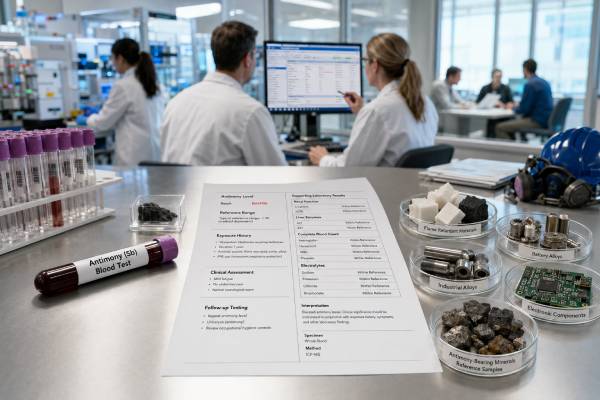
An antimony blood test checks for antimony, a naturally occurring metalloid that can enter the body through industrial dust, contaminated materials, certain products, some medicines, and environmental exposure. Most people have very low antimony exposure, and a detectable result does not automatically mean poisoning. The result becomes more important when it is above the lab’s reference range, rising on repeat testing, linked to a known workplace or environmental source, or paired with symptoms such as stomach upset, cough, chest symptoms, abnormal heart rhythm, or significant fatigue. Blood testing can help document recent or current exposure, but it is only one part of the evaluation. Timing, specimen quality, the form of antimony, urine testing, kidney and liver markers, and the exposure story all affect interpretation. A high result should be reviewed with a clinician, occupational medicine specialist, medical toxicologist, or poison control center when symptoms or a clear exposure are present.
- Antimony is not an essential nutrient, so blood levels are expected to be very low or below the lab’s reporting limit.
- A high antimony blood result usually points to recent or ongoing exposure, sample contamination, or antimony-containing medical treatment.
- Blood antimony is useful for recent exposure, while urine antimony is often used to assess absorbed antimony that is being excreted.
- Common exposure sources include smelting, flame-retardant materials, metal alloys, batteries, shooting ranges, dust, pigments, glass, ceramics, and some antimonial drugs.
- Urgent care is warranted after known ingestion, heavy inhalation, severe vomiting or diarrhea, fainting, chest pain, palpitations, confusion, or breathing trouble.
Table of Contents
- What the Antimony Blood Test Measures
- Normal Range and What Your Result Can Mean
- Causes of High Antimony Blood Levels
- Symptoms, Toxicity, and When Antimony Becomes Dangerous
- Blood vs Urine Antimony and Other Follow-Up Tests
- Preparation, Timing, and Sample Quality
- Follow-Up, Exposure Control, and Treatment
What the Antimony Blood Test Measures
An antimony blood test measures the amount of antimony in a blood sample. Depending on the laboratory, the sample may be whole blood, serum, or plasma. Many toxicology and trace-element labs report the result as micrograms per liter (µg/L) or nanograms per milliliter (ng/mL). These units are numerically equivalent: 1 µg/L equals 1 ng/mL.
Most clinical tests measure total antimony, not the exact chemical form. That distinction matters because antimony can exist in different forms, including trivalent antimony and pentavalent antimony. These forms can behave differently in the body and in the environment, but a routine clinical blood test usually answers a simpler question: how much antimony is present in the sample.
Clinicians may order this test when there is a concern about:
- Occupational exposure to antimony dust, fumes, alloys, or compounds
- Environmental exposure near mining, smelting, waste, or industrial sites
- Accidental ingestion of antimony-containing material
- Symptoms after a possible toxic exposure
- Monitoring during or after antimony-containing medical treatment
- An abnormal result from a broader heavy metals blood test panel
The test does not diagnose poisoning by itself. A person can have a detectable level without illness, especially if the result is low and there is no clear exposure source. On the other hand, a person with concerning symptoms after a known exposure should not wait for a blood result before seeking medical advice.
The most useful interpretation comes from combining the number with the timeline. A result drawn soon after a workplace spill, dust exposure, medication course, or ingestion tells a different story than a mildly detectable result found during routine screening with no symptoms.
Normal Range and What Your Result Can Mean
There is no single universal “safe” antimony blood level that applies to every lab, person, and exposure setting. Reference ranges vary because laboratories may use different specimen types, methods, reporting limits, and population data. The safest way to read your result is to compare it with the reference interval printed on the lab report.
Antimony is not required for human nutrition, so the expected result is usually undetectable, below the reporting limit, or very low. Low-level detection can occur because modern trace-element methods can measure extremely small amounts. A detectable result is not the same as toxicity.
Common result patterns
| Result pattern | What it often means | Reasonable next step |
|---|---|---|
| Below the lab reporting limit | No measurable antimony in that specimen, or a level too low for the method to quantify. | No action is usually needed unless symptoms or a known exposure are present. |
| Detectable but within the reference range | Low-level background exposure, recent minor exposure, or normal analytic detection. | Review exposure history if the test was ordered for a specific concern. |
| Above the reference range | Possible recent or ongoing exposure, contamination during collection, or antimony-containing medication use. | Repeat testing, review specimen handling, and consider urine antimony and workplace or home source assessment. |
| Markedly high or paired with symptoms | Potential clinically important exposure or poisoning, especially after ingestion, heavy dust inhalation, or antimonial therapy. | Contact poison control, occupational medicine, or a medical toxicologist promptly. |
A “high” antimony result should be interpreted in context. For example, a worker exposed to antimony trioxide dust may need industrial hygiene review even if symptoms are mild. A patient receiving antimony-based therapy for leishmaniasis may have an elevated level that reflects treatment, but the same patient may still need monitoring for heart rhythm, liver, pancreas, kidney, and blood-related side effects.
Reference ranges are not toxicity thresholds. A result slightly above the lab range does not prove harm. A very high result, a rising pattern, or symptoms after exposure deserves more attention.
Why the number can be hard to interpret
Blood antimony can be affected by the specimen type, collection tube, timing, and whether the exposure was recent, repeated, inhaled, swallowed, or injected as a medication. Antimony can distribute between serum, plasma, and red blood cells depending on its chemical form. This is one reason a whole-blood result may not match a serum or urine result.
For many metals, the pattern across several tests is more useful than one isolated number. That is also true for antimony. A clinician may compare the blood result with urine antimony, symptoms, workplace records, air monitoring, kidney function, liver enzymes, and other toxicology tests.
Causes of High Antimony Blood Levels
A high antimony blood test usually means the body has absorbed antimony recently or is continuing to absorb it. The next step is to identify where it came from. The most likely source depends on the person’s job, hobbies, environment, medications, and timing.
Occupational and industrial exposure
Workplace exposure is one of the most important causes of elevated antimony. Antimony and antimony compounds are used or encountered in several industries, including:
- Smelting, refining, and ore processing
- Antimony trioxide production or handling
- Flame-retardant manufacturing
- Lead-acid battery manufacturing and recycling
- Metal alloys, solder, and bearing metals
- Glass, ceramics, pigments, plastics, and rubber
- Electronics and semiconductor-related work
- Waste incineration and some industrial cleanup settings
In these settings, inhaling dust or fumes is often a larger concern than swallowing small amounts. Fine particles can irritate the airways and may be absorbed after deposition in the lungs or after being cleared from the lungs and swallowed.
Workers with high results may need review of respirator fit, ventilation, dust control, surface contamination, laundering practices, and whether antimony is being carried from work to home on clothing, shoes, tools, or vehicles. If other metals are present at the same workplace, clinicians may also consider tests for lead, arsenic, cadmium, mercury, or chromium. A specific blood lead test may be appropriate when battery work, ammunition, smelting, or old paint dust is part of the exposure story.
Hobbies, shooting ranges, and home sources
Some non-work activities can create antimony exposure. Indoor shooting ranges can contain antimony along with lead and other metals in airborne particulate matter and settled dust. Reloading ammunition, casting bullets, handling metal alloys, or working with old materials may also contribute.
Home exposure is usually low, but certain situations deserve attention. These include contaminated dust near industrial sites, old waste materials, imported pigments or cosmetics of uncertain composition, and contact with heavily contaminated soil. Small amounts of antimony can also migrate from some materials into food or beverages, but typical consumer exposure is usually far lower than occupational exposure.
If multiple household members have abnormal results, the source is more likely shared: dust, water, soil, a hobby, a workplace take-home pathway, or a product used by more than one person.
Medical antimony exposure
Some antimony-containing drugs are used in parts of the world to treat leishmaniasis, a parasitic infection. Examples include meglumine antimoniate and sodium stibogluconate. These medicines can raise antimony levels because they intentionally deliver antimony into the body.
In that setting, the blood test is not interpreted the same way as an environmental exposure test. The result must be reviewed with the treating clinician because antimonial drugs can have important side effects, including heart rhythm changes, gastrointestinal symptoms, pancreatitis, liver enzyme changes, muscle and joint pain, and blood abnormalities. Patients on these medications may need an ECG and blood monitoring during treatment.
Sample contamination
A surprising high result can come from contamination before, during, or after collection. Trace-element testing is sensitive. The wrong tube, contaminated needle, dust on skin, powder on gloves, or environmental contamination in the collection area can distort the result.
This is why repeat testing is often useful when the result does not match the exposure story. A repeat specimen should be collected using the lab’s trace-element instructions, ideally away from dusty work clothing or contaminated objects.
Symptoms, Toxicity, and When Antimony Becomes Dangerous
Antimony toxicity depends on the dose, route, chemical form, and duration of exposure. Inhaled dust, swallowed compounds, injected antimonial medicines, and skin or eye contact do not all cause the same pattern.
Mild or moderate exposure may cause irritation and nonspecific symptoms. More serious exposure can affect the digestive tract, lungs, heart, skin, liver, kidneys, and nervous system. Symptoms can overlap with other metal or chemical exposures, so the antimony test is often only one part of the investigation.
Possible symptoms of antimony exposure
Symptoms reported with antimony or antimony compound exposure may include:
- Nausea, vomiting, diarrhea, stomach cramps, or poor appetite
- Cough, throat irritation, chest tightness, or shortness of breath after dust exposure
- Eye, skin, nose, mouth, or throat irritation
- Headache, dizziness, fatigue, weakness, or sleep disturbance
- Skin irritation or small pustular “antimony spots” after occupational contact
- Abnormal heart rhythm, palpitations, fainting, chest discomfort, or ECG changes
- Liver, kidney, pancreas, or blood test abnormalities in more serious cases or during antimonial therapy
Chronic inhalation of antimony-containing dust can be linked with respiratory irritation and lung effects in some occupational settings. A person with cough, wheeze, reduced exercise tolerance, or abnormal chest imaging after long-term exposure may need occupational medicine or pulmonary evaluation.
Symptoms that need urgent attention
Seek urgent medical care or call poison control after a known or suspected significant exposure if any of the following occur:
- Repeated vomiting or severe diarrhea
- Chest pain, palpitations, fainting, or a very fast or irregular heartbeat
- Shortness of breath, wheezing, or persistent cough after inhalation
- Confusion, severe weakness, collapse, or seizure
- Eye injury or chemical burn
- A child, pregnant person, or medically fragile adult has a possible ingestion
- A high blood result is paired with new symptoms
Do not try to treat suspected antimony poisoning with supplements, detox products, or chelation products bought online. Some products marketed for “heavy metal detox” can cause harm, delay care, or interfere with proper testing.
When symptoms involve multiple systems or when the exposure could include several substances, a broader toxicology blood test panel may help clinicians look beyond antimony alone.
Blood vs Urine Antimony and Other Follow-Up Tests
Blood testing and urine testing answer related but different questions. Blood antimony can help document recent or current body burden. Urine antimony reflects absorbed antimony that the body is excreting, and it is often useful in occupational or environmental exposure assessment.
Neither test is perfect. A single urine sample can vary with hydration, timing, and recent exposure. A single blood test can miss an exposure that occurred earlier or can be affected by specimen type and contamination. In unclear cases, clinicians may use both.
How blood and urine tests compare
| Test | Best use | Main limitation |
|---|---|---|
| Blood antimony | Recent or current exposure, severe exposure evaluation, medication-related monitoring in selected settings. | Reference ranges vary, and the result may not show the full exposure history. |
| Urine antimony | Absorbed exposure that is being excreted, workplace monitoring, repeat exposure assessment. | Spot urine results vary; creatinine correction or repeat samples may be needed. |
| Hair or nail antimony | Sometimes used in research or forensic contexts. | External contamination is common; these tests are not reliable stand-alone diagnostic tools. |
If kidney injury is a concern, clinicians may order creatinine, estimated glomerular filtration rate, urinalysis, electrolytes, and urine protein tests. A full kidney function blood test panel can be helpful when exposure was heavy, prolonged, or mixed with other nephrotoxic metals.
If liver or pancreas effects are possible, tests may include ALT, AST, alkaline phosphatase, bilirubin, albumin, lipase, and amylase. Antimonial drugs in particular can require monitoring beyond a single antimony level.
Other follow-up tests may include:
- Complete blood count if fatigue, infection risk, anemia, or medication toxicity is possible
- ECG if there are palpitations, fainting, chest symptoms, or antimonial drug use
- Chest imaging or pulmonary function testing after chronic inhalation exposure
- Blood lead, urine arsenic speciation, mercury testing, or cadmium testing when exposure sources overlap
- Workplace air monitoring and surface wipe testing for industrial or shooting-range exposure
Antimony can be part of a mixed-metal exposure. For example, smelting, battery recycling, ammunition work, and contaminated dust may involve several metals. The pattern may be clearer when antimony is interpreted with other results rather than in isolation.
Preparation, Timing, and Sample Quality
Most people do not need to fast before an antimony blood test. The more important preparation is reducing contamination and giving the clinician a detailed exposure history.
Tell the ordering clinician or laboratory about:
- Your job, industry, and specific materials handled
- Recent spills, dust exposure, fires, welding, smelting, or cleanup work
- Shooting range exposure, ammunition work, metal casting, or ceramics work
- Antimony-containing medication use, especially for leishmaniasis
- Supplements, imported remedies, cosmetics, pigments, or powders
- Whether symptoms began before or after the suspected exposure
- The date and time of the likely exposure
For trace-element testing, collection details matter. The lab may require a special tube, special handling, or a specific specimen type. Blood should be drawn using materials approved for trace metals. Skin should be cleaned well, especially if the person recently worked around dust, powders, metals, or contaminated surfaces.
Timing also matters. A sample collected right after exposure may differ from one collected days or weeks later. If the suspected exposure is ongoing, a clinician may time urine collection around the work shift, compare pre-shift and post-shift results, or repeat testing after removal from exposure.
A single unexpected high result should often be repeated before major conclusions are made, especially if the person has no symptoms and no clear source. Repeating the test with careful collection can separate a true exposure from a specimen problem.
Questions that make the result easier to interpret
Before the follow-up visit, write down:
- The exact result, unit, specimen type, and reference range
- Whether the sample was blood, serum, plasma, or urine
- The date of the test and the date of possible exposure
- Any symptoms and when they started
- Work tasks from the prior several weeks
- Protective equipment used and whether others were exposed
- Any other abnormal metal, kidney, liver, blood count, or ECG results
This information helps the clinician decide whether the result suggests background exposure, a true toxicology concern, a workplace issue, or a collection problem.
Follow-Up, Exposure Control, and Treatment
The first step after a high antimony result is to prevent further exposure. Treatment is much less effective if the person continues to inhale, ingest, or bring home contaminated dust.
For workplace exposure, follow-up may include occupational medicine referral, review of safety data sheets, air monitoring, respirator evaluation, local exhaust ventilation, wet cleaning, protective clothing, and separate laundering. Workers should avoid eating, drinking, or smoking in contaminated areas and should wash hands and face before breaks. Work shoes and clothing should not carry dust into a car or home.
For home or hobby exposure, source control may include stopping the suspected activity, improving ventilation, using safer materials, wet-cleaning settled dust, testing well water or soil when appropriate, and preventing children from contacting contaminated dust or objects.
Medical treatment depends on symptoms, dose, and the form of exposure. Many mildly elevated results require exposure removal and monitoring rather than aggressive treatment. Symptomatic or severe cases may need hospital evaluation, ECG monitoring, IV fluids, anti-nausea treatment, correction of electrolyte problems, and monitoring of kidney, liver, pancreas, and blood markers.
Chelation is not a routine response to every high antimony result. It should be considered only by clinicians experienced in toxicology, usually with poison control or a medical toxicologist involved. Chelating agents can have side effects and may not be appropriate when exposure is low, the diagnosis is uncertain, or the result reflects external contamination.
A practical follow-up plan
A clinician may approach a high antimony result in this order:
- Confirm the result, unit, specimen type, and reference range.
- Ask about timing, job tasks, hobbies, medications, and symptoms.
- Repeat the test if the result is unexpected or collection quality is uncertain.
- Add urine antimony when ongoing or occupational exposure is suspected.
- Check related labs such as CBC, kidney function, liver enzymes, electrolytes, and urinalysis.
- Order ECG or urgent evaluation if cardiac symptoms, antimonial drug use, or severe illness is present.
- Remove or control the exposure source.
- Involve occupational medicine, environmental health, poison control, or medical toxicology when needed.
A normal repeat result after careful collection may suggest the first sample was contaminated or reflected a short-lived exposure. A persistently high or rising result suggests ongoing exposure and deserves a stronger source investigation.
What not to do after a high result
Do not assume that every detectable result means poisoning. Do not start chelation without medical guidance. Do not rely on hair testing alone to prove internal toxicity. Do not ignore symptoms because the number is only mildly elevated. Do not return to the same exposure source without controls if the result is clearly high or symptoms occurred during exposure.
The most useful response is steady and specific: confirm the lab result, identify the source, reduce exposure, check the organs most likely to be affected, and involve toxicology expertise when the clinical picture is concerning.
References
- Toxicological Profile for Antimony and Compounds 2019 (Review)
- CDC – NIOSH Pocket Guide to Chemical Hazards – Antimony 2019 (Guideline)
- Screening Assessment Antimony-containing Substances 2020 (Review)
- About the Biomonitoring Data Tables 2025 (Official Page)
- Interpretation of the Data 2025 (Official Page)
- Laboratory Analysis 2025 (Official Page)
Disclaimer
Antimony blood test results should be interpreted by a qualified clinician using the reporting laboratory’s reference range, the specimen type, symptoms, and exposure history. Suspected poisoning, known ingestion, heavy inhalation, or symptoms such as fainting, chest pain, palpitations, severe vomiting, confusion, or breathing difficulty should be treated as urgent medical concerns. This article is for educational purposes and is not a substitute for medical care, poison control guidance, or workplace safety evaluation.