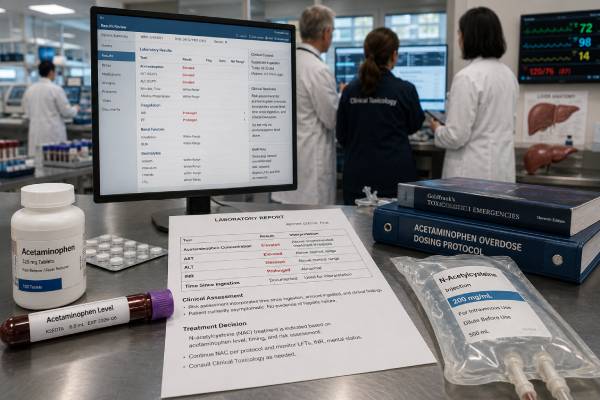
Acetaminophen is widely used for pain and fever, but too much can injure the liver before a person feels seriously ill. Blood testing is central because early symptoms may be mild, vague, or absent. The acetaminophen level shows how much drug is still in the bloodstream, while liver enzymes such as ALT and AST show whether liver cells are already leaking injury markers into the blood. These results mean different things depending on timing. A high acetaminophen level soon after a single overdose can warn that liver injury is likely unless treatment starts quickly. Very high ALT or AST later on can mean injury has already developed, even if the acetaminophen level has fallen. The safest interpretation uses the dose history, time since ingestion, acetaminophen concentration, ALT, AST, INR, bilirubin, kidney markers, and clinical symptoms together.
- An acetaminophen level is most useful when the time of a single overdose is known. A level drawn at or after 4 hours can be plotted on the Rumack-Matthew nomogram.
- ALT and AST may stay normal early after overdose. Normal liver enzymes in the first several hours do not always rule out future liver injury.
- A level at or above the treatment line usually means acetylcysteine is needed. Treatment decisions should not wait when the overdose may be toxic and testing is delayed.
- Repeated high dosing is interpreted differently from one-time overdose. The nomogram is not used for repeated supratherapeutic ingestion over more than 24 hours.
- A rising INR, low glucose, acidosis, confusion, or kidney injury is more concerning than enzyme numbers alone. These suggest impaired liver function or severe poisoning.
- Suspected overdose needs urgent poison center or emergency care. Early treatment can prevent severe liver damage.
Table of Contents
- What the Acetaminophen Level and Liver Enzymes Show
- Why Timing Changes the Meaning of the Results
- Single Overdose: Using the Nomogram
- Repeated High Dosing and Unknown Timing
- Liver Injury Patterns: ALT, AST, INR, Bilirubin, and Kidneys
- When Results Need Urgent Care or Treatment
- Common Mistakes When Reading These Labs
What the Acetaminophen Level and Liver Enzymes Show
An acetaminophen level measures the concentration of acetaminophen in blood, usually reported as mcg/mL or mg/L. Those two units are numerically the same: 10 mcg/mL equals 10 mg/L. The result is not interpreted like many routine drug levels. A “low” or “high” number is not enough by itself. The time since ingestion determines whether the number is reassuring, dangerous, or hard to interpret.
ALT and AST are liver enzymes. ALT is more liver-specific, while AST can also rise from muscle injury, heart injury, hemolysis, or severe body stress. In acetaminophen toxicity, both can rise sharply because the injury is mainly hepatocellular, meaning liver cells themselves are damaged. If you are comparing liver enzyme patterns more broadly, ALT and AST interpretation helps separate liver-cell injury from other patterns.
These tests answer different questions:
| Test | What it mainly shows | How it is used in overdose risk |
|---|---|---|
| Acetaminophen level | Drug still present in the blood | Predicts risk after a known-time acute ingestion and helps guide acetylcysteine treatment |
| ALT | Liver-cell injury | Often rises as hepatotoxicity develops; may be normal early |
| AST | Liver-cell injury, but also muscle and other tissue injury | Often rises with ALT in acetaminophen liver injury; context matters |
| INR or PT | Blood clotting function made by the liver | Rising values suggest impaired liver synthetic function and more serious poisoning |
| Bilirubin | Bile pigment processing and excretion | May rise later; severe early enzyme elevation can occur before marked jaundice |
| Creatinine | Kidney function | Detects kidney injury, which can occur with severe poisoning or acute liver failure |
A common early pattern is a measurable acetaminophen level with normal ALT and AST. That can still be dangerous if the level is too high for the time after ingestion. A common later pattern is the opposite: acetaminophen level is low or undetectable, but ALT, AST, and INR are rising. That can mean the drug has already been metabolized and the liver injury is now unfolding.
Acetaminophen is mostly handled through safe liver pathways at usual doses. In overdose, more drug is pushed through a pathway that produces NAPQI, a toxic metabolite. The liver normally neutralizes NAPQI with glutathione. When glutathione is depleted, NAPQI can damage liver cells, especially around the central vein area of the liver lobule. Acetylcysteine helps by replenishing glutathione and supporting safer metabolism.
Why Timing Changes the Meaning of the Results
Timing is the center of acetaminophen overdose interpretation. The same acetaminophen level can mean very different things at 4 hours, 12 hours, or 24 hours after ingestion.
For a single acute ingestion, the most useful level is generally drawn at least 4 hours after the overdose began. Before 4 hours, absorption may still be incomplete, especially with extended-release products, large ingestions, food, or medicines that slow the stomach, such as opioids or anticholinergic drugs. A level drawn too early can look safer than the true peak.
After about 4 hours, clinicians compare the acetaminophen concentration with the time since ingestion. A 4-hour level that is high enough may predict liver injury risk before enzymes rise. A 20-hour level can be much lower but still dangerous if it sits above the treatment line for that time point. The question is not “Is acetaminophen detectable?” but “Is it too high for the hour after ingestion?”
Liver enzymes follow a delayed clock. ALT and AST may be normal in the first several hours. They often start rising during the first 24 hours if injury develops, and severe cases can peak around 72 to 96 hours. Values can become very high, sometimes in the thousands or above 10,000 IU/L. Large numbers are alarming, but they do not replace function markers. INR, glucose, lactate, pH, mental status, kidney function, and overall clinical condition show whether the liver is failing, not just injured.
The clinical course often moves through stages:
- First 0–24 hours: nausea, vomiting, sweating, pallor, fatigue, or no symptoms; ALT and AST may still be normal.
- 24–72 hours: symptoms may improve while ALT and AST rise; right upper abdominal pain may appear.
- 72–96 hours: severe poisoning can cause very high ALT/AST, rising INR, low glucose, acidosis, kidney injury, confusion, bleeding risk, and acute liver failure.
- Recovery: if the person survives and the liver regenerates, labs can improve over days to weeks.
This timing explains why symptoms alone are unreliable. Feeling better on the second day does not always mean the overdose is resolving. It may simply mean the early nausea has passed while liver injury is becoming visible in the blood work.
Single Overdose: Using the Nomogram
For a known-time single overdose, clinicians use the Rumack-Matthew nomogram. The nomogram plots acetaminophen concentration against the number of hours since ingestion, usually from 4 through 24 hours. It is used to decide whether acetylcysteine is recommended after an acute ingestion.
In the United States and Canada, the commonly used treatment line begins at 150 mcg/mL at 4 hours and declines over time. A level on or above that line means treatment is recommended. A separate high-risk line begins at 300 mcg/mL at 4 hours and marks a higher-risk group that may need toxicology consultation and sometimes adjusted treatment strategies.
The nomogram works best when all of these are true:
- The ingestion was acute rather than spread over more than 24 hours.
- The time of ingestion is known with reasonable confidence.
- The blood sample was drawn at least 4 hours after ingestion.
- The result is paired with clinical assessment and liver-related labs.
The nomogram should not be used when the timing is unknown, conflicting, or unreliable. It is also not the right tool for repeated supratherapeutic dosing over several days. In those cases, clinicians look at the acetaminophen level, ALT, AST, INR, symptoms, and exposure history together.
A simplified example shows why timing matters:
| Scenario | Possible interpretation |
|---|---|
| Acetaminophen 160 mcg/mL at 4 hours | At or above the usual treatment threshold; acetylcysteine is generally indicated |
| Acetaminophen 40 mcg/mL at 4 hours | Often below the treatment line for a known-time immediate-release ingestion, but clinical context still matters |
| Acetaminophen 40 mcg/mL at 16 hours | More concerning than the same value at 4 hours because the expected safe concentration is much lower later |
| Acetaminophen undetectable with ALT 6,000 IU/L and rising INR | Can still fit late acetaminophen liver injury; the drug may be gone while injury continues |
Treatment should not be delayed when a potentially toxic ingestion occurred and the acetaminophen level will not be available in time. A common practical rule is that acetylcysteine is started if waiting for the level would push treatment beyond about 8 hours after a concerning acute overdose. The earlier acetylcysteine begins, the better it works.
Large or high-risk ingestions deserve extra caution. Very large doses, levels above the high-risk line, early acidosis, altered mental status, or lactate elevation can suggest more severe toxicity and the need for a poison center, medical toxicologist, intensive monitoring, or transfer to a center that can manage acute liver failure.
Repeated High Dosing and Unknown Timing
Repeated supratherapeutic ingestion means taking too much acetaminophen over more than 24 hours. This can happen accidentally when someone takes several acetaminophen-containing products at the same time, takes extra doses for severe pain, uses combination cold medicines, or does not realize that a prescription pain medicine also contains acetaminophen.
This pattern is different from a one-time overdose. The Rumack-Matthew nomogram is not used because there is no single time point to plot. Instead, clinicians ask:
- How much acetaminophen was taken each day?
- How many days did the pattern continue?
- Were there combination products, alcohol use, fasting, vomiting, malnutrition, or chronic illness?
- Is the acetaminophen level detectable?
- Are ALT or AST abnormal?
- Is INR rising or kidney function worsening?
In repeated high dosing, a level that looks modest can still matter. A concentration above about 20 mcg/mL in the setting of repeated supratherapeutic ingestion is often treated as concerning, especially if ALT or AST is abnormal. Any evidence of liver injury with a history of excess acetaminophen use usually pushes care toward acetylcysteine treatment and monitoring.
Unknown timing is handled with similar caution. If someone cannot say when the ingestion happened, gives conflicting times, has altered mental status, or may have taken an extended-release product or coingestants, a single “below line” interpretation may be unsafe. Clinicians often obtain an acetaminophen level immediately, repeat levels when delayed absorption is possible, and check ALT, AST, INR, bilirubin, electrolytes, creatinine, glucose, and acid-base status.
Internal medication review is often important. Acetaminophen can appear on labels as “acetaminophen,” “APAP,” or “paracetamol.” It may be present in tablets for fever, flu, sinus symptoms, sleep, migraine, or opioid-containing pain medicines. A toxicology blood test panel may also be used when the history suggests other drugs, alcohols, or poisons were involved, but acetaminophen requires its own timed interpretation.
Repeated high dosing is especially risky because people may not seek help right away. They may think they have a stomach virus, worsening flu, or pain-related nausea. By the time they feel ill enough to be evaluated, the acetaminophen level may be falling while ALT, AST, and INR are already rising.
Liver Injury Patterns: ALT, AST, INR, Bilirubin, and Kidneys
Acetaminophen overdose usually causes a hepatocellular pattern. ALT and AST rise much more than alkaline phosphatase. Bilirubin may be normal early and rise later. A broader liver function test panel helps separate this pattern from cholestasis, bile duct obstruction, viral hepatitis, alcohol-related injury, ischemic hepatitis, and other causes.
ALT and AST show liver-cell leakage, not liver performance. INR is often more important for severity because it reflects the liver’s ability to make clotting factors. A rising INR after acetaminophen toxicity can signal worsening synthetic function. Glucose can fall when the failing liver cannot maintain normal blood sugar. Lactate and pH can worsen in severe poisoning because of mitochondrial injury, shock, or acute liver failure.
Bilirubin may lag behind. A person can have severe acetaminophen liver injury with striking ALT and AST before obvious jaundice. Later, bilirubin may rise along with worsening INR and symptoms. Albumin is less useful for sudden overdose because it changes more slowly, but it can help show baseline liver or nutritional status in other contexts. If clotting and protein production are part of the concern, albumin and INR interpretation can clarify the difference between liver injury and liver function.
Kidney markers matter too. Creatinine and BUN can rise from dehydration, shock, direct kidney injury, or acute liver failure. Severe acetaminophen poisoning can cause acute kidney injury, sometimes alongside liver injury. A comprehensive metabolic panel is often useful because it includes electrolytes, kidney markers, glucose, bilirubin, albumin, and several liver-related tests.
The most concerning patterns include:
- ALT or AST rapidly rising into the thousands.
- INR rising above normal, especially if it continues to worsen.
- Low blood glucose.
- Metabolic acidosis or high lactate.
- Confusion, sleepiness, agitation, or signs of encephalopathy.
- Rising creatinine or reduced urination.
- Persistent vomiting, right upper abdominal pain, jaundice, or bleeding.
A falling ALT or AST is usually encouraging only when INR, mental status, glucose, lactate, creatinine, and overall condition are also improving. In massive liver cell death, enzymes can sometimes fall because fewer injured cells remain to leak enzymes, while liver function worsens. That is why clinicians do not judge recovery from ALT and AST alone.
When Results Need Urgent Care or Treatment
Suspected acetaminophen overdose should be treated as time-sensitive. A poison center, emergency department, or medical toxicologist can interpret the timing and decide whether acetylcysteine, activated charcoal, repeat levels, or hospital monitoring is needed. In the United States, Poison Control can be reached at 1-800-222-1222.
Urgent evaluation is needed when any of these apply:
- The amount taken may exceed recommended limits.
- The time of ingestion is unknown or uncertain.
- The overdose was intentional or self-harm may be involved.
- The product was extended-release.
- Other sedating medicines, alcohol, opioids, or anticholinergic drugs were taken.
- Vomiting, right upper abdominal pain, confusion, jaundice, fainting, or severe weakness occurs.
- ALT, AST, INR, creatinine, lactate, or glucose is abnormal.
- The person is pregnant, medically fragile, very young, older, malnourished, fasting, or has liver disease.
Acetylcysteine is the main antidote. It is given orally or intravenously, though many hospitals use IV treatment because it is faster to administer in vomiting, severe illness, pregnancy, or altered mental status. Treatment length is not simply a fixed clock. Clinicians reassess acetaminophen concentration, ALT, AST, INR, and the patient’s condition before stopping. Some people need treatment beyond the initial protocol if acetaminophen is still detectable, enzymes are rising, INR is abnormal, or the patient is not clinically well.
Activated charcoal may be considered early after a potentially toxic ingestion if the airway is protected and there are no contraindications. It can reduce absorption, especially soon after ingestion, with large ingestions, or when absorption may be delayed. It is not a substitute for acetylcysteine when antidote treatment is indicated.
Severe cases may need intensive care. Features such as acidosis, high lactate, altered mental status, kidney failure, very high acetaminophen concentrations, or worsening INR can require specialist management. In rare cases, dialysis or liver transplant evaluation may be considered. Kidney-related risk is often followed alongside liver testing; creatinine and eGFR interpretation can help explain what kidney markers do and do not show.
Common Mistakes When Reading These Labs
One mistake is assuming normal early liver enzymes rule out overdose risk. ALT and AST can remain normal for hours after a dangerous ingestion. A properly timed acetaminophen level is often the earlier warning signal.
Another mistake is treating the acetaminophen level as a stand-alone number. A level of 50 mcg/mL may be far less concerning at 4 hours than at 18 hours. The level must be matched to the clock.
A third mistake is using the nomogram for repeated high dosing. The nomogram was designed for acute ingestions with a known time, not for several days of extra dosing. Repeated supratherapeutic ingestion depends more on detectable acetaminophen, abnormal ALT or AST, symptoms, and overall risk.
A fourth mistake is stopping acetylcysteine only because the standard protocol time has ended. Treatment is usually continued until stopping criteria are met, such as an undetectable or very low acetaminophen level, improving liver enzymes, acceptable INR, and clinical improvement. A fixed 20- or 21-hour endpoint can be too short for delayed absorption, large overdose, repeated dosing, or established liver injury.
A fifth mistake is focusing only on ALT and AST when the person is clinically worse. INR, glucose, lactate, pH, creatinine, and mental status may show danger more directly than enzyme height. In advanced liver failure, the whole pattern matters.
A sixth mistake is missing hidden acetaminophen. Many people do not count cold medicine, nighttime flu medicine, migraine products, or opioid combination tablets. When unexplained hepatocellular injury appears, clinicians often check an acetaminophen level even if the person does not report a classic overdose. A dedicated acetaminophen blood test can be important because early treatment is safer than waiting for the pattern to become unmistakable.
The safest reading of these labs is cautious and time-based. A known-time acute overdose is judged with a timed acetaminophen level and the nomogram. Repeated or unclear exposure is judged with acetaminophen level, ALT, AST, INR, symptoms, kidney function, and clinical risk. Severe abnormalities or uncertainty should prompt urgent expert guidance, because early acetylcysteine can prevent liver failure.
References
- Management of Acetaminophen Poisoning in the US and Canada: A Consensus Statement 2023 (Consensus Statement)
- Updated guidelines for the management of paracetamol poisoning in Australia and New Zealand 2020 (Guideline)
- Fifty years of paracetamol (acetaminophen) poisoning: the development of risk assessment and treatment 1973-2023 with particular focus on contributions published from Edinburgh and Denver 2023 (Review)
- Acetaminophen Toxicity 2026 (Review)
- Acetaminophen 2016 (Review)
Disclaimer
Acetaminophen overdose can cause life-threatening liver injury and needs urgent medical or poison center guidance. This information is for education and should not be used to decide at home whether an overdose is safe, whether treatment is needed, or when to stop treatment. If overdose is possible, contact emergency services, a poison center, or a qualified clinician immediately.