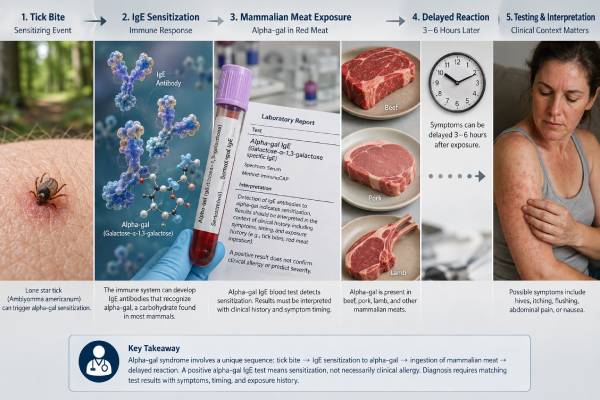
The alpha-gal IgE test is a blood test used to help diagnose alpha-gal syndrome, an allergy linked to tick bites and reactions to a sugar found in most non-primate mammals. Unlike typical food allergy, symptoms often begin two to six hours after eating beef, pork, lamb, venison, or another mammalian product. Some people react mainly with hives or stomach symptoms; others develop anaphylaxis. A positive blood result shows sensitization to galactose-alpha-1,3-galactose, usually shortened to alpha-gal, but it does not confirm the syndrome without a compatible history. People can carry alpha-gal IgE and eat mammalian foods without symptoms. Interpretation depends on the numeric result, total IgE, timing and consistency of reactions, recent tick exposure, cofactors such as alcohol or exercise, and tolerance of dairy, gelatin, medicines, or other mammal-derived ingredients. The test is most useful when ordered as part of a focused allergy evaluation rather than as a general screening test.
- The main diagnostic test is serum alpha-gal–specific IgE, interpreted with delayed symptoms after mammalian food or product exposure.
- A value of 0.1 kUA/L or higher is commonly considered detectable, but no single cutoff proves clinical alpha-gal syndrome.
- Reactions usually begin 2–6 hours after eating mammalian meat, though organ meat or injected products can cause faster symptoms.
- Beef, pork, lamb, venison, gelatin, dairy, and some medicines may matter, but each person’s tolerance pattern differs.
- Further tick bites can maintain or raise alpha-gal IgE, so tick avoidance is part of treatment and possible recovery.
- Breathing difficulty, throat swelling, fainting, or rapid severe symptoms require epinephrine and emergency care.
Table of Contents
- What the Alpha-Gal IgE Test Detects
- Why Tick Bites Lead to Delayed Reactions
- Interpreting Alpha-Gal IgE Results
- Symptoms and Products That Can Trigger Reactions
- False-Positive, Borderline, and Negative Results
- Management After a Positive Test
- Retesting, Recovery, and Tick Prevention
What the Alpha-Gal IgE Test Detects
Alpha-gal is a carbohydrate structure present on cells and tissues from most mammals other than humans, apes, and Old World monkeys. It is found in varying amounts in mammalian meat, fat, organs, gelatin, dairy, and some medical products made with mammalian ingredients.
The blood test measures IgE antibodies that bind alpha-gal. Laboratories commonly report the result in kUA/L. The assay does not measure how much alpha-gal a person ate, whether a tick is still attached, or how severe the next reaction will be.
Diagnosis generally requires two pieces of evidence:
- A history that fits alpha-gal syndrome, such as recurrent delayed hives, gastrointestinal symptoms, or anaphylaxis after mammalian meat or another relevant product
- Detectable alpha-gal–specific IgE in serum
A positive result without symptoms is called sensitization. Sensitization is common enough in tick-exposed regions that screening people who tolerate mammalian foods can identify antibodies that have no current clinical effect. The label “alpha-gal syndrome” should therefore be reserved for people whose test result and exposure history fit together.
The order may appear under names such as galactose-alpha-1,3-galactose IgE, alpha-galactose IgE, or alpha-gal specific IgE. It is different from beef, pork, or lamb extract IgE. Meat extracts can sometimes support the evaluation, but alpha-gal IgE is the central test because it targets the shared carbohydrate responsible for the syndrome.
Some clinicians also measure total IgE. A ratio between alpha-gal IgE and total IgE can add context when the specific result is low or total IgE is very high, but the ratio is not a universal stand-alone diagnostic rule. A specific IgE blood test always needs interpretation against actual exposure and symptoms.
Why Tick Bites Lead to Delayed Reactions
Alpha-gal syndrome most often begins after bites from certain ticks. In the United States, the lone star tick is the best-established association. Other tick species are linked with the syndrome in Europe, Australia, Asia, and other regions.
The exact immune sequence is still being studied. Tick saliva appears to promote an IgE response to alpha-gal or alpha-gal–containing material introduced during feeding. A person who previously ate meat without difficulty can then become sensitized and begin reacting months or years into adulthood. Children can also develop the syndrome.
The delay after eating is one of its defining features. Most conventional IgE-mediated food reactions start within minutes because allergenic proteins are rapidly available. Alpha-gal is often carried in fat-containing particles that enter the bloodstream during digestion and lipid absorption. This slower process helps explain why symptoms frequently begin after the person has gone to bed following an evening meal.
Timing is not identical for every exposure:
- Mammalian meat: reactions often begin 2–6 hours later.
- High-fat meat or large portions: may produce stronger or more reliable reactions because alpha-gal exposure and lipid absorption are greater.
- Organ meat, especially kidney: can trigger faster and sometimes more severe reactions because alpha-gal content may be high.
- Gelatin or dairy: timing and risk vary with dose and individual sensitivity.
- Injected or intravenous mammalian-derived products: can cause immediate reactions because the gastrointestinal delay is bypassed.
Cofactors can make an otherwise tolerated exposure cause symptoms. Exercise, alcohol, nonsteroidal anti-inflammatory drugs, infection, sleep loss, and menstruation have all been reported as possible amplifiers. This variability explains why someone may eat a hamburger safely one week and react to a similar meal another week.
A delayed pattern can obscure the diagnosis. People may blame a bedtime medicine, a nighttime environmental allergen, or an unexplained stomach illness rather than the dinner eaten hours earlier. A detailed food and symptom diary should therefore cover at least the preceding six to eight hours, not just the last food consumed.
The diary should record portion size, fat content, restaurant or packaged ingredients, alcohol, exercise, medicines, illness, and menstrual timing when relevant. A pattern may emerge only after several episodes. For example, lean meat at lunch may be tolerated while fatty pork eaten with alcohol late in the evening repeatedly causes symptoms. That pattern does not mean the allergy is imaginary or inconsistent; it shows that dose and cofactors alter the reaction threshold.
Tick exposure can also be easy to miss. Nymphs are small, and some bites are never noticed. A person does not need to recall a dramatic attached tick for the diagnosis to be possible. Residence, travel, hunting, gardening, hiking, pet exposure, and large local bite reactions can all contribute to the exposure history.
Interpreting Alpha-Gal IgE Results
Many laboratories consider 0.1 kUA/L or higher detectable. Some reports use 0.35 kUA/L as the positive threshold. Neither value is an absolute disease cutoff. Test performance depends on the population, assay, and clinical definition used.
A result becomes more convincing when the following features are present:
- Repeated delayed reactions after beef, pork, lamb, venison, or another mammalian product
- Symptoms beginning roughly two to six hours after eating
- A history of tick bites, large local reactions to bites, or substantial outdoor exposure in a region where relevant ticks live
- Improvement after avoiding the suspected mammalian triggers
- No better explanation for the episodes
Higher alpha-gal IgE generally increases the likelihood that sensitization is clinically meaningful, but it cannot predict reaction severity. A low-positive patient may have anaphylaxis, while a person with a much higher concentration may tolerate some dairy or gelatin.
| Laboratory and history pattern | Possible interpretation | Typical follow-up |
|---|---|---|
| Detectable IgE plus classic delayed reactions | Alpha-gal syndrome is likely. | Allergy consultation, individualized avoidance, epinephrine planning, and tick prevention. |
| Low positive but regular meat tolerance | Sensitization without clinical allergy is possible. | Avoid unnecessary restriction; review with a clinician before changing the diet. |
| High result with unclear symptoms | The antibody is present, but another condition may explain the symptoms. | Reconstruct exposures and consider other diagnoses rather than relying on the number alone. |
| Negative result with a classic history | Timing, assay limits, declining IgE, or an alternative allergy may be involved. | Specialist review, possible repeat testing, and selected additional tests. |
The result should be read with total IgE when available. For example, 0.5 kUA/L may represent a meaningful share of a total IgE of 10 IU/mL but a very small share of a total IgE of 2,000 IU/mL. Some specialist practices consider an alpha-gal–to–total IgE percentage when the diagnosis is uncertain, yet no percentage replaces a compatible history.
Results from different laboratories or assay platforms should not be compared as if they were identical. For trend monitoring, use the same laboratory method when possible and compare the numeric concentrations, not only positive or negative labels.
Examples of results in context
Consider a person with alpha-gal IgE of 0.4 kUA/L who eats beef and pork several times a week without symptoms. The result confirms antibodies but does not establish disease, and routine avoidance may not be justified. In contrast, the same value in someone with repeated hives and faintness four hours after hamburgers is much more meaningful.
A result of 20 kUA/L strongly supports substantial sensitization, but it still cannot tell whether the person tolerates cheese, reacts to gelatin, or will have a severe future episode. Those questions come from the exposure history. Likewise, a fall from 20 to 3 kUA/L may show improvement while still leaving clinically important reactivity.
When the result and history conflict, clinicians may review the original laboratory method, repeat the assay, measure total IgE, test selected mammalian extracts or components, and investigate alternative diagnoses. The purpose is not to accumulate every available test but to resolve the specific contradiction.
Symptoms and Products That Can Trigger Reactions
Alpha-gal reactions range from isolated gastrointestinal symptoms to life-threatening anaphylaxis. Symptoms may include:
- Hives, itching, flushing, or swelling
- Abdominal cramping, nausea, vomiting, or diarrhea
- Wheezing, cough, shortness of breath, or throat tightness
- Dizziness, fainting, low blood pressure, or collapse
- A combination of symptoms affecting more than one organ system
Some patients have repeated nighttime abdominal pain or diarrhea without obvious skin symptoms. This gastrointestinal-only form can still be related to alpha-gal when it follows mammalian meals and improves with avoidance.
The term “red meat allergy” is convenient but incomplete. Potential sources include:
| Category | Examples | Clinical note |
|---|---|---|
| Mammalian meat | Beef, pork, lamb, venison, rabbit, goat | Fatty cuts and organ meats may be more likely to trigger symptoms. |
| Mammalian fat and broth | Lard, tallow, bacon fat, meat stock, gravy | Hidden fat can explain reactions to foods that do not look meat-heavy. |
| Dairy | Milk, cream, cheese, ice cream | Many patients tolerate dairy; restriction should be individualized. |
| Gelatin | Gelatin desserts, marshmallows, capsules, some vaccines or medical products | Risk varies by dose, route, and sensitivity. |
| Medical products | Cetuximab, some heparin products, bioprosthetic valves, gelatin-containing agents | Injected exposure may cause immediate reactions and requires specialist planning. |
Poultry, fish, shellfish, eggs, and plants do not naturally contain alpha-gal in the same way and are generally not excluded for alpha-gal syndrome. However, preparation with mammalian fat or cross-contact can still matter.
Not every mammal-derived ingredient contains enough alpha-gal to trigger every patient. Highly refined ingredients, flavorings, excipients, and personal-care products create difficult questions because manufacturing details may be unclear. The degree of avoidance should match the person’s reaction history. Overly broad restriction can make nutrition and medication use unnecessarily difficult.
False-Positive, Borderline, and Negative Results
A positive alpha-gal IgE test can occur in people who have never reacted. Tick exposure can produce antibodies without clinical syndrome. This is especially relevant in regions where many residents spend time outdoors and sensitization is common.
A low positive is more likely to be misleading when the person eats mammalian meat regularly without symptoms. Avoiding tolerated foods solely because of a laboratory flag may reduce dietary variety, increase anxiety, and obscure the true cause of symptoms.
Cross-reactive IgE can also complicate interpretation. Alpha-gal is present on mammalian-derived test materials and may contribute to positive beef, pork, lamb, or milk IgE results. Cat allergy can involve a different mammalian protein, serum albumin, producing a pork-cat syndrome that usually causes more immediate reactions to pork. The timing and component pattern help separate these conditions.
A negative alpha-gal test does not completely exclude the syndrome. Possible reasons include:
- The IgE concentration has fallen since the last tick bite or reaction
- The sample was tested with a method or threshold that missed a low level
- The original episode had another trigger, such as a conventional meat protein allergy, gelatin allergy, medication reaction, or nonallergic condition
- The history was suggestive but not actually caused by alpha-gal
Unlike acute tryptase, alpha-gal IgE does not need to be collected during the reaction. It can be measured after recovery. An acute tryptase test may support that mast cell activation occurred during a severe event, but it cannot identify alpha-gal as the trigger.
Oral food challenges for suspected alpha-gal syndrome are complex because reactions are delayed, unpredictable, and influenced by cofactors. They should be considered only by an experienced allergy team with prolonged observation and emergency capability. Home testing by eating meat is unsafe after a history of systemic reaction.
Several other conditions can mimic parts of the syndrome. Immediate reactions to meat may reflect allergy to mammalian serum albumin or another protein rather than alpha-gal. Food poisoning, gallbladder disease, reflux, irritable bowel syndrome, medication reactions, chronic urticaria, and exercise-induced anaphylaxis can also produce overlapping symptoms. A reaction after a mixed meal may come from shellfish, nuts, wheat, or a drug taken with the meal. The delayed clock, repeated mammalian association, and alpha-gal IgE result help sort these possibilities, but no single feature works alone.
Management After a Positive Test
Management is individualized rather than based on one universal “mammal-free” list. Most symptomatic patients begin by avoiding mammalian meat and organ products. The allergist then determines whether dairy, gelatin, mammalian fat, or specific medical products also require restriction.
People who tolerate milk, cheese, or gelatin may not need to remove them. Continued tolerance should be documented rather than assumed from the blood value. Those with ongoing symptoms despite avoiding meat may need a closer review of hidden fats, broth, gelatin, dairy, medicines, supplements, or non-alpha-gal diagnoses.
A safety plan commonly includes:
- Prescribed epinephrine autoinjectors and training on prompt use
- A written emergency plan for delayed reactions
- Clear instructions about when to call emergency services
- Asthma assessment and control, because uncontrolled asthma can increase risk during food reactions
- Medical identification for people with severe reactions or important medical-product concerns
- Communication with surgeons, anesthesiologists, pharmacists, and infusion teams before procedures
Medication ingredients should be reviewed carefully but realistically. The presence of a mammalian-derived excipient does not guarantee a reaction, and the route and amount matter. Stopping an essential medicine without a medically suitable alternative can be more dangerous than the theoretical alpha-gal exposure. Pharmacists and allergists can help evaluate formulation-specific risk.
Cetuximab is a well-known high-risk biologic for sensitized patients because alpha-gal can be present on the molecule. Some other biologics or mammalian-derived medical products have produced reactions in individual cases, but risk is not uniform across the drug class. A drug allergy evaluation should address the exact product rather than applying a blanket ban.
Nutrition deserves attention when meat and dairy are both removed. Protein, iron, vitamin B12, calcium, and vitamin D can usually be obtained from poultry, fish, eggs, legumes, fortified foods, or supplements, but children, pregnant people, and those with multiple food restrictions may benefit from a dietitian.
Retesting, Recovery, and Tick Prevention
Alpha-gal IgE can decline over time when further tick bites are avoided. Some patients eventually tolerate selected mammalian foods again, while others remain reactive for years. A falling number is encouraging but does not prove that reintroduction is safe.
Retesting intervals vary. An allergist may repeat the test after roughly 6–12 months, particularly when symptoms have stopped, tick exposure has been minimized, and reintroduction is being considered. Decisions also depend on the original reaction severity, current total IgE, trend across several measurements, and whether the person has accidentally tolerated relevant foods.
Reintroduction after anaphylaxis should not be attempted at home. A specialist may first discuss dairy or lower-risk exposures, or may recommend continued avoidance. The plan must account for delayed reactions and the need for extended observation.
Preventing new bites is central because another bite may raise IgE again or restore clinical reactivity. Practical measures include:
- Use an effective tick repellent on exposed skin according to its label.
- Wear long pants and sleeves in brushy or wooded areas.
- Treat clothing and gear with permethrin when appropriate, following product instructions.
- Walk in the center of trails and avoid tall grass and leaf litter where possible.
- Shower and perform a full-body tick check soon after outdoor activity.
- Check children, pets, clothing, and outdoor equipment before bringing ticks indoors.
- Remove attached ticks promptly with fine-tipped tweezers and clean the area.
Large itchy reactions at tick-bite sites are common among people with alpha-gal syndrome but do not measure the severity of food allergy. New bites should be recorded, and repeat testing may be reasonable if symptoms recur or the IgE trend reverses.
The most useful long-term record includes alpha-gal IgE values, total IgE, dates of tick bites, accidental exposures, tolerated foods, reaction timing, and epinephrine use. This history allows the clinician to distinguish a true change in the syndrome from a laboratory fluctuation.
Travel and emergency planning deserve the same attention as diet. Carry epinephrine where delayed reactions could occur, including overnight trips, and make sure companions know where it is stored. Restaurant questions should focus on mammalian meat, broth, gravy, lard, tallow, and shared cooking fat rather than asking only whether a dish contains “red meat.” Before surgery or an infusion, provide the diagnosis early enough for the care team to review medications, hemostatic agents, implants, and gelatin-containing products. Keep both epinephrine devices within their recommended temperature range, check expiration dates, and replace any device that has been used or damaged.
References
- Clinical Diagnosis and Testing | Alpha-gal Syndrome 2026 (Official Guidance)
- The Immunology of Alpha-Gal Syndrome: History, Tick Bites and Delayed Anaphylaxis 2025 (Review)
- Alpha-Gal Syndrome: A Review for the General Internist 2025 (Review)
- Tick bites, IgE to galactose-alpha-1,3-galactose and urticarial or anaphylactic reactions to mammalian meat: The alpha-gal syndrome 2024 (Review)
- Diagnostic validity of specific immunoglobulin E levels to alpha-gal in alpha-gal syndrome: a cross-sectional analysis 2023 (Research Article)
- Diagnosis & management of alpha-gal syndrome: lessons from 2,500 patients 2021 (Review)
Disclaimer
This article is for education and does not confirm or exclude alpha-gal syndrome. Test results and food or medication restrictions should be reviewed with an allergy specialist, especially after a severe reaction. Use prescribed epinephrine and seek emergency care for symptoms of anaphylaxis.