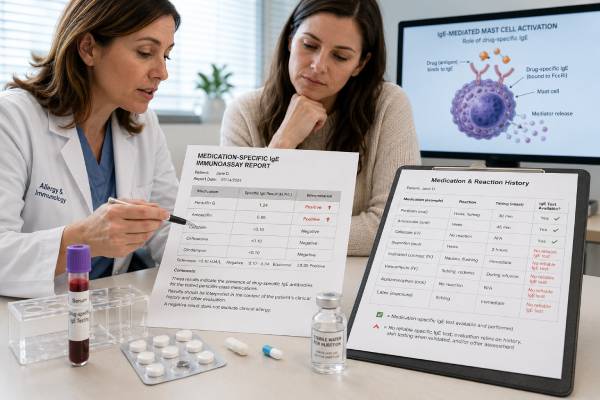
A drug allergy IgE test is a blood test that looks for immunoglobulin E antibodies to a specific medication or a drug-related chemical structure. It is useful only for selected immediate reactions and only a small number of medicines have validated or clinically supported assays. A positive result can support IgE-mediated allergy when symptoms such as hives, swelling, wheezing, low blood pressure, or anaphylaxis began soon after the drug was given. It does not prove that every future dose will cause a reaction, and a negative result usually cannot rule allergy out because drug-specific IgE may decline, the relevant metabolite may not be present in the test, or the assay may have low sensitivity. Many medication reactions are side effects, viral rashes, infusion reactions, or delayed T-cell reactions that IgE testing cannot detect. Diagnosis commonly depends on the exact reaction history, skin testing when validated, and a medically supervised drug challenge when the expected benefit is greater than the risk.
- Drug-specific IgE testing is available for only a limited number of medications and is not a universal drug allergy screen.
- The test is designed for immediate reactions, usually beginning within minutes to a few hours after a dose.
- A positive result supports sensitization, not automatic clinical allergy; it must match the drug, timing, and symptoms.
- A negative result does not reliably exclude drug allergy, especially years after the reaction or when the assay lacks the relevant metabolite.
- Delayed rashes, DRESS, Stevens-Johnson syndrome, and many organ reactions are not diagnosed with IgE blood tests.
- Never re-take a suspected medicine at home to check the result; challenges and desensitization require a clinical safety plan.
Table of Contents
- What Drug-Specific IgE Measures
- Which Medication Reactions Fit IgE Testing
- Medications With Available or Specialized Tests
- Interpreting Positive and Negative Results
- Why Drug IgE Testing Is Limited
- Skin Tests, BAT, Tryptase, and Drug Challenges
- Documentation, Delabeling, and Next Steps
What Drug-Specific IgE Measures
IgE-mediated drug allergy occurs when drug-specific IgE sits on mast cells and basophils. Re-exposure can link those IgE molecules and trigger release of histamine, tryptase, and other mediators. The result can be hives, angioedema, bronchospasm, vomiting, low blood pressure, or anaphylaxis.
The blood test measures free circulating IgE that binds the drug or a drug-protein structure attached to the laboratory test surface. Results are often reported in kUA/L with a laboratory cutoff for detectable antibody.
Drugs create a special testing problem because many are too small to trigger IgE by themselves. They act as haptens, binding to human proteins and forming a larger antigen. The relevant immune target may be:
- The unchanged parent drug
- A breakdown product or metabolite
- A drug-protein conjugate
- A side-chain structure shared by related medicines
- An excipient such as chlorhexidine, gelatin, or another ingredient rather than the active drug
A commercial assay must display the correct structure in a way that captures clinically relevant IgE. If it does not, the result may be negative even in a truly allergic patient.
Drug-specific IgE should not be confused with total IgE. A high total IgE does not identify a medication and can occur with eczema, asthma, parasites, or other conditions. A specific IgE blood test is meaningful only when it targets the exact suspected allergen and has evidence for that use.
The test also does not measure drug concentration, toxicity, immune-complex reactions, pharmacogenetic risk, or T-cell activation. Different mechanisms require different diagnostic strategies.
Which Medication Reactions Fit IgE Testing
IgE testing fits best when symptoms began rapidly after a dose. Immediate reactions often start within minutes to one hour, but onset up to several hours can still be compatible depending on the route, absorption, and drug.
Features that support an immediate hypersensitivity evaluation include:
- Generalized hives or intense itching
- Swelling of the lips, tongue, face, or throat
- Wheezing, bronchospasm, or sudden breathing difficulty
- Repetitive vomiting or severe abdominal symptoms as part of a multisystem reaction
- Dizziness, fainting, or low blood pressure
- Anaphylaxis during surgery, infusion, injection, or shortly after an oral dose
A reaction described only as “felt bad,” nausea, headache, fatigue, or diarrhea is more likely to be a side effect than IgE allergy unless other allergic signs occurred. The drug indication also matters: a rash during an antibiotic course may come from the infection itself.
Delayed reactions do not fit serum IgE testing well. These include maculopapular rashes beginning days into treatment, fixed drug eruptions, allergic contact dermatitis, drug-induced liver injury, interstitial nephritis, hemolytic anemia, serum sickness–like reactions, DRESS, acute generalized exanthematous pustulosis, Stevens-Johnson syndrome, and toxic epidermal necrolysis.
Some delayed reactions are assessed with patch testing, delayed-reading skin tests, blood-cell research assays, genetics, organ tests, or clinical criteria. Severe cutaneous adverse reactions are generally contraindications to routine drug challenge with the culprit medication.
A precise timeline is more valuable than the word “allergy.” Record:
- The exact generic and brand name
- Dose, route, and reason for treatment
- Time from dose to first symptom
- Skin, breathing, gastrointestinal, and circulation symptoms
- Photographs, vital signs, and emergency treatment
- Other drugs, foods, latex, antiseptics, or contrast present
- Whether related medicines were tolerated before or afterward
This information determines whether an IgE assay is relevant at all.
Medications With Available or Specialized Tests
Commercial or specialist serum IgE tests exist for only selected drugs and agents. Availability differs by country and laboratory. Examples may include some penicillin determinants, amoxicillin, ampicillin, cefaclor, certain neuromuscular blocking agents, chlorhexidine, insulin, protamine, gelatin, and a limited number of other substances.
Beta-lactam antibiotics
Penicillins and cephalosporins are the most familiar area of drug allergy testing. Commercial IgE assays may target penicillin G, penicillin V, amoxicillin, ampicillin, or cefaclor. Sensitivity is limited, so a negative blood result does not clear a patient.
The immune target may be the core beta-lactam structure or a side chain. Cross-reactivity is driven more often by similar side chains than by the entire antibiotic class. A person can react to amoxicillin yet tolerate a cephalosporin with a dissimilar side chain, or react to one cephalosporin without being allergic to penicillin.
Evaluation frequently relies on risk stratification, penicillin skin testing, and an oral amoxicillin or penicillin challenge. Low-risk histories may proceed directly to a supervised challenge without blood IgE testing.
The name of the original antibiotic matters because shared side chains can connect drugs that appear to belong to different subgroups. Amoxicillin and ampicillin have aminopenicillin side chains, while individual cephalosporins have their own R-group patterns. A clinician may therefore select an alternative by comparing structures rather than automatically avoiding every penicillin and cephalosporin. This approach can preserve narrow, effective antibiotics and reduce unnecessary exposure to broader agents.
Blood IgE cannot map all clinically important side-chain relationships. A test labeled “penicillin” may not include the determinant responsible for an amoxicillin-selective reaction, and a cephalosporin assay may not exist for the culprit drug. Testing strategy should begin with the exact generic name, not only the class. When a related antibiotic is needed, skin testing or a graded challenge may be chosen according to the reaction’s severity, recency, and structural similarity.
Perioperative agents
Anaphylaxis during anesthesia can involve neuromuscular blocking agents, antibiotics, chlorhexidine, latex, dyes, gelatin-based products, or other exposures given close together. Specialized IgE tests exist for some of these, but a full anesthesia record and exact administration times are essential.
Chlorhexidine-specific IgE can be particularly useful when exposure came from skin preparation, coated catheters, lubricating gels, or mouth products. A positive result must still be matched to the event.
Biologic drugs and mammalian-derived targets
Some monoclonal antibodies can cause IgE-mediated reactions. Cetuximab is linked to pre-existing IgE against alpha-gal in certain regions. Other biologic reactions may involve IgE, cytokine release, complement, or nonimmune infusion mechanisms. Routine commercial IgE testing is not available for most biologics.
A patient with a first-dose reaction to cetuximab or selected mammalian-derived products may need alpha-gal IgE testing rather than an assay labeled simply for the drug.
Insulin and excipients
Insulin allergy can involve the insulin molecule or additives such as protamine, metacresol, or zinc-related formulations. Specific IgE may be available in specialist settings, but positive results can occur in exposed patients without clinical allergy. Skin testing and formulation-specific history are important.
No reliable serum IgE assay exists for most medicines. Tests sold by nonvalidated laboratories should not be used to label a person allergic to a large list of drugs.
Interpreting Positive and Negative Results
A positive drug-specific IgE result means detectable antibody recognizes the test target. The result is most persuasive when the patient had an immediate, objective reaction to that same drug and the sample was collected within a clinically useful time after the event.
It does not reveal the severity of the next reaction. A low positive can accompany anaphylaxis, while a higher concentration may occur without a future reaction. Dose, route, asthma, illness, and treatment timing influence severity.
False-positive results can occur because of nonspecific binding, very high total IgE, cross-reactive structures, or sensitization without clinical symptoms. Some assays use a low detection cutoff that improves sensitivity but reduces specificity.
A negative result can mean:
- No drug-specific IgE is present
- IgE has declined since a remote reaction
- The clinically relevant metabolite or conjugate is missing from the assay
- The concentration is below detection
- The reaction used a non-IgE pathway
- The wrong drug or excipient was tested
Drug-specific IgE often decreases over time when the medicine is avoided. Testing many years later may therefore be less sensitive. A negative result cannot be interpreted as proof that the allergy has disappeared.
| Result and history | Meaning | Likely next step |
|---|---|---|
| Positive with convincing immediate reaction | Supports IgE-mediated allergy | Confirm the exact drug or side chain and plan avoidance, alternatives, or desensitization |
| Positive without compatible exposure | May represent sensitization or a false positive | Do not label allergy from the blood result alone |
| Negative with low-risk history | Allergy probability is lower | A supervised challenge may confirm tolerance |
| Negative after anaphylaxis | Does not exclude allergy | Use skin testing, BAT, event records, and challenge only when judged safe |
| Test unavailable or unvalidated | No reliable IgE conclusion can be drawn | Use a mechanism-specific allergy evaluation |
The numeric value should be retained with the assay name, units, collection date, and reference range. A simple “positive” entry in the medical record loses information needed for later reassessment.
The interval between the reaction and blood collection can change interpretation. Drug-specific IgE may be easier to detect during the months after an immediate reaction and may become undetectable with prolonged avoidance. There is no single sampling window that guarantees accuracy for every medicine, however, and testing too soon after an event is not known to replace the need for clinical assessment. The laboratory result should always be dated relative to the reaction.
Remote histories need special caution. A patient who reacted ten years ago may now have a negative assay because antibody levels declined, yet the original event may still have been IgE-mediated. Conversely, an isolated low positive years later does not prove current reactivity. The practical question is usually whether the medicine is needed now and whether a supervised evaluation can safely establish tolerance. Repeating the same weakly informative blood test without a plan for skin testing or challenge may add cost without resolving the label.
Why Drug IgE Testing Is Limited
Food and pollen allergens are usually proteins that can be placed directly into an assay. Drugs are often small molecules that become allergenic only after metabolism or protein binding. Recreating the correct immune target in a standardized commercial test is difficult.
Sensitivity and specificity vary substantially by drug. Penicillin-specific IgE assays are generally more specific than sensitive: a clear positive can be helpful, but many truly allergic patients test negative. Performance estimates also depend on how patients were selected and whether skin tests or challenges were used as the reference standard.
Other limitations include:
- Lack of validated decision thresholds for most drugs
- Declining IgE over months or years
- Differences between laboratory platforms
- Cross-reactive side chains and metabolites
- Reactions caused by excipients rather than the named active ingredient
- Non-IgE pathways that look clinically similar
- Inability to distinguish temporary sensitization from current clinical reactivity
- Limited evidence in children, pregnancy, and rare drugs
Testing a panel of unrelated medications is not useful. A person cannot be meaningfully screened for “all drug allergies” because the relevant assays do not exist and each reaction mechanism differs.
Total IgE does not correct these limitations. Dividing drug-specific IgE by total IgE is not a validated universal approach. A high total IgE may increase nonspecific positives but does not establish or exclude a medication allergy.
IgG tests marketed for drug allergy are also not substitutes for IgE. Drug-specific IgG can reflect exposure and has no standard role in diagnosing immediate clinical allergy.
Skin Tests, BAT, Tryptase, and Drug Challenges
Drug allergy evaluation usually combines several tools, chosen for the drug and reaction type.
Skin testing
Penicillin skin testing with validated major and minor determinants can detect mast cell–bound IgE. Skin testing is also used with selected cephalosporins, anesthetic agents, chlorhexidine, biologics, and other drugs at nonirritating concentrations, although validation varies.
A positive test supports immediate allergy. A negative test often needs a supervised challenge because sensitivity is incomplete. Improvised concentrations can cause irritant false positives, so testing should follow specialist protocols.
Basophil activation testing
A basophil activation test exposes fresh blood basophils to the suspected drug and measures markers such as CD63 or CD203c. It can help with selected beta-lactams, neuromuscular blockers, radiocontrast agents, biologics, and chemotherapy drugs. Availability, sensitivity, and standardization remain limited.
Acute tryptase
After suspected drug-induced anaphylaxis, acute tryptase collected promptly and compared with a later baseline can support systemic mast cell activation. It does not identify which medication caused the reaction. An acute tryptase test is especially useful during perioperative or infusion events with multiple possible triggers.
Drug challenge
A graded or single-dose drug challenge is the most direct way to confirm current tolerance in an appropriately selected patient. It is commonly used for low-risk penicillin labels and after negative testing. A challenge is diagnostic; it is not the same as desensitization.
Challenges are avoided or modified after severe delayed reactions, uncontrolled asthma, unstable disease, pregnancy in many circumstances, or when the drug is unnecessary. The facility must be able to recognize and treat an allergic reaction.
Desensitization
Desensitization gives gradually increasing doses to create temporary tolerance when a needed drug is likely to cause an immediate reaction and no suitable alternative exists. The protection lasts only while the medication is taken on schedule. It does not erase the allergy label.
Documentation, Delabeling, and Next Steps
An inaccurate medication allergy label can lead to less effective, more toxic, or broader-spectrum treatment. Penicillin labels are especially common and often persist from childhood despite vague or nonallergic histories.
Good documentation should state:
- Exact drug and formulation
- Reaction date or approximate year
- Dose and route
- Time to symptoms
- Objective signs and treatment
- Results of IgE, skin, BAT, tryptase, or challenge tests
- Drugs in the same class that were tolerated
- Whether the label was confirmed, narrowed, or removed
“Penicillin allergy” is less useful than “amoxicillin: hives 30 minutes after dose in 2023; skin test positive” or “childhood rash, direct oral challenge tolerated in 2025; label removed.”
Patients with low-risk histories may qualify for direct supervised challenge. Successful challenge should lead to active removal of the allergy from the electronic record, pharmacy profile, and personal medication list. Otherwise, the old label often reappears during future care.
Not every label should be tested by challenge. A history of Stevens-Johnson syndrome, toxic epidermal necrolysis, DRESS, acute generalized exanthematous pustulosis, drug-induced hepatitis, nephritis, hemolytic anemia, or another serious organ reaction is a high-risk pattern. These conditions are not ruled out by negative IgE or skin tests, and deliberate re-exposure may be dangerous. The record should name the severe phenotype clearly so that future clinicians do not mistake it for a simple rash.
For anaphylaxis or another convincing immediate reaction, evaluation may still be possible, but it requires a specialist plan. The clinician may postpone testing until recovery, examine baseline health and asthma control, test likely culprits and alternatives, and decide whether any challenge is justified. When the culprit is essential and allergy is likely, desensitization may be safer than a diagnostic challenge. The objective is a useful, specific label—not removal at any cost.
A positive IgE result may support avoiding the culprit while preserving related drugs with dissimilar structures. The aim is not always to ban an entire class. Side-chain analysis can identify safer beta-lactam alternatives, and a challenge can confirm them.
Written instructions should also explain what remains uncertain. For example, a patient may be cleared for amoxicillin after a challenge while still needing separate evaluation of a previous cephalosporin reaction. Another patient may have a confirmed chlorhexidine allergy but no evidence that anesthetic drugs were responsible. Precise conclusions prevent both accidental exposure and unnecessary avoidance. Patients should carry an updated list and share it before surgery, dental work, imaging procedures, or treatment with injectable medicines.
Seek emergency care for breathing difficulty, throat or tongue swelling, fainting, or rapidly worsening symptoms after a medication. Use epinephrine promptly when prescribed. After recovery, request the complete emergency and medication administration record because exact timing may determine which drug or excipient should be tested.
Do not order or interpret drug IgE testing without knowing whether the assay is validated for the suspected medication. A specialist can determine whether the result will add information, whether another test is more appropriate, and whether a supervised challenge is the safest path to a clear answer.
References
- An algorithm for the diagnosis of beta-lactam allergy, 2024 update 2025 (Guideline)
- Recommendations on how to proceed in case of suspected allergy to penicillin/β-lactam antibiotics 2025 (Position Statement)
- Drug hypersensitivity reactions: review of the state of the science for prediction and diagnosis 2024 (Review)
- Guideline for allergological diagnosis of drug hypersensitivity reactions 2023 (Guideline)
- Drug Allergy Practice Parameter Updates to Incorporate Into Your Clinical Practice 2023 (Review)
- Drug allergy: A 2022 practice parameter update 2022 (Guideline)
Disclaimer
This article is educational and does not confirm that a medication is safe or unsafe. Drug allergy testing, challenges, desensitization, and label removal should be directed by clinicians experienced with the specific reaction and medicine. Severe delayed reactions and suspected anaphylaxis require urgent specialist or emergency care.