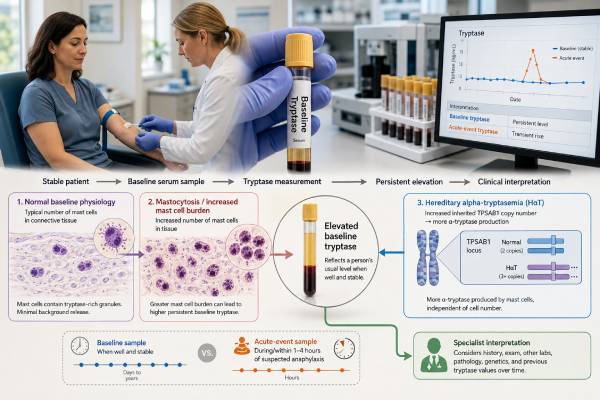
A baseline tryptase test measures the stable amount of tryptase circulating when a person is well and at least 24 hours beyond a suspected allergic or mast cell activation episode. The result helps interpret future acute reactions and can signal a persistently increased mast cell burden, hereditary alpha-tryptasemia, kidney disease, or certain blood disorders. It is not a stand-alone test for mastocytosis or mast cell activation syndrome. Many laboratories still flag values above about 11.4 ng/mL, while newer expert proposals describe 1–15 ng/mL as a broader normal range that includes many healthy people with hereditary alpha-tryptasemia. A baseline above 20 ng/mL is one minor criterion for systemic mastocytosis, but diagnosis requires additional clinical, genetic, bone marrow, or tissue findings. The most useful interpretation considers repeated measurements, collection timing, symptoms, kidney function, blood counts, anaphylaxis history, and whether extra copies of the tryptase gene explain the elevation.
- Collect baseline tryptase when symptoms have fully resolved, generally at least 24 hours after an acute reaction and preferably during usual health.
- A laboratory flag above 11.4 ng/mL does not automatically mean mastocytosis; reference limits and current expert ranges differ.
- A persistent value above 20 ng/mL is a minor systemic mastocytosis criterion, not a diagnosis by itself.
- Hereditary alpha-tryptasemia is a common genetic cause of elevated baseline tryptase and is confirmed by TPSAB1 copy-number testing.
- A normal baseline does not exclude systemic mastocytosis, especially in people with severe venom reactions or other strong clinical clues.
- Acute reactions are judged by change from this baseline, commonly using the baseline × 1.2 + 2 ng/mL formula.
Table of Contents
- Baseline Versus Acute Tryptase
- Collection Timing and Reference Ranges
- Interpreting a Persistent Elevation
- Hereditary Alpha-Tryptasemia
- Mastocytosis and Mast Cell Burden
- Other Causes of High Baseline Tryptase
- Follow-Up and Next Tests
Baseline Versus Acute Tryptase
Tryptase is an enzyme stored mainly in mast cell granules. A small amount circulates continuously, creating a personal baseline that is relatively stable over time. During severe systemic mast cell activation, additional mature tryptase enters the blood and produces a temporary rise.
The same laboratory assay can therefore answer two different questions:
- Baseline tryptase: What is the person’s usual stable concentration?
- Acute tryptase: Did the concentration rise during a suspected anaphylactic or mast cell activation event?
A baseline sample is essential because people begin at different levels. An acute result of 14 ng/mL may be a major increase for someone whose baseline is 3 ng/mL but almost no change for someone whose baseline is 13 ng/mL. The commonly used event threshold is acute tryptase greater than baseline multiplied by 1.2, plus 2 ng/mL.
Baseline tryptase is sometimes called basal serum tryptase, or BST. It reflects several influences: inherited tryptase gene copy number, mast cell number, kidney function, age, and certain hematologic conditions. It does not directly measure histamine release, allergic sensitization, or generalized inflammation.
A person can have frequent flushing, itching, gastrointestinal symptoms, or dizziness with a normal baseline. Conversely, someone can have a high baseline and no daily symptoms. The result must not be treated as a symptom score.
For an event-time comparison, an acute tryptase test should be collected promptly after symptoms begin. A broader tryptase blood test interpretation considers both the stable value and temporary rises.
Collection Timing and Reference Ranges
A true baseline should be collected after a person has returned to their usual state. Current guidance commonly recommends waiting at least 24 hours after complete resolution of anaphylaxis. When symptoms linger, a clinician may wait longer to avoid capturing the declining phase of the event.
No fasting is usually required. Antihistamines do not meaningfully lower serum tryptase and generally do not need to be stopped. The request form should note whether the sample is intended as a baseline or as part of an acute-reaction pair.
Reference ranges are evolving. Historically, many commercial assays used an upper reference limit near 11.4 ng/mL. More recent expert work has proposed that a normal baseline range of approximately 1–15 ng/mL better includes healthy people with inherited extra alpha-tryptase copies. Laboratories may continue using their validated local interval, so the printed flag and the clinical interpretation are not always identical.
| Baseline result | General context | Important caution |
|---|---|---|
| Below about 8 ng/mL | Common in the general population. | Does not exclude mastocytosis or severe anaphylaxis risk. |
| About 8–15 ng/mL | May be normal, genetically influenced, or mildly elevated by the laboratory’s range. | History and repeat stability determine whether more evaluation is useful. |
| About 15–20 ng/mL | More clearly above many proposed healthy ranges. | Hereditary alpha-tryptasemia and other causes are more likely than mastocytosis alone. |
| Above 20 ng/mL | Meets one minor laboratory criterion used in systemic mastocytosis classification when applicable. | Cannot diagnose systemic mastocytosis without other criteria and may require correction for hereditary alpha-tryptasemia. |
These bands are not rigid decision limits. A result of 19.8 and 20.2 ng/mL should not lead to completely different thinking. Analytical variation, biological variation, and the overall clinical picture matter. Repeating an unexpected value when the person is well can confirm persistence.
What counts as stable
Two baseline samples do not need to be identical. Small changes of a few tenths or even a few ng/mL can occur because of biological and analytical variation. A pattern such as 12.1, 12.8, and 11.9 ng/mL over several months is usually more consistent with a stable personal baseline than with progressive mast cell accumulation. A pattern that rises from 12 to 25 to 45 ng/mL, especially with new blood-count or organ findings, deserves a different level of attention.
The interval between repeat samples depends on the reason for testing. A sample repeated after several days may confirm that an event-related elevation has resolved. A stable mild elevation may not need frequent monitoring once genetics and common secondary causes have been addressed. People with diagnosed systemic mastocytosis may have scheduled measurements as part of disease assessment, but symptoms, blood counts, organ function, and imaging can be more informative than tryptase alone.
Units may be reported as ng/mL or mcg/L; the numbers are equivalent. Results should ideally be trended on the same assay platform because small method differences can matter near a threshold.
Interpreting a Persistent Elevation
A persistent elevation means that more than one well-state sample remains above the expected range, not simply that one result was high during an emergency. The pattern guides the next question.
A modest stable elevation with no concerning symptoms often reflects inherited tryptase copy number. A rising value, a markedly high value, or an elevation accompanied by abnormal blood counts, enlarged organs, bone disease, or recurrent anaphylaxis deserves a broader assessment.
Clinicians usually consider:
- The exact value and whether it is stable, increasing, or fluctuating
- Hereditary alpha-tryptasemia testing
- Kidney function and complete blood count
- Severe or unexplained anaphylaxis, especially after insect stings
- Fixed brown-red skin lesions that itch or swell when rubbed
- Unexplained osteoporosis, low-trauma fractures, or bone pain
- Enlarged liver, spleen, or lymph nodes
- Unexplained weight loss, low blood counts, high white blood cell counts, or other hematologic findings
- Peripheral blood testing for a KIT mutation when suspicion for clonal mast cell disease is meaningful
A high baseline does not automatically explain every symptom. Fatigue, brain fog, palpitations, abdominal discomfort, headache, and dizziness have many possible causes. Assigning them all to mast cells because tryptase is 12 or 14 ng/mL can delay evaluation for more common conditions.
The reverse error also occurs. A value inside the laboratory range may create false reassurance when the history strongly suggests clonal disease. Some patients with systemic mastocytosis have baseline tryptase below 20 ng/mL, and a normal result cannot overrule characteristic tissue findings, KIT mutations, or severe venom-associated anaphylaxis.
Baseline tryptase is also not the laboratory criterion for diagnosing an acute mast cell activation episode. That requires a temporary rise above the personal baseline. A stable value of 25 ng/mL may reflect mast cell burden or genetics but does not prove that current nonspecific symptoms represent active degranulation.
Hereditary Alpha-Tryptasemia
Hereditary alpha-tryptasemia, often abbreviated HαT or HaT, is an inherited trait caused by extra copies of alpha-tryptase–encoding sequence at the TPSAB1 gene. More gene copies generally produce a higher baseline tryptase. The trait is inherited in an autosomal dominant pattern, so it can occur across generations.
HαT is common, affecting an estimated several percent of many studied populations. It is one of the most frequent explanations for baseline tryptase above 8 or 11.4 ng/mL in allergy practice.
The trait has a wide clinical range:
- Many people have no symptoms and learn about it only after an incidental tryptase test.
- Some report flushing, itching, gastrointestinal symptoms, connective-tissue complaints, or autonomic symptoms, although the strength and specificity of these associations remain under study.
- HαT may increase the risk or severity of anaphylaxis in certain settings, particularly when another risk factor such as systemic mastocytosis or venom allergy is present.
- It can coexist with ordinary allergic disease, chronic urticaria, or unrelated medical conditions.
HαT is confirmed with specialized copy-number testing, usually digital droplet PCR or another validated method designed to assess TPSAB1. Standard gene sequencing may not reliably detect the relevant copy-number structure. A high tryptase alone cannot prove the trait.
The result can prevent unnecessary alarm. For example, a stable tryptase of 17 ng/mL in a healthy person with extra TPSAB1 copies may be explained by HαT rather than systemic mastocytosis. However, the genetic finding should not automatically end the evaluation when strong mastocytosis clues remain. The two conditions can coexist.
Current mastocytosis criteria allow adjustment or correction of the baseline tryptase contribution attributable to HαT when applying the greater-than-20 ng/mL minor criterion. The exact correction approach belongs in specialist interpretation because copy number, assay method, and classification rules matter.
A corrected value should not be confused with changing the laboratory result. The measured number remains the measured number; correction is a diagnostic calculation used to estimate how much of it may come from inherited alpha-tryptase. This can prevent a genetically expected concentration from being counted as evidence of mastocytosis when no other criterion is present. It also means that a person with HαT and a measured baseline above 20 ng/mL may not satisfy that specific minor criterion after adjustment.
HαT currently has no treatment aimed at removing the extra gene copies. Care focuses on the person’s actual clinical problems: avoiding proven triggers, treating allergic disease, carrying epinephrine when indicated, and investigating other causes of symptoms. An asymptomatic carrier does not need medication simply to lower tryptase.
Testing relatives is not automatically necessary. It may be useful when a family member has unexplained elevated tryptase, severe reactions, or needs help interpreting their own result. Genetic counseling can clarify inheritance and the limits of what the result predicts.
Mastocytosis and Mast Cell Burden
Mastocytosis is a group of disorders characterized by abnormal clonal accumulation of mast cells. Cutaneous forms primarily affect the skin, while systemic mastocytosis involves bone marrow or other organs outside the skin.
Baseline tryptase can serve as an indirect marker of mast cell burden, especially in systemic disease. Higher concentrations are common when more mast cells are present, but the relationship is imperfect. Tryptase can be influenced by HαT, kidney function, and associated blood disorders, and some people with low-burden systemic mastocytosis have values below 20 ng/mL.
Systemic mastocytosis is diagnosed using a combination of major and minor criteria. These can include dense mast cell clusters in bone marrow or another organ, atypical mast cell shape, aberrant cell-surface markers, activating KIT mutations, and a persistently elevated baseline tryptase. A person generally needs the required combination of criteria rather than one abnormal blood test.
Peripheral blood testing for KIT D816V with a highly sensitive method can identify some patients without immediately proceeding to bone marrow biopsy. A negative blood test does not completely exclude disease because the abnormal clone may be small. Bone marrow evaluation is considered when the clinical probability is high, the KIT result is positive, or other findings warrant direct tissue assessment.
Features that raise suspicion include:
- Unexplained recurrent anaphylaxis, particularly without hives or after a bee, wasp, or hornet sting
- Typical mastocytosis skin lesions
- Persistent tryptase clearly above the expected genetic range
- Osteoporosis or fractures at a younger age without another explanation
- Abnormal blood counts, enlarged spleen, or constitutional symptoms
- A detectable KIT mutation
The workup should be proportional to risk. A mildly elevated stable tryptase in a symptom-free person does not automatically justify invasive testing. In contrast, severe sting anaphylaxis with loss of consciousness may warrant specialist assessment even when baseline tryptase is not markedly high. An insect venom IgE evaluation and mast cell disorder screening often occur together in that setting.
Baseline tryptase in known mastocytosis
In established systemic mastocytosis, serial tryptase can provide a rough marker of disease burden, but it is not a complete activity score. Indolent disease can produce a high stable value for years, while advanced disease may show a rising value along with worsening blood counts, liver or spleen enlargement, bone problems, weight loss, or organ dysfunction. A change should be interpreted against the same assay and the rest of the clinical record.
Tryptase may fall when mast cell burden decreases with effective therapy, but symptom improvement does not always parallel the number. Mediator symptoms can fluctuate with triggers even when mast cell burden is stable. Conversely, a high value can persist in a patient whose symptoms are well controlled. Treatment decisions therefore are not based on one target concentration.
Children with skin-limited mastocytosis require age-appropriate interpretation. Some have elevated tryptase because of extensive skin involvement, yet most childhood cutaneous disease does not progress to adult systemic mastocytosis. The distribution of lesions, symptoms, organ findings, and trend over time guide whether systemic evaluation is needed.
Other Causes of High Baseline Tryptase
HαT and mastocytosis are not the only explanations. Baseline tryptase can rise in chronic kidney disease, some myeloid neoplasms, hypereosinophilic disorders, and other uncommon hematologic conditions. Severe acute illness can also complicate the timing of a supposed baseline sample.
Kidney function is relevant because reduced renal function is associated with higher tryptase. A clinician may review creatinine and estimated glomerular filtration rate before attributing the result to mast cells alone.
Myeloid disorders can produce tryptase because immature or abnormal blood cells may express related enzymes. Clues include anemia, abnormal platelets, high or low white blood cell counts, immature cells, enlarged spleen, or unexplained constitutional symptoms. A complete blood count and clinical examination help identify when hematology input is needed.
Technical and biological factors also matter:
- A sample collected too soon after anaphylaxis may still be elevated.
- Different assays may produce slightly different values.
- Rare assay interference can cause misleading results.
- Baseline tends to be fairly stable, but small natural fluctuations occur.
- Age and underlying health can shift population distributions.
A low baseline is generally not considered a deficiency and usually has no clinical significance. Tryptase is not ordered to diagnose an underactive immune system, and there is no treatment target for raising a low value.
Medications do not usually explain a chronically high baseline in a simple way. Antihistamines block histamine receptors but do not remove mast cells or reliably lower basal tryptase. Corticosteroids, biologics, and mast cell–directed therapies can affect symptoms or disease burden in selected conditions, yet a patient should not stop or start them merely to “clean up” a test result. The ordering clinician should document treatment because it may affect the broader clinical picture even when the assay itself remains valid.
Pregnancy, ordinary seasonal allergy, or a mild viral illness are not accepted explanations for a major persistent elevation by themselves. When a result is substantially high, it is safer to verify timing and investigate recognized causes than to assume a temporary everyday condition accounts for it.
Follow-Up and Next Tests
Follow-up should answer a defined question rather than repeat the same test indefinitely. For an unexpected elevation, a practical sequence may include:
- Confirm that the sample was collected during usual health and at least 24 hours after complete recovery from any reaction.
- Repeat baseline tryptase if timing, assay error, or persistence is uncertain.
- Review kidney function, blood counts, skin findings, bone history, reactions, and family history.
- Consider TPSAB1 copy-number testing for hereditary alpha-tryptasemia.
- Use sensitive peripheral blood KIT testing when clonal mast cell disease is a realistic concern.
- Refer to allergy, hematology, dermatology, or a mastocytosis center according to the findings.
- Reserve bone marrow biopsy for situations in which the probability and potential benefit justify an invasive test.
People with a known elevated baseline should keep the number in their medical record. During a future reaction, the baseline allows the emergency sample to be interpreted with the 20% plus 2 formula. The comparison is more informative than asking whether the acute value crossed a population reference limit.
A mast cell activation test panel may be considered for recurrent, clearly episodic multisystem symptoms, but mediator tests have strict collection and handling requirements. Chronic nonspecific symptoms without event-linked changes should not be diagnosed from borderline markers.
Seek emergency care for breathing difficulty, throat swelling, fainting, low blood pressure, or rapidly progressing symptoms after an exposure. Baseline testing is a planned outpatient tool; it should never delay epinephrine or emergency treatment during suspected anaphylaxis.
References
- Defining “Normal” basal serum tryptase levels: a context-dependent approach to improve diagnostics in systemic mastocytosis 2025 (Review)
- Hereditary alpha tryptasemia and clinical implications 2025 (Review)
- Utility of tryptase genotyping in the screening, diagnosis, and management of systemic mastocytosis 2025 (Review)
- Review and Updates on Systemic Mastocytosis and Related Entities 2023 (Review)
- The Normal Range of Baseline Tryptase Should Be 1 to 15 ng/mL and Covers Healthy Individuals With HαT 2023 (Position Statement)
- Updated Diagnostic Criteria and Classification of Mast Cell Disorders: A Consensus Proposal 2021 (Position Statement)
Disclaimer
This article is educational and cannot diagnose hereditary alpha-tryptasemia, mastocytosis, or mast cell activation syndrome. A specialist should interpret persistent elevations with symptoms, genetics, kidney function, blood counts, and any KIT or tissue findings. Suspected anaphylaxis requires prompt epinephrine and emergency care, not baseline testing. Keep copies of both baseline and acute reports because values from separate hospitals may not appear in the same medical record. Record collection dates and whether symptoms were present for each sample.