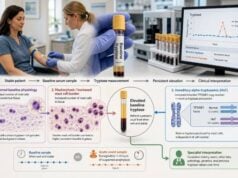
An insect venom IgE test measures antibodies directed against venom from honeybees, yellow jackets, paper wasps, hornets, or other stinging insects. It is most useful after a systemic sting reaction involving symptoms away from the sting site, such as widespread hives, throat tightness, breathing trouble, dizziness, or low blood pressure. The blood test can confirm sensitization, help identify the likely insect, and guide selection of venom immunotherapy. It cannot diagnose venom allergy by itself. Many people have detectable venom-specific IgE without ever developing a dangerous reaction, and the antibody level does not predict how severe the next sting will be. A negative result can also be misleading when testing occurs soon after a reaction, the wrong venom is tested, or the relevant allergen is missing from the assay. Allergists therefore interpret venom IgE together with the sting history, skin testing, component testing, baseline tryptase, and sometimes a basophil activation test.
- A positive venom-specific IgE result shows sensitization, not proof that a future sting will cause anaphylaxis.
- Testing is most appropriate after a systemic sting reaction, not after ordinary pain, redness, or swelling alone.
- Bee, yellow jacket, paper wasp, and hornet results can overlap because venoms contain cross-reactive proteins and carbohydrate structures.
- A negative early test may need repeating several weeks later when the reaction history strongly suggests venom allergy.
- The IgE number does not reliably measure reaction severity or determine who needs epinephrine.
- Severe sting reactions warrant baseline tryptase testing and assessment for mast cell disorders or hereditary alpha-tryptasemia.
Table of Contents
- What the Insect Venom IgE Test Measures
- Who Should Have Venom Allergy Testing
- Bee, Wasp, and Hornet Venom Markers
- How to Interpret Positive and Negative Results
- Timing, Preparation, and the Testing Process
- Anaphylaxis Risk, Tryptase, and Mast Cell Disorders
- How Results Guide Venom Immunotherapy
- What to Do After the Results
What the Insect Venom IgE Test Measures
The test measures venom-specific immunoglobulin E, or IgE, in a blood sample. IgE is an antibody that can attach to mast cells and basophils. When venom enters the body again, matching IgE may recognize venom proteins and cross-link receptors on these cells. The cells then release histamine, tryptase, leukotrienes, and other mediators that can cause hives, swelling, wheezing, vomiting, low blood pressure, or anaphylaxis.
Laboratories may test IgE against a whole-venom extract, individual venom components, or both. Whole extracts contain many proteins from one insect’s venom. Component tests measure IgE to selected purified or recombinant proteins. Both approaches detect sensitization. Neither recreates a sting or proves that the sensitization causes symptoms.
Results are usually reported in kilo units of allergen-specific IgE per liter, written as kUA/L, along with a laboratory class or interpretation. Modern assays can detect very small amounts, often near 0.1 kUA/L. Some reports use 0.35 kUA/L as a traditional positive threshold, but no single cutoff separates allergic from nonallergic people. A low result may be clinically important after convincing anaphylaxis, while a higher result may represent asymptomatic sensitization.
Venom IgE differs from total IgE. Total IgE reflects the combined amount of IgE against many possible targets and cannot identify the responsible insect. A person can have severe venom allergy with a normal total IgE level. Conversely, very high total IgE can increase the chance of low-level positive results that do not match the clinical history. A focused allergy blood test interpretation should therefore consider the specific venom result rather than a broad panel alone.
A complete diagnosis has two parts:
- A compatible clinical reaction after a sting
- Evidence of sensitization to a relevant venom by blood testing, skin testing, or another validated method
Testing people who have never had a systemic reaction often finds antibodies that do not require treatment. Screening can therefore create anxiety, unnecessary avoidance, and confusion about which venom would be used for immunotherapy.
Who Should Have Venom Allergy Testing
Venom allergy testing is mainly recommended after a systemic allergic reaction. “Systemic” means symptoms occurred beyond normal pain and swelling around the sting. Examples include:
- Hives or flushing over areas not directly stung
- Swelling of the lips, tongue, throat, or eyelids
- Cough, wheeze, shortness of breath, or a change in voice
- Repeated vomiting, severe abdominal cramping, or diarrhea with other allergic symptoms
- Dizziness, collapse, confusion, low blood pressure, or loss of consciousness
- Rapid involvement of more than one organ system
A large local reaction is different. Swelling may extend across a joint or involve most of an arm or leg, peak over 24 to 48 hours, and last several days. Although uncomfortable, it usually does not carry the same future risk as a prior systemic reaction. Routine venom testing and venom immunotherapy are generally unnecessary for isolated large local reactions, though unusual exposure patterns or major quality-of-life effects may justify specialist discussion.
Ordinary local reactions also do not need testing. Pain, redness, warmth, and a small area of swelling are expected effects of injected venom. Multiple simultaneous stings can cause toxic illness from the venom dose rather than IgE-mediated allergy. That situation needs urgent medical assessment but is interpreted differently from anaphylaxis.
Children with only generalized skin symptoms after a sting often have a lower risk of a severe future reaction than adults with the same history. Management may differ by age, exposure, insect, family circumstances, and local guidelines. Adults who developed widespread hives alone still need individualized assessment, especially when exposure is frequent or access to emergency care is limited.
Testing is especially important when the prior reaction included low blood pressure, fainting, airway symptoms, severe breathing difficulty, or an absence of hives despite cardiovascular collapse. Beekeepers, gardeners, forestry workers, outdoor tradespeople, and people living far from emergency care may face higher exposure consequences even when their laboratory pattern is complex.
The allergist will ask what the insect looked like, where the sting occurred, whether a stinger remained, how quickly symptoms started, what organs were involved, and which treatments were given. Honeybees commonly leave a barbed stinger, although this clue is not absolute. Yellow jackets often sting near food, garbage, or ground nests. Paper wasps build exposed comb-like nests, while hornet labels vary by region. Photographs of the insect or nest can help, but patients should not approach a nest to identify it.
Bee, Wasp, and Hornet Venom Markers
Whole-venom testing commonly includes honeybee, yellow jacket, paper wasp, white-faced hornet, and yellow hornet. The available choices depend on country and laboratory. In Europe, tests may emphasize Vespula species and European paper wasp. In North America, yellow jacket mixtures and separate hornet or paper-wasp reagents are common. Local insects matter because venom immunotherapy must cover the clinically relevant species.
Honeybee Components
Honeybee venom is often labeled Apis mellifera. Useful molecular markers include:
- Api m 1, phospholipase A2
- Api m 3, acid phosphatase
- Api m 4, melittin
- Api m 10, icarapin
IgE to one or more species-associated honeybee components can support genuine honeybee sensitization. A negative Api m 1 result does not exclude honeybee allergy because some patients mainly recognize other components. Whole honeybee venom and a panel of components may therefore provide more information than one molecule alone.
Yellow Jacket and Related Vespid Components
Yellow jacket venom is associated with Vespula species. Important markers include:
- Ves v 1, phospholipase A1
- Ves v 5, antigen 5
These components support genuine sensitization to yellow jacket venom. Hornets and yellow jackets belong to the vespid family and share several related proteins. A person stung by a hornet may therefore have positive yellow jacket, hornet, or multiple vespid results. Commercial nomenclature can also be confusing: the white-faced “hornet” is a Dolichovespula wasp rather than a true hornet.
Paper-Wasp Components
Paper-wasp testing may include Polistes venom. Component markers include:
- Pol d 1, phospholipase A1
- Pol d 5, antigen 5
Polistes and Vespula venoms can cross-react at the protein level. Component patterns may help, but they do not always identify the exact vespid species. Geography, nest type, season, sting setting, skin tests, and inhibition or functional testing may still be needed.
Why Several Venoms Can Test Positive
Double positivity to honeybee and vespid venom does not automatically mean true allergy to both. Possible explanations include:
- Genuine sensitization to two insects
- Similar protein families shared across venoms
- Cross-reactive carbohydrate determinants, called CCDs
- Very high total IgE with multiple low-level results
- A clinically irrelevant antibody response from prior stings
CCDs are sugar structures attached to allergen proteins. IgE can bind them in the laboratory without causing meaningful sting reactions. Recombinant component tests are often produced without these carbohydrate structures, which can help separate true species-associated sensitization from CCD-related overlap. Component testing is a second-level tool, however, not a replacement for the reaction history and first-line testing.
How to Interpret Positive and Negative Results
A positive venom IgE result means the immune system has made IgE that binds the tested venom or component. Its clinical meaning depends on the sting history. After a rapid systemic reaction to a honeybee sting, honeybee-specific IgE supports the diagnosis. In someone who has only experienced normal local swelling, the same result may be incidental sensitization.
The numerical level does not reliably predict the next reaction’s severity. A person with low venom-specific IgE can have severe anaphylaxis, while another person with a higher level may have no systemic symptoms. The value also changes with time since the sting, repeat exposure, total IgE, assay platform, and treatment. Results should not be used to rank a person as “mildly” or “severely” allergic.
A negative result lowers the likelihood of IgE sensitization to that reagent, but it does not always exclude venom allergy. Important reasons include:
- Testing during a temporary low-response period after the sting
- Gradual decline in venom-specific IgE over years
- A whole extract that contains too little of the patient’s main allergen
- Testing the wrong species or an incomplete regional panel
- An assay detection limit that misses low-level but relevant antibody
- A mast cell disorder with severe reactions despite weak conventional results
- A reaction caused by a different mechanism or by massive envenomation
Skin prick and intradermal tests can detect sensitization that blood testing misses. The reverse also occurs. Using both methods can improve sensitivity when the history is convincing. Intradermal testing uses dilute venom injected just under the skin and must be performed by trained clinicians because excessive concentrations can cause irritant or systemic reactions.
When history, skin testing, and venom IgE disagree, component testing may clarify the species. A basophil activation test can sometimes demonstrate functional cell activation when standard tests are negative or multiple venoms remain positive. BAT is specialized, method-dependent, and affected by nonresponsive basophils, so it is not a routine screening test.
No laboratory result should be interpreted without the reaction grade. Generalized hives alone, respiratory compromise, and shock carry different implications. The clinician also considers age, occupation, distance from emergency care, cardiovascular disease, asthma, pregnancy plans, and medications that may complicate treatment.
Timing, Preparation, and the Testing Process
Venom-specific IgE requires a standard blood draw and usually does not require fasting. Antihistamines do not suppress serum IgE, so they generally do not need to be stopped for the blood test. They can suppress skin-test responses, which is why medication instructions differ when skin testing is planned at the same visit.
The timing after a sting matters. Venom IgE may rise after exposure, but both blood and skin tests can be temporarily negative during an early refractory period. Testing should not be delayed when prompt evaluation is important, because many patients are positive soon after the event. When early results are negative despite a strong history, clinicians commonly repeat testing after several weeks. A later repeat may also be appropriate when years have passed and antibody levels have declined.
The laboratory order should be tailored to the suspected insect and local species. A broad panel without a clear history can produce multiple positives that are difficult to interpret. Useful information on the requisition includes:
- Date and location of the sting
- Suspected insect or nest description
- Whether a stinger was left behind
- Time from sting to symptoms
- Skin, airway, gastrointestinal, and cardiovascular symptoms
- Epinephrine use and emergency treatment
- Previous sting reactions
- Occupation and likely future exposure
Specific IgE results are often available within several days, but specialized component testing may take longer. Blood testing is useful when skin testing cannot be performed, when extensive skin disease is present, or when antihistamines cannot be stopped safely. Skin testing may add sensitivity and gives information through a different biological method.
Testing during venom immunotherapy has limited value for routine monitoring. IgE may remain positive for years even while treatment provides strong protection. Falling IgE or changing IgG levels do not prove that protection is complete. Decisions about stopping therapy rely more on treatment duration, original reaction severity, insect type, ongoing exposure, mast cell risk, and specialist judgment than on one repeat antibody value.
Anaphylaxis Risk, Tryptase, and Mast Cell Disorders
Anaphylaxis after an insect sting is a clinical emergency. Epinephrine is the first-line treatment when breathing, throat, circulation, or rapidly progressive multisystem symptoms are involved. Antihistamines may reduce itching or hives, but they do not treat airway obstruction or shock and should not delay epinephrine.
Venom IgE confirms sensitization; it does not calculate anaphylaxis risk by itself. Factors associated with more severe sting reactions include:
- A previous severe systemic reaction
- Older age
- Cardiovascular or significant respiratory disease
- Clonal mast cell disease, including systemic mastocytosis
- Elevated baseline tryptase or hereditary alpha-tryptasemia
- Frequent unavoidable exposure
- Delayed epinephrine during a reaction
Baseline serum tryptase should be measured after severe sting anaphylaxis and is increasingly considered in the evaluation of any systemic sting reaction. The sample must be obtained after the acute episode has resolved, not confused with an acute tryptase sample collected during the reaction. A persistent elevation can reflect increased mast cell burden, hereditary alpha-tryptasemia, kidney disease, or other causes.
A baseline tryptase result above the laboratory range deserves interpretation in context. Current anaphylaxis guidance also supports considering hereditary alpha-tryptasemia and clonal mast cell disease when baseline tryptase is above about 8 ng/mL in an appropriate high-risk setting. This is not a diagnostic cutoff for mastocytosis. Some people with clonal mast cell disease have tryptase below 20 ng/mL, and hereditary alpha-tryptasemia can elevate tryptase without a mast cell cancer.
Severe sting anaphylaxis with low blood pressure and few or no hives is a recognized presentation of mast cell disease. Adults with this pattern may need a risk score, KIT D816V testing in peripheral blood, TPSAB1 copy-number testing, or bone marrow evaluation. The workup should be directed by an allergist, hematologist, or mast cell specialist rather than triggered by the venom IgE number alone.
Acute tryptase can support mast cell activation when collected promptly after symptoms and compared with a later baseline. A normal acute value does not rule out anaphylaxis. Treatment should always follow the clinical reaction rather than wait for laboratory confirmation.
How Results Guide Venom Immunotherapy
Venom immunotherapy, or VIT, gives gradually increasing doses of the relevant venom to reduce the risk of another systemic reaction. It is the only treatment that changes the underlying venom-allergy response. For appropriately selected patients, it provides strong protection and greatly reduces fear and activity restrictions.
VIT is generally considered when a patient has had a systemic sting reaction and testing confirms sensitization to the responsible venom. The exact threshold for treatment depends on reaction severity, age, exposure, quality of life, and regional guidance. Sensitization without a systemic reaction is not enough. Isolated ordinary local swelling usually does not justify VIT.
Choosing the correct venom is essential. A clear honeybee history with honeybee sensitization supports honeybee VIT. When the insect is uncertain and several venoms test positive, the allergist may use skin-test strength, component results, regional insects, and the circumstances of the sting. Some patients need treatment with more than one venom because true double sensitization cannot be excluded or exposure involves multiple relevant insects.
Treatment has two phases:
- Build-up: The dose increases from a very small amount to a maintenance dose. Conventional schedules take weeks to months, while rush or ultrarush schedules reach maintenance more quickly under close supervision.
- Maintenance: The patient receives a stable dose at regular intervals, often every four weeks at first, with possible extension later.
A typical course lasts three to five years. Longer or indefinite treatment may be considered after extremely severe reactions, honeybee allergy with high exposure, systemic reactions during VIT, mastocytosis, other clonal mast cell disease, or major ongoing occupational risk. Stopping decisions are individualized because no blood test can guarantee that allergy has disappeared.
VIT reactions can occur, especially during build-up and in honeybee-allergic patients. Clinics administer injections where staff can recognize and treat systemic symptoms. Dose changes, antihistamine premedication, schedule adjustment, or biologic support may be considered for recurrent reactions. Cardiovascular medicines should not be stopped automatically; their benefits and risks should be reviewed with the prescribing clinician and allergist.
Successful VIT does not necessarily make venom-specific IgE negative. The immune response changes in several ways, including reduced mast cell and basophil reactivity and increased blocking antibodies. Clinical protection, not laboratory normalization, is the treatment goal.
What to Do After the Results
A result review should connect each laboratory finding to the actual sting. Ask the clinician to identify which venom is considered clinically relevant, whether skin or component testing is needed, and whether the result supports VIT. A report showing several positive insects should not be treated as a final diagnosis without resolving possible cross-reactivity.
After a systemic reaction, a complete plan commonly includes:
- Prescription of one or more epinephrine auto-injectors when indicated
- Hands-on training with the exact device
- A written emergency action plan
- Advice about when to call emergency services
- Baseline tryptase and further mast cell evaluation when appropriate
- Referral to an allergist for skin testing, component testing, and VIT assessment
- Review of asthma and cardiovascular health
- Discussion of work, hobbies, travel, and access to emergency care
Carry epinephrine where it can be reached quickly, not in a car exposed to extreme heat or cold. Family members, coworkers, and caregivers should know where it is and how to use it. After epinephrine, follow the emergency plan because symptoms can persist or return. People with prior shock, breathing compromise, delayed response to epinephrine, or limited access to care may need a second device.
Reduce exposure without allowing fear to control normal life. Wear shoes outdoors, use gloves for gardening, cover food and sweet drinks outside, avoid drinking directly from open cans, keep garbage sealed, and arrange professional nest removal. Do not swat at a flying insect. If honeybees are present, move away calmly; scrape or remove a retained stinger promptly without delaying emergency treatment.
Seek urgent care after a sting if symptoms spread beyond the sting site, breathing changes, the throat feels tight, faintness develops, repeated vomiting occurs, or several organ systems become involved. Use epinephrine promptly according to the action plan. A previous mild reaction does not guarantee that every later reaction will remain mild.
When all initial allergy tests are negative but the history strongly supports anaphylaxis, the evaluation is incomplete rather than reassuring. Repeat venom IgE and skin testing at an appropriate interval, verify that relevant regional venoms were included, and consider components or BAT. At the same time, assess alternative causes such as an unrelated food or medicine exposure, panic without objective allergic findings, cardiovascular collapse, or toxic effects from many stings.
Venom IgE testing is most valuable when it leads to a precise, usable plan: the likely insect, the evidence supporting allergy, the emergency response, and whether VIT can prevent another life-threatening reaction.
References
- Update in stinging insect hypersensitivity 2025 (Review)
- An algorithm for the diagnosis and treatment of Hymenoptera venom allergy, 2024 update 2024 (Review)
- Venom Component Allergen IgE Measurement in the Diagnosis and Management of Insect Sting Allergy 2025 (Review)
- Biomarkers for the Molecular Diagnosis of IgE-Mediated Hymenoptera Venom Allergy in Clinical Practice 2025 (Review)
- Anaphylaxis: A 2023 practice parameter update 2024 (Practice Parameter)
- Mastocytosis and insect venom allergy: a special relationship 2025 (Review)
Disclaimer
This article provides general education and does not diagnose venom allergy or replace evaluation by a qualified clinician. A systemic reaction after an insect sting can become life-threatening; use prescribed epinephrine promptly and seek emergency care according to your action plan. Do not start, stop, or change allergy treatment or cardiovascular medication based on a laboratory result alone.