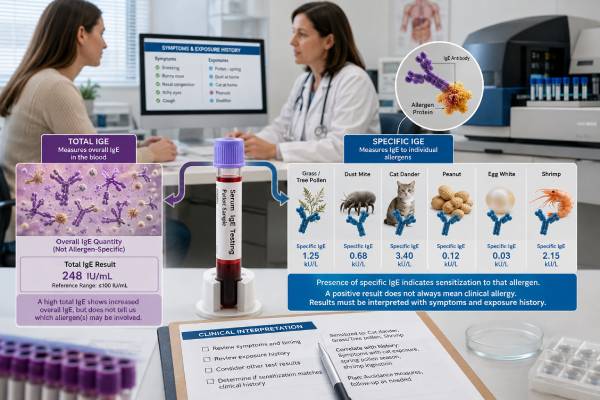
An allergy blood test panel measures immunoglobulin E antibodies in a blood sample. Depending on the order, it may include total IgE, specific IgE to selected foods or inhaled allergens, and sometimes molecular components from a single allergen source. The test can identify sensitization, meaning the immune system has made IgE that recognizes a substance. Sensitization is not the same as clinical allergy: many people have a positive result yet tolerate the food, animal, pollen, or other exposure without symptoms. The most reliable panel is therefore a focused one chosen from the reaction history rather than a broad screen of dozens of unrelated allergens. Results are interpreted with the timing and type of symptoms, regular exposure and tolerance, age, eczema or asthma, pollen cross-reactivity, and the likelihood of the suspected trigger. Blood testing is useful when skin testing is unsuitable, but it does not replace medical history or, when needed, a supervised challenge.
- Total IgE shows overall IgE activity, not the specific trigger; a normal value does not rule out allergy and a high value does not prove one.
- Specific IgE identifies sensitization to a named allergen, but the result must match symptoms after real exposure.
- Higher specific IgE often raises the probability of allergy, yet it does not reliably predict the severity of a future reaction.
- No fasting is usually needed, and antihistamines generally do not interfere with serum IgE testing.
- Broad food panels can create false alarms and unnecessary avoidance when ordered without a focused clinical history.
- Trouble breathing, throat swelling, fainting, or rapid multisystem symptoms require emergency care, not outpatient panel interpretation.
Table of Contents
- What Is Included in an Allergy Blood Test Panel
- How Clinicians Choose the Right Allergens
- How to Interpret Total IgE
- How to Read Specific IgE Results
- Cross-Reactivity and Component Testing
- Blood Testing Versus Skin Tests and Challenges
- Next Steps and Common Interpretation Errors
What Is Included in an Allergy Blood Test Panel
“Allergy panel” is a broad laboratory term rather than one standard test. One panel may contain eight common airborne allergens, while another contains 20 foods, regional pollens, molds, animal dander, or insect venoms. The exact list on the report matters more than the panel name.
Most orders use one or more of these measurements:
- Total IgE: the combined amount of circulating IgE directed against all targets.
- Allergen-specific IgE: IgE directed against a named extract, such as peanut, egg white, cat dander, dust mite, birch pollen, or shrimp.
- Allergen mixes: a preliminary test that combines several related substances, such as a grass mix. A positive mix may need follow-up with individual allergens.
- Molecular components: IgE to individual proteins within an allergen source, such as Ara h 2 in peanut or ovomucoid in egg.
Serum specific IgE is often reported in kilounits of allergen-specific antibody per liter, written as kUA/L. A common analytical detection point is around 0.10 kUA/L, while many laboratories use 0.35 kUA/L as a traditional positive threshold. These cutoffs are not universal diagnostic lines. A result just above a cutoff may be clinically irrelevant, while a lower result can still matter when the history is highly convincing or the assay does not represent the relevant protein well.
Total IgE is usually reported in international units per milliliter, which is numerically equivalent to kilounits per liter. Its reference interval changes substantially with age and laboratory method. Children may have age-banded ranges, and people with eczema or certain immune conditions can have values far above the usual interval.
A panel does not measure histamine, mast cell activation during a recent reaction, or delayed non-IgE immune responses. It also does not diagnose lactose intolerance, celiac disease, contact dermatitis, medication side effects, or most food intolerances. A specific IgE blood test answers a narrower question about one allergen, while a total IgE blood test measures the overall concentration.
How Clinicians Choose the Right Allergens
A useful order starts with the exposure story. The clinician asks what happened, how quickly it began, how reproducible it was, which foods or substances were present, whether the person has tolerated them since, and whether cofactors such as exercise, alcohol, infection, or an anti-inflammatory medicine were involved.
Immediate IgE-mediated reactions usually begin within minutes to two hours. Typical features include hives, swelling, repetitive vomiting, wheezing, throat tightness, or a fall in blood pressure. Symptoms that appear the next day, persist continuously, or occur without a consistent exposure often need a different evaluation.
For respiratory symptoms, a focused panel may reflect local exposure. Dust mites, cat, dog, cockroach, mold, grasses, weeds, and trees are not equally relevant in every climate or home. Seasonal timing can narrow the list: spring symptoms may suggest tree pollen, early summer may point to grasses, and late summer or autumn may fit weed pollens. Year-round symptoms in bed or while cleaning raise different questions than symptoms only during outdoor mowing.
For food reactions, known tolerance is powerful evidence. A child who eats wheat every week without symptoms generally should not be labeled wheat-allergic because of a low positive panel result. The same principle applies to milk, egg, soy, peanut, or tree nuts. Testing tolerated foods increases the chance of finding sensitization that has no clinical consequence.
A focused order commonly follows this sequence:
- Identify the most plausible exposure from the history.
- Test only the allergens that could reasonably explain the event.
- Add related components or cross-reactive allergens when they will change interpretation.
- Avoid testing foods or environmental allergens that are regularly tolerated and unrelated to symptoms.
- Use the result to decide whether avoidance, a challenge, or further evaluation is warranted.
Broad screening creates a statistical problem. When many tests are ordered in a person with a low pretest probability, some will be positive by chance or through harmless cross-reactivity. The apparent precision of a long laboratory list can therefore reduce diagnostic accuracy rather than improve it.
Children with moderate or severe eczema need especially careful selection. They often have high total IgE and multiple low-level food sensitizations, yet many of those foods may be tolerated. Removing several staple foods can impair growth and nutrition and may make later reintroduction more difficult. Testing is most useful when a food has caused an immediate reaction, has never been introduced and the child is considered high risk, or a specialist needs evidence before a supervised introduction. Chronic eczema alone does not prove that every positive food result is a trigger.
The same caution applies to adults with chronic hives. Most chronic spontaneous urticaria is not caused by a hidden food allergy, so broad food panels often generate distracting positives. Testing should follow a reproducible exposure pattern rather than the assumption that fluctuating hives must come from something eaten that day.
A focused environmental allergy IgE panel can be appropriate for persistent rhinitis or asthma when the selected allergens match the person’s region and exposure. A food allergy IgE panel should be limited to foods supported by a reaction history or a specific specialist question.
How to Interpret Total IgE
Total IgE provides background information, but it is a weak stand-alone allergy test. It may be high in people with allergic rhinitis, asthma, atopic dermatitis, food allergy, or several allergies at once. It can also rise for reasons unrelated to common allergy, including parasitic infections, some primary immune disorders, allergic bronchopulmonary aspergillosis, certain inflammatory diseases, and rare blood cancers.
A low or normal total IgE does not exclude a specific allergy. A person can have a small overall IgE pool but still make clinically important IgE against one allergen. Likewise, a very high total IgE does not reveal which substance causes symptoms.
The value can help in context:
- Very high total IgE with severe eczema may explain why numerous low-level specific IgE results appear on a panel.
- High total IgE with asthma and recurrent lung infiltrates may prompt evaluation for allergic bronchopulmonary aspergillosis when the clinical picture fits.
- Extremely high values with recurrent infections or unusual skin findings may lead to an immune-deficiency workup.
- A normal value with a convincing immediate reaction still warrants targeted specific IgE or skin testing.
Total IgE also matters for dosing calculations for some biologic treatments, although eligibility and dosing use condition-specific rules, body weight, and approved tables. It should not be interpreted as a treatment target that must be lowered into a “normal” range.
Age-specific reference ranges and assay methods differ. One laboratory may flag a value that another considers within range. Changes over time are hard to interpret unless samples were measured with the same method and there is a clear clinical reason for repeating the test.
A common mistake is to divide specific IgE by total IgE and assume the ratio proves allergy. Research is exploring whether this ratio improves prediction in selected settings, but it is not a universal diagnostic rule. Clinicians rely more on validated allergen-specific thresholds, component patterns, and the individual history.
How to Read Specific IgE Results
A positive specific IgE result means the immune system recognizes the tested allergen extract. It does not automatically mean exposure causes symptoms. The report must be read as a probability signal rather than a yes-or-no diagnosis.
Many laboratories display both the numeric concentration and a class, often class 0 through class 6. Class systems simplify reporting but lose detail. Two values in the same class can carry different probabilities depending on the allergen, age, population, and clinical history.
| Result pattern | Possible meaning | Usual next step |
|---|---|---|
| Undetectable or very low | IgE sensitization is less likely, but allergy is not impossible. | Reassess timing, allergen selection, and whether skin testing or challenge is appropriate. |
| Low positive without symptoms | May represent harmless sensitization or cross-reactivity. | Do not begin avoidance solely from the result; review actual tolerance. |
| Positive with a matching immediate reaction | Supports IgE-mediated allergy. | Develop an avoidance and emergency plan; consider confirmatory testing when needed. |
| High concentration | Often increases the likelihood of clinical allergy. | Interpret with allergen-specific evidence; it does not directly predict reaction severity. |
| Multiple related positives | May reflect genuine multiple allergies or one cross-reactive protein family. | Use exposure history and component testing to separate the patterns. |
For some foods, studies have identified concentrations associated with a high probability of reacting during an oral food challenge. These decision points vary by age, assay, referral population, and study design. They are not universal safety cutoffs, and values below them do not prove tolerance. The same concentration can mean something different in a toddler with recent hives after egg than in an adult who eats egg without symptoms.
Specific IgE also does not predict how severe the next reaction will be. A person with a modest level can have anaphylaxis, while another with a high level may have mild symptoms or no reaction. Asthma control, dose, route of exposure, exercise, alcohol, illness, and delayed use of epinephrine can influence severity.
Results can change over time
Specific IgE concentrations can rise or fall, particularly during childhood. A downward trend may support considering a supervised food challenge, but the trend is not proof that the allergy has resolved. Clinicians also consider the most recent reaction, skin-test size, component results, age, and the food involved. Peanut and tree-nut allergy often persist, while many children eventually tolerate milk or egg, sometimes first in extensively heated forms.
Seasonal pollen values can vary with exposure, and allergen immunotherapy may alter results without creating a simple “cured” threshold. Successful treatment is judged mainly by symptoms and controlled exposure, not by forcing a laboratory number to zero. Biologic drugs that alter IgE pathways can also make total or specific IgE measurements difficult to compare with pretreatment values. The ordering clinician should know about current allergy biologics and the assay’s limitations.
Negative results can occur when the wrong allergen was tested, the relevant protein is poorly represented in the extract, sensitization is below assay detection, or the reaction was not IgE-mediated. A clinician may repeat testing later in young children because food allergy can change as the immune system matures, but routine serial panels without a clinical question add little value.
Cross-Reactivity and Component Testing
Cross-reactivity occurs when IgE recognizes similar proteins in different sources. It can explain why a panel shows several positives even though only one or none causes important symptoms.
A common example is birch pollen sensitization. IgE against a birch-related protein can bind similar proteins in raw apple, peach, hazelnut, or other plants. This may cause itching or tingling in the mouth, often called pollen-food allergy syndrome, while cooked forms are tolerated. In contrast, sensitization to stable storage proteins in a food may be associated with a higher chance of systemic reactions.
Other patterns include:
- Dust mite or cockroach proteins cross-reacting with shellfish tropomyosin
- Grass pollen cross-reacting with some cereal or plant extracts without true food allergy
- Latex proteins cross-reacting with banana, avocado, kiwi, or chestnut
- Cross-reactive carbohydrate determinants producing broad low-level positives with limited clinical relevance
Component-resolved testing measures IgE to individual proteins rather than the whole-source extract. It can refine probability and explain cross-reactivity. For example, peanut component IgE testing distinguishes storage proteins such as Ara h 2 from pollen-related components. An egg component IgE test may add information about recognition of ovomucoid or ovalbumin, although no component result should be used alone to promise baked-egg tolerance or reaction severity.
Multiplex arrays can test many components from a small blood sample. They may be valuable for complex polysensitization, but they also generate large amounts of data. Without a focused question, they can reveal low-level findings that are difficult to translate into real-world restrictions.
Blood Testing Versus Skin Tests and Challenges
Serum IgE testing is especially useful when antihistamines cannot be stopped, widespread eczema prevents reliable skin testing, dermatographism causes nonspecific skin reactions, or the person cannot safely or practically undergo skin testing. It requires only a blood draw and carries no risk of triggering an allergic reaction from the laboratory assay itself.
Antihistamines generally do not affect serum IgE results, unlike skin-prick testing. Most people do not need to fast. Biotin and other supplements usually are not major issues for standard allergen-specific IgE assays, but patients should still provide a full medication and supplement list because laboratory methods vary.
Skin-prick testing provides rapid results and directly tests IgE reactivity in the skin. It can be sensitive and cost-effective when performed with valid extracts and controls. However, it also detects sensitization rather than proving symptoms, and results can be affected by medicines, skin disease, technique, and extract quality.
A supervised challenge exposes the person to the suspected trigger under controlled conditions. For food allergy, an oral food challenge is often the reference standard when history and testing do not give a clear answer. Nasal, bronchial, or medication challenges may be used for other questions. Challenges require specialist selection and safety measures; they are not home experiments.
Blood and skin testing are not automatically additive. Ordering both broad panels can magnify false positives. Clinicians often choose the method most likely to answer the question, then use a second method only when the first result conflicts with the history or a challenge decision needs more evidence.
The timing of blood testing after a reaction is usually flexible because allergen-specific IgE remains detectable after symptoms resolve. However, a small number of patients may have temporarily lower test reactivity soon after severe anaphylaxis, and a clinician may repeat testing when the initial result conflicts strongly with the history. This is different from tryptase, which must be collected during a short event-related window.
Specimen quality also matters. Hemolysis, insufficient volume, labeling errors, and testing on different platforms can complicate comparison. The laboratory should identify the exact allergen and method, especially when a result will determine whether a person continues avoiding a nutritionally important food or undergoes a challenge.
Next Steps and Common Interpretation Errors
The next step depends on whether the laboratory pattern agrees with real-life exposure.
When a result is positive and the history matches, the plan may include avoidance, label-reading education, asthma management, an epinephrine prescription, and testing for related allergens. When the result is positive but the food is eaten safely, continued consumption may be preferable to unnecessary avoidance, but major decisions should be discussed with a clinician, especially after any previous severe event.
When the result is negative despite a convincing reaction, the clinician may confirm that the correct extract was tested, consider skin testing or components, review non-IgE causes, and decide whether a supervised challenge is safe. For a suspected recent anaphylactic event, an acute tryptase test answers a different question: whether systemic mast cell activation occurred, not which allergen was responsible.
Common errors include:
- Treating every positive result as a disease diagnosis
- Assuming a higher number guarantees a more severe reaction
- Ordering dozens of foods for vague fatigue, bloating, headache, or chronic skin symptoms
- Removing foods that are regularly tolerated
- Confusing IgG “food sensitivity” panels with validated IgE allergy testing
- Ignoring cross-reactivity between pollens, plants, mites, and shellfish
- Comparing numbers from different assay systems as if they were identical
- Repeating panels without a question that could change management
Bring the full report to an allergy visit, including numeric values, units, reference intervals, and exact allergen names. A screenshot that shows only “high” or “class 2” can hide details needed for interpretation. Also bring a reaction timeline, photos, ingredient lists, and a record of foods or exposures that remain tolerated.
Seek emergency help for breathing difficulty, throat or tongue swelling, fainting, rapidly worsening wheeze, or symptoms involving several organ systems after an exposure. Use prescribed epinephrine promptly. An outpatient blood panel is intended to clarify future prevention after the person is safe; it is not an emergency diagnostic gate.
References
- EAACI guidelines on the diagnosis of IgE-mediated food allergy 2023 (Guideline)
- Systematic review and meta-analyses on the accuracy of diagnostic tests for IgE-mediated food allergy 2024 (Systematic Review)
- How to diagnose IgE-mediated food allergy 2024 (Review)
- Selected Technical Aspects of Molecular Allergy Diagnostics 2023 (Review)
- Molecular allergy diagnosis enabling personalized medicine 2025 (Review)
- IgE allergy diagnostics and other relevant tests in allergy, a World Allergy Organization position paper 2020 (Position Statement)
Disclaimer
This information is educational and does not diagnose or exclude an allergy. A qualified clinician should select and interpret IgE tests using the reaction history, current tolerance, examination, and other testing. Suspected anaphylaxis requires immediate epinephrine and emergency care rather than waiting for blood-test results.