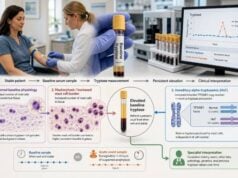
A total IgE blood test measures the combined amount of immunoglobulin E in serum, regardless of which allergens or antigens it recognizes. A high result is common in atopic dermatitis, allergic rhinitis, allergic asthma, and some food allergies, but it does not identify the trigger or prove that symptoms are allergic. Total IgE can also rise with parasitic infection, certain fungal diseases, chronic skin inflammation, some immune deficiencies, and uncommon blood or inflammatory disorders. The normal range changes greatly with age, population, and laboratory method, so the reference interval printed on the report matters more than a single internet cutoff. A normal total IgE does not rule out allergy because a person can have clinically important specific IgE within a normal total. Very high values deserve interpretation alongside symptoms, eosinophil count, infection history, travel, skin findings, lung disease, medicines, and targeted specific-IgE testing. The test is a context marker, not a stand-alone diagnosis or a general measure of how “strong” the immune system is.
- High total IgE is nonspecific and most often reflects atopy, eczema, allergic airway disease, or another immune stimulus.
- The test cannot reveal which food, pollen, animal, mold, drug, or venom is responsible.
- Normal ranges vary by age and laboratory; children often have different limits from adults.
- A normal result does not exclude a specific allergy, and a high result does not prove one.
- Values above 1,000 IU/mL or kU/L may still come from severe eczema, but persistent unexplained elevation warrants broader review.
- Total IgE can help with selected biologic-treatment decisions, but it is not a reliable measure of asthma severity or treatment response by itself.
Table of Contents
- What Total IgE Measures
- Reference Ranges, Units, and Age
- Allergy, Eczema, and Asthma
- Parasites, Infections, and Fungal Disease
- Very High IgE and Immune Disorders
- Low or Normal Total IgE
- Follow-Up and Treatment Use
What Total IgE Measures
IgE is one of five major antibody classes. It circulates at much lower concentrations than IgG, IgA, or IgM, but it has potent biological effects. IgE binds to high-affinity receptors on mast cells and basophils. When a matching antigen cross-links cell-bound IgE, those cells can release histamine, tryptase, leukotrienes, and other mediators.
The total IgE test adds together all measurable IgE in serum. It does not separate antibodies to dust mite from antibodies to peanut, parasites, or any other target. That distinction is provided by specific IgE testing.
Total IgE is usually reported in international units per milliliter, IU/mL, or kilounits per liter, kU/L. For IgE, these units are numerically equivalent: 1 IU/mL equals 1 kU/L. Some older reports use ng/mL, which requires a method-specific conversion and should not be compared casually with IU/mL.
The test requires a routine blood draw. Fasting is usually unnecessary. Antihistamines do not need to be stopped because they block histamine receptors rather than removing IgE from serum. Results may return within a few days, although timing varies.
Total IgE is sometimes ordered as part of an allergy evaluation, asthma phenotype assessment, recurrent-infection workup, eosinophilia evaluation, or pre-treatment assessment for an anti-IgE biologic. It can provide useful context, but it performs poorly as a general allergy screen. Many allergic people have normal total IgE, and many people with high total IgE do not have a clinically important allergy to every tested substance.
The value also does not measure immune “strength.” A high number does not mean the immune system is stronger, and a low number does not automatically mean it is weak. IgE is one narrow part of immune function. Antibody deficiency evaluations usually focus on infection history, IgG, IgA, IgM, vaccine responses, lymphocyte studies, or genetics rather than total IgE alone.
Reference Ranges, Units, and Age
Total IgE has an unusually wide and right-skewed distribution. Many healthy people have very low values, while a smaller group has values far above the median. The upper reference limit depends on who was included in the laboratory’s reference population and how the interval was calculated.
Age has a large effect. IgE is generally low in infancy, rises through childhood, may peak in adolescence or early adulthood, and can decline later. Pediatric laboratories often use age-specific ranges. Applying an adult limit to a young child, or a child’s range to an adult, can misclassify the result.
Population differences also matter. Allergen exposure, parasite prevalence, smoking, geography, genetics, and the frequency of atopic disease influence reference distributions. A 2024 systematic review found substantial variation in how total IgE reference intervals are established and reported, supporting the use of the local laboratory’s interval.
Some adult laboratories use an upper limit near 100 or 150 kU/L, while others use a higher value. Pediatric ranges may climb into several hundred kU/L during certain ages. These are examples, not universal cutoffs.
A practical way to read the report is:
| Pattern | Possible meaning | What it does not prove |
|---|---|---|
| Within the laboratory range | No generalized IgE elevation | Absence of specific allergy |
| Mild to moderate elevation | Common with atopy, eczema, rhinitis, or asthma | A particular allergen or disease severity |
| Marked elevation, often above 1,000 kU/L | Severe atopic disease is common; broader causes may need review | Hyper-IgE syndrome or parasite infection by itself |
| Very low or undetectable | Often a normal individual pattern | Complete assessment of antibody function |
The degree of elevation should be judged against the clinical picture. A value of 2,000 kU/L in a child with severe active eczema may be less surprising than the same value in an adult with no atopic symptoms. A one-time high result during active inflammation may not carry the same meaning as persistent elevation with recurrent infections and unusual physical findings.
Trend interpretation also requires consistency. Different assay platforms may not be perfectly interchangeable. Small changes can reflect normal biological and analytical variation. A drop from 800 to 650 kU/L does not necessarily signal meaningful improvement, and a rise from 90 to 130 kU/L does not establish disease progression.
Several background factors can shift the value without creating a new diagnosis. Cigarette smoking is associated with higher IgE in some populations. Season and ongoing allergen exposure may contribute to modest variation, particularly in people with pollen allergy. Skin-barrier inflammation can increase the total burden of IgE even when there has been no new immediate reaction. Genetics also influences baseline production, so relatives may have similarly high or low values without sharing the same symptoms. These influences are another reason not to compare one person’s result with a friend’s or with a cutoff taken from a different laboratory.
Total IgE can also affect how a low-level specific-IgE result is viewed. When the total is extremely high, many allergen-specific tests may be detectable because the immune system is producing a large pool of IgE. Some of those results represent genuine sensitization, while others may have little clinical relevance. The specific-IgE-to-total-IgE ratio has been studied as an additional clue, but it has not replaced the reaction history, skin testing, component testing, or supervised challenge. A low ratio does not make a serious past reaction unimportant, and a high ratio does not prove that exposure will cause symptoms.
The order in which results are reviewed matters. First ask whether the patient has a reproducible symptom pattern after a plausible exposure. Then evaluate the specific test for that exposure, the amount and form of exposure, cofactors, and alternative explanations. Total IgE is best used afterward to understand the broader immunologic background and the likelihood of multiple low-positive results. This approach reduces the risk of calling sensitization “allergy” and imposing unnecessary food or environmental avoidance.
Allergy, Eczema, and Asthma
Atopic disease is the most common setting for elevated total IgE. “Atopy” describes a tendency to make IgE against common environmental or food allergens and to develop conditions such as eczema, allergic rhinitis, or allergic asthma.
Atopic dermatitis can produce very high values, especially when disease is extensive, inflamed, infected, or poorly controlled. Levels in the thousands are not rare in severe eczema. The total value may loosely track disease activity in some people, but it is not accurate enough to guide daily treatment or determine which foods cause flares.
Broad food IgE panels are particularly misleading in severe eczema. High total IgE can accompany many low food-specific results, and children may be labeled allergic to foods they eat safely. Testing should target foods implicated by immediate reactions, not foods blamed solely for chronic eczema without a clear history.
Allergic rhinitis often raises total IgE, but the level does not identify whether pollen, dust mites, animals, or mold is responsible. Targeted skin or specific IgE testing is needed. A person with classic seasonal symptoms can have a normal total level and positive grass-specific IgE.
In asthma, total IgE may support an allergic phenotype when combined with sensitization and exposure-related symptoms. It does not diagnose asthma and does not measure airway obstruction. Spirometry, symptom variability, exacerbation history, inhaler use, blood eosinophils, and exhaled nitric oxide provide different information.
High total IgE is not a dependable asthma severity marker. Some people with mild allergic asthma have very high values, while severe eosinophilic or nonallergic asthma may occur with normal IgE. The result should not be used to decide whether an acute attack is dangerous.
Chronic spontaneous urticaria can involve IgE pathways, and baseline total IgE has been studied as a possible predictor of response to omalizumab. It is not a diagnostic test for chronic hives, and routine management is not based on a single cutoff.
Food allergy, venom allergy, and latex allergy may occur with normal or high total IgE. The clinically relevant measurement is usually specific IgE to the suspected allergen, interpreted with the reaction history. Dividing specific IgE by total IgE has been explored, especially when total IgE is extremely high, but the ratio is not a universal diagnostic rule.
Parasites, Infections, and Fungal Disease
IgE participates in immune responses against helminths, or parasitic worms. Infection can raise both total IgE and eosinophils, but neither test alone proves a parasite is present.
Parasite testing should follow exposure risk. Relevant details include residence or travel in endemic areas, walking barefoot in contaminated soil, untreated water, raw or undercooked foods, animal exposure, immigration history, eosinophilia, gastrointestinal symptoms, rash, anemia, lung symptoms, and immunosuppressive treatment.
Stool ova-and-parasite testing is not equally sensitive for every organism. Some infections require serology, repeated stool samples, blood films, imaging, or infectious-disease consultation. Strongyloides deserves special consideration before corticosteroids or other immunosuppression in people with epidemiologic risk because treatment can precipitate dangerous hyperinfection.
A high total IgE without eosinophilia or exposure history is not a reason to order every parasite test. Conversely, normal IgE does not exclude infection. The workup should be targeted rather than driven by the number alone.
Allergic bronchopulmonary aspergillosis, or ABPA, is an allergic lung disease that can complicate asthma or cystic fibrosis. It involves sensitization to Aspergillus fumigatus, high total IgE, airway inflammation, and characteristic clinical or imaging findings. Total IgE is part of diagnostic criteria and can be followed after treatment, but it cannot diagnose ABPA alone.
A person with asthma, recurrent mucus plugging, fleeting lung infiltrates, bronchiectasis, eosinophilia, and Aspergillus-specific sensitization deserves evaluation. A high total IgE in uncomplicated allergic asthma does not automatically mean ABPA.
Other fungal and chronic infections can influence IgE, particularly when they stimulate type 2 inflammation or damage barrier tissues. Human immunodeficiency virus, some chronic viral conditions, and skin colonization in eczema may be associated with altered IgE. These associations are nonspecific and should not prompt infection testing without clinical clues.
Very High IgE and Immune Disorders
Very high IgE attracts attention, but the most common explanation remains severe atopic disease. The number alone cannot diagnose a rare immune disorder.
Hyper-IgE syndromes are inborn errors of immunity characterized by particular combinations of eczema, recurrent infections, eosinophilia, and other features. Depending on the genetic cause, clues can include recurrent “cold” staphylococcal abscesses, pneumonia with lung cavities, chronic candidiasis, severe viral skin infections, unusual fractures, retained primary teeth, characteristic facial or skeletal findings, food allergy, or malignancy risk.
The clinical pattern matters more than crossing a numerical threshold. Many patients with IgE above 2,000 kU/L have ordinary atopic dermatitis rather than a monogenic syndrome. Conversely, some genetically confirmed immune disorders may not always produce extremely high IgE.
Referral to an allergist or clinical immunologist is reasonable when marked elevation accompanies:
- recurrent severe, unusual, or opportunistic infections;
- poor growth or chronic diarrhea;
- extensive viral warts, molluscum, or herpes infections;
- recurrent lung abscesses, pneumatoceles, or bronchiectasis;
- skeletal or dental abnormalities;
- persistent eosinophilia without a clear atopic cause;
- strong family history or consanguinity;
- unusual autoimmunity or malignancy.
Evaluation may include a complete blood count with differential, quantitative IgG, IgA, and IgM, vaccine antibody responses, lymphocyte subsets, infection cultures, imaging, and genetic testing. Total IgE is a clue within that evaluation, not the deciding test.
Other uncommon causes include IgE-producing plasma-cell disorders, Hodgkin lymphoma, certain other malignancies, inflammatory diseases, and drug reactions. These are considered when symptoms, blood counts, examination, or imaging point beyond common allergy.
A 2025 population-based study found associations between IgE at or above 1,000 IU/mL and several conditions, including eosinophilic disorders and inborn errors of immunity. Association does not mean that everyone above that level needs exhaustive testing. The useful response is a focused clinical review, especially when severe atopy does not explain the result.
Low or Normal Total IgE
A normal total IgE does not exclude allergic disease. Specific IgE makes up only a fraction of the total. A person can have enough peanut-specific or venom-specific IgE to react while the combined total remains within the laboratory range.
When symptoms strongly suggest allergy, the next test should target the suspected allergen rather than repeating total IgE. Skin-prick testing, specific IgE, component testing, or a supervised challenge may be appropriate.
Very low or undetectable IgE is often an individual normal pattern. Some studies have linked IgE deficiency, commonly defined below about 2 or 2.5 kU/L, with other antibody deficiencies or health conditions, but low IgE is not a recognized stand-alone diagnosis in every patient.
Further immune evaluation is more reasonable when low IgE accompanies recurrent sinus or lung infections, poor vaccine responses, low IgG or IgA, autoimmune disease, or another suggestive history. In an otherwise healthy person, an isolated low result often requires no treatment.
There is no therapy designed simply to raise total IgE. IgE has normal biological roles, but a low laboratory number without disease is not treated as a deficiency target. Likewise, a high result is not treated directly unless it is part of a defined condition.
Omalizumab complicates laboratory interpretation. The drug binds free IgE and forms complexes that are measured by many total IgE assays, so reported total IgE often rises after treatment begins even though free, biologically active IgE falls. Total IgE during therapy should not be interpreted as worsening allergy or used like an untreated baseline.
Other immune-modifying treatments, severe inflammation, pregnancy, and laboratory platform changes may affect values. Documenting the treatment date and assay method helps prevent false trend conclusions.
Follow-Up and Treatment Use
The next step after a high result depends on symptoms, not on the number alone. Start by reviewing why the test was ordered and whether the likely cause is already evident. The urgency is also clinical: breathing difficulty, faintness, rapidly spreading hives, or throat symptoms require immediate assessment, whereas an isolated high laboratory result in a well person is usually evaluated nonurgently.
A focused follow-up may include:
- Repeat total IgE only if confirmation or a true baseline will change care.
- Obtain a complete blood count with eosinophil count.
- Order specific IgE or skin tests only for plausible allergens.
- Review eczema severity, rhinitis, asthma control, and immediate food reactions.
- Assess travel, parasite exposure, infection history, and medications.
- Consider ABPA testing when asthma or cystic fibrosis features support it.
- Refer for immunology assessment when infections or syndromic findings are present.
Total IgE has a practical role in dosing eligibility for omalizumab in allergic asthma. Dosing tables use pretreatment total IgE and body weight within approved ranges, which vary by country, age, and indication. A value outside a table does not independently prove that the medicine will or will not work, and off-label decisions belong to a specialist.
For chronic spontaneous urticaria, omalizumab dosing generally is not based on total IgE in the same way as allergic asthma. For food allergy, current anti-IgE treatment protocols also follow indication-specific guidance. A general IgE result should not be used to calculate a dose without the approved table.
Routine repeated measurement is rarely needed for allergic rhinitis, ordinary eczema, or stable asthma. Clinical improvement is better judged by symptoms, sleep, skin examination, rescue-medication use, exacerbations, lung function, and quality of life.
Useful questions for the clinician include:
- Is this elevation appropriate for my age and laboratory?
- Does my eczema or allergic disease fully explain it?
- Should specific allergens be tested, and which ones?
- Is the eosinophil count also high?
- Do travel or infection features justify parasite testing?
- Are there signs of ABPA or an immune deficiency?
- Will this value affect biologic treatment, and is it a valid pretreatment baseline?
Avoid restrictive diets, costly environmental testing, parasite cleanses, or immune supplements based only on total IgE. These approaches can cause harm while missing the actual diagnosis. The test is most valuable when it narrows a clinically grounded evaluation. When repeat testing is appropriate, use the same laboratory when possible and record changes in treatment, infection, skin activity, and allergen exposure so the trend has interpretable context.
References
- A systematic review of total IgE reference intervals − A 2024 update 2024 (Systematic Review)
- Elevated IgE Levels—An Allergy or an Underlying Inborn Error of Immunity in Children? 2023 (Review)
- Clinical significance of very high IgE levels (≥1000 IU/mL): The population-based perspective 2025
- Reference values of serum total IgE in Uppsala 2023
- Immunoglobulin E (IgE), Serum 2026 (Official Laboratory Guide)
- Hyper IgE Syndrome 2025 (Official Organization Guide)
Disclaimer
This article provides general information and cannot diagnose allergy, parasitic infection, asthma, allergic bronchopulmonary aspergillosis, or an immune deficiency. A high or low total IgE result should be interpreted with symptoms, age, other laboratory tests, and clinical history. Do not start restrictive diets, parasite treatment, or immune therapy based only on total IgE.