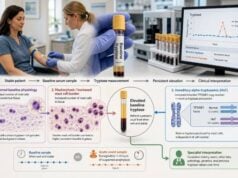
A peanut component IgE test measures antibodies to individual peanut proteins, known as Ara h components. It can distinguish sensitization to stable seed-storage proteins, which are more strongly associated with true systemic peanut allergy, from pollen-related proteins that often cause only mouth or throat symptoms. Ara h 2 is usually the most informative component, with Ara h 6 adding value in some patients. Ara h 1 and Ara h 3 are other storage proteins, while Ara h 8 commonly reflects birch-pollen cross-reactivity and Ara h 9 is a lipid transfer protein that is more relevant in some geographic regions. Component testing can improve diagnostic confidence and reduce unnecessary food challenges, but it cannot predict the exact severity of a future reaction or prove allergy without a compatible history. A positive result means sensitization to that protein. An oral food challenge remains the reference standard when history, skin testing, whole-peanut IgE, and component results do not agree.
- Ara h 2 is the most clinically useful peanut component in many populations and often improves specificity over whole-peanut IgE.
- Ara h 1, Ara h 2, Ara h 3, and Ara h 6 are stable storage proteins associated with genuine peanut allergy and systemic reactions.
- Ara h 8 commonly reflects birch-pollen cross-reactivity and is often linked with pollen-food syndrome rather than primary peanut allergy.
- Ara h 9 is a lipid transfer protein that may be important in Mediterranean and other populations.
- No component value predicts the exact severity or threshold of the next reaction, even when storage-protein IgE is high.
- A supervised oral food challenge may still be needed when the history and test pattern are uncertain.
Table of Contents
- What Peanut Component Testing Adds
- Ara h 1 Through Ara h 9
- Interpreting Common Component Patterns
- Components and Anaphylaxis Risk
- Oral Food Challenge Decisions
- Testing, Preparation, and Follow-Up
- Management After a Peanut Allergy Diagnosis
What Peanut Component Testing Adds
Whole-peanut specific IgE measures antibody binding to an extract containing many peanut proteins. That test is sensitive, but a positive result can arise from clinically important storage proteins or from cross-reactive proteins shared with pollens and other plants. Component testing separates those signals.
This distinction is most useful in three settings. First, a person may have a positive whole-peanut result but no clear reaction history. Second, a birch-pollen-allergic patient may report mouth itching after peanut but no systemic symptoms. Third, a child with eczema may have been screened broadly and labeled peanut-allergic despite never eating it.
Component testing does not replace the allergy history. The report should be interpreted beside:
- the exact peanut product and amount involved;
- time from ingestion to symptoms;
- skin, gastrointestinal, breathing, or circulation symptoms;
- prior tolerance and frequency of exposure;
- skin-prick test size;
- whole-peanut IgE;
- total IgE and eczema severity;
- age, asthma control, and geographic pollen pattern.
The names follow a standard allergen system. “Ara” refers to Arachis hypogaea, the peanut plant. The number identifies a protein. A result is usually reported in kUA/L. Laboratories may test only a subset, commonly Ara h 1, 2, 3, 6, 8, and 9.
A positive component result still means sensitization. Clinical allergy means that eating peanut causes reproducible symptoms. The same Ara h 2 value can have different implications in a toddler who developed hives after peanut butter and an adult who eats peanuts weekly without symptoms.
Component testing can reduce false-positive diagnoses, but it can also create complexity when many low results are reported. The objective is not to identify every detectable antibody. It is to decide whether peanut avoidance, a food challenge, or continued eating is appropriate.
Processing adds another reason not to treat the report as a direct simulation of eating peanut. Roasting can alter protein structure and may increase the IgE-binding behavior of several peanut allergens, while boiling may move some proteins into the cooking water. A component assay measures antibody binding under standardized laboratory conditions; it does not certify that a person will tolerate boiled peanut, refined peanut oil, baked foods, or a particular commercial product. Product form belongs in the clinical history, especially when reactions have occurred to one preparation but not another.
Assay menus also differ. One laboratory may report six recombinant or purified components, while another offers fewer proteins or uses a different analytical platform. Results from different methods are not always numerically interchangeable. Minor allergens, oleosins, and other lipid-associated proteins may be absent from a routine panel, and the panel says nothing about separate allergies to tree nuts, sesame, or legumes. For follow-up, comparing values from the same laboratory can reduce method-related noise, but the trend remains secondary to actual exposures and symptoms.
Ara h 1 Through Ara h 9
Peanut allergens belong to several protein families. Their stability to heat and digestion helps explain their clinical behavior.
Ara h 1
Ara h 1 is a vicilin storage protein. It resists digestion better than many pollen-related proteins and is associated with primary peanut allergy. Sensitization often occurs with other storage proteins rather than alone. Ara h 1 adds context but is generally less diagnostically useful than Ara h 2.
Ara h 2
Ara h 2 is a 2S albumin and the most widely validated peanut component. It is stable to heat and digestion and strongly associated with genuine peanut allergy. In many children with uncertain exposure, Ara h 2 provides better specificity than whole-peanut IgE.
Low values do not automatically exclude allergy, and high values do not eliminate all uncertainty. Published cutoffs vary according to age, assay, referral population, and whether the goal is high sensitivity or high specificity. A value that strongly predicts allergy in one clinic may perform differently in another.
Ara h 3
Ara h 3 is a legumin storage protein. It supports a storage-protein pattern but is usually not as discriminating as Ara h 2. Sensitization may occur with Ara h 1 and Ara h 2.
Ara h 6
Ara h 6 is another 2S albumin with substantial similarity to Ara h 2. Some patients react clinically with strong Ara h 6 sensitization despite low Ara h 2. Measuring both can improve sensitivity in selected cases, though Ara h 2 remains the first component most guidelines emphasize.
Ara h 8
Ara h 8 belongs to the PR-10 protein family and resembles the birch pollen allergen Bet v 1. It is relatively unstable to heat and digestion. Isolated Ara h 8 sensitization often causes pollen-food syndrome: immediate itching, tingling, or mild swelling of the lips, mouth, or throat, usually without generalized symptoms.
This pattern is common in birch-endemic regions. It does not guarantee a mild reaction, and a patient may be sensitized to both Ara h 8 and storage proteins. The whole pattern matters.
Ara h 9
Ara h 9 is a nonspecific lipid transfer protein. These proteins resist heat and digestion and can cause systemic reactions. Ara h 9 is especially relevant in Mediterranean areas and in patients sensitized to peach lipid transfer protein. Its predictive value is lower in regions where LTP sensitization is uncommon.
Other Ara h proteins exist, including profilin and oleosin components, but routine availability and clinical validation vary. Standard extracts may underrepresent lipid-associated allergens, so a convincing history deserves review even when the common panel is negative.
| Component | Protein family | Typical significance |
|---|---|---|
| Ara h 1 | Vicilin storage protein | Supports primary peanut sensitization |
| Ara h 2 | 2S albumin storage protein | Most useful marker of genuine peanut allergy in many populations |
| Ara h 3 | Legumin storage protein | Adds evidence of a stable storage-protein pattern |
| Ara h 6 | 2S albumin storage protein | Clinically important and complementary to Ara h 2 |
| Ara h 8 | PR-10 / Bet v 1–related | Often birch-related pollen-food syndrome |
| Ara h 9 | Lipid transfer protein | Regional marker associated with systemic reactions in LTP-sensitized patients |
Interpreting Common Component Patterns
The pattern is more informative than any single class label.
Ara h 2 positive with matching immediate symptoms strongly supports peanut allergy. If the history includes hives, vomiting, wheeze, or faintness soon after peanut, a challenge may not be needed to establish the diagnosis.
Ara h 2 and Ara h 6 positive reinforces a storage-protein pattern. It increases diagnostic confidence but still does not determine future reaction severity.
Whole-peanut positive, Ara h 2 negative, Ara h 8 positive often points toward birch-related cross-reactivity. If symptoms are limited to mouth itching and the patient tolerates meaningful amounts, strict systemic-allergy labeling may be inappropriate. A challenge can clarify uncertain cases.
Whole-peanut positive with all tested components negative may reflect a minor allergen not included in the panel, nonspecific binding, a value near the detection limit, or assay differences. The history determines whether more testing is needed.
Ara h 9 positive must be interpreted geographically and with peach or other LTP sensitization. In an LTP-endemic region, it may represent meaningful primary food allergy. In another region, isolated low-level positivity may be less informative.
Negative Ara h 2 with a convincing reaction does not rule out peanut allergy. Ara h 6, other components, skin testing, and the exact exposure may matter. Guidelines recommend interpreting Ara h 2 with the peanut extract rather than replacing the extract completely.
Low component values in severe eczema can be difficult to interpret because high total IgE increases the chance of broad low-level sensitization. A specific-to-total IgE ratio may be considered in research or selected clinical contexts, but it is not a universal diagnostic formula.
Trend data can help. Falling Ara h 2 and whole-peanut IgE may support reevaluation, while persistent or rising storage-protein values may make ongoing allergy more likely. Trends do not prove tolerance or persistence; oral exposure history remains decisive.
Laboratory classes should not be compared across platforms. The same serum may produce somewhat different values in different assays. Follow-up is more meaningful when the same laboratory and method are used.
Components and Anaphylaxis Risk
Storage-protein sensitization is associated with systemic peanut allergy, but component testing is not a severity test. Ara h 2 positivity raises the probability that peanut will cause symptoms; it does not tell whether the next reaction will be hives or shock.
Reaction severity varies because of factors the test does not measure:
- peanut dose;
- uncontrolled asthma;
- exercise near ingestion;
- infection or fever;
- alcohol;
- sleep deprivation;
- NSAID use;
- menstruation in some patients;
- delay in epinephrine;
- individual mast cell and cardiovascular responses.
A previous mild reaction does not guarantee future mild reactions. A previous severe reaction does not mean every accidental exposure will be severe. The emergency plan should be based on the diagnosis and clinical risk, not a numerical component class.
Studies show group-level relationships between higher Ara h 2 or broader storage-protein sensitization and reaction probability. Group associations cannot determine one person’s threshold. Some highly sensitized patients react to tiny amounts; others tolerate more before symptoms. Food challenges measure an observed threshold on one day, not a permanent safe dose.
Ara h 8-dominant pollen-food syndrome is often milder because the protein is unstable. However, symptoms should still be assessed carefully. Throat discomfort may be difficult to distinguish from early systemic symptoms, and co-sensitization to storage proteins changes the risk picture.
Ara h 9 and other lipid transfer proteins can be associated with severe reactions, often influenced by cofactors such as exercise or alcohol. Regional exposure patterns matter; a component panel interpreted without geography can misclassify risk.
Anyone with confirmed peanut allergy and a risk of systemic reaction should discuss epinephrine auto-injectors. The component result may support the diagnosis, but the response to accidental ingestion follows symptoms. Epinephrine is first-line for anaphylaxis and should not be delayed for antihistamines.
Oral Food Challenge Decisions
The oral food challenge remains the reference standard when the diagnosis is uncertain. Component testing helps decide who is likely to benefit from a challenge and who has such a high probability of allergy that challenge may add little.
A challenge may be considered when:
- peanut has never been eaten and screening produced a low positive;
- the original symptoms were vague or remote;
- whole-peanut IgE is positive but Ara h 2 is negative or very low;
- isolated Ara h 8 suggests pollen-food syndrome;
- values have declined over time;
- the patient may have outgrown allergy;
- removing the diagnosis would meaningfully improve diet and quality of life.
A challenge may be deferred when there is recent convincing anaphylaxis, uncontrolled asthma, active illness, pregnancy, strongly positive storage proteins with a matching history, or inability to stop medicines that interfere with observation. These are clinical judgments, not rigid exclusions.
The challenge uses measured doses at set intervals under supervision. The total dose and schedule differ by center. Staff watch for objective skin, respiratory, gastrointestinal, neurologic, and cardiovascular findings. Subjective mouth itching alone may require careful interpretation, especially in Ara h 8 sensitization.
Passing a challenge usually leads to advice to include peanut regularly. Infrequent exposure after a passed challenge can allow uncertainty and fear to return. The clinician should specify serving size, frequency, product form, and what to do after a missed period.
A home “test” is not equivalent. Giving a spoonful of peanut butter without medical guidance can expose a sensitized person to a large dose. Home introduction is appropriate only when an allergist has assessed the risk as low and provided clear instructions.
A basophil activation test may help in specialized centers when history, IgE, and components remain inconclusive. It measures cell activation in the laboratory and can reduce some food challenges, but availability and standardization are limited.
Testing, Preparation, and Follow-Up
Peanut component IgE requires a routine venous blood sample. Fasting is not usually necessary. Antihistamines do not interfere with serum IgE, so they generally can continue. Blood testing is useful when extensive eczema, medicines, or other factors make skin testing difficult.
Before the visit, document:
- exact peanut food and brand;
- amount eaten;
- raw, roasted, boiled, flour, or butter form;
- symptom timing and sequence;
- treatment and response;
- exercise, illness, alcohol, or NSAIDs;
- prior tolerated exposures;
- birch-pollen symptoms;
- current asthma control;
- previous whole-peanut and component results.
The report should include numerical values, units, assay, and detection limit. “Positive Ara h 2” without the concentration is incomplete. A value below detection is different from a component that was not ordered.
Repeat testing should answer a management question. In a young child with a known allergy, periodic whole-peanut and Ara h 2 testing may help determine when to consider a challenge. Repeating every few months without a challenge threshold can increase anxiety without changing care.
The rate of decline matters less than the whole trajectory. A modest fall over several years, smaller skin test, no recent reactions, and low pretest probability may support challenge. One sudden drop should be confirmed, especially if the laboratory changed.
Do not stop peanut in a person who eats it normally because of an incidental positive test. Continued tolerance is stronger evidence than sensitization. Unnecessary avoidance can complicate future interpretation and may increase fear.
The broader nut allergy IgE panel should not be used to infer peanut findings from tree nuts or vice versa. Peanut is a legume, and component names are food-specific.
Management After a Peanut Allergy Diagnosis
A confirmed diagnosis requires avoidance, label reading, emergency preparedness, and periodic reassessment. Peanut can appear in sauces, baked goods, candy, protein powders, international cuisines, desserts, and foods made on shared equipment.
Precautionary labeling such as “may contain peanut” is voluntary in many places and does not quantify the amount. The allergy team should help define which statements and manufacturing situations are acceptable for the individual.
Highly refined peanut oil contains very little protein and may be tolerated by many peanut-allergic people, while cold-pressed, expelled, or gourmet peanut oils can retain protein. Decisions about oils should be made with the allergist, not inferred from component results.
Carry epinephrine auto-injectors if prescribed and know when to use them. Symptoms such as breathing difficulty, repetitive cough, throat tightness, faintness, or rapidly progressing involvement of more than one system require prompt epinephrine. Antihistamines do not treat airway swelling or low blood pressure.
Peanut oral immunotherapy can raise the reaction threshold for some children and adolescents, reducing risk from accidental exposure. It requires daily dosing, continued peanut avoidance, and management of adverse reactions. It is not a cure and does not allow unrestricted eating. Other approaches, including biologic therapy and epicutaneous immunotherapy, continue to evolve.
The decision to pursue treatment depends on age, reaction history, family goals, ability to adhere, asthma control, and tolerance of treatment risk. Ara h 2 can help confirm the diagnosis but does not by itself select the best therapy.
Ask the allergist:
- Does my component pattern confirm primary peanut allergy or pollen cross-reactivity?
- Is Ara h 6 needed because Ara h 2 is negative?
- How does local birch or LTP sensitization affect interpretation?
- Is a supervised challenge appropriate?
- When should testing be repeated?
- What symptoms require epinephrine?
- Am I a candidate for immunotherapy or biologic treatment?
- Which forms of peanut oil and precautionary labels should I avoid?
The best interpretation produces a specific plan: confirmed allergy, likely pollen-food syndrome, uncertain diagnosis requiring challenge, or tolerance that should be maintained. Component testing is valuable because it sharpens that decision, not because it predicts the future with certainty.
References
- EAACI guidelines on the diagnosis of IgE-mediated food allergy 2023 (Guideline)
- Biomarkers of peanut allergy in children over time 2024
- Evaluating clinical importance of sensitization to Ara h 6 quantitatively in Japanese children 2024
- Exploring geographical variances in component-resolved diagnosis: A global overview 2025 (Review)
- Feast for thought: A comprehensive review of food allergy 2021-2023 2024 (Review)
- Research Advancements in Peanut Proteins, Their Allergenic Properties, and Modifications in Food Processing 2025 (Review)
Disclaimer
This article provides general information about peanut component IgE testing and cannot diagnose allergy or predict the severity of a future reaction. Do not introduce peanut, stop eating tolerated peanut, or perform a food challenge based only on a laboratory result. Severe allergic symptoms require epinephrine when prescribed and emergency care.