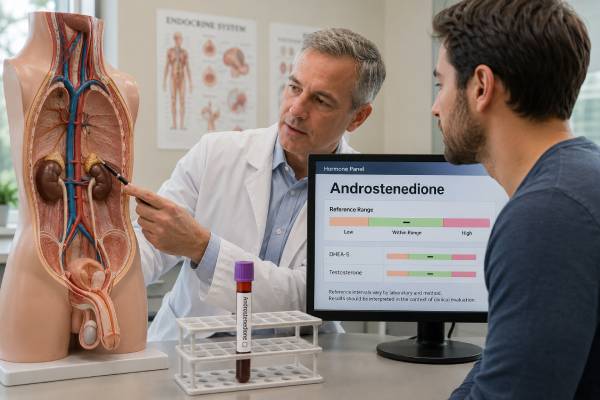
An androstenedione test measures a steroid hormone made by both the adrenal glands and testes. Androstenedione is weaker than testosterone, but it is an important precursor that tissues can convert into testosterone or estrogens. In adult men, the test is not a routine substitute for total testosterone. It is most useful when a clinician is investigating an unusual androgen pattern, an adrenal steroid disorder, congenital adrenal hyperplasia, a suspected androgen-producing tumor, early or delayed puberty, or a mismatch among testosterone, DHEA-S, 17-hydroxyprogesterone, and symptoms. Results are highly method- and age-dependent, and levels can vary during the day. A high value does not identify the source by itself because either the adrenal glands, the testes, or external hormone use may contribute. A low value is usually less specific and may reflect reduced adrenal or gonadal production, pituitary suppression, glucocorticoid treatment, severe illness, or normal age-related variation.
- Androstenedione is an androgen precursor, not the main hormone used to diagnose low testosterone in adult men.
- High results may come from adrenal overproduction, testicular production, congenital adrenal hyperplasia, tumors, or androgen products.
- DHEA-S and 17-hydroxyprogesterone help assess an adrenal source; testosterone, LH, and FSH help assess a testicular or pituitary pattern.
- Morning collection is often preferred because androstenedione follows an ACTH-related daily rhythm.
- Reference ranges vary substantially by age and assay, so the laboratory interval is more useful than a universal cutoff.
Table of Contents
- What androstenedione is and where it comes from
- Why an androstenedione test is ordered in men
- Preparation, timing, and laboratory methods
- What a high androstenedione result can mean
- What a low androstenedione result can mean
- How to interpret androstenedione with other hormones
- Follow-up testing and next steps
- Limitations, common mistakes, and warning signs
What androstenedione is and where it comes from
Androstenedione is a 19-carbon steroid in the pathway that produces active sex hormones. Cholesterol is converted through several steps into steroid precursors such as pregnenolone, DHEA, and androstenedione. Enzymes can then convert androstenedione into testosterone or aromatize it into estrone. Testosterone can be converted further into dihydrotestosterone or estradiol in specific tissues.
Both adrenal and testicular tissue contribute to circulating androstenedione in men. The adrenal cortex produces DHEA and DHEA-S in large quantities and converts some DHEA into androstenedione. Leydig cells in the testes also make androstenedione as part of testosterone synthesis. The relative contribution changes with age, health, medications, and the steroid pathway involved.
Androstenedione has direct androgen activity, but it is much less potent than testosterone and dihydrotestosterone. Its clinical value comes mainly from its position in steroid synthesis. A concentration that is unexpectedly high or low can reveal altered enzyme activity or excess production upstream of testosterone.
The adrenal component is stimulated mainly by adrenocorticotropic hormone, or ACTH. This gives androstenedione a daily pattern similar to cortisol and DHEA: values tend to be higher earlier in the waking day and lower later. Unlike DHEA-S, which has a long half-life and is relatively stable through the day, androstenedione can change enough that collection timing matters.
Age also matters. Levels are low in early childhood, rise around adrenarche and puberty, peak in young adulthood, and generally decline later in life. A value that is normal for a pubertal boy may not be interpreted the same way in an older adult. Pediatric interpretation requires age- and pubertal-stage-specific ranges.
Circulating concentration also does not reveal how much active androgen a tissue experiences. Skin, prostate, fat, bone, and other tissues express different steroid-converting enzymes. Two men with the same serum androstenedione can therefore generate different local amounts of testosterone, estrone, estradiol, or downstream metabolites. This tissue-level conversion, sometimes called intracrine metabolism, helps explain why symptoms do not track neatly with one precursor concentration.
The pathway contains several feedback loops. Rising testosterone and estradiol reduce hypothalamic and pituitary stimulation of the testes, while cortisol feeds back on ACTH-driven adrenal production. An enzyme block can cause a precursor to accumulate even when the final hormone is low. External glucocorticoids can lower adrenal precursors by suppressing ACTH, while external testosterone can suppress testicular steroid production through low LH. The same androstenedione value can therefore arise from increased production, reduced conversion, altered clearance, or treatment effects.
Androstenedione also differs from 11-oxygenated androgens, a group of adrenal-derived steroids that has received increasing attention in congenital adrenal hyperplasia and other androgen-excess states. Some modern mass-spectrometry panels include 11-ketotestosterone and related compounds because they can remain biologically active even when conventional androgens appear controlled. These tests are not routine everywhere, but they may explain persistent clinical androgen effects in selected patients.
Androstenedione is not interchangeable with the total testosterone test. A man can have an abnormal androstenedione result while testosterone remains normal because conversion and feedback mechanisms compensate. He can also have low testosterone with androstenedione in range if the problem lies elsewhere in the hypothalamic-pituitary-testicular axis.
Why an androstenedione test is ordered in men
Most adult men with symptoms of androgen deficiency begin with morning total testosterone, not androstenedione. The test becomes useful when the clinical question involves adrenal steroid production, an enzyme disorder, or an unexplained pattern of androgen excess or deficiency.
Common reasons include:
- Evaluating suspected congenital adrenal hyperplasia, especially alongside 17-hydroxyprogesterone
- Monitoring known congenital adrenal hyperplasia or glucocorticoid treatment
- Investigating unexplained high testosterone or other androgen results
- Assessing possible adrenal or testicular hormone-producing tumors
- Evaluating early puberty, delayed puberty, or atypical pubertal development
- Clarifying adrenal versus gonadal contribution when DHEA-S, testosterone, or other steroids are abnormal
- Investigating a suspected steroidogenic enzyme defect
- Assessing exposure to androgenic supplements or anabolic steroids when the hormone pattern is unusual
In classic 21-hydroxylase deficiency, cortisol synthesis is impaired and ACTH rises, driving steroid precursors toward androgen production. 17-hydroxyprogesterone is the main screening marker, but androstenedione and testosterone help show the degree of androgen excess and treatment control. In other forms of congenital adrenal hyperplasia, the pattern differs, so the result must be read as part of a steroid profile.
In adult men, visible virilization is not a useful clue because normal testosterone already produces male secondary sexual characteristics. Excess adrenal androgen may instead appear as acne, oily skin, accelerated hair loss in a genetically susceptible scalp, increased libido, mood or behavior changes, infertility from external androgen use, or an unexpectedly high laboratory value. Many men with modestly high androstenedione have no distinctive symptom.
A tumor is uncommon, but testing may be appropriate when androgen concentrations are markedly elevated, rising quickly, or accompanied by an adrenal or testicular mass. Adrenal tumors may produce several steroids rather than one isolated hormone. Testicular tumors may alter testosterone, estradiol, hCG, or androstenedione depending on their cell type.
For infertility, androstenedione is not a first-line marker. Semen analysis, testosterone, FSH, LH, and sometimes prolactin or inhibin B usually provide more direct information. It can be added when a broader steroid disorder is suspected rather than ordered as a general fertility screen.
Preparation, timing, and laboratory methods
Follow the ordering laboratory’s instructions. Fasting may not always be required, but a morning sample is often preferred for consistency and because ACTH-driven steroids have a circadian rhythm. Repeat testing should be collected at a similar time whenever possible.
Before the blood draw, tell the clinician about:
- Glucocorticoids such as prednisone, dexamethasone, or hydrocortisone
- Testosterone therapy, anabolic steroids, selective androgen receptor modulators, or prohormones
- DHEA supplements and products marketed as adrenal support or hormone boosters
- Anticonvulsants and other medicines that affect liver metabolism
- Recent severe illness, surgery, major calorie restriction, or intense exercise changes
- Shift work or an irregular sleep schedule
Do not stop glucocorticoids or other prescribed medicines on your own. In congenital adrenal hyperplasia, dose timing can strongly affect the result. The clinician may specify whether blood should be drawn before the morning glucocorticoid dose, at a set time after dosing, or as part of an ACTH stimulation test.
Laboratories commonly report androstenedione in ng/dL, ng/mL, or nmol/L. Unit conversion is important because a number cannot be compared safely without its unit. Approximate conversions are:
- 1 ng/mL = 100 ng/dL
- 1 ng/mL is about 3.49 nmol/L
- 1 nmol/L is about 28.6 ng/dL
Reference intervals vary considerably. The assay platform, calibration, age, pubertal stage, and local population all influence the range. For this reason, it is safer to use the interval printed on the report than to compare the result with a generic online chart.
Steroid immunoassays may cross-react with related molecules, particularly when concentrations are low or multiple precursors are elevated. Liquid chromatography–tandem mass spectrometry can separate steroid compounds more specifically and is often preferred for complex steroid profiles, pediatric testing, tumor evaluation, and congenital adrenal hyperplasia. Results from different methods may not match exactly.
Laboratory quality is especially important when the result will trigger imaging, genetic testing, or a long-term change in glucocorticoid therapy. An unexpected value should be checked for unit transcription, specimen timing, reference interval, and possible cross-reactivity before it is treated as biologically real. In complex cases, repeating the sample with a mass-spectrometry method can prevent a false-positive cascade.
Reference intervals describe the central distribution in a comparison population; they do not define a treatment target. A value near the upper limit can be normal for one healthy man, while a value still inside range may be abnormal for a patient whose previous stable concentrations were much lower and whose other steroids are changing. Trend, magnitude, and pattern matter more than whether the report displays a single high or low flag.
A borderline result may need repetition rather than immediate imaging. The repeat should use the same laboratory and method when possible, because changing platforms can create an apparent change that reflects measurement rather than biology.
What a high androstenedione result can mean
A high result means production, release, or exposure exceeds what the laboratory expects for the person’s age and assay. It does not prove where the hormone came from.
Adrenal overproduction
An adrenal source becomes more likely when DHEA-S is also high or when 17-hydroxyprogesterone and other adrenal precursors fit an enzyme-block pattern. Causes include congenital adrenal hyperplasia, ACTH-driven adrenal stimulation, and uncommon androgen-producing adrenal tumors.
In congenital adrenal hyperplasia, poor cortisol synthesis removes some negative feedback on ACTH. The adrenal glands receive a stronger signal and produce excess precursors and androgens. Treatment aims to replace deficient hormones when needed and control excess ACTH without causing glucocorticoid overtreatment. A single androstenedione number cannot determine whether the dose is correct; symptoms, growth or pubertal status, 17-hydroxyprogesterone, renin or electrolytes in selected forms, and timing relative to medication are also important.
Cushing disease or severe ACTH excess can alter adrenal androgens, but patterns are not uniform. Chronic glucocorticoid excess may eventually suppress DHEA-S despite other adrenal abnormalities. Interpretation depends on the whole adrenal picture rather than assuming every high androstenedione result reflects high cortisol.
An adrenal tumor is more concerning when the elevation is marked, new, progressive, or accompanied by abnormal cortisol, DHEA-S, 11-oxygenated androgens, or imaging findings. Benign adenomas and malignant tumors have overlapping hormone patterns, so biochemical severity alone does not establish pathology.
Testicular production
A testicular source may be considered when testosterone, estradiol, hCG, or examination findings point toward gonadal production while DHEA-S remains unremarkable. Leydig-cell or other steroid-producing tumors are rare. A painless testicular lump, asymmetry, heaviness, or rapid change warrants examination and usually ultrasound rather than relying on blood tests alone.
In men with congenital adrenal hyperplasia, testicular adrenal rest tumors can develop from adrenal-like cells in the testes under chronic ACTH stimulation. These lesions can impair fertility by compressing seminiferous tissue and may be bilateral. Androstenedione contributes to monitoring, but ultrasound and disease-specific assessment are needed.
External hormones and supplements
DHEA, androstenedione-containing prohormones, anabolic steroids, compounded hormone products, and contaminated supplements can raise or distort results. External androgens often suppress LH and FSH, and they can reduce sperm production even when serum androgens look high. Disclosure matters because the biochemical pattern may otherwise resemble a tumor or enzyme disorder.
Some products no longer list androstenedione openly but contain related prohormones. A clinician may ask about gym products, online peptides, “post-cycle” drugs, and sexual-health supplements as well as prescriptions.
What a low androstenedione result can mean
Low androstenedione is generally less diagnostic than a high result. Because both adrenal and testicular tissue contribute, several pathways can produce the same low value.
Possible causes include:
- Adrenal insufficiency or reduced ACTH stimulation
- Hypopituitarism affecting ACTH and gonadotropins
- Primary testicular failure when several testicular steroids are low
- Suppression from glucocorticoid medication
- Suppression from external testosterone or anabolic steroids
- Severe systemic illness, undernutrition, or major physiologic stress
- Normal age-related decline
- A result near the lower limit that reflects assay or day-to-day variation
In primary adrenal insufficiency, cortisol and often aldosterone are more clinically important than androstenedione. Symptoms such as weight loss, low blood pressure, salt craving, vomiting, abdominal pain, darkening of the skin, or low sodium require direct adrenal evaluation. Androstenedione cannot rule adrenal insufficiency in or out.
In central adrenal insufficiency caused by pituitary or hypothalamic disease, ACTH may be low or inappropriately normal. Other pituitary hormones may also be affected, creating low testosterone with low LH and FSH. A broader pituitary assessment is more useful than repeating androstenedione alone.
Glucocorticoids suppress ACTH and can reduce adrenal androgen production. This is expected during treatment and does not necessarily mean intrinsic adrenal damage. Dose, duration, timing, and the reason for treatment determine its significance.
A low value in an otherwise healthy older man may have little independent meaning. DHEA, DHEA-S, and androstenedione generally decline with age. Evidence does not support using androstenedione replacement simply to move a laboratory result into a young-adult range.
How to interpret androstenedione with other hormones
The neighboring hormones in the steroid pathway usually provide more information than the absolute value alone.
Hormones commonly paired with androstenedione
| Test | What it adds | Pattern that may be informative |
|---|---|---|
| DHEA-S | Relatively adrenal-specific androgen marker | High DHEA-S with high androstenedione supports adrenal contribution |
| 17-hydroxyprogesterone | Screens for 21-hydroxylase deficiency | High values may prompt an ACTH stimulation test or steroid profile |
| Total and free testosterone | Shows the main circulating androgen status | Discordance can reveal altered conversion or a non-testosterone pathway |
| LH and FSH | Shows pituitary signaling to the testes | Suppressed values suggest external androgen exposure or central suppression |
| Cortisol and ACTH | Assesses the broader adrenal axis | Helps identify ACTH-driven excess or adrenal insufficiency |
| Estradiol and hCG | Evaluates estrogenic symptoms and selected tumors | Useful with gynecomastia, breast tenderness, or a testicular mass |
DHEA-S is especially helpful because most circulating DHEA-S comes from the adrenal glands. A high androstenedione with normal DHEA-S does not exclude an adrenal source, but it reduces the simplicity of that conclusion and increases attention to testicular production, enzyme-specific patterns, assay interference, or external products. The DHEA-S test in men is also more stable across the day.
LH and FSH clarify whether the pituitary is responding normally. High testosterone or androgen exposure should suppress gonadotropins through negative feedback. High androgens with gonadotropins that are not suppressed may signal assay interference, inconsistent exposure, resistance to androgen action, or an unusual regulatory pattern that needs specialist review.
For congenital adrenal hyperplasia, clinicians may use a multi-steroid panel rather than serial single tests. The ratio among precursors can point toward 21-hydroxylase, 11β-hydroxylase, 3β-hydroxysteroid dehydrogenase, or other rare defects. Genetic testing may confirm the diagnosis after biochemical evaluation.
Follow-up testing and next steps
The next step should answer a specific unresolved question. A mildly abnormal isolated result often calls for confirmation; a marked or coherent multi-hormone pattern may call for targeted imaging or specialist assessment.
Possible follow-up includes:
- Repeat morning androstenedione using the same method
- DHEA-S and DHEA
- 17-hydroxyprogesterone, sometimes before and after ACTH stimulation
- Cortisol and ACTH
- Total testosterone, SHBG, free testosterone, LH, and FSH
- Estradiol, hCG, and tumor markers when a testicular process is suspected
- Electrolytes, renin, and aldosterone for selected adrenal disorders
- A comprehensive steroid profile by mass spectrometry
- Adrenal CT or MRI when biochemical findings support an adrenal lesion
- Testicular examination and ultrasound when a gonadal source is possible
- Genetic testing for confirmed or strongly suspected inherited enzyme disorders
Treatment follows the cause, not the isolated number. Congenital adrenal hyperplasia may require carefully adjusted glucocorticoid and, in some forms, mineralocorticoid therapy. Tumors require endocrine and surgical evaluation. Medication or supplement effects are handled by supervised adjustment or cessation. Central hormone deficiencies require pituitary assessment. No treatment may be needed for a small, stable deviation without symptoms or corroborating abnormalities.
Monitoring intervals depend on the condition. Rechecking too soon can create noise, while waiting too long is inappropriate when values are rapidly rising or a mass is suspected. A clinician familiar with adrenal and gonadal steroid testing can set timing based on the suspected mechanism.
Limitations, common mistakes, and warning signs
The biggest mistake is assigning an adrenal or testicular source from androstenedione alone. Both organs produce it, and peripheral tissues convert it. Source determination requires neighboring hormones, history, examination, and sometimes imaging.
Other common errors include:
- Comparing results from different units or assay platforms
- Using an adult range for a child or pubertal adolescent
- Ignoring collection time or glucocorticoid dose timing
- Assuming a normal result rules out congenital adrenal hyperplasia
- Treating low androstenedione as a reason for over-the-counter DHEA
- Overlooking anabolic steroids, prohormones, or contaminated supplements
- Ordering repeated broad hormone panels without a clear clinical question
Seek urgent medical care for severe weakness, vomiting, dehydration, fainting, very low blood pressure, confusion, or severe abdominal pain when adrenal crisis is possible. A new hard testicular lump, sudden testicular pain, or rapidly enlarging scrotal swelling needs prompt examination. Severe headache, visual loss, or multiple pituitary-hormone symptoms also require timely assessment.
Androstenedione testing is most useful as a pathway marker. It can strengthen evidence for adrenal androgen excess, reveal abnormal steroid synthesis, and contribute to tumor or puberty evaluation. It becomes clinically meaningful only when the result is placed beside DHEA-S, 17-hydroxyprogesterone, testosterone, gonadotropins, medications, age, and the reason the test was ordered.
References
- Adrenal Androgens and Aging 2023 (Review)
- The Sex Hormone Precursors Dehydroepiandrosterone and Its Sulfate: Roles in Health and Disease 2025 (Review)
- Congenital Adrenal Hyperplasia 2025 (Review)
- Physiology, Testosterone 2023 (Review)
- Testicular vs adrenal sources of hydroxy-androgens in prostate cancer 2017 (Review)
Disclaimer
This article provides general education and does not diagnose an adrenal, testicular, pituitary, or genetic disorder. Androstenedione must be interpreted with age-specific laboratory ranges, collection timing, other steroid results, medicines, symptoms, and examination findings. Do not change glucocorticoids, testosterone, or other hormone treatment without medical supervision.