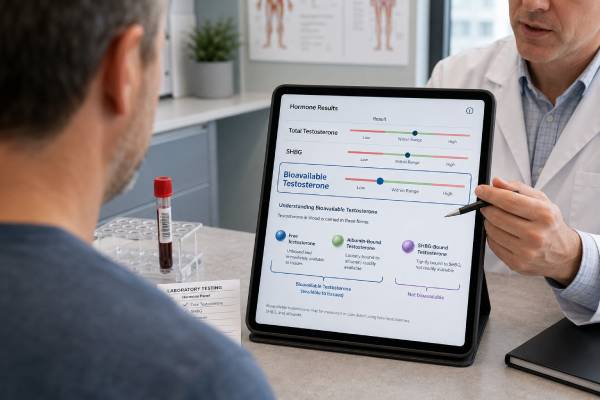
A bioavailable testosterone test estimates the testosterone that is free or loosely bound to albumin and therefore more readily available to tissues. It excludes the portion bound tightly to sex hormone-binding globulin (SHBG). The test can clarify androgen status when total testosterone and symptoms do not agree, especially in men with obesity, diabetes, thyroid or liver disease, aging-related SHBG changes, HIV, or medicines that alter hormone binding. Bioavailable testosterone is not the first test every man needs. Most evaluations begin with morning total testosterone, repeated on a separate day if low. SHBG, albumin, calculated free testosterone, or bioavailable testosterone are then added when total testosterone is borderline or a binding abnormality is likely. Results depend heavily on the laboratory method and reference interval. A low value supports reduced available androgen only when the sample was collected appropriately and the patient has compatible symptoms; it should not be used as a stand-alone reason to start testosterone treatment.
- Bioavailable testosterone includes free testosterone plus albumin-bound testosterone, but not tightly SHBG-bound hormone.
- Low SHBG can make total testosterone look low even when bioavailable testosterone is less reduced.
- High SHBG can hide low available testosterone behind a total testosterone result that appears normal.
- Testing is most useful for borderline or discordant cases, not as a universal replacement for total testosterone.
- Method-specific ranges are essential because calculated, ammonium-sulfate, and other laboratory approaches are not interchangeable.
Table of Contents
- What bioavailable testosterone means
- When the test is useful
- How bioavailable testosterone is measured
- Preparation and timing
- Normal ranges and low results
- SHBG and discordant result patterns
- Causes of low bioavailable testosterone and follow-up
- Limitations and treatment decisions
What bioavailable testosterone means
Testosterone circulates in three main forms. A small fraction is unbound, or free. A larger portion is bound loosely to albumin. Most of the remainder is bound more tightly to SHBG. Total testosterone is the sum of all three fractions.
Bioavailable testosterone usually means free testosterone plus the albumin-bound fraction. Albumin holds testosterone weakly, so the hormone can dissociate and enter tissues more readily than SHBG-bound testosterone. The concept is useful, but the boundaries are not absolute. SHBG-bound testosterone may participate in cell signaling in some settings, and tissue exposure also depends on blood flow, receptors, local enzymes, and conversion to dihydrotestosterone or estradiol.
The three common terms are therefore related but not identical:
- Total testosterone: all circulating testosterone, regardless of binding
- Free testosterone: the small unbound fraction
- Bioavailable testosterone: free plus albumin-bound testosterone
Most guidelines recommend total testosterone as the initial biochemical test because it is widely available and better standardized than many free or bioavailable assays. A total testosterone result becomes harder to interpret when SHBG is unusually high or low. Bioavailable or calculated free testosterone can then reveal whether the tissue-accessible fraction follows the same pattern.
The test does not measure androgen action inside muscle, bone, brain, prostate, or sexual tissues. Two men with the same bioavailable concentration may have different symptoms because androgen-receptor sensitivity, age, health, sleep, body composition, medications, and local steroid metabolism differ. Laboratory data support diagnosis; they do not replace the clinical picture.
When the test is useful
Bioavailable testosterone is most useful when total testosterone is near the lower boundary, symptoms are convincing but total testosterone appears acceptable, or a condition known to alter SHBG is present.
Situations that may justify testing include:
- Borderline total testosterone on one or more morning samples
- Symptoms of androgen deficiency with unexpectedly normal total testosterone
- Low total testosterone in a man with obesity, insulin resistance, or type 2 diabetes
- Aging, hyperthyroidism, liver disease, HIV, or anticonvulsant use that may raise SHBG
- Hypothyroidism, nephrotic syndrome, glucocorticoid use, or metabolic disease that may lower SHBG
- Monitoring when a clinician needs a binding-adjusted measure
- Evaluation of a rare discrepancy among total testosterone, free testosterone, and symptoms
Symptoms that increase the relevance of testing include persistently low libido, fewer spontaneous erections, hot flashes, reduced body hair, infertility, unexplained anemia, low bone density, or loss of testicular volume. Fatigue, low mood, poor concentration, and weight gain are less specific and should not be attributed to testosterone without considering sleep apnea, depression, thyroid disease, medication effects, anemia, chronic illness, and lifestyle factors.
The test is not usually necessary when total testosterone is clearly normal on well-timed samples, SHBG is unremarkable, and symptoms point elsewhere. It may also add little when total testosterone is clearly and repeatedly low and the next step is to determine the cause with LH, FSH, prolactin, and other testing.
Routine testing in symptom-free men is not recommended. A result outside range can lead to repeated panels and treatment pressure even when no clinical disorder is present. Testing should answer a defined question and have a plausible next step.
Fertility plans change the meaning of the evaluation. A man trying to conceive should not begin exogenous testosterone solely because bioavailable testosterone is low. Testosterone therapy can suppress LH, FSH, intratesticular testosterone, and sperm production. The cause of the low value and fertility-preserving options should be discussed first.
How bioavailable testosterone is measured
Laboratories can obtain bioavailable testosterone in several ways. The report should state whether the result was measured directly, separated by a laboratory technique, or calculated.
Ammonium sulfate precipitation
A traditional method adds ammonium sulfate to serum to precipitate SHBG and the testosterone bound to it. The remaining supernatant contains free and albumin-bound testosterone, which is then measured. The technique can estimate bioavailable testosterone, but it is labor-intensive and not offered everywhere. Technical details and assay quality influence the result.
Calculated bioavailable testosterone
A calculation uses total testosterone, SHBG, albumin, and an equation based on binding assumptions. This method is convenient and can be informative when the input measurements are accurate. Different formulas use different binding constants and may produce different results, especially at extreme SHBG concentrations.
Measured albumin may be used, or a standard albumin value may be assumed. The assumption is usually reasonable in healthy adults but may be less accurate in severe liver disease, kidney disease, malnutrition, critical illness, or other conditions with abnormal albumin.
Related free-testosterone methods
Equilibrium dialysis measures free testosterone after allowing unbound hormone to move across a membrane until equilibrium is reached. It is often considered a reference approach for free testosterone, not bioavailable testosterone. Ultrafiltration is another physical separation method. These tests are specialized, and their reference ranges differ from calculated values.
Direct analogue free-testosterone immunoassays are widely available but may not reliably reflect the true free fraction, particularly when SHBG is abnormal. A result labeled “free testosterone” should not automatically be treated as equivalent to equilibrium dialysis or a validated calculation.
Mass spectrometry can improve measurement of total testosterone, especially at low concentrations, but calculating bioavailable testosterone still depends on SHBG, albumin, and the chosen equation. High-quality inputs do not eliminate uncertainty in the binding model.
Common ways to assess available testosterone
| Approach | Reports | Main strength | Main limitation |
|---|---|---|---|
| Total testosterone plus SHBG | Binding context | Widely available | Does not directly quantify available fraction |
| Calculated free testosterone | Estimated unbound fraction | Useful with abnormal SHBG | Equation-dependent |
| Calculated bioavailable testosterone | Free plus albumin-bound fraction | Reflects weakly bound hormone | Depends on albumin and binding assumptions |
| Ammonium sulfate method | Measured bioavailable fraction | Physical separation of SHBG-bound hormone | Less available and method-sensitive |
| Equilibrium dialysis | Free testosterone | Strong reference method | Specialized and not bioavailable testosterone |
Preparation and timing
Testosterone follows a daily rhythm linked to sleep. In men with a typical schedule, concentrations are generally highest in the morning. The initial sample is usually collected between about 7:00 and 10:00 or 11:00 a.m. A night-shift worker may need testing after the main sleep period rather than at a conventional clock time.
A fasting sample is often preferred because eating, especially a glucose-containing meal, can lower testosterone temporarily in some men. The clinician or laboratory should provide exact instructions. Water is usually permitted.
For a reliable result:
- Avoid testing during acute illness or soon after major surgery when possible.
- Get a representative night of sleep.
- Avoid an unusually intense workout or severe calorie restriction before the test.
- Report testosterone, anabolic steroids, DHEA, “test boosters,” opioids, glucocorticoids, and anticonvulsants.
- Tell the clinician about thyroid, liver, kidney, metabolic, and pituitary conditions.
- Do not stop prescribed medication without medical advice.
If total testosterone is low, repeat testing on a separate morning is usually needed. The repeat should ideally include SHBG and albumin when binding is central to interpretation. Biological variability means one result can differ substantially from another even without a change in health.
Collection timing must be documented when monitoring therapy. A testosterone injection can produce peaks and troughs that depend on formulation and dose interval. Gel results depend on application time, skin transfer precautions, and contamination risk. A blood sample accidentally contaminated by testosterone gel near the venipuncture site can produce a falsely high result.
Normal ranges and low results
There is no universal bioavailable testosterone range. Laboratories use different assays, calculations, age groups, and units. Common units include ng/dL, ng/mL, nmol/L, or a percentage of total testosterone. The reference interval printed on the report must be used.
A range is not an “optimal” target. It describes values observed in a comparison population under the laboratory’s method. Men near either boundary may be healthy, and a value inside range does not exclude disease when symptoms, SHBG, and repeated results strongly disagree.
Low bioavailable testosterone can support androgen deficiency when all of the following are present:
- Compatible symptoms or signs
- Appropriate morning collection
- Reliable total testosterone, SHBG, and albumin measurements
- A validated method or calculation
- Confirmation on a separate day when required
- A pattern that is not better explained by temporary illness or medication
The result should be interpreted beside total testosterone. If both total and bioavailable testosterone are low, genuine reduced androgen availability is more likely. If total testosterone is low but bioavailable testosterone is within range, low SHBG may be lowering the total concentration. If total testosterone is normal but bioavailable testosterone is low, high SHBG may be concealing a reduced available fraction.
A very low result is more concerning than a value just below range, but severity does not locate the cause. LH and FSH are needed to distinguish primary testicular failure from hypothalamic or pituitary suppression. Prolactin, thyroid testing, iron studies, and pituitary imaging are added selectively.
A high bioavailable testosterone result may occur with testosterone therapy, anabolic steroids, low SHBG, over-replacement, laboratory error, or less commonly endogenous androgen excess. Symptoms and risks depend on the cause. High hematocrit, acne, infertility, sleep-apnea worsening, or mood changes may be relevant during external androgen exposure.
SHBG and discordant result patterns
SHBG is made mainly by the liver and binds testosterone with high affinity. Changes in SHBG alter total testosterone even when testosterone production has not changed proportionally.
Typical SHBG-related patterns
| Pattern | Possible interpretation | Common contexts |
|---|---|---|
| Low total, low SHBG, bioavailable near range | Total testosterone may overstate deficiency | Obesity, insulin resistance, type 2 diabetes, hypothyroidism |
| Normal total, high SHBG, low bioavailable | Total testosterone may conceal low availability | Aging, hyperthyroidism, liver disease, some anticonvulsants, HIV |
| Low total and low bioavailable | Reduced production is more likely | Primary or secondary hypogonadism, illness, medication suppression |
| High total and high SHBG, bioavailable normal | Binding elevation may explain high total | Hyperthyroidism, estrogen exposure, selected liver conditions |
Obesity commonly lowers SHBG through metabolic and hepatic mechanisms. Total testosterone may fall into a low or borderline range while free or bioavailable testosterone is less affected. This does not mean obesity-related reproductive suppression is harmless; some men have genuinely low available testosterone as severity increases. It means the panel must separate a binding effect from reduced production.
High SHBG can create the opposite problem. An older man or a man with hyperthyroidism may have total testosterone that appears reassuring, yet the free or bioavailable fraction is low. A SHBG test in men is therefore especially useful when symptoms and total testosterone conflict.
Albumin also matters. Severe hypoalbuminemia can affect calculated bioavailable testosterone and may signal liver disease, kidney protein loss, malnutrition, or systemic illness. In that setting, improving the underlying disease may be more important than labeling the hormone result.
Causes of low bioavailable testosterone and follow-up
Low available testosterone can arise from testicular failure, inadequate pituitary stimulation, reversible functional suppression, high SHBG, or a combination.
Primary causes include Klinefelter syndrome, testicular injury, orchitis, torsion, chemotherapy, radiation, and loss of testicular tissue. LH and often FSH rise because the pituitary is trying to stimulate underperforming testes.
Secondary causes include pituitary tumors, hyperprolactinemia, congenital gonadotropin deficiency, head injury, opioid use, glucocorticoids, severe obesity, undernutrition, intense endurance training, and chronic systemic disease. LH and FSH are low or inappropriately normal despite low testosterone.
Follow-up may include:
- Repeat morning total testosterone
- SHBG, albumin, and calculated free testosterone
- LH and FSH
- Prolactin
- TSH and free T4
- Complete blood count, ferritin, and iron saturation
- Liver and kidney tests
- A1c or fasting glucose
- Semen analysis when fertility matters
- Pituitary MRI for selected severe or multi-hormone patterns
Management begins with the cause. Weight loss, treatment of sleep apnea, recovery from illness, improved nutrition, or adjustment of an interfering medicine may improve the result. Fixed testicular or pituitary disorders require targeted care.
Testosterone therapy is not the only response and may be inappropriate when fertility is desired. Gonadotropins, treatment of hyperprolactinemia, selective estrogen receptor modulators, or other specialist approaches may preserve or restore sperm production in selected secondary conditions.
Limitations and treatment decisions
Bioavailable testosterone has practical limitations: method standardization is incomplete, reference ranges vary, calculations depend on assumptions, and symptoms are not specific. The test can clarify a difficult case but can also create false precision.
Common mistakes include:
- Comparing results from different methods as if they were equivalent
- Using a generic online range instead of the reporting laboratory’s interval
- Treating one borderline result
- Ignoring collection time, sleep, illness, or food intake
- Assuming calculated bioavailable testosterone is directly measured
- Starting testosterone before discussing fertility
- Targeting a high “optimal” number without evidence of clinical deficiency
Treatment decisions require symptoms, repeated biochemical evidence, cause assessment, contraindication review, and shared discussion of benefits and risks. Monitoring may include testosterone, hematocrit, symptoms, adverse effects, and prostate-related assessment based on age and risk.
Urgent evaluation is warranted for severe headache with visual loss, a new testicular mass, sudden testicular pain, or symptoms of a pituitary emergency. Most borderline binding-related results are not emergencies, but they should not be used to self-prescribe testosterone, DHEA, aromatase inhibitors, or unregulated hormone products.
Bioavailable testosterone is best viewed as a resolving test. It helps explain whether SHBG and albumin are distorting total testosterone and whether the available fraction is truly low. It works best inside a structured evaluation rather than as an isolated score of masculinity, fitness, or aging.
Why bioavailable and free testosterone can disagree
Bioavailable testosterone includes free testosterone plus the portion loosely bound to albumin. Free testosterone includes only the unbound fraction. The two values usually move in the same direction, but they are not interchangeable. Albumin concentration, the laboratory’s binding assumptions, and the calculation used can create a meaningful difference, especially in severe liver disease, kidney disease, malnutrition, protein-losing conditions, or critical illness.
Some laboratories estimate bioavailable testosterone mathematically from total testosterone, SHBG, and albumin. Others use an ammonium-sulfate precipitation method to remove SHBG-bound hormone before measuring the remainder. These methods can have different biases and reference intervals. A result should therefore be compared only with the range supplied for that method, not with a number from a different laboratory or an online calculator.
When albumin is assumed rather than measured, the calculation may be adequate in a generally healthy outpatient but less dependable in a person with edema, major weight loss, cirrhosis, nephrotic syndrome, burns, or severe inflammation. Measuring albumin can improve the estimate, although even a mathematically precise result cannot correct an inaccurate total testosterone or SHBG assay.
Using the result in a treatment decision
A borderline bioavailable testosterone value should be placed beside the symptoms that prompted testing. Reduced libido, fewer spontaneous erections, infertility, hot flushes, low bone density, anemia, and loss of body hair carry more diagnostic weight than fatigue or reduced motivation alone. A man with nonspecific symptoms and a value near the lower limit may benefit more from evaluation of sleep, depression, thyroid disease, anemia, medication effects, or metabolic health than from immediate hormone treatment.
The result also needs the LH pattern. Low bioavailable testosterone with high LH supports reduced testicular reserve. Low bioavailable testosterone with low or normal LH suggests pituitary, hypothalamic, medication-related, or functional suppression. Prolactin, FSH, thyroid tests, iron studies, and pituitary assessment are selected from that pattern rather than ordered automatically.
During testosterone therapy, bioavailable testosterone can help when total levels are difficult to interpret because SHBG is unusual, but it does not replace safety monitoring. Hematocrit, blood pressure, sleep-apnea symptoms, acne, edema, breast symptoms, prostate-related assessment when appropriate, and fertility effects remain important. Dose escalation should not be based on a desire to place bioavailable testosterone at the top of a range. The aim is a physiological exposure that improves a confirmed deficiency without avoidable harm.
Before repeating the test, record the collection time, sleep pattern, recent illness, fasting status, and all hormone doses. A second result obtained under similar conditions is more useful than comparing one morning value with an afternoon value from another laboratory. This consistency is especially important when a borderline result may lead to years of treatment.
Because reference intervals are usually derived from selected populations, they do not define the exact concentration at which every individual develops symptoms. The report should support a clinical judgment, not replace it. A stable result near the boundary is interpreted differently from a sharp decline after pituitary surgery, chemotherapy, or testicular injury.
References
- Sexual and Reproductive Health 2026 (Guideline)
- The British Society for Sexual Medicine Guidelines on Male Adult Testosterone Deficiency, with Statements for Practice 2023 (Guideline)
- Male hypogonadism: recommendations from the Fifth International Consultation on Sexual Medicine 2025 (Position Statement)
- Associations of Testosterone and Related Hormones With All-Cause and Cardiovascular Mortality and Incident Cardiovascular Disease in Men 2024 (Systematic Review)
- Testosterone Therapy in Men With Hypogonadism: An Endocrine Society Clinical Practice Guideline 2018 (Guideline)
Disclaimer
This article is for general education and does not diagnose testosterone deficiency or determine whether hormone treatment is appropriate. Bioavailable testosterone must be interpreted with the laboratory method, total testosterone, SHBG, albumin, timing, symptoms, medications, health conditions, and fertility goals. Do not use prescription or nonprescription hormones without qualified medical supervision.