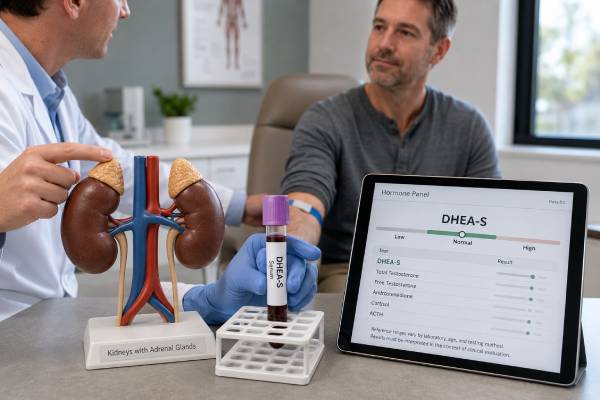
A DHEA-S test measures dehydroepiandrosterone sulfate, the most abundant circulating adrenal androgen. In men, DHEA-S comes almost entirely from the adrenal glands, making it more useful for assessing adrenal androgen production than testosterone, which is produced mainly by the testes. The test may be ordered when an adrenal steroid disorder, congenital adrenal hyperplasia, an androgen-producing adrenal tumor, pituitary or adrenal insufficiency, or an unexplained hormone pattern is suspected. It is not a routine test for low libido, erectile dysfunction, fatigue, or age-related testosterone concerns. DHEA-S peaks in early adulthood and falls steadily with age, so an older man’s result must not be compared with a young-adult target. High values require interpretation with symptoms and other steroids; low values are often nonspecific. Supplements can distort results and may expose users to androgenic or estrogenic effects. The laboratory’s age-specific range, medication history, and the surrounding cortisol, ACTH, testosterone, and gonadotropin results determine what the number means.
- DHEA-S is produced mainly by the adrenal cortex, so it helps identify an adrenal contribution to androgen abnormalities.
- Levels are highest in young adulthood and decline with age, making age-specific ranges essential.
- Markedly high DHEA-S may suggest congenital adrenal hyperplasia, an adrenal tumor, or DHEA use, but mild elevations are less specific.
- Low DHEA-S can occur with adrenal or pituitary insufficiency, glucocorticoid use, chronic illness, or normal aging.
- DHEA-S is relatively stable through the day, but results still depend on assay, age, medicines, and supplements.
Table of Contents
- What DHEA-S is
- Why men have a DHEA-S test
- Preparation, units, and reference ranges
- What high DHEA-S can mean
- What low DHEA-S can mean
- Interpreting DHEA-S with other tests
- DHEA supplements and misleading results
- Follow-up, limitations, and warning signs
What DHEA-S is
DHEA and DHEA-S are steroid precursors made in the zona reticularis of the adrenal cortex. The adrenal gland releases DHEA, and the enzyme SULT2A1 adds a sulfate group to form DHEA-S. Sulfation makes the molecule more water-soluble and gives it a longer half-life. DHEA-S circulates at much higher concentrations than DHEA and changes less from hour to hour.
DHEA-S has weak direct androgen activity. Its importance comes from its ability to serve as a reservoir for DHEA and as raw material for local production of androstenedione, testosterone, dihydrotestosterone, estrone, and estradiol. Skin, fat, bone, brain, prostate, and other tissues express different steroid-converting enzymes, so they can generate active hormones locally.
In healthy adult men, conversion of adrenal DHEA-S into circulating testosterone contributes only a small proportion of total testosterone because the testes produce far more. This is why a low DHEA-S result does not automatically explain low serum testosterone, and why raising DHEA-S with a supplement does not necessarily correct clinical hypogonadism.
Adrenocorticotropic hormone, or ACTH, stimulates adrenal androgen production. DHEA itself has a daily rhythm related to ACTH and cortisol. DHEA-S changes less over the day because it clears slowly, which makes it a practical adrenal androgen marker.
Concentrations rise during adrenarche in childhood, increase through puberty, peak around the second or third decade, and then decline progressively. By old age, levels may be a small fraction of the young-adult peak. This predictable decline is sometimes called adrenopause, but it is not an abrupt male equivalent of menopause and does not by itself indicate disease.
DHEA-S differs from the androstenedione test in men. DHEA-S is far more adrenal-specific, whereas androstenedione can come from both adrenal and testicular sources and shows more daily variation.
Why men have a DHEA-S test
The test is ordered when the source or direction of adrenal androgen production matters. It is most valuable inside a focused endocrine evaluation.
Reasons include:
- Suspected congenital adrenal hyperplasia
- An unexplained elevation of androstenedione, testosterone, or other androgens
- A possible androgen-secreting adrenal mass
- Evaluation of adrenal insufficiency or hypopituitarism
- Monitoring selected adrenal disorders
- Clarifying whether an androgen abnormality is mainly adrenal or gonadal
- Investigating unusual pubertal timing in children or adolescents
- Checking suspected DHEA or prohormone exposure
In adult men, excess adrenal androgens may produce few obvious signs because androgen receptors already receive strong stimulation from testicular testosterone. A high DHEA-S result may therefore be discovered through testing rather than symptoms. Acne, oily skin, accelerated androgen-sensitive hair loss, or changes associated with supplements can occur, but none is specific.
A sudden, marked, or progressively rising result deserves more attention than a stable mild elevation. Adrenal tumors that secrete androgens are uncommon, and many produce more than one steroid. Cortisol, androstenedione, testosterone, 17-hydroxyprogesterone, and newer 11-oxygenated androgen measurements may help characterize the pattern.
Low DHEA-S can support reduced adrenal androgen production, but it is not a first-line diagnostic test for adrenal insufficiency. Morning cortisol, ACTH, electrolytes, renin, and ACTH stimulation testing answer more direct questions. DHEA-S may add context because a normal age-adjusted level can make chronic adrenal insufficiency less likely in some settings, while a low level is not specific enough to confirm it.
DHEA-S is also not a standard male fertility marker. Testosterone, FSH, LH, prolactin, semen analysis, and sometimes inhibin B are more relevant. It may be ordered when infertility appears within a broader adrenal or steroidogenic disorder.
Preparation, units, and reference ranges
A DHEA-S test usually requires a blood sample. Fasting is often unnecessary, and the sample can be more flexible in timing than testosterone because DHEA-S is relatively stable throughout the day. A clinician may still request a morning draw so that it aligns with cortisol, ACTH, or other adrenal tests.
Tell the clinician and laboratory about:
- DHEA, pregnenolone, or “adrenal support” supplements
- Testosterone, anabolic steroids, or prohormones
- Glucocorticoids such as prednisone, dexamethasone, and hydrocortisone
- Anticonvulsants, insulin, and other medicines that may affect steroid metabolism
- Recent severe illness, surgery, major weight loss, or prolonged calorie restriction
- Known adrenal, pituitary, liver, or kidney disease
Do not stop prescribed glucocorticoids without medical direction. Abrupt withdrawal can be dangerous when the hypothalamic-pituitary-adrenal axis is suppressed.
DHEA-S is often reported in mcg/dL or µmol/L. Approximate conversions are:
- 1 mcg/dL is about 0.0271 µmol/L
- 1 µmol/L is about 36.9 mcg/dL
Always confirm the unit on the report. A value copied without units can be misread by a factor of nearly 37.
Reference intervals vary greatly by age and sex. A laboratory may divide adult men into decade-based groups because the decline is large. Some ranges also depend on assay platform and population. Comparing a 65-year-old man with a 20-year-old interval can falsely label normal aging as deficiency.
A reference range is not a proven wellness target. Moving an older man’s DHEA-S into a young-adult range has not been shown to prevent aging, restore fertility, or reliably improve energy. Clinical decisions should follow symptoms and diagnosis rather than a commercial “optimal” zone.
Immunoassays are common. Mass spectrometry may be used when multiple steroids are measured or when interference is suspected. Results from different methods should not be trended as though they are identical.
What high DHEA-S can mean
A high DHEA-S result points toward increased adrenal androgen production or external DHEA exposure because the adrenal glands produce almost all circulating DHEA-S.
Congenital adrenal hyperplasia
Congenital adrenal hyperplasia includes inherited enzyme defects in cortisol synthesis. Reduced cortisol feedback raises ACTH, which stimulates adrenal growth and diverts steroid precursors toward androgen pathways. In 21-hydroxylase deficiency, 17-hydroxyprogesterone is the main screening marker. DHEA-S, androstenedione, testosterone, and 11-oxygenated androgens help describe the degree of androgen excess and treatment response.
Not every person with congenital adrenal hyperplasia has high DHEA-S at every visit. Glucocorticoid timing, disease control, age, assay, and the specific enzyme defect influence the pattern. A low value during treatment can reflect strong ACTH suppression rather than ideal control.
Adrenal tumors
Androgen-secreting adrenal tumors are rare. Concern increases when DHEA-S is several times the upper limit, rises rapidly, or accompanies abnormal cortisol secretion, an adrenal mass, weight loss, abdominal symptoms, or a broad steroid excess pattern. Benign and malignant lesions can overlap biochemically, so imaging features, size, growth, and pathology matter.
An incidental adrenal nodule with a small DHEA-S elevation does not automatically mean the tumor is producing androgens. The result should be repeated and evaluated with a structured adrenal workup.
Physiologic and medication-related causes
Young age within the adult range, normal biological variation, and assay differences can create mild elevations. DHEA supplements are a frequent preventable cause. Some products contain more active ingredient than the label states or include related prohormones.
Hyperprolactinemia and selected endocrine states have been associated with altered DHEA-S, but the direction and clinical relevance are not always consistent. The result should not be used to infer a diagnosis without corroborating tests.
What low DHEA-S can mean
Low DHEA-S is common with advancing age and often has limited independent significance. It can also reflect reduced ACTH stimulation, impaired adrenal cortex function, medication suppression, or severe illness.
Possible causes include:
- Primary adrenal insufficiency
- Secondary adrenal insufficiency from pituitary or hypothalamic disease
- Long-term glucocorticoid treatment
- Cushing syndrome or chronic cortisol excess that suppresses adrenal androgens in some patients
- Severe chronic illness or inflammatory disease
- Malnutrition, anorexia, or major physiologic stress
- Normal age-related decline
- Laboratory variation near the lower limit
In primary adrenal insufficiency, symptoms may include fatigue, weight loss, low blood pressure, salt craving, nausea, abdominal pain, darkened skin, low sodium, and high potassium. DHEA-S may be low, but diagnosis relies on cortisol and ACTH testing.
In secondary adrenal insufficiency, ACTH is low or inappropriately normal. Aldosterone is often preserved because it is regulated mainly by the renin-angiotensin system. Other pituitary hormones may be affected, causing low testosterone with low or normal LH and FSH, thyroid-hormone abnormalities, or growth-hormone deficiency.
Glucocorticoids suppress ACTH and commonly lower DHEA-S. A low result in a patient taking prednisone may be expected. It does not justify adding DHEA without considering the treatment indication, adrenal reserve, and possible interactions.
Low DHEA-S alone does not diagnose “adrenal fatigue.” Major endocrine societies do not recognize adrenal fatigue as a condition established by saliva or DHEA-S panels. Persistent symptoms deserve evaluation for validated causes such as anemia, thyroid disease, sleep disorders, depression, medication effects, infection, and true adrenal insufficiency.
Interpreting DHEA-S with other tests
The surrounding hormone pattern helps determine whether the issue is adrenal, testicular, pituitary, external, or simply age-related.
Common DHEA-S result patterns
| DHEA-S pattern | Other findings | Possible interpretation |
|---|---|---|
| Markedly high | High androstenedione or broad steroid excess | Adrenal overproduction, congenital adrenal hyperplasia, or adrenal tumor |
| High | Suppressed LH and FSH, supplement use | External DHEA or prohormone exposure |
| Low | Low cortisol, high ACTH | Possible primary adrenal insufficiency |
| Low | Low cortisol, low or normal ACTH, other pituitary deficits | Possible central adrenal insufficiency |
| Low for young-adult range | Older age, normal clinical evaluation | Likely age-related decline |
Androstenedione changes more through the day and can come from testes as well as adrenals. Testosterone in adult men is primarily testicular. LH and FSH show pituitary signaling to the testes. This separation allows a clinician to recognize an adrenal-only elevation versus a broader androgen pattern.
17-hydroxyprogesterone is essential when 21-hydroxylase deficiency is suspected. A borderline baseline value may be followed by an ACTH stimulation test. Cortisol and ACTH evaluate adrenal reserve and feedback. Renin, aldosterone, and electrolytes are added when mineralocorticoid function is relevant.
The adrenal hormone test panel can be more informative than repeating DHEA-S alone when symptoms suggest a true adrenal disorder.
DHEA supplements and misleading results
DHEA is sold without prescription in some countries and marketed for energy, muscle, libido, mood, anti-aging, or “adrenal support.” Oral DHEA can raise DHEA-S and may also increase downstream androgens or estrogens.
Evidence for routine supplementation in healthy men is weak and inconsistent. Benefits vary by population, dose, baseline level, and outcome. Raising a laboratory value does not prove that a symptom will improve.
Potential adverse effects include acne, oily skin, hair loss in genetically susceptible men, breast tenderness, mood changes, sleep disturbance, altered lipids, changes in prostate-related symptoms, and interactions with hormone-sensitive conditions. Product quality and dose accuracy can be unreliable.
DHEA can confuse testing for adrenal tumors or congenital adrenal hyperplasia. It should be reported before blood collection. A clinician may recommend stopping it for an appropriate washout period, but the timing should be individualized.
Athletes should also consider anti-doping rules. DHEA is prohibited in sport because it is a precursor to active androgens. A supplement marketed as natural does not mean it is permitted or contamination-free.
Follow-up, limitations, and warning signs
An unexpected result should be checked for age range, units, assay, supplements, and medication effects. A repeat may be appropriate before imaging, especially for a mild isolated elevation.
Follow-up can include:
- DHEA and androstenedione
- 17-hydroxyprogesterone
- Cortisol and ACTH
- Total testosterone, SHBG, LH, and FSH
- A multi-steroid mass-spectrometry profile
- Electrolytes, renin, and aldosterone
- Adrenal CT or MRI when biochemical evidence supports it
- Pituitary testing when ACTH and other hormones are low
Common mistakes are comparing against the wrong age group, treating low age-related DHEA-S, assuming high DHEA-S proves cancer, and forgetting supplements. Another is using DHEA-S as a direct measure of stress; it cannot quantify psychological stress or diagnose burnout.
Seek urgent care for severe vomiting, dehydration, fainting, confusion, very low blood pressure, or severe abdominal pain when adrenal crisis is possible. Rapidly progressive weakness, unexplained weight loss, or a newly discovered adrenal mass requires timely medical evaluation. Most isolated mild DHEA-S abnormalities are not emergencies, but they should be interpreted rather than self-treated.
DHEA-S is valuable because it points strongly toward the adrenal androgen pathway. It becomes meaningful when age, other adrenal hormones, testosterone, medicines, and the clinical reason for testing are considered together.
Age, supplements, and adrenal context
DHEA-S changes more with age than many routine laboratory markers. Concentrations are high in young adulthood and generally decline over later decades. A result that is ordinary for a man in his twenties may be unusual for a man in his seventies, while an older adult’s low value may reflect expected aging rather than adrenal failure. The laboratory should provide an age-appropriate male interval, and interpretation should avoid comparing the result with a single “optimal” target promoted for all ages.
Over-the-counter DHEA is a major source of confusing results. Supplement labels may not match actual content, and DHEA can be converted into androstenedione, testosterone, and estrogens in peripheral tissues. A high DHEA-S after supplementation does not prove that the adrenal glands are overproducing hormone. It reflects exposure plus individual metabolism. Potential effects include acne, oily skin, hair changes, mood symptoms, gynecomastia, altered lipids, and interactions with hormone-sensitive conditions. Stopping or changing a supplement should be discussed with the clinician when it was prescribed or used for a medical purpose.
DHEA-S is useful because sulfation makes it relatively stable across the day and because the adrenal glands are its dominant source. It is less useful as a direct measure of androgen action. A man can have a high DHEA-S and normal testosterone, or a low DHEA-S with normal sexual function. The downstream conversion of adrenal precursors varies among tissues and individuals.
How clinicians investigate a marked elevation
A clearly and repeatedly elevated value is first checked for units, age range, supplement use, and laboratory error. The clinician then looks for rapid-onset acne, accelerated hair changes, unexplained changes in libido or muscle, testicular findings, Cushing-like features, abdominal or flank symptoms, and signs of congenital adrenal hyperplasia. Most modest elevations do not indicate a tumor, but a very high value or a rapidly progressive clinical picture deserves timely endocrine assessment.
Additional tests may include morning testosterone, androstenedione, 17-hydroxyprogesterone, cortisol-related testing, ACTH, estradiol, and metabolic or liver studies. The selection depends on whether the concern is an adrenal tumor, nonclassic congenital adrenal hyperplasia, Cushing syndrome, exogenous exposure, or an unrelated testosterone problem. Imaging should follow a credible biochemical and clinical signal; incidental adrenal nodules are common and can create unnecessary anxiety when imaging is ordered without a focused indication.
A low DHEA-S is similarly nonspecific. It can occur with aging, adrenal insufficiency, pituitary disease, glucocorticoid treatment, or chronic illness. Suspected adrenal insufficiency is assessed with cortisol and ACTH-based testing, not DHEA-S alone. Symptoms such as unexplained weight loss, low blood pressure, vomiting, severe weakness, abdominal pain, or electrolyte abnormalities require direct medical evaluation.
DHEA-S should therefore be viewed as an adrenal-source marker that guides the next question. It is not a stand-alone diagnosis of adrenal health, biological age, vitality, or testosterone status, and it should not be “corrected” with supplements simply because it falls below a nonmedical target.
In men being evaluated for infertility or low testosterone, DHEA-S usually remains a supporting marker rather than the central test. LH, FSH, total and free testosterone, prolactin, examination, and semen analysis more directly assess the pituitary–testicular axis. DHEA-S becomes more relevant when the pattern suggests an adrenal source, when androgen precursors are unexpectedly elevated, or when a supplement or adrenal disorder could be distorting the picture.
Serial testing should have a clinical purpose. Small fluctuations within the same range may reflect ordinary biological and analytical variation. Repeated monthly measurements rarely add value when symptoms are stable and no treatment is being adjusted. A meaningful trend is one obtained with the same method and linked to a change in exposure, disease activity, or management.
Emergency symptoms should be separated from routine hormone interpretation. Severe weakness with vomiting, low blood pressure, confusion, dehydration, or collapse can indicate an adrenal crisis and requires urgent care; waiting for a DHEA-S result is unsafe. Rapid virilizing changes, a palpable abdominal mass, or major unexplained steroid abnormalities also deserve prompt specialist review. Most isolated mild deviations are not emergencies and can be confirmed methodically.
The safest question after an abnormal result is what specific diagnosis the next test will evaluate. This keeps the workup proportionate and avoids treating a laboratory marker as though it were the disease itself.
When a result is repeated, use the same supplement status and laboratory if possible. A large change after stopping DHEA is evidence of exposure, while a persistent marked elevation deserves endocrine review. Interpretation should remain tied to symptoms and the rest of the steroid profile rather than a target value.
References
- Adrenal Androgens and Aging 2023 (Review)
- The Sex Hormone Precursors Dehydroepiandrosterone and Its Sulfate: Roles in Health and Disease 2025 (Review)
- The Role of Cortisol and Dehydroepiandrosterone in Obesity, Metabolic Syndrome, and Age-Related Diseases 2025 (Review)
- Dehydroepiandrosterone and Bone Health 2024 (Review)
- Impact of DHEA supplementation on testosterone and estradiol levels in men and women: a meta-analysis of randomized controlled trials 2025 (Systematic Review)
Disclaimer
This article is educational and does not diagnose adrenal insufficiency, congenital adrenal hyperplasia, or an adrenal tumor. DHEA-S must be interpreted with age-specific laboratory ranges, medicines, supplements, symptoms, and related adrenal and gonadal tests. Do not start DHEA or change glucocorticoid treatment without qualified medical guidance.