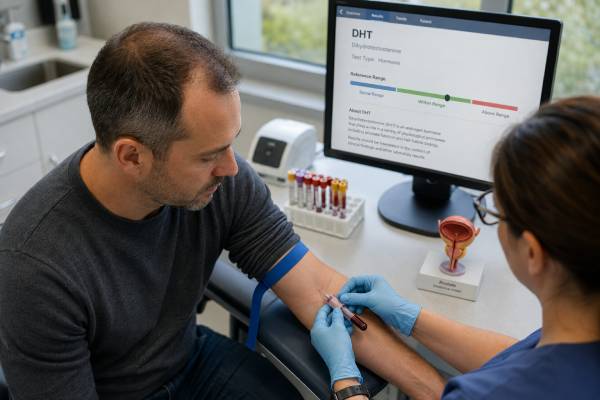
A dihydrotestosterone (DHT) test measures a potent androgen made when the enzyme 5-alpha-reductase converts testosterone into DHT. The hormone is essential for fetal development of male external genitalia, pubertal growth of the prostate and body hair, and androgen signaling in skin and other tissues. In adult men, serum DHT testing has limited routine use. It may help evaluate a suspected 5-alpha-reductase deficiency, monitor selected treatments, investigate an unusual androgen pattern, or support a specialist assessment of development or endocrine disease. It is not a dependable stand-alone test for male-pattern hair loss, prostate enlargement, sexual symptoms, or “androgen status.” Hair follicles and prostate tissue create DHT locally, so blood concentration does not directly show tissue exposure. Finasteride and dutasteride can lower serum DHT substantially, while testosterone therapy may raise it depending on the formulation. Results require the laboratory’s method-specific range, medication history, testosterone level, age, and the reason testing was ordered.
- DHT is made from testosterone by 5-alpha-reductase and binds the androgen receptor more strongly than testosterone.
- Serum DHT does not reliably predict scalp hair loss or prostate size, because local enzyme activity and genetic sensitivity matter more.
- Finasteride and dutasteride lower DHT, so medication use and dose timing must be reported.
- Low DHT with normal or high testosterone may support impaired 5-alpha-reduction, but diagnosis requires specialist testing and often genetics.
- Reference ranges differ by assay, and mass spectrometry is generally more specific than many immunoassays.
Table of Contents
- What DHT does in the body
- When DHT testing is used
- Collection, preparation, and laboratory methods
- What high DHT can mean
- What low DHT can mean
- DHT, hair loss, and the prostate
- Interpreting DHT with other hormones
- Follow-up, treatment effects, and limitations
What DHT does in the body
DHT is a metabolite of testosterone. The 5-alpha-reductase enzymes remove a double bond from testosterone, creating an androgen that binds the androgen receptor with greater affinity and forms a more stable receptor complex. This makes DHT a powerful signal in tissues that express the enzyme and receptor.
Two well-characterized 5-alpha-reductase isoenzymes are clinically important. Type 2 is prominent in the prostate, seminal vesicles, genital skin, and hair follicles. Type 1 is found in skin, liver, and other tissues. A third isoenzyme also exists, but its clinical role is less clearly defined.
DHT has major developmental roles:
- Formation of the penis, scrotum, and prostate before birth
- Pubertal growth of the prostate and external genital tissues
- Facial and body-hair development
- Sebaceous-gland activity and acne susceptibility
- Androgen signaling in scalp follicles that are genetically sensitive to miniaturization
Testosterone remains essential for muscle, bone, libido, sperm production, and many other functions. DHT cannot be aromatized into estradiol, so it does not replace testosterone’s estrogen-related effects on bone and other tissues.
Most DHT acts locally. The prostate, skin, and hair follicles convert testosterone within the tissue, and local DHT concentration may be much higher than the serum level suggests. The circulating test therefore provides only a partial view of androgen biology.
Serum DHT also reflects clearance and treatment. Testosterone gels may expose skin to high local testosterone and produce more DHT than some injectable regimens. A man’s blood level can change without a corresponding change in scalp or prostate response because receptor sensitivity and local enzyme expression remain different.
A total testosterone test is usually more important for evaluating adult androgen deficiency. DHT is added when its specific conversion pathway is relevant.
When DHT testing is used
DHT testing is specialized rather than routine. It may be useful in several settings:
- Suspected 5-alpha-reductase type 2 deficiency
- A disorder of sex development involving undervirilization
- Evaluation of an unusual testosterone-to-DHT relationship
- Monitoring the biochemical effect of finasteride or dutasteride in selected cases
- Research or specialist monitoring during testosterone therapy
- Investigation of rare androgen-production or metabolism disorders
- Assessment of an unexpected androgen pattern when standard testing is inconclusive
In 5-alpha-reductase type 2 deficiency, a person with a 46,XY karyotype has reduced conversion of testosterone to DHT. External genital development may be atypical at birth, while testosterone-driven virilization can increase at puberty. The testosterone-to-DHT ratio, sometimes after hCG stimulation, can support the diagnosis, but thresholds vary by age, assay, and protocol. Genetic testing of SRD5A2 may confirm it.
Serum DHT is generally not needed before starting finasteride for male-pattern hair loss or benign prostatic hyperplasia. Diagnosis and treatment usually depend on clinical findings, not a baseline DHT number. Measuring the level rarely predicts whether the medicine will work or whether adverse effects will occur.
The test is also not a standard evaluation for low libido, erectile dysfunction, fatigue, infertility, or gym performance. Total testosterone, SHBG, free testosterone, LH, FSH, prolactin, and semen analysis answer more relevant questions.
Some clinics market DHT testing as a way to find an “optimal androgen balance.” Evidence does not support broad screening or treatment to a narrow target. A high or low serum value should have a defined clinical question before it prompts medication changes.
Collection, preparation, and laboratory methods
A DHT test uses serum or plasma. Fasting instructions vary. Because testosterone has a daily rhythm and DHT derives from testosterone, a morning sample is often preferred when the result will be compared with total testosterone.
Before collection, report:
- Finasteride, dutasteride, or topical 5-alpha-reductase inhibitors
- Testosterone injections, gels, pellets, patches, or oral formulations
- Anabolic steroids, selective androgen receptor modulators, or prohormones
- DHEA, saw palmetto, and supplements marketed for hair or prostate health
- Recent changes in dose or formulation
- Severe illness, surgery, calorie restriction, or major sleep disruption
Do not stop a prescribed drug solely to obtain a “natural” result unless the treating clinician gives instructions. For treatment monitoring, the point is often to measure the effect while the medicine is being taken.
DHT may be reported in ng/dL, ng/mL, pg/mL, or nmol/L. Approximate conversions include:
- 1 ng/dL is about 0.0344 nmol/L
- 1 nmol/L is about 29.1 ng/dL
The number must always be interpreted with its unit and laboratory interval.
Assay quality is particularly important because DHT concentrations are lower than total testosterone and structurally similar steroids may interfere. Liquid chromatography–tandem mass spectrometry can improve specificity. Immunoassays vary in cross-reactivity and may produce method-dependent differences.
Reference intervals are not interchangeable. Age, sex, pubertal stage, assay, and treatment status influence the range. A result from one laboratory should not be compared directly with a range from another platform.
The testosterone-to-DHT ratio is sometimes calculated in suspected enzyme deficiency. Both hormones should be measured by reliable methods from the same sample, with consistent units. A ratio can be misleading if one assay is inaccurate, if the patient uses a 5-alpha-reductase inhibitor, or if timing differs.
What high DHT can mean
High serum DHT usually reflects increased testosterone substrate, greater conversion, external androgen exposure, or laboratory variation. It does not automatically mean disease.
Possible causes include:
- Testosterone therapy, particularly formulations that produce more peripheral conversion
- Anabolic steroids or androgenic prohormones
- Naturally high testosterone and 5-alpha-reductase activity
- Rare androgen-producing conditions
- Laboratory interference or a method-specific high value
Testosterone gel can raise DHT because the hormone passes through skin rich in 5-alpha-reductase. Injectable testosterone may create a different DHT pattern. A high value during treatment should be interpreted with total and free testosterone, timing relative to the dose, symptoms, hematocrit, and clinical goals.
High DHT does not establish the cause of acne, hair loss, urinary symptoms, irritability, or sexual changes. These outcomes depend on local tissue metabolism, androgen-receptor genetics, age, and other hormones. A man with normal serum DHT can have advanced androgenetic alopecia, while another with a high level may retain scalp hair.
An isolated mild elevation without symptoms or a corroborating abnormality may require only confirmation. A marked rise with high testosterone, suppressed LH and FSH, infertility, acne, testicular shrinkage, or undisclosed supplement use suggests external androgen exposure.
Endogenous DHT-secreting tumors are not a common clinical category. Tumors generally affect upstream testosterone or precursor production, and DHT changes secondarily. Investigation should focus on the entire steroid pattern and examination rather than assuming a direct DHT-producing lesion.
What low DHT can mean
Low DHT may result from reduced testosterone, impaired 5-alpha-reduction, medication, severe illness, or normal assay variation.
Common explanations include:
- Finasteride or dutasteride use
- Low total and free testosterone
- Primary or secondary hypogonadism
- Congenital 5-alpha-reductase type 2 deficiency
- Severe liver disease or altered steroid metabolism
- External testosterone suppression after discontinuation
- A specimen or assay issue near the lower measurement limit
Finasteride inhibits mainly type 2 5-alpha-reductase, while dutasteride inhibits type 1 and type 2. Dutasteride generally suppresses circulating DHT more strongly. A low result during therapy is expected and does not by itself show excessive treatment.
Low DHT caused by low testosterone should be evaluated through the standard androgen pathway. Morning total testosterone, SHBG, free testosterone, LH, FSH, and prolactin are more useful for locating the cause.
In congenital 5-alpha-reductase deficiency, serum testosterone may be normal or rise after hCG, but DHT remains relatively low, creating an elevated testosterone-to-DHT ratio. The phenotype, age, pubertal stage, assay, and genetics determine interpretation. Adult self-testing cannot establish the diagnosis.
A low serum DHT result in a healthy adult with normal testosterone and no developmental concern often has uncertain significance. There is no established indication to “replace DHT” to treat a laboratory number. DHT-based treatments are not routine and may affect the prostate, skin, hair, and fertility-related signaling.
DHT, hair loss, and the prostate
DHT is central to both androgenetic alopecia and benign prostatic hyperplasia, but blood testing is a poor predictor of either condition.
Hair loss
In genetically susceptible scalp follicles, DHT shortens the growth phase and gradually miniaturizes terminal hairs. The frontal hairline, temples, and crown are commonly affected in men. Genetics determine follicle sensitivity, androgen-receptor expression, and local enzyme activity.
Serum DHT can be normal in a man with rapid hair loss. The scalp can create enough DHT locally, and sensitive follicles can respond strongly to ordinary concentrations. Conversely, high serum DHT does not guarantee baldness.
Diagnosis is based on the pattern, scalp examination, family history, and exclusion of other causes such as alopecia areata, telogen effluvium, iron deficiency, thyroid disease, infection, or scarring alopecia. A DHT level cannot distinguish these conditions by itself.
Finasteride reduces DHT and can slow male-pattern hair loss in many men. Response is assessed by photographs and hair density over months, not by reaching a specific serum target. Topical and oral treatments have different exposure and risk profiles.
Prostate
DHT supports prostate development and growth. In benign prostatic hyperplasia, type 2 5-alpha-reductase converts testosterone to DHT within prostate tissue. Finasteride and dutasteride shrink the gland over time and lower the risk of urinary retention or surgery in appropriately selected men.
Serum DHT does not correlate closely enough with prostate volume or urinary obstruction to serve as a screening test. Evaluation uses symptom history, examination, urinalysis, post-void residual or flow testing in selected patients, prostate-specific antigen when appropriate, and imaging or cystoscopy when indicated.
Five-alpha-reductase inhibitors lower prostate-specific antigen by roughly half after sustained treatment in many men. Clinicians adjust interpretation and monitor the trend. DHT measurement is not a substitute for proper prostate assessment.
Interpreting DHT with other hormones
DHT should be placed in the testosterone pathway.
Common DHT patterns
| Testosterone | DHT | Other clues | Possible interpretation |
|---|---|---|---|
| Low | Low | LH and FSH high or low | Primary or secondary hypogonadism |
| Normal or high | Low | Finasteride or dutasteride use | Expected enzyme inhibition |
| Normal or high | Low | Developmental undervirilization, high T:DHT ratio | Possible 5-alpha-reductase deficiency |
| High | High | Suppressed LH and FSH | External testosterone or androgen exposure |
| Normal | Normal | Patterned hair loss | Local follicle sensitivity remains likely |
SHBG affects total testosterone but binds DHT as well. Free fractions may differ from total concentrations. Estradiol provides information about aromatization, especially during testosterone therapy. LH and FSH show whether pituitary signaling is suppressed or compensating.
In infertility, DHT is secondary to semen analysis and gonadotropins. External androgens can produce high testosterone and DHT while suppressing sperm production. A normal serum androgen result does not mean intratesticular testosterone is sufficient.
Follow-up, treatment effects, and limitations
Follow-up depends on the reason for testing. A suspected enzyme disorder may require repeat testosterone and DHT, hCG stimulation, genetic testing, pediatric or reproductive endocrinology review, and detailed developmental assessment. A treatment-monitoring question may require only consistent timing and the same assay.
Potential follow-up tests include:
- Morning total testosterone
- SHBG and free testosterone
- LH and FSH
- Estradiol
- Semen analysis
- hCG stimulation testing
- SRD5A2 genetic testing
- Prostate evaluation based on symptoms and age
- Dermatologic assessment for hair loss
Common mistakes include ordering DHT for every case of hair loss, assuming serum concentration equals scalp or prostate exposure, comparing different assay methods, and changing finasteride dose to chase a number. Another mistake is interpreting low DHT during dutasteride treatment as hormone failure.
Five-alpha-reductase inhibitors can cause sexual, reproductive, breast, and mood-related adverse effects in some users, while many tolerate them well. Decisions should consider the treatment indication, dose, alternatives, and individual response. Pregnant people should not handle crushed or broken tablets because exposure may affect development of a male fetus.
Seek prompt care for a hard testicular mass, sudden testicular pain, inability to urinate, blood in the urine, severe headache with visual change, or rapidly progressive developmental concerns in a child. Hair loss alone is rarely urgent, but scarring, inflammation, pain, or sudden shedding warrants timely dermatologic evaluation.
DHT testing answers a narrow biochemical question. It can support evaluation of conversion defects or document drug effects, but it cannot measure masculinity, predict baldness, diagnose prostate enlargement, or replace a complete androgen assessment.
DHT in hair follicles and the prostate
Circulating DHT does not perfectly represent DHT activity inside hair follicles or prostate tissue. Both tissues can convert testosterone locally through 5-alpha-reductase, and local enzyme expression, androgen-receptor sensitivity, genetics, age, and treatment exposure influence the biological effect. A man with androgenetic alopecia may have a serum DHT value within range, while another man with a high result may retain dense scalp hair because follicle susceptibility differs.
Male-pattern hair loss is diagnosed mainly from its distribution, progression, family history, and scalp examination. A DHT blood test is rarely required. Dermatological assessment is more useful when hair loss is sudden, patchy, associated with inflammation or scarring, or accompanied by thyroid, nutritional, autoimmune, or medication-related clues. Treatment decisions for androgenetic alopecia are not based on reaching a particular serum DHT number.
The same principle applies to benign prostatic enlargement. Prostate size and urinary symptoms do not correlate closely enough with one serum DHT value to make the test a screening tool. Evaluation may include symptom scores, urinalysis, examination, post-void residual measurement, kidney function, prostate-specific antigen when appropriate, and imaging or urodynamic testing in selected men. Difficulty urinating, fever with urinary symptoms, visible blood, recurrent infection, or inability to pass urine requires direct assessment.
Interpreting DHT during 5-alpha-reductase inhibitor treatment
Finasteride and dutasteride reduce conversion of testosterone to DHT. Dutasteride inhibits both major 5-alpha-reductase isoenzymes more extensively, while finasteride is more selective. Serum DHT generally falls, but the degree depends on adherence, dose, timing, assay, and individual metabolism. Measuring DHT is not routinely required to prove that the medicine is working; clinical response and adverse effects are usually more important.
Potential adverse effects include reduced libido, erectile or ejaculatory symptoms, lower semen volume, breast tenderness or enlargement, and mood symptoms in some users. Fertility concerns deserve discussion because semen parameters can change, particularly in men with pre-existing impairment. The medicine also lowers prostate-specific antigen, which affects interpretation during prostate screening and monitoring. Clinicians commonly account for duration of treatment when judging PSA changes.
A low DHT result while taking a 5-alpha-reductase inhibitor is an expected pharmacological effect, not evidence of adrenal or testicular failure. Total testosterone may remain stable or rise modestly. If sexual symptoms develop, the evaluation should include timing, baseline function, relationship factors, vascular risks, other medicines, testosterone status, and the original reason for treatment rather than assuming the DHT number alone proves causation.
Markedly high DHT without androgen use is uncommon. Confirmation is important because immunoassay interference and cross-reactivity with related steroids can produce misleading values. A specialist may repeat the measurement with mass spectrometry and review testosterone, androstenedione, adrenal markers, and clinical features. Tumor imaging is not the automatic first response to a mildly high isolated result.
DHT testing is most defensible when a clinician has a focused question about steroid metabolism, an unusual developmental disorder, treatment response in a complex case, or a discordant androgen pattern. For ordinary hair loss or prostate symptoms, tissue-specific clinical evaluation usually provides more actionable information than a serum level.
Developmental disorders create a different use case. In 5-alpha-reductase deficiency, conversion of testosterone to DHT is impaired, affecting external genital development and pubertal changes. Diagnosis may involve testosterone and DHT before and after hCG stimulation, steroid profiling, genetics, and specialist assessment. Ratios used in this setting are protocol- and age-dependent and should not be applied to adult hair-loss or prostate testing.
DHT should also not be interpreted as a cardiovascular or athletic performance marker. Supraphysiological androgen exposure can raise hematocrit, worsen acne and sleep apnea, suppress fertility, and alter lipids even when DHT is not markedly elevated. Conversely, lowering DHT does not remove all androgen effects because testosterone continues to act directly. Treatment decisions should focus on the diagnosed condition and whole-person risk rather than a single metabolite.
Men considering finasteride or dutasteride should discuss the expected benefit for the actual indication. Hair-density changes take months and are maintained only while treatment continues. Urinary improvement and prostate-volume reduction also develop gradually. Baseline sexual function, fertility plans, breast symptoms, and PSA context should be documented so later changes can be judged fairly.
A DHT result obtained after stopping treatment may remain altered for a period that depends on the medicine’s half-life and tissue effects. The date of the last dose belongs on the interpretation, and repeat testing should be performed only when it will alter management.
Laboratory ranges also vary by age and method. DHT immunoassays may cross-react with related steroids, and values near a decision threshold can be confirmed with mass spectrometry. No treatment should be started solely because a result differs from a range taken from another laboratory.
References
- Biochemistry, Dihydrotestosterone 2023 (Review)
- 5α-Reductase Inhibitors 2024 (Review)
- Androgenetic Alopecia 2024 (Review)
- The Sex Hormone Precursors Dehydroepiandrosterone and Its Sulfate: Roles in Health and Disease 2025 (Review)
- Dihydrotestosterone: Biochemistry, Physiology, and Clinical Implications of Elevated Blood Levels 2017 (Review)
Disclaimer
This article is educational and cannot diagnose a 5-alpha-reductase disorder, hair-loss condition, prostate disease, or testosterone problem. DHT results must be interpreted with the assay, testosterone, medications, age, symptoms, and specialist findings. Do not change finasteride, dutasteride, testosterone, or other hormone-related treatment without medical guidance.