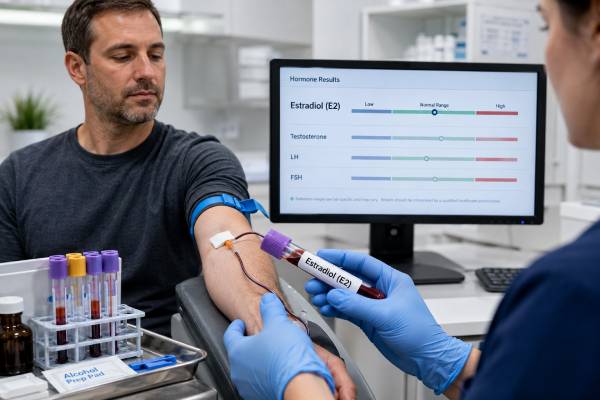
An estradiol (E2) test in men measures the most biologically active form of estrogen. Most male estradiol is created when aromatase converts testosterone into estradiol in fat, bone, brain, testes, and other tissues. Men need estradiol for bone strength, normal sexual function, feedback to the brain and pituitary, and aspects of fertility and metabolism. Testing may help evaluate gynecomastia, breast tenderness, infertility, delayed or early puberty, a suspected testicular or adrenal tumor, unexplained low bone density, or symptoms during testosterone or aromatase-inhibitor treatment. It is not a general “hormone balance” score, and the testosterone-to-estradiol ratio has no universally accepted target. Results in men are relatively low, so assay sensitivity matters; a sensitive liquid chromatography–tandem mass spectrometry method may be more reliable than a standard immunoassay. High or low values should be interpreted with testosterone, SHBG, LH, FSH, medications, body composition, liver health, and the laboratory’s own reference range.
- Estradiol is necessary in men, particularly for bone health, sexual function, and hormonal feedback.
- High estradiol may result from obesity, testosterone therapy, liver disease, medications, or rare tumors, but symptoms and other hormones determine significance.
- Low estradiol can occur with low testosterone, aromatase inhibition, or rare aromatase defects and may contribute to bone loss or hot flashes.
- Sensitive assays are preferable at male concentrations, because some routine immunoassays are inaccurate near the lower range.
- There is no universal “ideal” testosterone-to-estradiol ratio, and treatment should not chase a ratio alone.
Table of Contents
- What estradiol does in men
- Why an E2 test is ordered
- Preparation, timing, and assay choice
- Normal ranges and result interpretation
- What high estradiol can mean
- What low estradiol can mean
- Testosterone, estradiol, and SHBG patterns
- Follow-up tests, treatment, and common mistakes
What estradiol does in men
Estradiol is often described as a female hormone, but men produce and require it throughout life. The testes secrete a small amount directly, while most circulating estradiol comes from aromatization of testosterone and androstenedione in peripheral tissues. Aromatase is active in fat, bone, brain, skin, and the reproductive tract.
Estradiol supports several functions:
- Bone mineralization and normal bone turnover
- Closure of growth plates during puberty
- Sexual desire and aspects of erectile function
- Feedback regulation of gonadotropin-releasing hormone, LH, and FSH
- Fluid balance and vascular signaling
- Sperm maturation and reproductive-tract function
- Brain and mood-related signaling
Rare men with aromatase deficiency or estrogen-receptor defects have provided strong evidence for estradiol’s importance. They may develop continued linear growth because growth plates do not close normally, low bone density, skeletal pain, metabolic abnormalities, and impaired fertility despite normal or high testosterone.
Too much estradiol can also cause problems, particularly when estrogenic stimulation exceeds androgen action in breast tissue. Gynecomastia reflects glandular breast proliferation, not simply a high E2 number. Local estrogen production, androgen levels, receptor sensitivity, medications, age, body fat, and disease all influence the outcome.
Serum estradiol cannot measure tissue production directly. A man may have breast tenderness or gynecomastia with an E2 concentration inside the laboratory range if local aromatization or androgen deficiency shifts the tissue balance. Another man may have a mildly high serum value without symptoms.
The hormone also interacts with SHBG. Estradiol can increase hepatic SHBG production, while SHBG binds both testosterone and estradiol. A high SHBG state can change total concentrations without proportionally changing free hormone exposure.
Why an E2 test is ordered
Estradiol testing is most helpful when a specific condition could change estrogen production or action.
Common indications include:
- Gynecomastia or persistent breast tenderness
- A breast change during testosterone treatment
- Delayed or incomplete puberty
- Very early puberty or rapid pubertal progression
- Infertility with an abnormal hormone pattern
- Suspected testicular, adrenal, or hCG-producing tumor
- Unexplained low bone density, recurrent fractures, or continued growth after expected epiphyseal closure
- Monitoring aromatase inhibitors in selected patients
- Assessing excessive aromatization during testosterone therapy
- Evaluation of severe liver disease or another condition that alters estrogen metabolism
A gynecomastia hormone panel usually includes testosterone, LH, hCG, and sometimes prolactin as well as estradiol. The purpose is to identify the cause of the estrogen-androgen imbalance, not merely to confirm that breast tissue is present.
Estradiol may also be checked in men taking testosterone when breast tenderness, excessive fluid retention, or an unexpectedly high E2-related pattern develops. Routine repeated E2 testing in every man on testosterone is not always necessary, especially when symptoms are absent and dosing is appropriate.
The test is not a reliable screening tool for mood, fat distribution, libido, or erectile dysfunction by itself. These concerns are multifactorial. Standard testosterone evaluation, medication review, cardiovascular risk assessment, sleep, mental health, and relationship factors may be more relevant.
Men should not order E2 solely to calculate an online “T:E ratio.” The ratio changes with units and assay method, and no single target has been validated for all men, ages, fertility goals, or treatments.
Preparation, timing, and assay choice
Estradiol usually requires a blood sample. Fasting is not always necessary. When E2 is measured with testosterone, a morning sample is often convenient and improves interpretation of the testosterone result.
Tell the clinician about:
- Testosterone therapy and the exact formulation, dose, and timing
- Aromatase inhibitors such as anastrozole, letrozole, or exemestane
- Selective estrogen receptor modulators such as clomiphene or tamoxifen
- hCG or gonadotropin therapy
- Anabolic steroids, DHEA, prohormones, and bodybuilding products
- Finasteride or dutasteride
- Antipsychotics, spironolactone, ketoconazole, and other medicines associated with gynecomastia
- Liver, kidney, thyroid, adrenal, or testicular disease
- High-dose biotin, which can interfere with some immunoassays
Treatment timing can matter. Testosterone injections may produce peaks in testosterone and estradiol after dosing, while gels create a different daily pattern. Serial tests should use similar timing relative to the dose.
Male estradiol concentrations are low compared with concentrations in many premenopausal women. Some standard immunoassays have limited accuracy and may overestimate or underestimate E2 at the male range because of cross-reactivity and sensitivity limits. A sensitive LC–MS/MS assay is often preferred when precise low-level measurement is important, such as in men on aromatase inhibitors, children, or patients with suspected estrogen deficiency.
Results are commonly reported in pg/mL or pmol/L. Approximate conversion:
- 1 pg/mL is about 3.67 pmol/L
- 1 pmol/L is about 0.272 pg/mL
The report’s unit and reference interval must be used. A value of 30 means something very different in pg/mL than in pmol/L.
Assay methods should not be mixed when trending results. A change after switching laboratories may reflect calibration rather than a true biological shift.
Normal ranges and result interpretation
There is no single universal male estradiol range. Many laboratories report an adult male interval somewhere around the low tens of pg/mL, but the exact lower and upper limits vary by method, age, and population. A sensitive-assay range cannot be applied to a standard immunoassay result.
The word “normal” has limits. A reference interval contains most results from a comparison population; it does not prove that every value inside it is ideal for every person. Nor does a slight flag prove disease.
Interpretation should consider:
- Symptoms and physical findings
- Total and free testosterone
- SHBG and albumin
- LH and FSH
- hCG when a tumor is possible
- Prolactin when pituitary suppression or gynecomastia is unexplained
- Liver and thyroid function
- Body fat and recent weight change
- Medications and hormone products
- Timing relative to testosterone or hCG dosing
A borderline high result without symptoms, on an insensitive assay, may need confirmation rather than immediate treatment. A very high result with a testicular mass or elevated hCG needs prompt investigation.
A low E2 result is most meaningful when obtained with a sensitive assay and accompanied by low testosterone, aromatase-inhibitor use, hot flashes, bone loss, or an unusual developmental pattern. Values near the assay’s detection limit can be imprecise.
The free estradiol fraction is rarely measured in routine care. SHBG changes can alter total E2, but validated free-estradiol testing is less standardized and usually unnecessary.
What high estradiol can mean
High estradiol can reflect increased production, reduced clearance, medication, external hormones, or a tumor-related signal.
Obesity and increased aromatization
Adipose tissue expresses aromatase. Men with more body fat may convert more testosterone and androstenedione into estrogens. Obesity also lowers SHBG and can suppress the hypothalamic-pituitary-testicular axis, producing low total testosterone and a relative estrogen-androgen imbalance.
The pattern is not identical in every man. Some men with obesity have E2 in range but low testosterone; others have a mild E2 elevation. Weight reduction may improve testosterone, SHBG, metabolic health, and aromatization without the need for an estrogen-blocking drug.
Testosterone, hCG, and anabolic steroids
More testosterone substrate can produce more estradiol. High doses, large injection peaks, or nonprescribed anabolic steroids may raise E2. hCG stimulates testicular testosterone and can increase intratesticular and circulating estradiol.
Symptoms may include breast tenderness, gynecomastia, fluid retention, or mood changes, but these are not specific. Adjusting an excessive testosterone dose or dosing pattern is often more appropriate than automatically adding an aromatase inhibitor.
Liver disease and medication effects
The liver metabolizes estrogens and makes SHBG. Advanced liver disease can increase estrogenic effects through altered clearance, higher SHBG, reduced testosterone production, and changes in aromatization. Spironolactone, some antiandrogens, ketoconazole, and several other medicines can shift estrogen-androgen action even when serum E2 is not markedly high.
Tumors and endocrine disorders
Rare testicular tumors may produce estrogen directly or produce hCG, which stimulates testicular steroid production. Adrenal tumors can produce aromatizable precursors or estrogens. Clinical concern rises with a testicular mass, rapid gynecomastia, very high E2, elevated hCG, suppressed gonadotropins, or other abnormal steroids.
Hyperthyroidism can raise SHBG and alter estrogen metabolism. The total E2 result may rise while the free fraction changes differently. Thyroid testing helps when symptoms or the hormone pattern suggest it.
What low estradiol can mean
Low estradiol usually results from low testosterone substrate or blocked aromatization.
Possible causes include:
- Primary or secondary hypogonadism
- Aromatase-inhibitor treatment
- Severe undernutrition or chronic illness
- Rare aromatase deficiency
- Rare estrogen-receptor dysfunction
- Overly aggressive suppression during fertility or testosterone treatment
- Assay inaccuracy near the lower range
Men with very low E2 may experience hot flashes, reduced libido, joint discomfort, lower bone density, increased bone turnover, or changes in body composition. Symptoms overlap with low testosterone, making the surrounding panel essential.
Bone risk is particularly important. Estradiol is a major regulator of male bone health. Long-term aromatase inhibition can lower bone mineral density, especially when E2 is driven too low. Monitoring may include symptom review, E2 by a sensitive assay, vitamin D and calcium assessment, and bone-density testing in selected patients.
Aromatase inhibitors are used in specific male fertility, pubertal, and endocrine settings, often off label. They should not be used simply because a man dislikes his E2 number. The dose needed to alter aromatization can vary, and oversuppression may impair bone and sexual health.
Low estradiol with normal or high testosterone and continued linear growth may raise concern for a rare aromatase or estrogen-receptor disorder, particularly in a younger person. Specialist endocrine and genetic evaluation is required.
Testosterone, estradiol, and SHBG patterns
The most informative view is the pattern across the panel.
Common testosterone and estradiol patterns in men
| Testosterone | Estradiol | Possible context |
|---|---|---|
| Low | Low | Primary or secondary hypogonadism, severe illness, energy deficit |
| Low or borderline | Normal or mildly high | Obesity, liver disease, increased aromatization, low SHBG |
| High | High | Testosterone therapy, anabolic steroids, hCG use |
| Normal or high | Very low | Aromatase inhibitor, rare aromatase deficiency, assay issue |
| Normal | High | High SHBG, liver or thyroid disease, medication, tumor evaluation |
The testosterone-to-estradiol ratio is sometimes used in male infertility research and selected specialist practices. Its interpretation depends on whether testosterone and E2 use compatible units and accurate assays. No universal cutoff defines health, fertility, gynecomastia risk, or the need for an aromatase inhibitor.
SHBG can raise total testosterone and total estradiol simultaneously. Free testosterone may still be low. A SHBG test helps distinguish high total hormone values caused by binding from true excess production.
LH and FSH show pituitary feedback. High E2 from an external or tumor source may suppress gonadotropins. High LH with low testosterone suggests testicular failure, which can create a relative estrogenic state even when E2 is not high.
Follow-up tests, treatment, and common mistakes
Follow-up depends on the pattern and symptoms. It may include:
- Repeat sensitive estradiol measurement
- Morning total testosterone, SHBG, and free testosterone
- LH and FSH
- hCG and testicular ultrasound
- Prolactin
- TSH and free T4
- Liver and kidney tests
- DHEA-S and other adrenal steroids
- Bone-density testing
- Medication and supplement review
Treatment targets the cause. Weight loss may reduce aromatization. Excessive testosterone dosing may need adjustment. A tumor requires specialist management. Liver or thyroid disease needs direct treatment. Aromatase inhibitors may be appropriate in selected cases but require careful dosing and monitoring.
Common mistakes include treating every high E2 result, using a standard female assay without considering low-level accuracy, assuming breast enlargement always means high serum estradiol, and ignoring low testosterone. Another error is suppressing E2 until it is nearly undetectable in pursuit of a ratio.
Gynecomastia that is new, painful, rapidly enlarging, one-sided, hard, fixed, associated with nipple discharge, or accompanied by a testicular lump needs prompt examination. Severe headache or visual change may suggest pituitary disease. Sudden testicular pain is an emergency.
Estradiol in men is neither an unwanted by-product nor a stand-alone measure of hormone balance. Appropriate testing can uncover clinically important excess or deficiency, but the result works best when it is tied to testosterone production, SHBG, gonadotropins, treatment exposure, and the symptom that prompted testing.
Why the assay matters at male concentrations
Estradiol circulates at much lower concentrations in men than in many premenopausal women. Some routine immunoassays lose accuracy and specificity near the lower end, where cross-reactivity with related compounds and analytical noise can have a large proportional effect. A result that will drive a major treatment decision may need confirmation with a sensitive liquid chromatography–tandem mass spectrometry method.
The term “sensitive estradiol” is not fully standardized. A laboratory may use it to describe an improved immunoassay or a mass-spectrometry method. The report should be checked for the actual technique and reference interval. Results from different methods should not be trended as though they are identical.
Estradiol also changes with testosterone exposure. Injectable testosterone can create peaks in both testosterone and aromatization, while gels and other formulations have different profiles. A sample drawn at a testosterone peak may show a higher estradiol than one drawn at a trough. Treatment timing, symptoms, body composition, liver function, and SHBG all belong in the interpretation.
Bone, breast, and sexual health
Men need estradiol for normal bone remodeling. Very low exposure—whether from severe hypogonadism, aromatase deficiency, excessive aromatase-inhibitor use, or profound androgen deprivation—can accelerate bone loss and increase fracture risk. Joint discomfort and changes in body composition may occur, but symptoms are nonspecific. Bone-density testing, fracture history, calcium and vitamin D status, and the cause of low estradiol matter more than an isolated value.
High estradiol may contribute to breast tenderness or gynecomastia, particularly when testosterone action is low, but many men with gynecomastia have an estradiol value within range. Local aromatization in breast and fat tissue, medication effects, receptor sensitivity, puberty, liver disease, and the relative androgen–estrogen balance can all be involved. A gynecomastia hormone panel is interpreted with examination and hCG or testicular findings when indicated.
Sexual function does not improve in a simple linear way as estradiol falls. Excessively suppressing estradiol during testosterone therapy can worsen libido, erections, mood, or bone health in some men. Aromatase inhibitors are therefore not routine add-ons for every mildly elevated result or for an arbitrary testosterone-to-estradiol ratio. They require a clear indication, appropriate dosing, and monitoring.
When estradiol is markedly high, clinicians review exogenous estrogen, testosterone or anabolic steroid use, obesity, liver disease, thyroid disease, hCG, and testicular or adrenal sources. Unexpected results are confirmed before imaging. When estradiol is low, testosterone, LH, FSH, treatment exposure, nutrition, and bone risks are reviewed. The clinical goal is not to force every man into a narrow online range but to identify a reproducible abnormality that explains symptoms or changes management.
Body fat is relevant because aromatase is active in adipose tissue, but obesity-related breast symptoms or low testosterone should not be reduced to estradiol alone. Obesity can lower SHBG, suppress the hypothalamic–pituitary axis, worsen sleep apnea, and change insulin and liver function. Sustainable weight loss may improve several parts of this pattern at once, whereas aggressive estradiol suppression can create new problems.
A testosterone-to-estradiol ratio is sometimes promoted as a universal indicator of fertility, libido, or “balance.” Ratios can change simply because different units are used, and there is no single validated target that applies to all assays and clinical settings. Reproductive specialists may examine the relationship in selected infertile men, but treatment still depends on semen analysis, symptoms, testosterone, gonadotropins, body composition, and the cause.
Men on androgen-deprivation treatment for prostate cancer are a distinct group. Their low testosterone also causes very low estradiol, contributing to bone loss, hot flushes, metabolic change, and altered body composition. Monitoring and prevention focus on fracture risk, bone density, exercise, calcium and vitamin D adequacy, and osteoporosis medicine when indicated rather than trying to restore estradiol independently.
Unexpected breast discharge, a hard unilateral breast mass, a testicular lump, rapid feminizing change, or a strongly elevated hCG result requires direct evaluation. These findings are not safely explained by an estradiol number alone. For less urgent abnormalities, confirmation with the right assay and a review of medicines and testosterone timing usually come first.
Follow-up testing should be proportional. A small asymptomatic deviation may need only confirmation and review of timing, while a marked reproducible abnormality with breast, testicular, liver, thyroid, or fertility findings warrants a directed workup. Repeated testing without a management question can amplify ordinary assay variation.
References
- Estrogens, Male Reproduction and Beyond 2023 (Review)
- A Review on Testosterone: Estradiol Ratio—Does It Matter in the Clinical Setting? 2024 (Review)
- The Loss of Estradiol by Androgen Deprivation in Prostate Cancer Patients: Implications for Bone, Cardiovascular and Metabolic Health 2024 (Review)
- New liquid chromatography tandem mass spectrometry method for the sensitive estradiol quantification in human serum 2024 (Study)
- Gynecomastia: Etiology, Diagnosis, and Treatment 2023 (Review)
Disclaimer
This information is educational and does not diagnose an estrogen disorder, gynecomastia cause, tumor, or treatment complication. Estradiol must be interpreted with the assay method, testosterone, SHBG, gonadotropins, medicines, symptoms, and the laboratory’s range. Do not start or change testosterone, hCG, tamoxifen, or an aromatase inhibitor without qualified medical care.