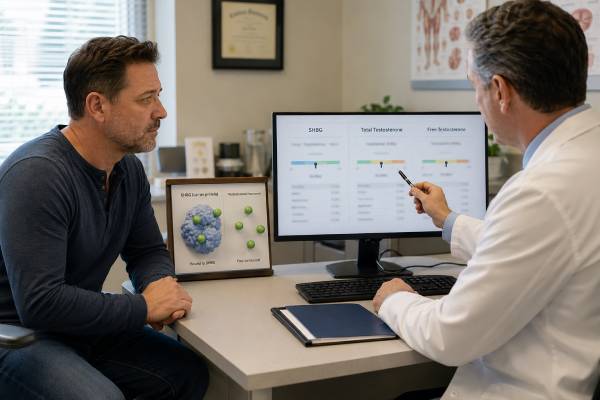
A sex hormone-binding globulin (SHBG) test measures a liver-produced protein that carries testosterone and estradiol in the blood. Its main use in men is to explain why total testosterone may not match symptoms or free testosterone. High SHBG can make total testosterone appear normal or high while the unbound fraction is low. Low SHBG can make total testosterone appear low even when free testosterone is less reduced. Aging, thyroid disease, liver disease, obesity, insulin resistance, diabetes, kidney conditions, medicines, and hormone exposure can all change SHBG. The result is not a diagnosis by itself and should not be treated as an independent target. Clinicians interpret it with morning total testosterone, albumin, calculated or measured free testosterone, symptoms, and related tests. A single unusual value may need confirmation, especially when illness or assay interference is possible. Understanding SHBG prevents two common errors: diagnosing testosterone deficiency from a low total value caused mainly by low binding protein, and missing low free testosterone when high SHBG keeps total testosterone inside the laboratory range.
- SHBG is a carrier protein, not a direct measure of testosterone production or androgen action.
- Low SHBG commonly occurs with obesity and insulin resistance and can lower total testosterone disproportionately.
- High SHBG can conceal low free testosterone behind a normal total testosterone result.
- Free testosterone calculations require accurate total testosterone, SHBG, and albumin values plus a validated equation.
- Treatment should address the underlying cause and clinical hormone pattern, not attempt to normalize SHBG alone.
Table of Contents
- What SHBG measures
- When an SHBG test is useful
- Preparation and free testosterone calculation
- Normal range and result patterns
- Causes of high SHBG
- Causes of low SHBG
- Symptoms and follow-up tests
- Treatment and monitoring
What SHBG measures
SHBG is a glycoprotein made primarily by the liver. It binds sex steroids with high affinity, particularly testosterone and dihydrotestosterone, and also carries estradiol. Most circulating testosterone is protein-bound: a portion is tightly attached to SHBG, another portion is more loosely bound to albumin, and a small fraction remains free.
Total testosterone includes all of these fractions. Free testosterone refers to the unbound fraction. Bioavailable testosterone usually means free plus albumin-bound testosterone, based on the idea that albumin binding is relatively weak. These measures answer related but different questions.
SHBG affects the distribution and clearance of hormones. When SHBG rises, more testosterone may be held in the bound pool and total testosterone can rise even if free testosterone does not. When SHBG falls, total testosterone may fall because the circulating bound reservoir is smaller. The body’s feedback system may partially adjust production, so the relationship is not a simple fixed percentage.
An SHBG test does not measure receptor activation in muscle, bone, brain, prostate, or sexual tissues. It also does not prove why the protein is high or low. Its value is interpretive: it helps determine whether total testosterone accurately represents the fraction available to tissues.
SHBG also carries estradiol, but its use in men is most established for testosterone interpretation. A value should not be labeled good or bad without the rest of the hormone pattern. A low value may explain a low total testosterone and indicate metabolic risk, while a high value may reveal why symptoms occur despite a seemingly normal total level.
When an SHBG test is useful
SHBG is most useful when total testosterone is borderline or conflicts with symptoms. It is also ordered when a condition known to alter binding protein is present. The clinician may use SHBG and albumin to calculate free testosterone or decide whether a measured free testosterone method is needed.
Testing is appropriate when a man has symptoms of androgen deficiency but total testosterone is normal and high SHBG is possible. It can also prevent overdiagnosis in a man with obesity, diabetes, or another low-SHBG condition whose total testosterone is below range but free testosterone remains adequate.
Possible symptoms include reduced libido, fewer morning erections, infertility, hot flushes, low bone density, loss of body hair, small testes, gynecomastia, anemia, and reduced muscle performance. Fatigue and low mood are nonspecific and should not be attributed to SHBG or testosterone without broader evaluation.
SHBG may be measured in liver or thyroid disease, major weight change, HIV, nephrotic syndrome, suspected androgen excess, use of estrogens or anticonvulsants, and monitoring of complex hormone treatment. It can also clarify unexpected testosterone results during anabolic steroid or antiandrogen exposure.
The test is not needed every time testosterone is measured. In a healthy symptomatic man with two clearly low morning total testosterone results and a coherent LH pattern, SHBG may add limited information. In contrast, it is particularly valuable near diagnostic thresholds.
Commercial “hormone optimization” panels often present SHBG as a target to manipulate. No evidence-based approach treats an isolated SHBG number in the absence of a clinical problem. The purpose is to interpret hormone availability and identify an underlying condition when appropriate.
Preparation and free testosterone calculation
SHBG itself has less pronounced daily variation than testosterone, but the sample is usually collected in the morning with total testosterone. Many guidelines favor fasting diagnostic testosterone samples. Follow the laboratory’s instructions, especially when glucose, insulin, lipids, thyroid, or liver tests are being collected at the same time.
Avoid testing during severe acute illness when possible. Illness can alter testosterone production, liver protein synthesis, nutrition, and medication exposure. A result obtained during hospitalization may not represent the stable outpatient state.
List all medicines, hormones, injections, supplements, and performance-enhancing products. Estrogens, thyroid hormone excess, some anticonvulsants, glucocorticoids, androgens, and antiandrogens may change SHBG or the testosterone relationship. Do not stop a prescribed medicine without the clinician who manages it.
Calculated free testosterone uses total testosterone, SHBG, and albumin in a mathematical binding model. Some equations assume a standard albumin value; others use the measured concentration. Different equations can produce different results, especially at extreme SHBG or testosterone values. The laboratory should identify its approach.
Equilibrium dialysis is a reference method for free testosterone, while ultrafiltration is another separation technique. Direct analog immunoassays are less reliable. A free testosterone test should be interpreted using a method-specific range, and values from unlike methods should not be compared casually.
Accurate input assays matter. If total testosterone is incorrect, the calculated free value will also be incorrect. Liquid chromatography–tandem mass spectrometry is often used for high analytical specificity, though validated immunoassays may be suitable. An implausible result may warrant repeat testing in a high-quality laboratory.
Normal range and result patterns
SHBG reference intervals vary with age, assay, laboratory, and population. Results are often reported in nanomoles per liter. The range printed on the report is the relevant starting point. An online “optimal” interval cannot replace method-specific interpretation.
The relationship with total and free testosterone is more informative than the SHBG flag alone.
| Pattern | Possible interpretation | Clinical response |
|---|---|---|
| Low total testosterone, low SHBG, normal free testosterone | Total value may be reduced mainly by low binding protein | Repeat if needed; assess metabolic and underlying causes rather than diagnosing deficiency automatically |
| Normal total testosterone, high SHBG, low free testosterone | High binding may conceal reduced available testosterone | Confirm free testosterone and evaluate high-SHBG causes |
| Low total and free testosterone with low or normal SHBG | Biochemical androgen deficiency is more likely | Repeat morning testing; measure LH, FSH, prolactin as indicated |
| High total testosterone, high SHBG, normal free testosterone | High total value may reflect expanded bound fraction | Investigate thyroid, liver, medicine, or estrogen-related causes |
| High free testosterone with low SHBG | Androgen exposure or low-binding state may contribute | Review dosing, supplements, symptoms, hematocrit, and related tests |
A value near a limit should not be interpreted more precisely than the assay supports. Repeat testing under similar conditions is reasonable when the result would change a long-term diagnosis or treatment. The same laboratory improves comparability.
Age affects both SHBG and testosterone. SHBG often increases with age, which can preserve total testosterone while free testosterone falls. Age is not a diagnosis, however; symptoms, repeat values, health status, and treatment risks still determine significance.
The ratio of total testosterone to SHBG is sometimes called a free androgen index. It is used more commonly in women and is not considered the preferred measure of free testosterone in men. Validated free testosterone calculation or equilibrium dialysis provides a more appropriate assessment.
Causes of high SHBG
Aging is associated with rising SHBG in many men. The change can contribute to a gradual decline in free testosterone even when total testosterone remains in range. Clinicians should not assume every older man with high SHBG needs treatment; the complete clinical criteria for hypogonadism still apply.
Hyperthyroidism can increase liver production of SHBG. Total testosterone may rise while free testosterone is normal or low. Symptoms such as weight loss, tremor, heat intolerance, palpitations, and frequent bowel movements support thyroid testing. Excess thyroid replacement can have a similar effect.
Liver conditions can alter SHBG, although the direction varies with disease stage and type. Chronic hepatitis and cirrhosis may raise SHBG and disturb estrogen-androgen balance. Liver enzymes alone do not measure synthetic function, so the wider clinical and laboratory picture matters.
Estrogen exposure stimulates SHBG production. This may occur with prescribed estrogen, environmental or topical transfer, or conditions that increase estrogenic signaling. Some anticonvulsants and other medicines also raise SHBG through hepatic enzyme and protein effects.
HIV and certain antiretroviral treatment contexts have been associated with high SHBG. Marked weight loss, undernutrition, and some genetic differences can also contribute. A naturally high value may exist without disease, but the testosterone fractions should still be interpreted correctly.
Androgen deficiency itself may allow SHBG to rise because androgens tend to suppress production. This can create a reinforcing pattern: lower testosterone and higher SHBG reduce free testosterone further. The cause still needs classification with LH, FSH, and related tests.
A high result should prompt targeted thyroid, liver, medication, nutrition, and hormone review—not a supplement intended to force SHBG down. Lowering the carrier without addressing the cause has no established clinical benefit.
Causes of low SHBG
Obesity and insulin resistance are among the most common associations with low SHBG. High insulin and liver fat can reduce SHBG production. Total testosterone may fall, sometimes leading to an incorrect diagnosis of hypogonadism if free testosterone and symptoms are not considered.
Type 2 diabetes and metabolic syndrome are also associated with low SHBG. Low SHBG can serve as a metabolic risk marker in population studies, but it is not a diagnostic test for diabetes. Hemoglobin A1c, fasting glucose, lipids, blood pressure, waist measures, and liver assessment provide direct clinical information.
Hypothyroidism may lower SHBG. Symptoms include cold intolerance, constipation, dry skin, weight gain, slowed thinking, and fatigue, though many are nonspecific. Thyroid-stimulating hormone and free thyroxine confirm the diagnosis.
Androgens, anabolic steroids, and some progestins suppress SHBG. A man using exogenous testosterone may have low SHBG and a relatively high free fraction, depending on dose and timing. Glucocorticoids can also lower SHBG and suppress endogenous testosterone production.
Nephrotic syndrome causes urinary protein loss and may reduce SHBG and albumin. Severe protein-losing states complicate calculated free testosterone because albumin assumptions may be wrong. Kidney and urine testing is selected when edema, proteinuria, or renal disease is suspected.
Acromegaly and some rare endocrine or genetic conditions can lower SHBG. Fatty liver disease is frequently linked through metabolic dysfunction. A low value by itself does not identify which condition is present.
Weight loss and improved insulin sensitivity may raise SHBG and total testosterone. The change in total testosterone does not necessarily represent the same magnitude of increased testosterone production because the binding reservoir also expands. Clinical improvement and free testosterone provide context.
Symptoms and follow-up tests
SHBG itself usually does not cause a distinct symptom set. Symptoms arise from the underlying condition or from altered free sex-steroid exposure. Low free testosterone may contribute to reduced libido, fewer morning erections, infertility, hot flushes, low bone density, anemia, reduced body hair, and changes in muscle and fat. High free testosterone from excess androgen exposure may cause acne, oily skin, mood changes, elevated hematocrit, and suppression of fertility.
The first follow-up is usually repeat total testosterone with SHBG and albumin under standardized morning conditions. Free testosterone may be calculated or measured by a reliable method. LH and FSH distinguish primary testicular failure from central suppression. A luteinizing hormone test in men is particularly useful when testosterone is low.
Prolactin is checked when testosterone is low with low or normal LH, sexual symptoms, infertility, or pituitary concerns. Thyroid tests evaluate a common cause of high or low SHBG. Liver enzymes, bilirubin, albumin, kidney function, urine protein, glucose, A1c, and lipids are selected from the pattern.
Semen analysis is required when fertility is the question. Normal free testosterone does not guarantee normal sperm. Men using testosterone or anabolic steroids may have suppressed LH, FSH, and sperm production despite adequate serum androgen levels.
Pituitary MRI is not a response to SHBG alone. It is considered with severe central hypogonadism, persistently high prolactin, headaches, visual symptoms, or additional pituitary deficiencies. Similarly, liver imaging or specialist referral is guided by direct evidence of liver disease, not merely an SHBG flag.
A male hormone test panel can organize these tests, but broad repeat panels should not replace focused evaluation of the underlying condition.
Treatment and monitoring
There is no standard treatment whose goal is simply to raise or lower SHBG. Management addresses the condition affecting hormone binding and determines whether true androgen deficiency or excess is present.
For low SHBG associated with obesity, insulin resistance, or fatty liver, sustainable weight reduction, physical activity, sleep-apnea treatment, diabetes care, and cardiovascular risk management can improve health and may normalize the hormone pattern. These measures are not a guarantee that every testosterone-related symptom will resolve, but they treat the main driver.
Hyperthyroidism or hypothyroidism is treated according to thyroid diagnosis. Liver, kidney, or protein-losing disease requires condition-specific care. A contributing medicine may be changed when benefits and alternatives allow, but only with the prescriber.
Testosterone therapy is considered only when symptoms and consistently low testosterone establish hypogonadism after binding effects are addressed. Men with low total testosterone and normal free testosterone often need treatment of the underlying metabolic condition rather than automatic testosterone replacement. Men with high SHBG and confirmed low free testosterone may meet criteria even when total testosterone looks less abnormal.
Fertility plans must be discussed before testosterone treatment. Exogenous testosterone suppresses LH and FSH and can reduce sperm production. Alternative specialist treatments may be considered for central hypogonadism when conception is desired.
Monitoring uses the same laboratory method where possible. Testosterone therapy requires formulation-timed hormone testing, hematocrit, adverse-effect review, and age- and risk-appropriate prostate assessment. SHBG can be rechecked when the underlying condition changes, but repeated frequent measurement is unnecessary when it will not alter management.
SHBG is best viewed as an interpretive lens. It explains the relationship between total and free testosterone and points toward metabolic, thyroid, liver, medication, or aging influences. Used that way, it prevents both overtreatment and missed deficiency.
SHBG in metabolic health
Low SHBG frequently accompanies insulin resistance, fatty liver, and type 2 diabetes. It can be an early population-level risk marker, but it does not diagnose these conditions in an individual. A man with low SHBG should be assessed with direct measures such as waist circumference, blood pressure, glucose or A1c, lipids, liver tests, and clinical risk factors.
Improved insulin sensitivity often raises SHBG. As the carrier rises, total testosterone may increase even without an equivalent rise in free testosterone production. This is not a false improvement; it reflects a changed distribution of hormone. Symptoms and free testosterone help determine whether androgen status also improved.
Conversely, aggressively lowering SHBG to increase a calculated free fraction is not an evidence-based metabolic or sexual treatment. Androgenic supplements may lower SHBG while suppressing endogenous LH, damaging fertility, worsening lipids, and raising hematocrit. The numerical change can look favorable while overall health worsens.
SHBG during liver and thyroid disease
The liver produces SHBG, but liver disease does not always move it in one direction. Inflammatory activity, cirrhosis, nutrition, insulin resistance, alcohol use, and hormone clearance interact. A high or low result should be interpreted with albumin, bilirubin, enzymes, clotting measures when indicated, imaging, and the clinical diagnosis rather than used as a stand-alone liver-function test.
Thyroid hormone stimulates SHBG production. Hyperthyroidism or excessive replacement may raise SHBG and total testosterone, while hypothyroidism may lower both. Correcting the thyroid disorder can normalize the binding pattern. Free testosterone should be interpreted cautiously during unstable thyroid treatment because the relationship is changing.
Albumin is also important. Severe liver disease, kidney protein loss, malnutrition, or inflammation can lower albumin, affecting bioavailable testosterone calculations. A formula that assumes normal albumin may be misleading. In complex illness, a specialist may favor a reference free testosterone method.
When an abnormal SHBG result needs no direct treatment
Some men have a stable high or low SHBG because of age, genetics, body composition, or a well-understood medicine. If total and free testosterone are adequate and no underlying disease requires treatment, observation may be appropriate. Repeating SHBG frequently will not improve symptoms or prevent disease.
The decision changes when binding masks a clinically important hormone abnormality. High SHBG with repeatedly low free testosterone and specific symptoms can support hypogonadism. Low SHBG with low total but normal free testosterone can prevent an incorrect diagnosis. In both cases, SHBG has done its job by refining interpretation; it is not the primary treatment target.
When SHBG is extreme, a specialist may repeat total testosterone with a high-quality assay and obtain equilibrium-dialysis free testosterone. This is more reliable than repeatedly applying different online calculators. Confirmation is especially important before labeling a man hypogonadal or changing long-term therapy.
The most useful report preserves total testosterone, SHBG, albumin, calculated or measured free testosterone, units, method, and collection conditions together.
References
- Sexual and Reproductive Health 2026 (Clinical Guideline)
- Male hypogonadism: recommendations from the Fifth International Consultation on Sexual Medicine 2025 (Consensus Recommendations)
- The British Society for Sexual Medicine Guidelines on Male Adult Testosterone Deficiency, with Statements for Practice 2023 (Clinical Guideline)
- Associations of Testosterone and Related Hormones With All-Cause and Cardiovascular Mortality and Incident Cardiovascular Disease in Men 2024 (Systematic Review and Meta-analysis)
- Testosterone Deficiency Guideline 2024 (Clinical Guideline)
Disclaimer
This article is educational and does not diagnose testosterone deficiency, thyroid disease, liver disease, or a metabolic condition. SHBG results require interpretation with total and free testosterone, symptoms, medicines, health history, and method-specific ranges. Do not change hormones or prescription medicine without a qualified clinician.