A free testosterone test estimates the small share of testosterone that is not tightly bound to sex hormone-binding globulin (SHBG). It can clarify hormone status when total testosterone and symptoms do not agree, especially in men with unusually high or low SHBG. A low result may support testosterone deficiency, but it should not be interpreted alone or from a single poorly timed sample. The test method matters: equilibrium dialysis is a reference technique, while many laboratories calculate free testosterone from total testosterone, SHBG, and albumin. Direct analog immunoassays are less reliable at the low concentrations found in serum. Diagnosis usually requires compatible symptoms, repeat morning testing, and assessment of the pituitary–testicular axis. Illness, obesity, thyroid disease, liver disease, medications, aging, and changes in protein binding can all alter results. A carefully interpreted free testosterone value helps distinguish a genuine androgen problem from a misleading total testosterone result and directs the next tests without turning one number into a diagnosis.
- Free testosterone is most useful when total testosterone is borderline or SHBG is outside its usual range.
- A low result should usually be confirmed on another morning, when the patient is well and following the laboratory’s preparation instructions.
- Calculated free testosterone is only as accurate as the total testosterone, SHBG, albumin, and equation used.
- Low free testosterone with high LH suggests testicular failure; low free testosterone with low or normal LH suggests hypothalamic or pituitary suppression.
- Symptoms such as low libido, fewer spontaneous erections, infertility, anemia, or reduced bone density are more specific than fatigue alone.
Table of Contents
- What a free testosterone test measures
- When free testosterone testing helps
- Test methods and preparation
- Normal range and result interpretation
- Causes of low free testosterone
- High free testosterone results
- Symptoms and follow-up tests
- Treatment and monitoring
What a free testosterone test measures
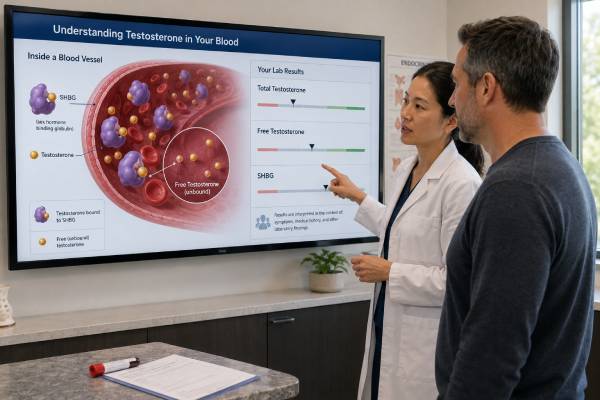
Most testosterone in blood travels attached to proteins. A large portion is bound tightly to SHBG, a smaller portion is loosely bound to albumin, and usually only about 1% to 3% circulates unbound. The unbound fraction is called free testosterone. Because it can move into tissues without first separating from a carrier protein, it is often described as the readily available fraction, although hormone delivery and action are more complicated than that simple model suggests.
A free testosterone result is not a separate hormone from total testosterone. Total testosterone includes the free, albumin-bound, and SHBG-bound portions. The two values can therefore move together, but they may diverge when SHBG changes. A man with high SHBG can have a total testosterone value that appears reassuring while his free testosterone is low. A man with low SHBG can have a low total value while free testosterone remains within the laboratory range.
Albumin-bound plus free testosterone is sometimes called bioavailable testosterone. A bioavailable testosterone test addresses a related question, but its value and laboratory method are not interchangeable with free testosterone. Clinicians should use the test named on the report and the reference interval validated for that method.
Free testosterone does not measure androgen sensitivity. A normal concentration cannot exclude androgen-receptor disorders, medication effects, depression, sleep problems, vascular disease, or other causes of sexual symptoms. Likewise, a low concentration does not prove that every symptom is caused by testosterone. The result has meaning only when combined with history, examination, repeat testing, and the wider hormone pattern.
When free testosterone testing helps
Free testosterone is usually a second-line or clarifying test rather than the first number ordered for every man. Total testosterone measured on two separate mornings remains the usual starting point when androgen deficiency is suspected. Free testosterone adds the most information when total testosterone is near the lower limit, when symptoms are convincing despite an apparently normal total result, or when a condition is likely to alter SHBG.
High SHBG may occur with aging, hyperthyroidism, some liver conditions, HIV, certain anticonvulsants, estrogen exposure, and marked weight loss. In that setting, total testosterone may be normal or high because more hormone is carried in the bound pool, while the free fraction is lower. Low SHBG is common with obesity, insulin resistance, type 2 diabetes, hypothyroidism, nephrotic syndrome, glucocorticoid exposure, and use of some androgens. It can lower total testosterone without reducing free testosterone to the same degree.
A separate SHBG test in men is therefore commonly ordered with total testosterone. Free testosterone may also be useful during evaluation of delayed or incomplete puberty, pituitary disease, infertility, unexplained osteoporosis, anemia, or treatment monitoring, although the exact panel depends on the clinical situation.
Testing should be symptom-led. Low energy by itself is nonspecific and can reflect sleep apnea, iron deficiency, mood disorders, medication effects, overtraining, chronic pain, or systemic disease. Sexual symptoms—especially reduced libido, fewer morning erections, and impaired erectile function—raise suspicion more than general fatigue, but they still have many possible causes. A clinician should not use free testosterone as a broad wellness screen or prescribe treatment solely to move a number toward the upper part of a range.
Test methods and preparation
The way free testosterone is obtained can substantially affect the result. Equilibrium dialysis separates unbound hormone across a membrane and is widely regarded as a reference method. Ultrafiltration is another physical separation approach. These methods are technically demanding and are not available in every laboratory.
Many laboratories instead report calculated free testosterone. The calculation uses measured total testosterone and SHBG, usually with albumin measured or assumed, and applies a binding equation. Common equations do not always give identical answers. Results may become less dependable when total testosterone or SHBG is extremely high or low, when albumin is abnormal, or when the underlying immunoassays are inaccurate. The report should identify whether the value was measured or calculated and, ideally, which equation was used.
Direct analog free testosterone immunoassays are convenient but generally do not accurately represent the true free fraction. A result from one method should not be compared casually with a reference range developed for another. Long-term monitoring is easier when the same laboratory and method are used.
For diagnosis, blood is commonly collected in the morning, often between 7 and 10 a.m., because testosterone has a daily rhythm and is usually highest after sleep. The rhythm is less pronounced in older men and can be shifted in night workers. For shift workers, sampling soon after the main sleep period may be more meaningful than a fixed clock time. Some guidelines favor fasting testing because food, particularly a glucose load, can temporarily lower testosterone. Follow the ordering clinician’s and laboratory’s instructions rather than changing medication or fasting without guidance.
Avoid testing during an acute infection, immediately after major surgery, during severe sleep deprivation, or soon after an unusually strenuous endurance event unless the clinical question is urgent. Record testosterone, anabolic steroids, opioids, glucocorticoids, antiandrogens, anticonvulsants, supplements, and biotin use. Do not stop a prescribed drug on your own. Men using testosterone therapy need sampling timed to the formulation and dosing schedule, because a trough after an injection and a level soon after application of a gel answer different questions.
Normal range and result interpretation
There is no single universal free testosterone normal range. Values vary with age, assay, calculation, units, population, and laboratory calibration. Reports may use picograms per milliliter, nanograms per deciliter, or picomoles per liter. A number copied from an online chart may not match the method used on the patient’s sample.
The laboratory interval is a starting point, not a treatment target. A value just below the lower limit has different weight from a repeatedly very low value accompanied by specific symptoms and a coherent LH/FSH pattern. Borderline results should be repeated, preferably under similar conditions. Total testosterone and SHBG should be reviewed at the same time.
| Pattern | Possible interpretation | Usual next step |
|---|---|---|
| Low total, normal free testosterone, low SHBG | Binding effect is possible; obesity or insulin resistance may contribute | Repeat testing, assess metabolic health and symptoms |
| Normal total, low free testosterone, high SHBG | Total testosterone may mask reduced available hormone | Confirm method and result; investigate causes of high SHBG |
| Low total and low free testosterone | Biochemical androgen deficiency is more likely | Repeat morning test; measure LH, FSH, prolactin as indicated |
| High total and high free testosterone | Exogenous androgen exposure or uncommon endogenous overproduction may be present | Review treatment, supplements, timing, and related laboratory findings |
| Discordant or implausible result | Assay interference, calculation limits, or sampling error may be involved | Repeat with a reliable method or specialist laboratory |
The clinical threshold used to diagnose hypogonadism may differ from the lower boundary printed by the laboratory. Guidelines emphasize symptoms plus consistently low testosterone rather than a free testosterone cutoff alone. An isolated low value after poor sleep, illness, or calorie restriction should not automatically lead to a lifelong diagnosis.
Men already receiving therapy require a different interpretation. The goal is generally symptom improvement and a safe concentration in the intended physiological range, not the highest possible free testosterone. Hematocrit, prostate-related assessment when appropriate, blood pressure, fertility plans, and adverse effects matter alongside the hormone value.
Causes of low free testosterone
Low free testosterone can result from reduced testosterone production, excessive SHBG binding, or both. The LH and FSH pattern helps identify where the problem may originate.
Primary hypogonadism begins in the testes. When Leydig-cell function falls, testosterone declines and the pituitary usually responds by producing more LH. FSH may also rise, particularly when sperm-producing tissue is affected. Causes include Klinefelter syndrome, prior testicular torsion, orchitis, chemotherapy, radiation, severe testicular injury, and some forms of testicular failure. A luteinizing hormone test in men helps distinguish this pattern from central suppression.
Secondary or central hypogonadism originates in the hypothalamus or pituitary. Testosterone is low while LH and FSH are low or inappropriately normal. Possible causes include pituitary tumors, high prolactin, iron overload, traumatic brain injury, congenital gonadotropin deficiency, severe obesity, uncontrolled systemic illness, undernutrition, excessive exercise, sleep disorders, and medicines such as long-term opioids or high-dose glucocorticoids.
Functional suppression may improve when the underlying condition is treated. Weight loss in a man with severe obesity, effective treatment of sleep apnea, improved diabetes control, recovery from illness, or adjustment of a suppressive medication can raise testosterone without direct hormone replacement. This is one reason to investigate the cause before treating the number.
High SHBG can specifically lower free testosterone relative to total testosterone. Hyperthyroidism, chronic liver disease, certain medicines, estrogen exposure, aging, and some chronic infections are examples. Conversely, albumin abnormalities or inaccurate input measurements can distort a calculated value.
Exogenous testosterone and anabolic-androgenic steroids create a special pattern. Blood levels can be high, normal, or low depending on the substance and timing, while LH and FSH are suppressed. After stopping, endogenous production may remain low for months and fertility can be impaired. The clinician needs an honest list of injections, gels, oral compounds, “prohormones,” and bodybuilding products to interpret the test safely.
High free testosterone results
A high free testosterone result is most often related to testosterone treatment, anabolic steroid use, dosing timing, or a low SHBG concentration rather than a hormone-producing tumor. The first step is to confirm the test, units, method, reference interval, and time since any medication was taken.
Men using injectable testosterone can have a peak shortly after dosing and a lower value before the next injection. A sample drawn at the wrong point in the cycle may make an otherwise stable regimen look excessive or inadequate. Skin contamination can falsely elevate testosterone when blood is drawn from an arm where gel was applied. Careful washing, use of a different site, and following the laboratory’s collection instructions reduce this risk.
Low SHBG can produce a free testosterone value that is relatively high even when total testosterone is not strikingly elevated. Obesity, insulin resistance, hypothyroidism, nephrotic syndrome, and androgen exposure can lower SHBG. The underlying condition and clinical effects should guide management.
Less commonly, endogenous androgen excess can arise from an adrenal or testicular tumor, congenital adrenal hyperplasia, or another steroid-production disorder. These possibilities are considered when testosterone is unexpectedly and repeatedly high without disclosed androgen use, particularly if DHEA-S, androstenedione, hCG, estradiol, or examination findings are abnormal. The workup should be directed by an endocrinologist or urologist rather than a broad unsupervised panel.
Excess androgen exposure can cause acne, oily skin, mood changes, worsening sleep apnea, reduced sperm production, testicular shrinkage, gynecomastia through aromatization, and an elevated hematocrit. A high free testosterone value is not evidence of superior health or performance. The safest response is to identify why it is high and whether the patient is experiencing treatment-related harm.
Symptoms and follow-up tests
Symptoms that more strongly support androgen deficiency include reduced sexual desire, fewer spontaneous or morning erections, erectile dysfunction, infertility, hot flushes in severe deficiency, loss of body hair, reduced shaving frequency, small or soft testes, gynecomastia, low-trauma fractures, and reduced bone density. Less specific findings include fatigue, low mood, poor concentration, reduced muscle performance, increased body fat, and sleep disturbance.
A clinician usually repeats total testosterone and either measures or calculates free testosterone under standardized conditions. SHBG and albumin clarify binding. LH and FSH separate primary from secondary patterns. Prolactin is useful when gonadotropins are low or normal, libido is reduced, infertility is present, or pituitary disease is suspected. The prolactin test in men may need a repeat sample because stress and some medicines can cause a temporary rise.
Other testing depends on the pattern. Thyroid tests, liver enzymes, iron studies, complete blood count, metabolic testing, pituitary hormones, semen analysis, or bone-density imaging may be appropriate. Pituitary MRI is not required for every low testosterone result, but it may be indicated with very low testosterone and low gonadotropins, persistently high prolactin, headaches, visual symptoms, or additional pituitary deficiencies.
Men trying to conceive need special attention. Testosterone treatment suppresses LH and FSH and can markedly reduce sperm production. A fertility-focused evaluation may include semen analysis, examination, FSH, LH, total testosterone, and selected markers rather than assuming low free testosterone should be treated with testosterone. A male fertility hormone panel complements but does not replace semen analysis.
Seek prompt medical assessment for a new testicular mass, severe headache with visual change, breast discharge, rapid breast enlargement, signs of a blood clot, chest pain, shortness of breath, or neurological symptoms. These findings are not explained safely by an online interpretation of free testosterone.
Treatment and monitoring
Treatment begins with the cause. Sleep, nutrition, resistance exercise, weight management, treatment of systemic disease, and review of suppressive medicines may improve functional low testosterone. These steps should be realistic and individualized; they are not a substitute for treating a pituitary tumor, genetic condition, or established testicular failure.
Testosterone therapy may be considered for men with persistent symptoms and consistently low testosterone after appropriate evaluation, provided benefits, risks, fertility goals, and contraindications are reviewed. A complete hypogonadism blood test panel helps establish the pattern before treatment. Therapy is generally inappropriate as a response to a single borderline result or as an anti-aging intervention in a man without confirmed deficiency.
Men who want near-term fertility should not start exogenous testosterone without specialist advice. Depending on the cause, treatments that stimulate endogenous gonadotropins or testosterone production may be considered, but they require medical supervision and are not interchangeable with routine testosterone replacement.
Monitoring differs by formulation and health history. It often includes symptoms, testosterone timed to the preparation, hematocrit, adverse effects, and prostate assessment appropriate to age and risk. Blood pressure, sleep apnea symptoms, edema, acne, mood changes, and fertility effects should be reviewed. Dose changes should not chase day-to-day fluctuations or an internet “optimal” range.
A well-performed free testosterone test is most valuable when it resolves a specific uncertainty: whether abnormal binding is hiding or exaggerating androgen deficiency. Used with total testosterone, SHBG, symptoms, and gonadotropins, it can sharpen diagnosis. Used alone, it can create false certainty and unnecessary treatment.
Common calculation and reporting problems
Calculated free testosterone may be reported automatically, but the result can be unreliable when SHBG is extremely high or low, albumin is abnormal, or total testosterone was measured by an assay with poor accuracy. Some reports assume a standard albumin concentration without stating it. Men with cirrhosis, nephrotic syndrome, severe malnutrition, or critical illness may need measured albumin or a reference free testosterone method.
Unit conversion is another source of error. Picograms per milliliter, nanograms per deciliter, and picomoles per liter cannot be compared by moving a decimal point intuitively. The same numeric value can mean something entirely different in another unit. Treatment should never be changed from a screenshot or online range without confirming the original report.
A calculated value is also equation-dependent. Two validated equations may differ, especially near extremes. Longitudinal monitoring is most meaningful when the same laboratory and method are used. If an unexpected value would trigger imaging or long-term testosterone therapy, confirmation with equilibrium dialysis or another high-quality method may be appropriate.
The purpose of resolving a borderline result is to improve diagnostic confidence, not to create a more sensitive number to optimize. A man with normal free testosterone and nonspecific symptoms still needs evaluation for sleep, mood, vascular, metabolic, and medication-related causes. A man with repeatedly low free testosterone and specific symptoms needs cause-focused testing before treatment.
Repeat testing should answer whether the abnormality is persistent. It should not become a series of daily checks in response to normal fluctuation. Changes in sleep, weight, thyroid status, liver function, medicines, and testosterone dosing can alter the result over time, so those changes should be documented whenever a trend is interpreted.
For men not receiving treatment, a confirmed low result has the most value when it leads to classification with LH and FSH and identification of a reversible or structural cause. For men receiving treatment, safety and symptom benefit matter more than achieving a particular percentile.
References
- Sexual and Reproductive Health 2026 (Clinical Guideline)
- The British Society for Sexual Medicine Guidelines on Male Adult Testosterone Deficiency, with Statements for Practice 2023 (Clinical Guideline)
- Male hypogonadism: recommendations from the Fifth International Consultation on Sexual Medicine 2025 (Consensus Recommendations)
- Testosterone Deficiency Guideline 2024 (Clinical Guideline)
- Associations of Testosterone and Related Hormones With All-Cause and Cardiovascular Mortality and Incident Cardiovascular Disease in Men 2024 (Systematic Review and Meta-analysis)
Disclaimer
This information is for education and does not replace individual medical care. Free testosterone results must be interpreted using the laboratory method, reference interval, symptoms, medications, and related hormone tests. Do not start, stop, or change testosterone or another prescription medicine without a qualified clinician.