A prolactin test in men measures a pituitary hormone that can affect sexual function, testosterone production, fertility, and breast symptoms when it is persistently elevated. High prolactin can suppress hypothalamic signaling, reduce LH and FSH, and produce a pattern of low testosterone with low or inappropriately normal gonadotropins. Common causes include medicines that block dopamine, hypothyroidism, kidney disease, stress during blood collection, macroprolactin, and prolactin-secreting pituitary adenomas. A single mild elevation is often repeated because sleep, exercise, sex, meals, chest-wall stimulation, and venipuncture stress can temporarily raise the result. The degree of elevation, symptoms, medication list, assay method, and related hormones determine whether pituitary imaging is needed. Low prolactin is less commonly a clinical problem but may occur with pituitary damage or dopamine-enhancing treatment. Men with severe headache, visual changes, neurological symptoms, or a very high confirmed result need timely assessment. Treating the cause can restore testosterone and fertility in some men without direct testosterone replacement.
- Mild high prolactin often needs a calm repeat sample before pituitary imaging is considered.
- Persistent high prolactin can lower LH, FSH, testosterone, libido, erections, and sperm production.
- Antipsychotics, metoclopramide, some antidepressants, opioids, verapamil, and other medicines may raise prolactin.
- Macroprolactin can produce a high laboratory result with fewer biological effects and may be checked in selected cases.
- Severe headache, loss of peripheral vision, double vision, or neurological symptoms with high prolactin requires prompt care.
Table of Contents
- What prolactin does in men
- When a prolactin test is used
- Preparation and repeat testing
- Normal range and result interpretation
- Causes of high prolactin
- Low prolactin results
- Pituitary imaging and other tests
- Treatment, fertility, and follow-up
What prolactin does in men
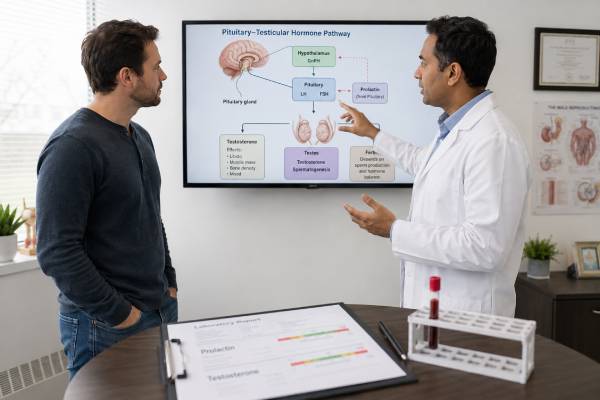
Prolactin is made by lactotroph cells in the anterior pituitary. Dopamine released by the hypothalamus normally restrains prolactin secretion. Anything that blocks dopamine action, interrupts delivery of dopamine to the pituitary, or stimulates lactotroph cells can raise the blood concentration.
Prolactin is best known for supporting lactation, but it also interacts with reproductive and metabolic physiology in men. Normal prolactin may support aspects of sexual and reproductive function, while sustained excess can inhibit pulsatile gonadotropin-releasing hormone. LH and FSH then fall or fail to rise appropriately, testosterone decreases, and spermatogenesis may be impaired.
The endocrine pattern is usually central: low testosterone with low or normal LH. This differs from primary testicular failure, where LH is typically high. A luteinizing hormone test in men helps identify that distinction.
High prolactin can contribute to reduced libido, erectile dysfunction, infertility, fewer spontaneous erections, loss of body hair, low bone density, and occasionally breast discharge or gynecomastia. Symptoms depend on both hormone suppression and the size of any pituitary mass. A large adenoma can cause headache, visual-field loss, double vision, or other pituitary deficiencies.
Prolactin is secreted in pulses and changes with sleep and stress. A laboratory value is therefore not a fixed personality or performance marker. It must be interpreted by degree, persistence, symptoms, and cause.
When a prolactin test is used
Prolactin is commonly measured when testosterone is low and LH or FSH is low or inappropriately normal. It may be included in evaluation of reduced libido, erectile dysfunction, infertility, delayed puberty, gynecomastia, galactorrhea, headaches, visual symptoms, or suspected pituitary disease.
The test is especially useful when a medicine known to affect dopamine has been started or increased. It may establish a baseline before treatment, document a suspected adverse effect, or monitor management. Medication-associated hyperprolactinemia can cause significant sexual and bone-health consequences, but treatment changes must be coordinated with the prescribing clinician.
In infertility, prolactin is not required for every man with normal testosterone and no sexual symptoms. It becomes more relevant when testosterone is low, libido or erections are affected, gonadotropins suggest central suppression, or there are pituitary features. A male fertility hormone panel combines it with semen analysis and other hormones rather than using prolactin alone.
A pituitary incidentaloma often prompts prolactin measurement because even a modestly sized prolactinoma may be treated medically, while a non-prolactin-secreting mass can raise prolactin by compressing the pituitary stalk and reducing dopamine delivery. The magnitude of elevation helps distinguish these possibilities, but assay issues and tumor size must be considered.
Prolactin is not a routine test for nonspecific fatigue in an otherwise healthy man. Nor should it be used to diagnose stress, depression, or sexual dysfunction without broader evaluation. The value of the test comes from a plausible pituitary, medication, reproductive, or breast-related question.
Preparation and repeat testing
A prolactin test uses a blood sample. Laboratories vary in fasting requirements, and the ordering clinician may pair it with morning testosterone. Because prolactin rises during sleep, a sample collected soon after waking can differ from one taken later. Many clinicians favor collection at least a short time after waking and after the patient has rested quietly.
Avoid strenuous exercise, significant chest or nipple stimulation, and sexual activity before the sample when the laboratory or clinician advises, because these can transiently raise prolactin. Stress from travel, needles, pain, or a difficult blood draw may also increase it. A calm rest of 20 to 30 minutes before repeat sampling can help when the first elevation is mild.
Do not stop a medicine to “clean up” the result. Bring the complete list, including antipsychotics, antidepressants, anti-nausea drugs, opioids, blood-pressure medicines, hormones, supplements, and recreational substances. Abrupt withdrawal from psychiatric medicine or opioids can be dangerous.
Mild elevations are commonly repeated. The repeat may be fasting and performed in the morning under standardized conditions. Some centers use serial samples through an indwelling catheter when venipuncture stress is strongly suspected, though this is not necessary for most people.
Macroprolactin is a large complex of prolactin, often bound to an antibody, that may be detected by the assay but have lower biological activity. Laboratories can use polyethylene glycol precipitation or another method to estimate monomeric prolactin. Testing is useful when the level is elevated but symptoms and related hormones are not consistent with active hyperprolactinemia.
The “hook effect” is an important assay issue with a very large pituitary tumor. Extremely high prolactin can overwhelm some immunoassays and produce a falsely modest result. Diluting the sample reveals the true concentration. Clinicians consider this when imaging shows a large mass but prolactin is only mildly elevated.
Normal range and result interpretation
Prolactin reference intervals vary by laboratory, assay, units, and sex. Results may be reported in nanograms per milliliter or milli-international units per liter. Conversion errors are common, so interpretation should use the units and range on the report.
The degree of elevation matters, but no single cutoff identifies every cause. A small rise may reflect stress, a medicine, hypothyroidism, kidney disease, or macroprolactin. A more substantial persistent elevation makes a prolactinoma more likely, while a non-prolactin pituitary mass usually produces a more modest stalk-effect elevation. Exceptions occur, and assay interference can blur these distinctions.
| Result pattern | Possible interpretation | Usual follow-up |
|---|---|---|
| Mild isolated elevation, no symptoms | Stress, sleep, exercise, macroprolactin, or medicine effect | Repeat under standardized conditions; review medicines; consider macroprolactin |
| Persistent elevation with low testosterone and low/normal LH | Biologically active hyperprolactinemia suppressing the gonadal axis | TSH, kidney function, medicine review, pituitary assessment |
| Marked elevation with headache or visual symptoms | Prolactinoma or another significant pituitary process | Prompt endocrine review and pituitary MRI |
| Large pituitary mass with only modest prolactin | Stalk effect or assay hook effect | Request diluted assay and complete pituitary evaluation |
| High total prolactin but normal monomeric prolactin | Macroprolactinemia | Interpret with symptoms; treatment may not be required |
| Low prolactin with other pituitary deficits | Pituitary damage or broad hypopituitarism | Assess additional pituitary hormones and structural cause |
A single value should not be used to estimate tumor size. Small prolactinomas can produce high concentrations, and large nonfunctioning tumors may cause only a moderate rise. Imaging and the full pituitary panel resolve the difference.
Testosterone suppression may be significant even when breast discharge is absent. Men often present later than women because there is no menstrual change to reveal the problem. Sexual symptoms, infertility, and visual complaints deserve careful review.
Causes of high prolactin
Medicines are a common cause. Dopamine D2 receptor antagonists—particularly many antipsychotics and anti-nausea medicines such as metoclopramide—remove dopamine’s inhibitory effect. Some antidepressants, opioids, verapamil, methyldopa, and other drugs can also raise prolactin. The likelihood and magnitude vary among agents and individuals.
A prolactinoma is a benign pituitary adenoma that secretes prolactin. Microadenomas are smaller, while macroadenomas are larger and more likely to cause mass effects. In men, delayed recognition can allow a tumor to grow before diagnosis. Most prolactinomas respond well to dopamine agonist treatment.
A nonfunctioning pituitary tumor or another sellar mass can compress the pituitary stalk. This reduces dopamine delivery and causes a stalk-effect elevation. The prolactin concentration is often lower than with a large true prolactinoma, but overlap occurs.
Primary hypothyroidism can raise thyrotropin-releasing hormone and increase prolactin. Correcting thyroid hormone deficiency may normalize the result. Chronic kidney disease reduces prolactin clearance and alters regulation. Liver disease, chest-wall injury, seizures, and severe physiological stress are additional causes.
Macroprolactin explains some asymptomatic laboratory elevations. It is not a tumor and does not always require treatment, although a person can have both macroprolactin and elevated active monomeric prolactin.
Sex, nipple stimulation, exercise, sleep, and stress cause transient physiological elevations. These are usually modest and resolve. A repeat sample distinguishes a temporary response from persistent disease.
Rare causes include ectopic prolactin secretion and inherited disorders. Assay interference by heterophile antibodies can also create a false result. When symptoms, imaging, and laboratory values conflict, communication with the laboratory is important.
Low prolactin results
Low prolactin receives less attention because there is no widely accepted syndrome defined by one low value in men. It may occur with dopamine agonists, medications that increase dopamine activity, pituitary surgery or radiation, traumatic pituitary injury, or broader hypopituitarism.
An isolated mildly low result without symptoms and with normal other pituitary hormones often has limited clinical significance. Reference intervals are assay-specific, and prolactin varies. The result should not be treated simply to raise it into an “optimal” range.
Very low prolactin accompanied by low LH, FSH, testosterone, thyroid hormone, cortisol, or growth-related markers raises concern for pituitary damage. The priority is identifying clinically dangerous hormone deficiencies, especially adrenal insufficiency, rather than treating prolactin itself.
Some research has associated low prolactin with sexual, metabolic, or psychological outcomes, but observational associations do not establish that increasing prolactin improves health. Dopamine agonist dosing for a prolactinoma is adjusted according to tumor control, prolactin normalization, symptoms, and adverse effects—not to avoid every value near the low end.
Men taking cabergoline or bromocriptine should report dizziness, nausea, faintness, impulse-control changes, mood or behavioral changes, and other adverse effects. Doses should not be changed without the treating clinician. In selected long-term high-dose settings, cardiac valve monitoring may be considered.
Low prolactin is therefore interpreted in the context of treatment and pituitary function. It rarely explains infertility or low testosterone by itself, because excess rather than deficiency is the established suppressive problem.
Pituitary imaging and other tests
Pituitary MRI with a dedicated sellar protocol is the preferred imaging test when persistent hyperprolactinemia is unexplained or when neurological symptoms suggest a mass. Imaging is usually performed after pregnancy is excluded where relevant, medicines and physiological causes are reviewed, hypothyroidism and kidney disease are assessed, and the result is confirmed when appropriate.
A very high confirmed prolactin level, visual-field symptoms, severe or progressive headache, cranial nerve symptoms, or evidence of multiple pituitary deficits supports urgent specialist evaluation. Formal visual-field testing is used when a mass approaches or compresses the optic chiasm.
Laboratory follow-up often includes morning testosterone, LH, FSH, thyroid-stimulating hormone and free thyroxine, creatinine, and other pituitary hormones. Cortisol assessment is particularly important when a pituitary mass or hypopituitarism is possible. A hypogonadism blood test panel shows whether the gonadal axis is suppressed.
If testosterone is low, SHBG or free testosterone may clarify binding effects. Semen analysis is needed when fertility is a concern. Bone-density assessment may be appropriate after long-standing hypogonadism, fractures, or other osteoporosis risks.
MRI findings must match the hormone pattern. Small incidental pituitary lesions are common, and not every lesion explains a mild prolactin elevation. Conversely, a large mass with a surprisingly low prolactin requires consideration of the hook effect and sample dilution.
Urgent emergency assessment is appropriate for sudden severe headache, visual loss, double vision, vomiting, confusion, weakness, or collapse, which can indicate pituitary apoplexy or another neurological emergency. Routine follow-up is not suitable for those symptoms.
Treatment, fertility, and follow-up
Treatment targets the cause. Hypothyroidism is treated with thyroid hormone, kidney disease managed appropriately, and contributing medicines reviewed with the prescriber. When an antipsychotic is essential, options may include dose adjustment, switching to a prolactin-sparing agent, or specialist addition of another treatment, but psychiatric stability comes first.
Dopamine agonists are first-line treatment for most prolactinomas. Cabergoline is often favored because it is effective and generally well tolerated, while bromocriptine remains useful in selected situations. These medicines can lower prolactin, shrink the tumor, improve testosterone, restore sexual function, and allow sperm production to recover.
Surgery is considered when medication is ineffective or not tolerated, when there is acute compression requiring intervention, or in selected patient-preference and tumor circumstances. Radiation is rarely needed. Follow-up includes prolactin measurements, symptoms, testosterone recovery, visual assessment, and repeat MRI at intervals based on tumor size and response.
Testosterone should not automatically be started before treating the prolactin cause. Gonadal function may recover after prolactin normalizes. If hypogonadism persists, treatment can be considered with attention to tumor control and fertility. Exogenous testosterone suppresses sperm production, so men seeking conception need reproductive endocrine or urology input.
Fertility can improve substantially after successful treatment, but recovery is not immediate and other male or female factors may coexist. Semen analysis documents response directly. Gonadotropin treatment may be considered if central hypogonadism persists and pregnancy is desired.
Monitoring should also address bone health after prolonged testosterone deficiency. Adequate calcium and vitamin D, weight-bearing activity, smoking cessation, and osteoporosis treatment when indicated complement endocrine care.
A prolactin result is most useful when it is confirmed, placed in the medication and pituitary context, and linked to the degree of reproductive suppression. This avoids unnecessary MRI for a stress-related rise while ensuring that significant pituitary disease is not missed.
Medication-associated hyperprolactinemia
When a medicine is the likely cause, the decision is not simply whether prolactin is high. The clinician weighs the degree of elevation, sexual and reproductive symptoms, bone risk, psychiatric or gastrointestinal benefit, and available alternatives. A stable antipsychotic regimen may be essential, and abrupt discontinuation can cause severe relapse.
Options can include repeating the test, reducing the dose, switching to a prolactin-sparing medicine, or adding a carefully selected agent under psychiatric and endocrine supervision. Dopamine agonists can worsen or destabilize some psychiatric conditions and are not routine self-treatment for a medication-related elevation. Shared care between the prescriber and endocrinologist is often the safest approach.
Men with long-standing suppression may need testosterone, semen, and bone assessment even when the prolactin elevation is modest. The absence of galactorrhea does not mean the result is harmless. Sexual symptoms may be the first sign, while reduced bone density develops silently.
Monitoring a prolactinoma over time
After a dopamine agonist is started, prolactin often falls before all symptoms recover. Testosterone may take time to normalize, and semen recovery can take longer. Tumor shrinkage is assessed by MRI at an interval based on initial size, proximity to the optic pathways, prolactin response, and symptoms. Visual fields are repeated when the optic chiasm was threatened.
Adherence and dose timing should be reviewed before labeling treatment resistant. Rarely, a tumor responds incompletely and requires dose escalation, surgery, or another strategy. A sudden severe headache or visual change during follow-up requires urgent evaluation for apoplexy or mass effect rather than waiting for the next routine prolactin level.
In selected patients with prolonged normal prolactin and major tumor shrinkage, a supervised attempt to reduce or stop medication may be considered. Recurrence is possible, so follow-up testing continues. The decision depends on tumor characteristics, treatment duration, residual lesion, dose, and patient preference.
Fertility and testosterone recovery
Treating hyperprolactinemia can restore endogenous gonadotropin signaling, which is preferable to immediate testosterone replacement when fertility is desired. Semen analysis should be repeated when conception is the goal because normalization of serum testosterone does not guarantee complete sperm recovery.
If testosterone remains low after prolactin control, the clinician reassesses pituitary damage, tumor mass effect, age, obesity, medications, and other causes. Gonadotropin therapy may be considered for persistent central infertility. Exogenous testosterone can improve symptoms but suppresses sperm and may obscure recovery of the axis.
Bone health deserves attention during recovery. Men with long-standing low testosterone, fractures, or other risks may need bone-density scanning and treatment. Restoration of prolactin and testosterone reduces one driver of bone loss, but existing osteoporosis may require additional therapy.
Prolactin results should be interpreted with the laboratory’s upper limit rather than a universal number. The same concentration can be reported in different units, and conversion errors can exaggerate or minimize the apparent elevation. A trend is most reliable when the same assay is used.
Breast discharge in a man is uncommon and warrants direct evaluation even when prolactin is only mildly elevated. A hard breast mass, bloody discharge, skin change, or enlarged nodes requires breast assessment because prolactin testing cannot exclude malignancy.
For men without a tumor who have a temporary stress-related rise, reassurance after a normal repeat can prevent unnecessary imaging. The test is most effective when both serious and benign explanations are considered in proportion to the result.
A confirmed cause, rather than the prolactin number alone, determines whether observation, a medicine change, dopamine-agonist therapy, surgery, or broader pituitary replacement is appropriate.
Regular follow-up should have a defined purpose: confirming biochemical control, monitoring tumor effects, documenting reproductive recovery, or checking treatment safety.
References
- Diagnosis and management of prolactin-secreting pituitary adenomas: a Pituitary Society international Consensus Statement 2023 (Consensus Statement)
- Prolactinoma Management 2025 (Clinical Review)
- Hyperprolactinemia 2023 (Clinical Review)
- Prolactinoma 2023 (Clinical Review)
- Prolactin Relationship with Fertility and In Vitro Fertilization Outcomes—A Review of the Literature 2023 (Review)
Disclaimer
This information is educational and does not diagnose a pituitary tumor or determine treatment. Prolactin must be interpreted with symptoms, medicines, repeat testing, related hormones, and imaging when indicated. Seek urgent care for severe sudden headache, visual loss, double vision, confusion, or neurological symptoms.