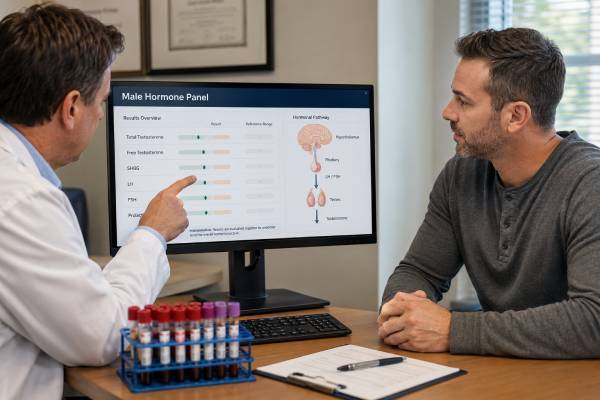
A male hormone test panel combines total testosterone, free testosterone, SHBG, LH, FSH, and prolactin to evaluate androgen status and the pituitary–testicular axis. It can help investigate low libido, erectile symptoms, infertility, delayed or incomplete puberty, gynecomastia, low bone density, or suspected pituitary or testicular disease. The tests are most useful as a pattern, not as separate wellness scores. Low testosterone with high LH suggests primary testicular dysfunction, while low testosterone with low or inappropriately normal LH suggests central or functional suppression. SHBG explains why total and free testosterone may disagree, FSH adds information about sperm-producing tissue, and prolactin can reveal a suppressive medication effect or pituitary disorder. A single low morning testosterone result does not establish hypogonadism. Results should be confirmed when appropriate and interpreted with symptoms, collection timing, illness, sleep, medicines, anabolic steroid exposure, and fertility goals. The panel does not replace semen analysis, examination, thyroid or metabolic evaluation, or targeted imaging when clinical findings point elsewhere.
- Total testosterone is usually the starting test; free testosterone is most helpful when SHBG is abnormal or the total result is borderline.
- LH and FSH show whether the pituitary response is appropriate and whether testicular compartments may be affected.
- Prolactin is especially useful with low testosterone plus low or normal LH, sexual symptoms, infertility, headaches, or visual changes.
- Morning repeat testing is often needed because testosterone varies with sleep, illness, meals, and day-to-day biology.
- Men planning fertility should disclose testosterone or anabolic steroid use because both can suppress LH, FSH, and sperm production.
Table of Contents
- What the panel evaluates
- When a male hormone panel is useful
- Tests in the panel
- Preparation and testing methods
- Common result patterns
- Causes of abnormal results
- Follow-up testing and referral
- Treatment, fertility, and monitoring
What the panel evaluates
The male reproductive hormone system begins in the hypothalamus, which releases gonadotropin-releasing hormone in pulses. The pituitary responds by releasing LH and FSH. LH stimulates Leydig cells in the testes to produce testosterone. FSH works with high intratesticular testosterone to support Sertoli cells and sperm development. Testosterone, estradiol, and inhibin B provide feedback to the brain and pituitary.
The panel samples several points in this pathway. Total and free testosterone assess circulating androgen concentration. SHBG shows how much testosterone may be tightly bound. LH and FSH reveal the strength of pituitary signaling. Prolactin can identify a suppressive influence on hypothalamic and pituitary function.
This combination helps localize a problem. A low testosterone value alone cannot show whether the testes are failing, the pituitary is not sending enough signal, SHBG is making the total value misleading, or temporary illness is suppressing the system. The additional markers narrow those possibilities.
The panel has limits. It does not measure androgen-receptor sensitivity, sperm count, semen quality, erectile blood flow, thyroid function, adrenal steroids, liver function, or metabolic health. It cannot explain every symptom and should not be ordered as a substitute for history and examination.
The phrase “male hormone panel” is not standardized. Laboratories may bundle different tests. Some include estradiol or DHEA-S and omit FSH or prolactin. The ordering clinician should define the clinical question and confirm which analytes are included rather than assuming every commercial package is equivalent.
When a male hormone panel is useful
The panel is useful when symptoms and risk factors make an endocrine cause plausible. More specific signs of androgen deficiency include reduced libido, fewer spontaneous erections, infertility, hot flushes, loss of body hair, small or soft testes, gynecomastia, low-trauma fracture, low bone density, delayed puberty, and unexplained anemia. Fatigue, low mood, poor concentration, and reduced exercise performance are less specific and require a broader assessment.
It may be ordered after a low total testosterone result to classify the cause. It is also useful when total testosterone is borderline and SHBG may be abnormal, when semen analysis shows a low sperm concentration, or when pituitary disease is suspected.
Risk factors include severe obesity, type 2 diabetes, sleep apnea, chronic opioid or glucocorticoid use, anabolic steroid exposure, chemotherapy, testicular radiation, torsion, orchitis, pituitary surgery or radiation, traumatic brain injury, iron overload, HIV, and genetic conditions such as Klinefelter syndrome.
Routine testing of every asymptomatic adult is not generally recommended. Commercial screening can identify borderline values that fluctuate naturally and lead to unnecessary treatment. The panel should not be used to pursue a maximized testosterone target in a man without symptoms or confirmed deficiency.
Infertility creates a distinct indication. Hormones help identify endocrine and testicular patterns, but a semen analysis remains essential. Normal hormones cannot guarantee normal sperm, and abnormal hormones do not determine that pregnancy is impossible. The male fertility hormone panel places greater emphasis on semen findings and may include inhibin B.
Children and adolescents need pediatric interpretation. Puberty changes LH, FSH, testosterone, SHBG, and inhibin markers substantially. Adult reference ranges should not be applied to delayed puberty or differences of sex development.
Tests in the panel
Total testosterone
Total testosterone includes free hormone plus testosterone bound to albumin and SHBG. It is the usual first test for suspected androgen deficiency. Low values should generally be repeated in the morning. The result is interpreted with symptoms and the laboratory method, not as a stand-alone age or performance score.
Free testosterone
Free testosterone is the small unbound fraction. It is useful when total testosterone is near a decision threshold or SHBG is unusually high or low. Equilibrium dialysis is a reference method, while calculated free testosterone uses total testosterone, SHBG, and albumin. A free testosterone test is only as reliable as its method and input measurements.
SHBG
SHBG is a liver-produced carrier protein. High SHBG can make total testosterone look normal or high while free testosterone is lower. Low SHBG can make total testosterone look low while free testosterone is less affected. Obesity, insulin resistance, thyroid disease, liver disease, aging, and medicines can change SHBG.
LH
LH stimulates Leydig-cell testosterone production. High LH with low testosterone suggests primary testicular failure. Low or normal LH with low testosterone suggests central or functional suppression. A numerically normal LH may be physiologically inadequate when testosterone is very low.
FSH
FSH supports Sertoli cells and spermatogenesis. High FSH often indicates seminiferous tubule damage, especially with small testes or low sperm concentration. Normal FSH does not prove normal fertility or exclude focal sperm-production defects.
Prolactin
Persistent high prolactin can suppress gonadotropin-releasing hormone and lower LH, testosterone, libido, and fertility. Stress, medicines, hypothyroidism, kidney disease, macroprolactin, and pituitary adenomas can cause an elevation. Mild unexpected results are often repeated.
Each test answers a different part of the pathway. Their combined interpretation is more valuable than labeling each as optimal or suboptimal.
Preparation and testing methods
Untreated men are generally tested in the early morning, often between 7 and 10 a.m., because testosterone follows a sleep-related daily rhythm. Shift workers should discuss collection relative to their principal sleep period. Many guidelines favor fasting samples for diagnostic consistency, although laboratories differ.
Adequate sleep matters. A sample after an all-night shift, severe sleep deprivation, acute illness, surgery, or major endurance effort may not reflect the usual state. Severe calorie restriction and undernutrition can suppress the axis. If the clinical situation is not urgent, repeating testing after recovery may prevent a false diagnosis.
Tell the clinician about all medicines and substances, including testosterone, anabolic steroids, hCG, fertility drugs, opioids, glucocorticoids, antiandrogens, anticonvulsants, antipsychotics, supplements, and biotin. Do not stop a prescription without guidance. The exact date and time of hormone dosing are essential.
Total testosterone should be measured with a reliable, quality-controlled assay. Liquid chromatography–tandem mass spectrometry is often favored for accuracy, especially at low concentrations, although high-quality immunoassays may be used. Free testosterone methods are not interchangeable. Direct analog assays are generally less reliable than equilibrium dialysis or validated calculation.
Prolactin can rise with stress, exercise, sleep, sexual activity, and difficult venipuncture. A mildly high value may be repeated after a calm rest period. Macroprolactin testing can determine whether much of the measured hormone is a large, less biologically active form.
Long-term comparison is easiest with the same laboratory and similar timing. Results copied between laboratories should not be compared without checking units and reference intervals. Men on testosterone therapy require formulation-specific timing rather than routine morning testing.
Common result patterns
The panel becomes useful when results are grouped physiologically.
| Pattern | Possible meaning | Usual next step |
|---|---|---|
| Low total and free testosterone, high LH; FSH may be high | Primary testicular dysfunction | Repeat testosterone, examine testes, assess fertility and specific causes |
| Low testosterone, low or normal LH/FSH | Central or functional hypogonadism | Prolactin, medicine and illness review, pituitary assessment when indicated |
| Low total testosterone, normal free testosterone, low SHBG | Binding-related low total value | Assess obesity, insulin resistance, thyroid and other causes; repeat if needed |
| Normal total testosterone, low free testosterone, high SHBG | Binding may conceal androgen deficiency | Confirm method and investigate causes of high SHBG |
| High prolactin, low testosterone, low/normal LH | Hyperprolactinemic suppression | Repeat prolactin, TSH, medication review, macroprolactin or MRI as indicated |
| Suppressed LH/FSH with normal or high testosterone | Exogenous testosterone, anabolic steroid, or hCG effect | Review exposure and fertility goals; monitor treatment safety |
| High FSH with normal testosterone and LH | Predominant spermatogenic damage | Semen analysis, examination, genetic evaluation when severe |
A single borderline pattern should not be overread. Testosterone varies from day to day, LH is pulsatile, and prolactin is stress-responsive. Repeat testing may be more informative than immediately expanding to imaging.
The term “normal” must be used carefully. A normal-range LH may be inappropriately low when testosterone is profoundly reduced. A total testosterone inside its interval may not be adequate when SHBG is very high and free testosterone is low. Conversely, a low total result in severe obesity may largely reflect low SHBG.
Results during treatment have different meanings. Suppressed LH and FSH are expected with exogenous testosterone. The goal is not to normalize gonadotropins while continuing a suppressive drug. Monitoring focuses on dose timing, symptoms, hematocrit, adverse effects, and fertility consequences.
Causes of abnormal results
Primary testicular causes include Klinefelter syndrome, prior cryptorchidism, torsion, orchitis, trauma, chemotherapy, radiation, testicular surgery, and some genetic or autoimmune conditions. Testosterone may fall, LH rise, and FSH rise more sharply when sperm-producing tissue is damaged.
Central causes include pituitary tumors, high prolactin, pituitary surgery or radiation, traumatic brain injury, infiltrative disease, hemochromatosis, congenital gonadotropin deficiency, and hypothalamic disorders. Other pituitary hormones may also be abnormal, and symptoms can include headaches, visual change, loss of body hair, or low blood pressure.
Functional suppression can occur with severe obesity, uncontrolled diabetes, sleep apnea, systemic illness, undernutrition, extreme exercise, chronic stress, opioids, and glucocorticoids. These conditions may lower testosterone and gonadotropin drive without permanent structural failure. Treating the cause can improve the panel.
SHBG changes create discordance. Low SHBG is associated with obesity, insulin resistance, hypothyroidism, nephrotic syndrome, glucocorticoids, and androgen exposure. High SHBG can occur with aging, hyperthyroidism, liver disease, HIV, estrogen exposure, and some anticonvulsants. A SHBG test in men is an interpretive tool, not a disease diagnosis by itself.
Prolactin can be raised by antipsychotics, metoclopramide, some antidepressants and opioids, hypothyroidism, kidney disease, pregnancy-related states not applicable to typical male physiology, chest-wall stimulation, stress, and pituitary adenomas. Assay macroprolactin can cause a high laboratory value with fewer biological effects.
Anabolic steroids and nonprescribed testosterone may produce high, normal, or low measured testosterone depending on the compound and timing while suppressing LH and FSH. Products marketed as prohormones or boosters can contain undeclared active agents. Recovery after cessation may be prolonged.
Follow-up testing and referral
A low testosterone result is usually repeated. SHBG and albumin help calculate free testosterone. Thyroid-stimulating hormone and free thyroxine evaluate thyroid effects on symptoms and binding. A complete blood count can identify anemia before treatment and an elevated hematocrit that changes safety.
Liver and kidney tests help explain SHBG and prolactin abnormalities. Iron studies detect hemochromatosis. Hemoglobin A1c, lipids, blood pressure, and sleep-apnea assessment may identify metabolic contributors that require treatment independently of testosterone.
Semen analysis is required when fertility is a concern. FSH and hormones cannot measure sperm concentration or motility. Severe oligospermia or azoospermia may require karyotype, Y-chromosome microdeletion testing, CFTR testing, and reproductive urology referral.
Pituitary MRI is considered when prolactin remains high, testosterone is very low with low gonadotropins, headaches or visual symptoms are present, or other pituitary hormones are deficient. A mildly high prolactin caused by a medicine or stressful draw may be repeated before imaging. The prolactin test in men should be interpreted by degree and context.
Testicular ultrasound is used for a mass, pain, significant asymmetry, difficult examination, abnormal hCG, or another targeted structural question. It is not a routine response to every low testosterone value.
Endocrinology referral is helpful for pituitary disease, complex assay discordance, congenital disorders, or uncertain central hypogonadism. Reproductive urology is appropriate for infertility, azoospermia, a testicular lesion, varicocele, or fertility-preserving treatment. Emergency evaluation is needed for acute testicular pain, severe headache with visual loss, or neurological symptoms.
Treatment, fertility, and monitoring
Treatment starts with the identified cause. Weight reduction, sleep-apnea treatment, adequate nutrition, recovery from illness, improved diabetes control, and review of suppressive medicines may restore functional hormone suppression. Pituitary tumors, thyroid disease, iron overload, and testicular disorders require specific management.
Testosterone therapy may be considered when compatible symptoms and consistently low testosterone confirm deficiency and contraindications have been assessed. It is not a treatment for an isolated low LH, low SHBG, or nonspecific fatigue with normal testosterone. A hypogonadism blood test panel should ideally be documented before treatment.
Exogenous testosterone suppresses LH and FSH and can markedly reduce sperm production. Men who want children now or later should discuss fertility preservation and alternative treatments before starting. Depending on the cause, hCG, FSH, or selected off-label medicines may stimulate endogenous production under specialist supervision.
Monitoring testosterone therapy includes symptoms, a formulation-timed testosterone level, hematocrit, adverse effects, and age- and risk-appropriate prostate assessment. Blood pressure, sleep apnea, edema, acne, breast tenderness, mood, and fertility effects should also be reviewed. The goal is a safe physiological level and meaningful benefit, not the highest free testosterone possible.
A broad male hormone panel is most useful when it leads to a narrower explanation. It should identify whether further attention belongs on the testes, pituitary, protein binding, fertility, medicines, or a reversible health condition. Repeating sound measurements and treating the cause is more valuable than chasing every isolated flag.
Choosing a focused panel instead of repeating every marker
The first set of results should narrow the next question. If testosterone is low and LH is high, repeated prolactin testing is unlikely to explain primary testicular failure. If prolactin is persistently elevated with low gonadotropins, pituitary and medication evaluation becomes more important than adding adrenal androgens. If total and free testosterone disagree, confirming SHBG, albumin, and assay quality is more useful than ordering an unrelated broad panel.
This staged approach reduces false positives. Every laboratory test has biological and analytical variation, and a larger panel creates more chances for a value to fall just outside its reference interval in a healthy person. Mild isolated flags should be confirmed and connected to physiology before imaging or treatment.
The panel can also be incomplete for the clinical problem. Erectile dysfunction may require cardiovascular risk assessment. Fatigue may need blood count, thyroid, sleep, mood, and medication review. Gynecomastia may require hCG, estradiol, breast examination, or testicular ultrasound. Infertility requires semen analysis and sometimes genetics. The correct next test is the one that addresses the unresolved mechanism.
Interpreting changes after a health intervention
Weight loss, improved sleep, treatment of sleep apnea, recovery from illness, or adjustment of a suppressive medicine can change several values at once. SHBG may rise with improved insulin sensitivity, increasing total testosterone even if production changes less dramatically. Free testosterone, symptoms, and LH provide context for whether gonadal function truly improved.
After treatment of high prolactin, LH and testosterone may recover over time. After stopping anabolic steroids, gonadotropins may recover before semen parameters. After primary testicular injury, LH may remain high even if testosterone is supported with replacement. Trends should be interpreted according to the expected mechanism, not judged by whether all numbers return to the middle of their ranges.
Testing intervals should match the intervention. Hormones repeated a few days after a lifestyle change are unlikely to provide meaningful evidence. Formulation-specific timing is necessary during testosterone treatment, and reproductive recovery is assessed over months with semen analysis.
Communicating uncertainty and avoiding numerical targets
Reference intervals overlap between symptomatic and asymptomatic men. A panel can strengthen or weaken a diagnosis, but it rarely explains every symptom with certainty. Clinicians should state what the pattern supports, what it does not show, and what finding would change the plan.
Terms such as “optimal,” “balanced,” or “male hormone age” can imply precision that the tests do not provide. Treatment aims should be clinical: restore deficient hormone safely, treat the cause, preserve fertility when desired, and improve symptoms that are plausibly hormone-related. A number near the top of a range is not inherently healthier than one in the middle.
Clear communication is particularly important when results are borderline. Options may include repeating the test under better conditions, addressing reversible factors, using a more accurate assay, or monitoring without treatment. This prevents a temporary fluctuation from becoming a permanent diagnosis.
Men should avoid changing supplements or hormone doses between an abnormal result and medical review unless safety requires it. Preserving the exposure history helps identify the cause. Bringing photographs of product labels and the exact last-dose time is often more useful than describing a product as a booster.
A result that could lead to lifelong treatment deserves confirmation. Repeating the relevant subset under standardized conditions is usually better than immediately repeating every item in the panel.
Clear documentation also prevents a future clinician from interpreting treatment-suppressed LH and FSH as an untreated pituitary disorder.
References
- Sexual and Reproductive Health 2026 (Clinical Guideline)
- Male hypogonadism: recommendations from the Fifth International Consultation on Sexual Medicine 2025 (Consensus Recommendations)
- The British Society for Sexual Medicine Guidelines on Male Adult Testosterone Deficiency, with Statements for Practice 2023 (Clinical Guideline)
- Testosterone Deficiency Guideline 2024 (Clinical Guideline)
- Updates to Male Infertility: AUA/ASRM Guideline (2024) 2024 (Guideline Amendment)
Disclaimer
This information is educational and does not diagnose a hormone disorder or determine treatment. Results require interpretation with symptoms, examination, assay methods, medicines, health conditions, and fertility plans. Do not start, stop, or change testosterone, fertility drugs, or other prescriptions without a qualified clinician.