
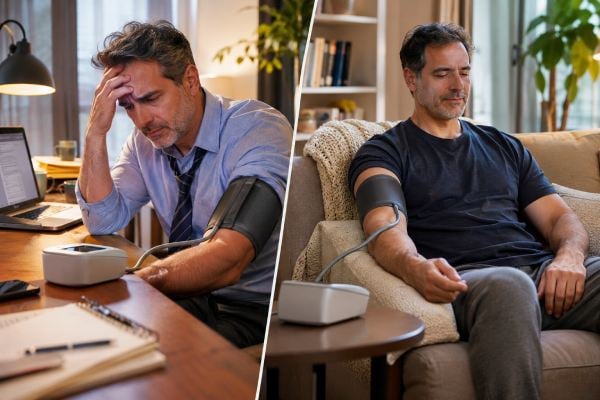
Yes. Anxiety and acute stress can temporarily raise blood pressure, sometimes by a noticeable amount. When the brain detects a threat, the sympathetic nervous system releases stress hormones that speed the heart and tighten blood vessels. That “fight-or-flight” response can push both systolic and diastolic pressure upward for minutes or longer. A high reading during a panic episode, argument, medical visit, painful event, or period of intense worry does not automatically mean you have chronic hypertension. The key question is what your blood pressure does when you are calm and measured correctly over time. Anxiety can also complicate blood-pressure control indirectly by disrupting sleep, reducing activity, increasing alcohol use, and making people repeatedly check their numbers in ways that create more worry. At the same time, persistent hypertension should not be dismissed as “just stress.” The safest approach is to separate temporary spikes from your usual resting pressure with standardized home readings, and to treat both anxiety and high blood pressure when either is present.
Table of Contents
- How anxiety can raise blood pressure
- Temporary spike or true hypertension?
- How to check blood pressure when you feel anxious
- Can chronic anxiety cause long-term high blood pressure?
- What helps both anxiety and blood pressure
- When a high reading needs medical care
- Common questions about anxiety and blood pressure
How anxiety can raise blood pressure
Anxiety changes blood pressure through normal stress physiology. When you perceive danger—even if the danger is a thought rather than a physical threat—the brain activates sympathetic nerves and releases hormones such as adrenaline. Heart rate can rise, the heart can pump more forcefully, and some blood vessels constrict. Those changes help direct blood and oxygen toward muscles during an emergency, but they also raise blood pressure.
This response can happen with:
- A panic attack
- An argument or frightening event
- Public speaking or a stressful meeting
- Pain
- A medical appointment
- Worry about a health result
- Repeatedly checking blood pressure while afraid of the number
The size of the rise differs greatly among people. Someone may see only a small change, while another person may see a large temporary increase. Research on acute mental stress shows that people with hypertension can have strong cardiovascular responses to intense stressors, but one stress-induced reading cannot tell you what your usual blood pressure is.
The effect also works in the other direction: seeing a high number can create anxiety, which can raise the next reading. That feedback loop is common. It is one reason a calm, standardized measurement routine is more informative than taking many readings during distress.
Medical settings can create a specific version of this problem called white coat hypertension, in which office readings are high while out-of-office measurements are lower. The reverse pattern—normal office pressure but high readings outside the clinic—can also occur, which is why home or ambulatory monitoring can be useful.
Temporary spike or true hypertension?
A temporary stress response and chronic hypertension are not the same thing. Hypertension is diagnosed from average blood-pressure patterns, not from the highest number you have ever seen.
A reading is more likely to reflect a temporary stress response when it:
- Occurs during obvious fear, pain, conflict, panic, or exertion
- Falls after several minutes of quiet rest
- Is much higher than your usual correctly measured home readings
- Is followed by normal readings on other calm days
Persistent hypertension is more likely when correctly measured readings remain high across multiple days and settings. The 2025 U.S. blood-pressure guideline continues to emphasize standardized measurement and the value of home monitoring in diagnosis and treatment.
One useful distinction is state versus baseline. Anxiety can change your state right now. Hypertension describes your average cardiovascular state over time. Both can coexist, and anxiety does not protect you from having genuine hypertension.
If your clinic numbers and home numbers disagree substantially, 24-hour ambulatory blood pressure monitoring can provide a more complete picture. A portable monitor takes repeated readings during normal daily life and sleep, helping clinicians identify white coat hypertension, masked hypertension, nighttime hypertension, and overall averages.
Do not “correct” a reading by taking it over and over
If a number surprises you, wait quietly and repeat it once after at least a minute. Continually rechecking every few minutes because you are afraid can reinforce anxiety and make the data less useful. A planned schedule produces better information than an anxiety-driven schedule.
How to check blood pressure when you feel anxious
The goal is not to make yourself perfectly relaxed. The goal is to measure under the same reasonable conditions each time.
Use this routine:
- Use a validated automatic upper-arm monitor. Wrist devices are more position-sensitive and are generally not the first choice when a suitable upper-arm cuff can be used. A guide to choosing a validated home blood pressure monitor can help with device selection and cuff fit.
- Avoid common short-term triggers. Do not smoke, exercise, or consume caffeine during the 30 minutes before measuring. Empty your bladder first.
- Sit quietly for at least five minutes. Support your back, keep both feet flat, and do not talk or use your phone.
- Support the arm at heart level. Put the cuff on bare skin and use the correct cuff size.
- Take two readings about one minute apart. Record both rather than repeatedly measuring until you get the number you want.
- Measure at consistent times. If your clinician asks for a home log, morning and evening readings for several days are often more useful than random checks throughout the day.
If you are visibly panicked, first sit safely and let the acute surge settle. Slow breathing for several minutes may help you become still enough to measure properly. Do not use breathing as a trick to manufacture an artificially low number; use it to return to a normal resting condition.
What if the first reading is much higher than the second?
That happens often. Movement, talking, rushing, a full bladder, poor arm support, or anticipatory anxiety can inflate the first reading. This is one reason repeated standardized measurements are recommended. Your clinician may use an average rather than a single value.
The pattern matters more than a one-time difference. If the first reading is always dramatically higher, mention that when you share your log.
Look for measurement factors before blaming anxiety
Anxiety is only one reason a reading can be unexpectedly high. A cuff that is too small, measuring over clothing, dangling the arm below heart level, crossing the legs, talking, a full bladder, recent exercise, nicotine, or caffeine can all shift the result. Cold temperatures and pain can raise pressure too. Correcting these factors often makes the home log much easier to interpret.
It is also worth checking the monitor itself. Use a device that has passed an accepted validation protocol and a cuff sized for your arm. Bring it to a medical visit periodically so your technique and device can be compared with the clinic equipment. If a monitor gives erratic readings despite correct use, do not assume your body is changing wildly from minute to minute; the equipment or cuff fit may be part of the problem.
Can chronic anxiety cause long-term high blood pressure?
The relationship is more complicated than the short-term stress response. Observational research finds an association between anxiety and hypertension, but association does not prove that anxiety alone causes persistent high blood pressure in every person. The relationship can run in both directions, and many shared factors are involved.
Chronic anxiety may influence long-term blood pressure through several routes:
Repeated sympathetic activation. Frequent stress responses may keep heart rate, vascular tone, and stress signaling elevated more often than normal.
Sleep disruption. Anxiety can make it harder to fall asleep, stay asleep, or maintain a regular sleep schedule. Poor sleep is linked with hypertension and can increase appetite and stress reactivity. If sleep is a recurring issue, the relationship between sleep and blood pressure is worth addressing directly.
Alcohol, nicotine, and stimulant use. Some people use alcohol, cigarettes, nicotine products, or excess caffeine to cope. These can complicate blood-pressure control.
Lower physical activity. Avoidance, fatigue, or fear of exercise can reduce activity, removing one of the most effective lifestyle tools for blood-pressure management.
Medication adherence and health behaviors. Anxiety can make routines harder to maintain. Some people skip medication because they fear side effects; others take readings so frequently that normal variability becomes alarming.
Shared biology and health conditions. Autonomic nervous system activity, inflammation, obesity, sleep apnea, pain, and other factors can influence both mental and cardiovascular health.
The practical message is not that every anxious person will develop hypertension. It is that persistent anxiety deserves care in its own right, and regular blood-pressure assessment is reasonable when anxiety and elevated readings occur together.
Certain substances can connect the two problems as well. High caffeine intake may cause palpitations or jitteriness in sensitive people and can transiently raise blood pressure. Decongestants containing sympathomimetic ingredients can raise pressure, and nicotine activates the cardiovascular system. Some prescription medicines can also affect blood pressure or anxiety symptoms. If a pattern began after a new medicine, supplement, stimulant, or major change in caffeine or nicotine use, review it with a clinician or pharmacist rather than stopping treatment on your own.
What helps both anxiety and blood pressure
The best strategy treats the two problems separately where needed while taking advantage of habits that support both.
Regular aerobic activity
Walking, cycling, swimming, and other aerobic exercise can lower resting blood pressure over time and may reduce stress reactivity. Start at a manageable level and build consistency. If anxiety makes you fear that an increased heart rate is dangerous, talk with a clinician about what symptoms and exertion levels are expected during exercise.
Strength training
Moderate resistance training can also help lower resting blood pressure and improve confidence in physical capacity. Use controlled breathing and avoid repeated all-out straining.
Sleep regularity
A stable wake time, adequate sleep opportunity, and treatment of sleep apnea when present can support both mood and cardiovascular health. Anxiety often worsens when sleep becomes irregular, while poor sleep can raise next-day stress sensitivity.
Slow breathing and relaxation skills
Breathing exercises, mindfulness-based practices, progressive muscle relaxation, and other stress-management approaches may produce modest blood-pressure benefits for some people. A 2025 systematic review found that several relaxation and stress-management interventions can lower blood pressure, although study quality and certainty vary across techniques. These methods are best viewed as supportive tools, not replacements for indicated hypertension treatment.
For a broader set of practical options, see stress-reduction habits for blood pressure.
Evidence-based anxiety treatment
If anxiety is frequent, hard to control, or causing avoidance, sleep problems, panic attacks, or major distress, consider formal treatment. Cognitive behavioral therapy and other psychotherapies can be effective for anxiety disorders, and medication may be appropriate for some people. Treating anxiety is worthwhile even if blood pressure does not change dramatically, because the goal is also better functioning and quality of life.
Do not stop blood-pressure or psychiatric medication because of a home reading without discussing it with the prescriber. Some medications can affect blood pressure, and sudden changes can create new problems.
Create a measurement boundary
For people who become preoccupied with blood-pressure readings, a planned boundary can be useful: measure only at the times your clinician recommends unless you have a specific medical reason to check. Record the readings, then move on with your day. The monitor should be a data tool, not a constant threat detector.
When a high reading needs medical care
Anxiety can raise blood pressure, but it is unsafe to assume a very high reading is harmless because you feel stressed.
If your blood pressure is higher than 180/120 mm Hg, wait at least one minute and measure again correctly. If it remains that high, contact a healthcare professional promptly for guidance. If blood pressure above 180/120 mm Hg is accompanied by chest pain, shortness of breath, weakness, numbness, vision change, difficulty speaking, confusion, or other new concerning symptoms, treat it as a hypertensive emergency and seek emergency care.
Call for emergency help for symptoms that suggest a heart attack or stroke even if you believe anxiety may be involved. Panic can cause chest tightness, rapid breathing, tingling, dizziness, and a racing heart, but those symptoms can overlap with serious medical conditions. New, severe, or unusual symptoms should not be self-diagnosed as anxiety.
Make a routine medical appointment if home readings are repeatedly in a high range even when you feel calm. Persistent elevation deserves evaluation for hypertension, medication needs, sleep apnea, kidney disease, and other contributors.
Common questions about anxiety and blood pressure
Can a panic attack make blood pressure very high?
It can cause a substantial temporary increase. The height of the spike varies from person to person. The important follow-up is whether pressure comes down and what properly measured readings look like after the episode and on other days.
Can worrying about blood pressure raise the reading?
Yes. Anticipatory anxiety can activate the same stress response that raises heart rate and vascular tone. That does not make the reading “fake”; it means the reading reflects a stressed state rather than necessarily your usual baseline.
Should I take blood pressure every time I feel anxious?
Usually not unless your clinician has specifically told you to do so. Symptom-triggered checking can create a feedback loop and produce a biased set of readings collected mostly during distress. A scheduled home-monitoring plan is generally more useful for assessing hypertension.
Can anxiety cause low blood pressure too?
Anxiety most commonly produces a temporary rise, but some people feel faint because of hyperventilation, a vasovagal response, dehydration, medication effects, or another cause. Symptoms such as fainting or repeated near-fainting deserve medical evaluation rather than being assumed to be anxiety.
If relaxation lowers my reading, does that prove I do not have hypertension?
No. Blood pressure is supposed to be measured at rest, so a lower calm reading may simply be a more accurate resting measurement. You could still have hypertension if your average resting readings remain elevated across days.
Which number should I show my doctor?
Show the complete log rather than only the highest or lowest readings. Include dates, times, and any relevant notes such as medication timing or unusual stress. A pattern gives your clinician much more information than a single number.
For many home-monitoring plans, clinicians are interested in averages collected over several days rather than isolated peaks. That approach reduces the influence of ordinary moment-to-moment variability and makes it easier to see whether treatment is working. Follow the schedule your own clinician gives you, especially if you are adjusting medication or have recently been diagnosed.
The most useful mindset is to treat blood pressure as a trend measured under repeatable conditions, not as a score you must control perfectly at every moment. Anxiety can create real temporary spikes, but long-term decisions should be based on calm, correctly measured averages and the rest of your cardiovascular risk profile.
References
- Improving anxiety screening for adults with hypertension: An integrative review 2026 (Review)
- Effectiveness of stress management and relaxation interventions for management of hypertension and prehypertension: systematic review and network meta-analysis 2025 (Systematic Review)
- 2025 AHA/ACC/AANP/AAPA/ABC/ACCP/ACPM/AGS/AMA/ASPC/NMA/PCNA/SGIM Guideline for the Prevention, Detection, Evaluation and Management of High Blood Pressure in Adults: A Report of the American College of Cardiology/American Heart Association Joint Committee on Clinical Practice Guidelines 2025 (Guideline)
- Physiological reactivity to acute mental stress in essential hypertension-a systematic review 2023 (Systematic Review)
- Central stress pathways in the development of cardiovascular disease 2023 (Review)
- Association between anxiety and hypertension in adults: A systematic review and meta-analysis 2021 (Systematic Review)
Disclaimer
This article is for general education and does not diagnose anxiety, panic disorder, or hypertension. Very high blood pressure or new symptoms such as chest pain, shortness of breath, weakness, vision changes, or difficulty speaking require medical assessment and may require emergency care.





