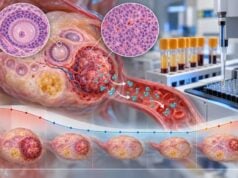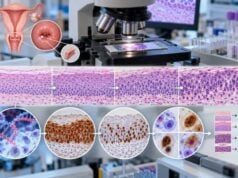
BRCA1 and BRCA2 testing can identify inherited cancer risk and tumor DNA-repair defects that matter in ovarian cancer care. These genes help repair dangerous double-strand breaks in DNA through homologous recombination. When a harmful BRCA1 or BRCA2 variant is inherited, lifetime risks of ovarian, fallopian tube, primary peritoneal, breast, and some other cancers rise. When a BRCA alteration is present only in the tumor, it can still influence the tumor’s biology and may affect treatment choices, but it does not automatically mean relatives inherited the same risk. For people diagnosed with epithelial ovarian cancer, professional guidance supports germline genetic testing broadly rather than limiting testing to those with a strong family history. Results should be classified carefully: a pathogenic or likely pathogenic variant can guide medical decisions, while a variant of uncertain significance should not be treated as a positive result. Genetic counseling helps connect the laboratory finding to the patient’s treatment, prevention options, and family.
- BRCA1 and BRCA2 are DNA-repair genes; harmful variants can impair homologous recombination and increase ovarian cancer susceptibility.
- Germline testing uses blood, saliva, or another normal-tissue source to look for inherited variants that can be passed to relatives.
- Tumor testing looks for somatic BRCA changes in cancer cells and can identify treatment-relevant alterations that are not necessarily inherited.
- A pathogenic or likely pathogenic variant is clinically actionable; a VUS is not. Variants of uncertain significance should not drive preventive surgery or family testing as though they were harmful.
- A negative BRCA1/2 result does not eliminate hereditary risk, because other genes such as RAD51C, RAD51D, BRIP1, and Lynch syndrome genes can also matter.
Table of Contents
- What BRCA1 and BRCA2 Do
- Who Should Have BRCA Testing
- Germline vs Tumor BRCA Testing
- What Positive, Negative, and VUS Results Mean
- How BRCA Results Affect Ovarian Cancer Risk
- How BRCA Status Can Affect Treatment
- Family Testing and Practical Next Steps
What BRCA1 and BRCA2 Do
BRCA1 and BRCA2 are tumor-suppressor genes. Their proteins participate in homologous recombination, a high-fidelity system for repairing double-strand breaks in DNA. Cells constantly experience DNA damage from normal metabolism, replication, and environmental exposures. When repair works, the genome stays relatively stable. When both functional copies of a key repair gene are lost in a cell, errors accumulate and cancer can develop more easily.
A person who inherits a pathogenic variant in one copy of BRCA1 or BRCA2 is born with reduced backup capacity. Cancer usually develops only after the remaining working copy is lost or disabled in a susceptible cell. This “two-hit” concept helps explain why an inherited variant raises risk without guaranteeing that cancer will occur.
BRCA-related ovarian cancers are often high-grade serous carcinomas arising in the fallopian tube, ovary, or peritoneum. These cancers may show homologous recombination deficiency, a broader tumor state in which repair through the same pathway is impaired. A separate HRD test can look for this wider pattern, which may occur with or without a BRCA1/2 mutation.
BRCA testing is therefore doing two jobs in modern ovarian cancer care. It can identify an inherited cancer-predisposition syndrome, and it can characterize a tumor’s repair biology. Those questions overlap, but they are not identical.
Who Should Have BRCA Testing
For people with epithelial ovarian, fallopian tube, or primary peritoneal cancer, germline testing is recommended broadly. Family history alone is not a reliable gatekeeper. Some people with a pathogenic BRCA variant have little or no obvious family history because relatives are few, family structure is small, cancers occurred on the paternal side, relatives died young from unrelated causes, or the variant happened to pass through family members who never developed cancer.
Testing is most useful when offered early enough to influence treatment and family counseling. The exact timing can depend on clinical circumstances, but guidelines emphasize testing at diagnosis rather than years later.
BRCA testing is also considered in people without ovarian cancer when personal or family history suggests hereditary breast and ovarian cancer. Examples include multiple relatives with breast or ovarian cancer, breast cancer at unusually young ages, male breast cancer, pancreatic cancer, metastatic or high-risk prostate cancer, or a known familial BRCA variant. Ancestry associated with higher frequencies of founder variants can also affect pretest probability.
Many laboratories now use multigene panels instead of testing only BRCA1 and BRCA2. A broader gynecologic cancer gene panel may include BRCA1, BRCA2, BRIP1, RAD51C, RAD51D, PALB2, and mismatch-repair genes linked to Lynch syndrome. Panel choice should match the personal and family history because broader testing increases the chance of finding both useful results and uncertain variants.
Testing a person who has already had a relevant cancer is often the most informative starting point for a family. If a pathogenic familial variant is found, unaffected relatives can then have targeted testing for that specific variant.
Germline vs Tumor BRCA Testing
Germline testing asks whether a BRCA1 or BRCA2 variant is present in essentially every cell of the body and can be inherited. The sample is commonly blood or saliva. Modern testing typically sequences the genes and also looks for larger deletions or duplications that ordinary sequencing alone might miss.
Somatic tumor testing examines DNA from the cancer. It can find a BRCA alteration that developed only in tumor cells. It can also detect an inherited variant because an inherited variant is present in the tumor too. For that reason, a BRCA finding on tumor testing may need confirmatory germline testing if hereditary status is not already known.
| Feature | Germline testing | Tumor testing |
|---|---|---|
| Typical sample | Blood or saliva | Tumor tissue, sometimes tumor-derived DNA |
| Main question | Is the variant inherited? | Does the cancer carry a BRCA alteration? |
| Meaning for relatives | Can indicate inherited risk and justify cascade testing | Does not establish inherited risk without germline confirmation |
| Treatment relevance | Can be relevant | Can be relevant |
| Can miss something the other finds? | Yes, tumor-only variants | Yes, depending on specimen quality, coverage, or reporting |
Tumor testing has practical limitations. Old tissue can be degraded, a biopsy may contain too few cancer cells, and laboratory panels differ in the variants they detect and report. Germline laboratories also differ in methods, so a high-quality report should state which genes and variant types were assessed.
A result may also come from paired tumor-normal testing, where tumor DNA and a normal sample are analyzed together. This approach can distinguish inherited from tumor-acquired changes more directly and can reduce ambiguity.
The sample source should be visible on the report. This matters because a patient can hear “your tumor has a BRCA2 mutation” and reasonably assume the change is inherited, even though tumor-only testing cannot answer that question by itself. The reverse is also true: a germline result tells the team about inherited predisposition but does not describe every additional mutation present in the cancer. Asking whether the test was performed on blood, saliva, or tumor tissue can prevent a major misunderstanding.
Turnaround time also varies. Germline results may return in a few weeks, while tumor profiling can take longer if tissue must be retrieved, reviewed, and processed. If treatment decisions are time-sensitive, the oncology team may order germline and tumor testing in parallel rather than sequentially.
What Positive, Negative, and VUS Results Mean
Genetic laboratories generally classify variants using categories such as pathogenic, likely pathogenic, variant of uncertain significance, likely benign, and benign. The classification is based on multiple evidence types, including population frequency, predicted effect on the protein, laboratory functional data, family segregation, and observations in affected individuals.
A pathogenic or likely pathogenic variant is treated as a clinically meaningful loss or disruption of gene function. In a germline test, that result supports hereditary breast and ovarian cancer risk management and family testing. In a tumor test, it can also inform tumor biology and treatment discussions.
A variant of uncertain significance (VUS) means there is not enough evidence to label the change either harmful or harmless. This is not a “weak positive.” Clinical guidelines specifically caution against making preventive surgery, intensified screening, or predictive family testing decisions based only on a VUS. Most VUS findings that are eventually reclassified move toward benign rather than pathogenic categories, although reclassification can take years.
A negative result can mean several things. If the family has a known pathogenic BRCA variant and the tested relative does not carry it, that is a true negative for that familial variant. If no familial variant is known, a negative BRCA1/2 test is less definitive. The family could carry a pathogenic variant in another gene, a variant not detectable by the method used, or an inherited risk pattern that is not explained by currently known genes.
This is where testing of RAD51C and RAD51D or BRIP1 may become relevant as part of an appropriate multigene panel.
How BRCA Results Affect Ovarian Cancer Risk
BRCA1 and BRCA2 do not confer the same ovarian cancer risk or the same age pattern. Contemporary reviews place lifetime tubo-ovarian cancer risk roughly in the 39%–44% range for BRCA1 and around 10%–20% for BRCA2, with estimates varying by study, family history, population, and age endpoint. Risk tends to rise earlier for BRCA1 than for BRCA2.
This difference affects prevention timing. In many guidelines, risk-reducing salpingo-oophorectomy is discussed after childbearing around age 35–40 for BRCA1 and age 40–45 for BRCA2, with individualized timing based on family history and patient priorities. Removing the fallopian tubes and ovaries lowers tubo-ovarian cancer risk substantially but causes infertility and, before natural menopause, abrupt surgical menopause.
Risk-reducing surgery is not the same as screening. CA-125 blood testing and transvaginal ultrasound have not been shown to provide a screening strategy that reliably replaces risk-reducing surgery for high-risk BRCA carriers. Some clinicians may use surveillance selectively when surgery is deferred, but its limitations should be explained clearly.
A positive BRCA result also affects breast cancer risk management and may have implications for pancreatic or prostate cancer risk in a family. The exact recommendations differ between BRCA1 and BRCA2 and depend on sex, age, family history, prior cancers, and local guidelines.
For someone already diagnosed with ovarian cancer, the hereditary-risk discussion remains important even if treatment is the immediate priority. A germline result can change the preventive care of children, siblings, parents, and more distant relatives for decades.
How BRCA Status Can Affect Treatment
BRCA-associated ovarian cancers often have impaired homologous recombination. That weakness can make tumor cells more sensitive to DNA-damaging strategies, including platinum chemotherapy, and can create susceptibility to PARP inhibitors in appropriate clinical settings.
PARP inhibitors exploit a concept called synthetic lethality. When a tumor already has defective homologous recombination, blocking another DNA-repair pathway through PARP can push cancer cells beyond their ability to repair damage. The clinical benefit depends on disease setting, prior treatment, regulatory approvals, and individual patient factors, so a BRCA result is one part of a larger treatment decision rather than an automatic prescription.
Tumor HRD testing can add information beyond BRCA status. Some BRCA-wild-type tumors show genomic evidence of homologous recombination deficiency and may behave differently from HR-proficient tumors. Conversely, not every BRCA-altered cancer responds forever; resistance mechanisms can emerge, including restoration of BRCA function in some cases.
A somatic BRCA variant can be treatment-relevant even when germline testing is negative. This is one reason ovarian cancer practice increasingly integrates both inherited and tumor testing rather than choosing only one.
Other tumor markers still have different jobs. For example, CA-125 monitoring tracks a circulating protein associated with disease burden in many epithelial ovarian cancers, while BRCA testing characterizes DNA repair and hereditary risk. One cannot substitute for the other.
Family Testing and Practical Next Steps
A germline pathogenic BRCA1 or BRCA2 result has implications beyond the person tested. Each first-degree relative such as a parent, sibling, or child has a 50% chance of carrying the same autosomal dominant variant. Cascade testing usually looks only for the known familial variant, making it simpler and more informative than starting over with a broad panel in every relative.
The result should be shared in a way relatives can use. A genetics clinic can provide a copy of the laboratory report and a family letter explaining which gene and exact variant were found. Relatives should ideally be tested through a qualified clinical laboratory rather than relying on consumer genotyping, which may examine only a small subset of BRCA variants.
After any BRCA test, useful questions include:
- Was this germline, tumor, or paired testing?
- Was the result pathogenic/likely pathogenic, VUS, or negative?
- If tumor testing was positive, do I still need germline confirmation?
- If germline testing was negative, did the test include other ovarian cancer susceptibility genes?
- Does this result change treatment now?
- Does it change the timing of risk-reducing surgery or breast surveillance?
- Which relatives should be offered targeted testing?
If the report is several years old, re-review can be worthwhile. Variant classifications, gene-risk estimates, and testing technology evolve. A panel that was considered comprehensive in the past may not include genes now routinely assessed.
Reproductive planning can also be part of the discussion. A person with a germline BRCA1 or BRCA2 pathogenic variant may want information about preimplantation genetic testing or prenatal testing, although these are personal choices rather than required medical steps. Fertility preservation may be relevant before cancer treatment or before risk-reducing surgery, particularly for younger patients who have not completed childbearing.
Risk management should remain gene-specific. BRCA1 and BRCA2 both increase tubo-ovarian cancer risk, but their age-related risk curves differ, so recommendations for risk-reducing salpingo-oophorectomy are not identical. Breast surveillance and prevention are also central because the inherited result affects more than ovarian cancer. For men in the family, the same familial variant can still matter because BRCA variants can increase male breast, prostate, pancreatic, and other cancer risks depending on the gene. A family letter that focuses only on “ovarian cancer risk” may therefore miss important implications for male and female relatives alike.
BRCA testing is most valuable when the laboratory result is connected to a clear plan. For ovarian cancer, that plan can include immediate treatment choices, tumor HRD assessment, future recurrence strategies, prevention of additional cancers, and cascade testing for relatives. The result is not merely a label; it is a piece of biologic information that can guide care across a lifetime and across a family.
Genetic counseling is also useful after a negative result when the family history remains strongly suggestive. The counselor can confirm whether deletion and duplication analysis was included, whether another multigene panel is appropriate, and whether testing an affected relative would be more informative. A negative BRCA result should narrow the question, not automatically end hereditary-risk assessment.
References
- Germline and somatic testing for ovarian Cancer: An SGO clinical practice statement 2024 (Position Statement)
- EMQN best practice guidelines for genetic testing in hereditary breast and ovarian cancer 2024 (Guideline)
- Germline Genetic Testing for Hereditary Breast and Ovarian Cancer: Current Concepts in Risk Evaluation 2024 (Review)
- Selection of Germline Genetic Testing Panels in Patients With Cancer: ASCO Guideline 2024 (Guideline)
- Cancer of the ovary, fallopian tube, and peritoneum: 2025 update 2025 (Review)
Disclaimer
This article provides general information about BRCA1 and BRCA2 testing and does not replace genetic counseling, oncology care, or individualized risk assessment. Cancer risks, prevention timing, and treatment choices depend on the exact variant, personal and family history, age, reproductive plans, tumor features, and current guidelines. Do not make medical or surgical decisions based on a VUS without expert review.