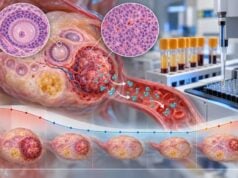
An HRD test looks for evidence that an ovarian cancer has lost an important DNA-repair pathway called homologous recombination. Tumors with homologous recombination deficiency, or HRD, are less able to repair double-strand DNA breaks accurately and may be more sensitive to platinum chemotherapy and PARP inhibitors. HRD testing is most relevant in high-grade serous and high-grade endometrioid ovarian, fallopian tube, and primary peritoneal cancers. A test may detect BRCA1 or BRCA2 mutations, measure patterns of genomic scarring such as loss of heterozygosity, telomeric allelic imbalance, and large-scale state transitions, or combine both approaches into a genomic instability score. “HRD-positive” is not one universal laboratory definition; cutoffs and methods differ by assay and by the treatment evidence linked to that assay. The result should therefore be interpreted with tumor type, germline and somatic BRCA testing, disease setting, prior treatment, and the specific PARP inhibitor decision being considered.
- HRD means a tumor has impaired homologous recombination DNA repair, often because of BRCA1/2 dysfunction or other repair defects.
- Many HRD assays combine BRCA testing with a genomic scar or genomic instability score, but the exact components and positive cutoff are assay specific.
- An HRD-positive result can predict a larger average benefit from some PARP inhibitor strategies, especially in newly diagnosed advanced high-grade ovarian cancer.
- HRD-negative does not mean “no PARP benefit” in every clinical setting, and HRD-positive does not guarantee response.
- Tumor HRD testing does not replace germline genetic testing, because hereditary BRCA or other cancer-risk variants have implications for the patient and relatives.
Table of Contents
- What Homologous Recombination Deficiency Means
- How HRD Testing Is Performed
- BRCA Mutations and Genomic Instability
- Understanding HRD-Positive and HRD-Negative Results
- How HRD Guides PARP Inhibitor Decisions
- Limitations of HRD Tests
- What to Do With an HRD Result
What Homologous Recombination Deficiency Means
Cells constantly experience DNA damage. One of the most serious forms is a double-strand break, in which both strands of the DNA molecule are disrupted. Homologous recombination repair is a high-fidelity system that uses a matching DNA template to repair these breaks accurately.
BRCA1 and BRCA2 are central proteins in this pathway. If both functional copies of one of these genes are lost in a tumor, homologous recombination can fail. Similar deficiency can arise through other genetic or epigenetic changes in the broader repair network.
When homologous recombination is defective, a cancer cell survives by using less accurate repair mechanisms. Over time, this leaves characteristic patterns in the genome. These patterns are often called genomic scars because they record the historical consequences of faulty repair.
HRD matters clinically because DNA-repair weakness can create a therapeutic vulnerability. Platinum chemotherapy produces DNA damage, and PARP inhibitors interfere with another repair pathway. In an HR-deficient cell, blocking PARP can push DNA damage beyond what the tumor can tolerate, a concept called synthetic lethality.
Not every ovarian cancer is equally likely to be HRD. The biomarker is most established in high-grade serous ovarian cancer and related fallopian tube and primary peritoneal cancers. High-grade endometrioid cancers can also be relevant. Other ovarian tumor types have different biology and should not automatically be interpreted through the same HRD framework.
HRD is also not synonymous with hereditary cancer. A tumor can be HRD because of a somatic BRCA mutation found only in the cancer, BRCA1 promoter methylation, or another acquired repair defect. Conversely, a germline cancer-risk variant requires a separate hereditary assessment. A BRCA1 and BRCA2 test addresses hereditary and tumor-specific questions that overlap with, but are not identical to, HRD testing.
How HRD Testing Is Performed
Most clinical HRD tests use tumor tissue from surgery or biopsy. DNA is extracted from a formalin-fixed paraffin-embedded tumor block, and the laboratory performs sequencing and copy-number analysis.
A pathologist first checks that the sample contains enough viable tumor. If tumor cellularity is too low, the assay may fail or produce an indeterminate result. Necrosis, poor fixation, small biopsies, and prior treatment can all reduce sample quality.
Different commercial and laboratory-developed assays use different methods. Common components include:
- BRCA1 and BRCA2 sequencing to identify pathogenic tumor variants;
- loss of heterozygosity, or LOH, which measures regions where one parental DNA copy has been lost;
- telomeric allelic imbalance, or TAI, which detects imbalanced chromosome regions extending toward telomeres;
- large-scale state transitions, or LST, which measure certain large chromosomal breaks and rearrangements;
- broader copy-number or mutational signatures that reflect defective repair.
Some assays combine several scar measurements into a genomic instability score. A widely used clinical approach combines LOH, TAI, and LST. In major ovarian cancer trials, a genomic instability threshold such as 42 has been used with a specific companion diagnostic, but patients should not apply that number to results from another platform. Different assays have different algorithms, calibration, and treatment-linked thresholds.
Other tests report the percentage of tumor genome affected by LOH rather than a combined score. Still others use sequencing signatures or functional approaches. Because the word “HRD” can refer to several technical strategies, the test name matters.
The report should ideally state the assay, specimen, whether BRCA1/2 were evaluated, the genomic score or category, the positivity threshold, and whether the sample met quality requirements.
Timing can matter as well. Many clinicians prefer to obtain tumor BRCA and HRD information early in the course of advanced high-grade disease so the result is available when maintenance treatment is discussed after platinum chemotherapy. Waiting until the end of chemotherapy can create avoidable delays if tissue retrieval, sequencing, or repeat testing is needed. When the original surgery occurred elsewhere, requesting the pathology block early can be useful.
A blood-based germline panel and a tumor HRD assay may therefore be ordered around the same time, but they should not be confused. The blood or saliva test asks whether an inherited variant is present in the person’s constitutional DNA. The tumor assay asks what molecular defects and genomic scars are present in the cancer. One test can be positive while the other is negative.
BRCA Mutations and Genomic Instability
BRCA status and genomic scarring provide related but different information.
A pathogenic BRCA1 or BRCA2 mutation can directly explain why homologous recombination is impaired. If the tumor has lost the remaining normal copy, the repair defect can be profound. This is one reason BRCA-mutated ovarian cancers often show strong platinum and PARP inhibitor sensitivity.
However, many HRD-positive tumors do not have a BRCA1 or BRCA2 mutation. They may have other repair-pathway alterations or epigenetic changes that produce a similar genomic scar. These are often described as BRCA-wild-type HRD-positive cancers.
Conversely, genomic scar testing looks backward at the tumor’s history. A scar can remain even if the cancer later restores some homologous recombination function. For example, a BRCA-mutated tumor can develop a reversion mutation that restores the reading frame of the gene and contributes to resistance. The old genomic scar does not disappear simply because current repair capacity has changed.
This distinction helps explain why HRD is an imperfect predictor. A scar test is not a live measurement of DNA-repair function. It identifies a phenotype associated with treatment sensitivity at the population level.
Hereditary testing remains important. Tumor sequencing may identify a BRCA variant that could be germline, but only appropriate germline testing can determine whether it was inherited. Other ovarian cancer susceptibility genes, including BRIP1, RAD51C, and RAD51D, may also affect hereditary counseling. A broader gynecologic cancer gene panel may be used when clinically indicated.
Understanding HRD-Positive and HRD-Negative Results
An HRD-positive result means the tumor meets the laboratory’s validated definition of homologous recombination deficiency. Depending on the assay, that may mean a pathogenic BRCA1/2 alteration, a genomic instability score above a threshold, high genomic LOH, or a defined combination.
The result suggests the cancer has biological features associated with greater sensitivity to certain DNA-damaging and PARP-directed therapies. It does not prove that a particular treatment will work.
An HRD-negative result means the assay did not detect enough evidence to meet its positive threshold. Some laboratories use the term homologous recombination proficient, or HRP. This classification can be useful, but it should not be interpreted as absolute proof that every tumor cell has normal homologous recombination function.
An indeterminate or failed result means the laboratory could not classify the tumor reliably. Common reasons include low tumor percentage, insufficient DNA, poor tissue quality, or borderline analytic findings. A new tissue block, another specimen, or an alternate assay may be considered if the result is likely to change treatment.
| Result | General meaning | Important caution |
|---|---|---|
| HRD-positive | Repair-deficiency evidence meets the assay threshold | Predicts probability of benefit, not guaranteed response |
| HRD-negative/HRP | Insufficient genomic evidence of HRD by that assay | Does not exclude all benefit from every PARP strategy |
| Indeterminate/failed | No reliable classification | May require another specimen or method |
The numerical score should never be compared across platforms as though all assays use the same scale. A score near one assay’s cutoff can be especially sensitive to technical and biological factors.
How HRD Guides PARP Inhibitor Decisions
HRD testing became clinically important because PARP inhibitor trials showed different magnitudes of benefit according to BRCA and HRD status. In newly diagnosed advanced high-grade ovarian cancer, HRD-positive tumors often derive a larger average progression-free survival benefit from PARP inhibitor maintenance strategies than HRD-negative tumors.
The exact decision is more complicated than “positive equals PARP inhibitor.” Treatment depends on:
- whether the disease is newly diagnosed or recurrent;
- response to platinum chemotherapy;
- BRCA mutation status;
- HRD assay and result;
- prior PARP inhibitor exposure;
- previous lines of treatment;
- adverse-effect risks and blood counts;
- current regulatory approvals and clinical guidelines.
Some PARP inhibitor indications have changed over time as overall-survival data matured and regulators reassessed benefit-risk in specific recurrent-disease populations. Therefore, an old treatment rule found online may no longer match current practice.
HRD results can also help frame expectations. A BRCA-mutated or otherwise HRD-positive tumor may be especially likely to benefit from a strategy that exploits defective DNA repair, while an HRD-negative tumor may have a smaller average benefit in certain settings. Individual patients can still respond differently.
An ovarian cancer biomarker profile places HRD alongside BRCA status, pathology, and other markers rather than treating it as a stand-alone test.
Limitations of HRD Tests
HRD testing has several limitations that are easy to miss when a report gives a single positive or negative label.
No universal definition
Different assays evaluate different genomic features and use different cutoffs. Two tests can classify the same tumor differently, especially near a threshold.
Genomic scars are historical
Scar-based tests reflect past repair deficiency. They do not directly measure whether homologous recombination is functioning today. Resistance mechanisms can emerge after the scar was created.
Tumor heterogeneity
Different regions of a cancer can contain different clones. A small specimen may not represent the whole tumor, and metastatic disease may evolve after the original surgery.
Tissue quality
Low tumor content and damaged DNA can cause false-negative, indeterminate, or failed results. Pathology review before testing is important.
Non-BRCA repair genes are difficult to interpret
Not every alteration in a homologous recombination repair gene causes the same functional deficiency, and not every gene mutation predicts PARP benefit as strongly as BRCA1/2. A broad gene panel should not be converted into an “HRD-positive” label without validated evidence.
Treatment effect is context dependent
A biomarker can be predictive in one clinical setting and less useful in another. The magnitude of PARP benefit depends on treatment line, prior therapy, and the specific drug strategy.
These limits are why major expert groups emphasize analytically and clinically validated companion diagnostics rather than assuming any generic “DNA repair panel” provides equivalent HRD information.
What to Do With an HRD Result
The first step is to identify exactly what was tested. Ask for the full molecular report rather than only “HRD positive” or “HRD negative.” Useful details include the assay name, BRCA result, genomic score or LOH value, cutoff, and whether testing passed quality control.
Next, confirm whether germline testing has been completed. All patients with epithelial ovarian cancer are commonly considered for hereditary risk evaluation, and tumor-only HRD testing cannot replace that process. If a tumor BRCA alteration is found, genetic counseling may be needed to determine whether it is inherited.
Then connect the biomarker to the actual treatment decision. Ask the oncology team:
- Which PARP inhibitor or maintenance strategy is being considered?
- Was the HRD assay validated for this decision?
- How much does the result change the expected benefit in this disease setting?
- What are the important toxicities and monitoring requirements?
- If the test failed, would repeating it on another specimen change management?
For recurrent cancer, prior platinum response and previous PARP exposure may be at least as important as an old HRD score. A new molecular profile can sometimes be useful if the disease has evolved, but repeating a genomic scar test does not necessarily measure current repair function better.
Patients should also distinguish HRD testing from ovarian cancer ctDNA testing. HRD generally characterizes tumor biology for treatment selection, while ctDNA approaches are being studied or used for mutation detection and disease monitoring in different contexts.
The practical value of HRD testing is greatest when it answers a specific treatment question. A well-interpreted result combines molecular biology, pathology, clinical history, and current evidence rather than reducing ovarian cancer to a single score.
It is reasonable to ask how close a genomic score is to the assay cutoff, but a borderline number should not be treated as a precise biological boundary. Laboratory thresholds are designed to classify populations for a validated clinical use. Tumors just above and just below a cutoff can share biological features, and treatment decisions may still depend on BRCA status, response to platinum, and the overall evidence for the proposed regimen. If the clinical stakes are high and a result is technically borderline or unexpected, pathology and molecular review can help determine whether repeat or alternative testing is justified. The goal is to avoid treating an assay threshold as more biologically precise than the evidence supports.
Because HRD assays are not interchangeable, the report should identify the platform, specimen, result category, and any assay-specific genomic score or cutoff used. Those details matter when clinicians apply trial evidence or drug-label criteria to an individual treatment decision.
References
- Homologous recombination deficiency in ovarian cancer: Global expert consensus on testing and a comparison of companion diagnostics 2025 (Consensus)
- Unraveling Homologous Recombination Deficiency in Ovarian Cancer: A Review of Currently Available Testing Platforms 2025 (Review)
- Homologous recombination deficiency (HRD) diagnostics: underlying mechanisms and new perspectives 2024 (Review)
- ESGO-ESMO-ESP consensus conference recommendations on ovarian cancer: pathology and molecular biology and early, advanced and recurrent disease 2024 (Consensus)
- Germline and somatic testing for ovarian Cancer: An SGO clinical practice statement 2024 (Position Statement)
- Homologous Recombination Deficiency and Ovarian Cancer Treatment Decisions: Practical Implications for Pathologists for Tumor Typing and Reporting 2022 (Review)
Disclaimer
HRD testing is a tumor biomarker used to support ovarian cancer treatment decisions, not a stand-alone prediction of response or a substitute for germline genetic testing. Assays use different methods and thresholds, so results must be interpreted according to the specific validated test and current treatment setting. PARP inhibitor decisions should be made with an oncology team using up-to-date clinical guidance.