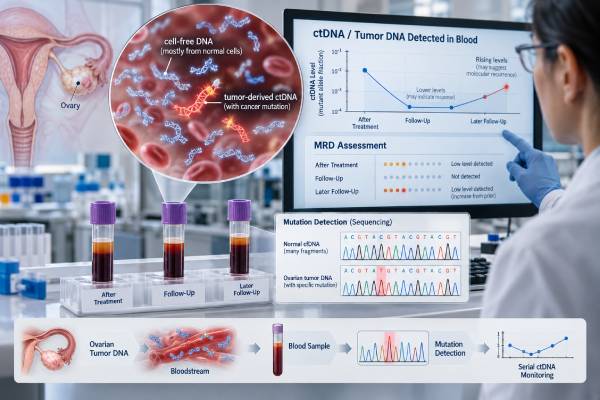
An ovarian cancer circulating tumor DNA (ctDNA) test looks for fragments of tumor-derived DNA in blood. It is a type of liquid biopsy that can identify selected mutations, estimate whether molecular disease remains after treatment, and track changes in tumor DNA over time. The technology is promising because a blood sample can sometimes reveal cancer activity before it is obvious on imaging or through symptoms. However, ctDNA is not yet a universal standard for ovarian cancer screening or routine surveillance, and a negative result cannot prove that no cancer remains. Ovarian tumors vary widely in how much DNA they release into the bloodstream, especially when disease volume is small. Test design also matters: some assays are customized to mutations from a person’s tumor, while others search a fixed panel without prior tumor sequencing. Results are most useful when interpreted as trends alongside pathology, imaging, CA-125, treatment history, and the assay’s validated purpose.
- A positive ctDNA result means tumor-associated DNA was detected: it can support evidence of molecular disease, but the clinical meaning depends on timing, assay design, and the variants found.
- A negative result does not rule out residual or recurrent ovarian cancer: low-volume or low-shedding disease may fall below the assay’s detection limit.
- MRD testing looks for molecular residual disease after treatment: it is promising for recurrence-risk assessment but is not yet a universal replacement for standard ovarian cancer follow-up.
- Mutation-focused ctDNA can reveal treatment-relevant changes: results may include BRCA pathway alterations or resistance-related mutations, but tissue testing remains important.
- Serial results are often more informative than one sample: persistent clearance, new detectability, or rising ctDNA can provide more context than an isolated measurement.
Table of Contents
- What Ovarian Cancer ctDNA Testing Measures
- ctDNA for MRD and Recurrence Monitoring
- Mutation Detection and Tumor Profiling
- Tumor-Informed vs Tumor-Naive ctDNA Tests
- Understanding Positive, Negative, and Changing Results
- Limitations, False Results, and Sources of Uncertainty
- When ctDNA May Be Used and What Comes Next
What Ovarian Cancer ctDNA Testing Measures
Cells throughout the body release small DNA fragments into the bloodstream. Most of this material is normal cell-free DNA. A smaller fraction can come from cancer cells; that cancer-derived portion is called circulating tumor DNA, or ctDNA.
A ctDNA assay does not usually look for a substance unique to ovarian cancer. Instead, it searches for molecular features associated with a person’s tumor, such as single-nucleotide variants, insertions or deletions, copy-number changes, rearrangements, or abnormal DNA-methylation patterns. Which features are measured depends on the assay.
This differs from a traditional serum tumor marker. CA-125 monitoring in ovarian cancer measures a protein concentration. ctDNA testing analyzes genetic or epigenetic material released by tumor cells. Both can change with tumor burden, but they represent different biology and have different limitations.
The amount of tumor DNA in plasma may be described as variant allele fraction, molecules per milliliter, mean tumor molecules, or tumor fraction. These measures are not interchangeable. A value from one platform should not be compared directly with a value from another unless the laboratory specifically supports that comparison.
Several technical methods are used. Highly sensitive polymerase chain reaction methods can track one or a few known variants. Targeted next-generation sequencing can search dozens or hundreds of genes. Some newer approaches analyze methylation, fragment patterns, or genome-wide signals. The required blood volume, analytical sensitivity, and reporting threshold differ by platform.
In ovarian cancer, ctDNA is being studied or used selectively for three broad purposes: detecting molecular residual disease (MRD) after treatment, monitoring for recurrence or treatment response, and identifying tumor mutations from blood when tissue is unavailable or when a current molecular snapshot may help. A broader ctDNA test overview helps explain the general liquid-biopsy concepts that also apply outside gynecologic cancer.
ctDNA for MRD and Recurrence Monitoring
Molecular residual disease means cancer-derived material remains after treatment even though conventional testing may show no visible disease. The appeal of ctDNA is that it can potentially detect this molecular signal from a blood sample.
After ovarian cancer surgery and chemotherapy, researchers have found that persistent or newly detectable ctDNA is often associated with a higher likelihood of recurrence and shorter progression-free survival. Meta-analyses across epithelial ovarian cancer studies also support an association between detectable ctDNA and poorer outcomes. These findings make ctDNA a strong research biomarker, but they do not mean every commercial MRD result has a proven treatment pathway.
The key distinction is between prognostic information and actionable information. A test may predict that recurrence risk is higher without proving that changing treatment based on that result improves survival. That evidence gap is one reason ctDNA-guided ovarian cancer surveillance is not yet a universal standard.
Timing can strongly affect interpretation. A sample drawn immediately after major surgery can contain large amounts of normal cell-free DNA from tissue injury, potentially diluting the tumor signal. Chemotherapy can also change ctDNA rapidly. For serial monitoring, clinicians generally interpret samples according to a consistent protocol and the assay’s recommended collection windows rather than comparing arbitrarily timed draws.
A typical research or specialty-use pattern may look like this:
- A baseline tumor or blood sample identifies trackable mutations.
- Blood is collected after surgery, after systemic therapy, or at planned surveillance points.
- The assay reports whether tumor-associated DNA remains detectable.
- Subsequent samples are compared for clearance, persistence, or reappearance.
- Concerning molecular findings are interpreted with CA-125, symptoms, examination, and imaging.
A positive MRD result can be meaningful even when a CT scan shows no measurable tumor, but it should not automatically trigger treatment outside a validated clinical pathway. The ctDNA MRD testing concept is evolving rapidly, and ovarian-cancer-specific clinical trials remain important for determining when earlier molecular detection should change care.
Mutation Detection and Tumor Profiling
ctDNA can also be used as a blood-based form of genomic profiling. Instead of asking only “is molecular disease present?”, a sequencing panel may ask “which tumor alterations are detectable now?”
This can be useful when a tissue biopsy is difficult, old, inadequate, or unsafe to obtain. Blood may also capture DNA released from more than one tumor site, offering a broader snapshot of molecular heterogeneity than a single biopsy. In recurrent ovarian cancer, that can be relevant because treatment pressure can select resistant tumor clones over time.
Potentially informative findings include alterations in TP53, BRCA1, BRCA2, and other DNA-repair genes, as well as copy-number or resistance-associated changes. In high-grade serous ovarian cancer, TP53 mutations are extremely common, so a known tumor TP53 variant can sometimes serve as a useful tracking marker. BRCA-related findings may have treatment relevance, but any therapy decision still depends on whether the alteration is pathogenic, whether it is germline or somatic, the disease setting, and current drug eligibility.
One clinically interesting resistance mechanism is a BRCA reversion mutation. A tumor that initially had an inactivating BRCA mutation can acquire a second change that restores enough BRCA protein function to repair DNA more effectively. Such reversions have been associated with resistance to platinum therapy or PARP inhibitors. ctDNA may detect these evolving subclones without requiring another surgical biopsy, although interpretation remains specialized.
Blood-based sequencing is not a complete substitute for tissue. Tumor tissue provides histology, grade, architecture, immunohistochemistry, and molecular context that plasma cannot. It can also detect alterations when a cancer is not shedding enough DNA into blood. For initial ovarian cancer characterization, ovarian tumor biomarker profiling generally combines pathology with germline and tumor testing rather than relying on ctDNA alone.
If a pathogenic hereditary-cancer gene variant appears in ctDNA, the result may require germline confirmation. Plasma sequencing cannot always determine whether a variant came from the tumor, an inherited germline change, or a blood-cell clone without additional testing.
Tumor-Informed vs Tumor-Naive ctDNA Tests
ctDNA assays are often described as tumor-informed or tumor-naive. The distinction affects sensitivity, setup time, and what a negative result means.
A tumor-informed assay begins by sequencing a person’s tumor tissue, sometimes together with normal blood, and selecting a set of tumor-specific variants. A customized blood test then searches for those exact variants. Because the assay already knows what molecular signal to look for, it can often achieve very high analytical sensitivity for MRD monitoring.
Advantages can include:
- strong specificity for known tumor-derived variants;
- the ability to track multiple private mutations rather than one generic marker;
- lower risk that a random unrelated blood-cell variant will be mistaken for the tumor when matched normal sequencing is used.
The tradeoffs are that adequate tumor tissue is required, custom assay development takes time, and the test may miss new tumor clones that no longer carry or shed the originally selected markers. A detailed tumor-informed ctDNA test is therefore most naturally suited to personalized longitudinal monitoring.
A tumor-naive assay does not require prior tumor sequencing. It searches plasma directly using a predefined panel or broader genomic/epigenomic signature. This may be faster to start and can identify new alterations, but sensitivity for very low-volume MRD can be challenging. Tumor-naive methods also need strong bioinformatic filters to separate tumor signals from non-tumor sources.
Neither approach is inherently best for every ovarian cancer situation. A tumor-informed assay may be attractive when the goal is ultra-sensitive recurrence tracking after definitive treatment. A broader tumor-naive panel may be more useful when the goal is to identify current resistance mutations in advanced disease and no recent tissue is available.
The report should clearly state which approach was used. Without that information, it is difficult to understand the meaning of “not detected.” A negative result from a broad plasma panel is not equivalent to a negative result from a highly sensitive personalized MRD assay, and even the latter cannot exclude all microscopic disease.
Understanding Positive, Negative, and Changing Results
The most useful way to interpret ctDNA is to ask what the test was designed to detect, whether the tumor had a known trackable signal, and how the result changed over time.
Positive or detected generally means the assay found molecular features meeting its threshold for tumor-associated DNA. In an MRD setting, persistent detection after treatment can indicate a higher risk of relapse. During metastatic treatment, a falling ctDNA signal may be consistent with response, while a rising signal can suggest increasing tumor burden or resistant disease. These relationships are probabilistic, not absolute.
Negative or not detected means no reportable tumor signal was found above the assay’s detection threshold in that sample. It does not mean “cancer-free.” A tumor can be present but shed little DNA, especially when deposits are small, confined to certain anatomic sites, or biologically low-shedding. Pre-analytical problems can also reduce the amount of analyzable DNA.
Indeterminate or insufficient is different from negative. The sample may contain too little cell-free DNA, fail quality controls, or lack enough informative variants for a confident call. Repeating the test may be reasonable, depending on the assay and clinical purpose.
Trends can add important context:
- Positive to negative: molecular clearance can support treatment response.
- Negative to positive: new detectability can raise concern for molecular recurrence.
- Persistently positive: may suggest residual disease or treatment-resistant clones.
- Falling but still positive: may indicate response without complete molecular clearance.
- Changing mutation profile: may reveal clonal evolution under therapy.
These patterns are strongest when blood is collected at comparable clinical time points using the same validated assay. Switching platforms can create apparent changes caused by different gene coverage or sensitivity rather than true biology.
A ctDNA result should also be compared with conventional markers. A patient can have a rising CA-125 but negative ctDNA, or detectable ctDNA with a normal CA-125. Discordance is not automatically an error; the markers measure different processes. The next step depends on symptoms, disease history, imaging, and how reliable each marker has been for that individual.
Limitations, False Results, and Sources of Uncertainty
The main limitation of ctDNA testing is biologic sensitivity. Tumors do not release DNA into blood at a constant rate. Disease volume, blood supply, cell turnover, metastatic location, treatment, and tumor subtype can all affect shedding.
A second limitation is clonal hematopoiesis. As people age, normal blood-forming cells can acquire mutations and expand into clones. These changes can appear in plasma sequencing and may involve genes also seen in cancer. If an assay does not adequately distinguish blood-cell mutations from tumor mutations, a non-tumor variant can be misclassified. Matched white-blood-cell sequencing and careful bioinformatic filtering help reduce this problem.
Other limitations include:
- Assay coverage: a panel cannot detect a mutation in a gene or region it does not analyze.
- Detection threshold: very low variant fractions may fall below the validated limit of detection.
- Specimen handling: delayed processing or poor collection can release normal DNA from white blood cells and dilute the tumor fraction.
- Tumor evolution: a personalized marker selected from the original tumor may become less representative after years of treatment.
- Clinical-action gap: detecting recurrence earlier is useful only if acting on that earlier signal improves outcomes.
- Cost and access: reimbursement and availability vary, especially for serial MRD testing outside established indications.
False reassurance is the most important patient-level risk. A negative result should not be used to postpone evaluation of new abdominal swelling, pelvic pain, early satiety, unexplained weight change, bowel or urinary symptoms, or concerning imaging.
The opposite risk is overreacting to a low-level positive result without confirming its significance. Depending on the test, repeating the sample, reviewing the original tumor genotype, checking for clonal hematopoiesis, and obtaining imaging may be more appropriate than immediately changing treatment.
When ctDNA May Be Used and What Comes Next
In 2026, ovarian cancer ctDNA is best viewed as an emerging and selectively used precision-oncology tool, not a routine replacement for standard diagnostic and surveillance methods. Its strongest near-term roles are likely to be in clinical trials, high-risk molecular monitoring programs, difficult-to-biopsy recurrent disease, and research-guided treatment response assessment.
A clinician considering ctDNA may ask:
- What decision will this test change? Testing without a defined clinical question can generate information without a clear action.
- Is tumor tissue available? Tissue may be better for initial molecular profiling, while plasma can complement it later.
- Is the goal MRD detection or mutation discovery? Those goals favor different assay designs.
- How sensitive is the assay in this setting? Analytical sensitivity on paper does not guarantee clinical sensitivity in low-shedding ovarian cancer.
- What will happen after a positive result? A plan for confirmation, imaging, trial enrollment, or treatment review should be considered before testing.
For recurrence surveillance, standard follow-up still relies on clinical assessment, symptom review, and selected use of CA-125 and imaging based on the patient’s disease and care plan. ctDNA may add another molecular layer, but it has not eliminated the need for these tools.
For advanced cancer, a blood-based ctDNA mutation panel may be useful when recent tissue cannot be obtained or when resistance evolution is the main question. Any potentially actionable finding should be evaluated against the original pathology, prior genomic results, current ovarian cancer treatment guidelines, and the specific evidence supporting that biomarker-drug pairing.
The field is moving quickly. The most important future evidence will not simply show that ctDNA predicts recurrence. It will show whether a defined ctDNA-guided action—earlier imaging, a different maintenance strategy, treatment escalation, or clinical-trial intervention—improves meaningful outcomes compared with standard care.
References
- Circulating Tumour DNA for Ovarian Cancer Diagnosis and Treatment Monitoring: What Perspectives for Clinical Use? 2025 (Review)
- Circulating tumor DNA as a biomarker for predicting progression-free survival and overall survival in patients with epithelial ovarian cancer: a systematic review and meta-analysis 2024 (Systematic Review)
- The Role of Circulating Tumor DNA in Ovarian Cancer 2024 (Review)
- Advances in application of circulating tumor DNA in ovarian cancer 2023 (Review)
- Circulating tumour DNA-Based molecular residual disease detection in resectable cancers: a systematic review and meta-analysis 2024 (Systematic Review)
- Circulating tumor DNA: current implementation issues and future challenges for clinical utility 2024 (Review)
Disclaimer
This article is for general education and does not establish whether ctDNA testing is appropriate for a specific person with ovarian cancer. ctDNA results should be interpreted by the treating oncology team with the assay’s validated specifications, tissue pathology, imaging, standard biomarkers, and treatment history. New or worsening symptoms require clinical evaluation even when ctDNA is not detected.