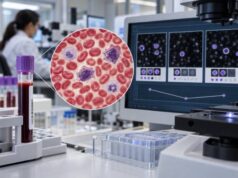
A tumor-informed ctDNA test is a personalized blood test built from genetic changes found in a patient’s own cancer. It is most often used to detect molecular residual disease (MRD) after treatment and to monitor for recurrence over time. First, the laboratory sequences tumor tissue and identifies a set of tumor-specific mutations. Later blood samples are then searched very deeply for those same mutations in circulating tumor DNA (ctDNA). This focused approach can detect extremely small molecular signals that may appear before a recurrence becomes visible on imaging. A positive result usually means tumor-specific DNA is detectable and recurrence risk is higher. A negative result means the assay did not detect the tracked tumor signal in that sample, but it cannot prove that no cancer remains. Tumor-informed testing is especially powerful when tissue is available and the clinical question is residual disease, but its value depends on the cancer type, assay, sampling schedule, and whether an evidence-based action follows the result.
- What it measures: A personalized set of mutations taken from the patient’s own tumor and tracked later in plasma.
- Main use: MRD detection, recurrence-risk assessment, and serial monitoring after curative-intent treatment.
- Positive result: Tumor-specific ctDNA is detected and usually indicates a substantially higher risk of recurrence.
- Negative result: No tracked ctDNA is detected at that time; microscopic disease can still be present below the sampling limit.
- Key tradeoff: Tumor-informed assays can be highly specific and sensitive for low-level MRD but require suitable tumor tissue and extra setup time.
Table of Contents
- What “tumor-informed” ctDNA means
- How a personalized ctDNA assay is built
- Why tumor-informed testing can detect very low MRD
- What positive, negative, and serial results mean
- Where tumor-informed ctDNA is used
- Limitations, false negatives, and unresolved questions
- Tumor-informed versus tumor-naive ctDNA testing
What “tumor-informed” ctDNA means
“Tumor-informed” describes how the blood test is designed. The laboratory studies the patient’s tumor tissue first, then uses that information to create a personalized plasma assay.
This differs from a fixed-panel liquid biopsy that begins with blood and searches the same predetermined gene list in every patient. A tumor-informed assay already knows which molecular changes belong to the individual tumor, so later blood testing can focus sequencing effort on those targets.
The basic sequence is:
- identify somatic mutations in the tumor;
- select a set that is suitable for tracking;
- create a personalized assay;
- test plasma for those exact mutations;
- repeat blood testing over time.
The approach is particularly suited to ctDNA minimal residual disease testing, where the amount of cancer-derived DNA can be extraordinarily small. After surgery or definitive therapy, a person can have no measurable disease on CT, MRI, or PET while a microscopic population of cancer cells remains. If those cells shed enough DNA into blood, a highly focused assay may detect it.
Tumor-informed does not mean the test measures the whole tumor continuously. The personalized panel reflects the mutations selected from the tissue that was sequenced. The blood result reports whether evidence from that tracked fingerprint is detectable now.
Commercial examples include Signatera and RaDaR, although the number of tracked variants, sequencing chemistry, calling algorithms, report format, and validated cancer settings differ between assays.
How a personalized ctDNA assay is built
Most tumor-informed workflows begin with formalin-fixed tumor tissue saved from surgery or biopsy. Some platforms also use a matched normal sample, often blood, to help separate true tumor mutations from inherited variants and from mutations that arise in blood-forming cells.
Tumor sequencing
The laboratory may use whole-exome sequencing, whole-genome sequencing, or another broad tumor-sequencing method to identify candidate somatic alterations. A solid tumor NGS test used for therapy selection can overlap with this step, but the purpose is different: tumor-informed MRD design prioritizes stable, trackable tumor variants rather than only drug targets.
Variant selection
The assay then chooses multiple mutations that appear suitable for longitudinal tracking. Platforms often favor clonal or truncal changes believed to be present across much of the original tumor. Tracking many variants reduces dependence on one mutation and increases the chance that at least several tumor molecules will be informative in plasma.
Personalized plasma testing
Once the panel is designed, cell-free DNA from blood is sequenced very deeply. Multiplex PCR or other targeted enrichment methods concentrate laboratory effort on the patient-specific targets.
This is a major efficiency gain. A broad plasma panel may spread sequencing across hundreds of genes because it does not know which mutation is present. A tumor-informed assay spends far more of its analytical depth on variants already known to belong to the tumor.
Serial reuse
After setup, later monitoring usually needs only blood. That makes repeated testing practical during postoperative surveillance or treatment response assessment. The personalized panel is generally reused, allowing the care team to compare molecular status over time.
The first result therefore tends to take longer than later results because the assay must be designed and validated for that individual patient.
Why tumor-informed testing can detect very low MRD
MRD is a difficult analytical problem because ctDNA can be only a tiny fraction of total cell-free DNA after curative-intent treatment. Most circulating DNA in that situation comes from normal cells, not cancer.
Tumor-informed testing improves the signal-to-noise problem in several ways.
It searches for known tumor variants
If the laboratory has already confirmed that a mutation exists in the tumor, finding the same mutation in plasma is more informative than discovering a low-level variant without context. Multiple matching variants strengthen the evidence that the signal is tumor-derived.
It allows extremely deep targeted sequencing
Because the genomic search space is narrow, the assay can sequence selected loci many thousands of times and use error-suppression methods to distinguish true molecules from sequencing artifacts.
It can reduce clonal-hematopoiesis false positives
Clonal hematopoiesis occurs when normal blood-forming cells acquire mutations and release their DNA into plasma. These variants can look like tumor ctDNA. Comparing tumor and normal blood data helps filter them.
This matters because some genes altered by clonal hematopoiesis are also common cancer genes. A low-level plasma mutation is not automatically proof of residual cancer unless its origin is established.
It can combine evidence across multiple mutations
At low tumor fractions, no single variant may appear in every blood tube. Personalized multi-variant approaches can integrate weak signals across several loci to produce a binary detected/not-detected result.
The result is not unlimited sensitivity. Blood contains a finite number of DNA molecules. If no tumor fragment is physically present in the sample, even perfect sequencing cannot detect it. This sampling limit is one of the most important reasons a negative MRD result cannot equal guaranteed cure.
The number of plasma molecules also depends on how much blood is collected and how efficiently cell-free DNA is recovered. This creates an important difference between analytical limit of detection and clinical sensitivity. A laboratory may demonstrate that its method can detect a defined molecular concentration in validation materials, yet some real recurrences will still be missed because the patient’s tumor releases little or no ctDNA into peripheral blood. Clinical performance therefore has to be measured in actual patients at the intended postoperative or surveillance time point, not inferred from a laboratory sensitivity claim alone.
What positive, negative, and serial results mean
Tumor-informed ctDNA is best interpreted as a longitudinal biomarker rather than a one-time verdict.
| Pattern | Typical meaning | What it does not prove |
|---|---|---|
| Positive after definitive treatment | Patient-specific tumor DNA is detectable; recurrence risk is generally much higher. | It does not identify the location or exact size of residual disease. |
| Negative after definitive treatment | No tracked tumor DNA was detected in that sample; recurrence risk is generally lower. | It does not rule out microscopic or low-shedding disease. |
| Persistently positive | Ongoing molecular disease may be present despite treatment. | It does not by itself determine which therapy will work. |
| Positive then negative | Molecular clearance may indicate treatment response. | It does not guarantee durable remission. |
| Negative then positive | A newly emerging molecular signal can indicate recurrence before standard detection. | It does not mean a lesion will already be visible on imaging. |
Positive does not mean “visible recurrence now”
A ctDNA-positive result can precede radiographic recurrence by months in some studies. That is one of the technology’s main attractions, but it can also create uncertainty. A patient may have molecular evidence of disease with no lesion that can yet be localized.
The next step should therefore be defined by the evidence for that cancer. Options may include earlier imaging, repeat testing, closer surveillance, treatment when supported by a trial or guideline, or enrollment in a ctDNA-directed study.
Negative does not mean zero risk
A negative result lowers risk compared with a positive result in many studies, but false negatives occur. Some tumors shed little DNA; small-volume disease may release too few molecules; and certain anatomical sites are underrepresented in plasma.
Repeated negative results are often more reassuring than a single negative because they sample the circulation at multiple points in time. Even so, they generally complement rather than replace standard surveillance.
Quantitative values require caution
Some assays report a quantitative metric in addition to a binary call. Changes can be useful within the same validated platform, but percentages or concentrations should not be treated as a universal tumor-volume scale. ASCO’s 2026 guideline cautions against using fractional or concentration-based ctDNA measurements as a general surrogate for disease burden.
Where tumor-informed ctDNA is used
Tumor-informed testing has the strongest rationale when very small residual disease matters and the original tumor is available for assay design.
Postoperative risk stratification
After surgery, ctDNA-positive patients consistently have higher recurrence rates than ctDNA-negative patients across multiple solid tumors. This makes MRD one of the strongest emerging molecular prognostic factors in cancers such as colorectal, breast, lung, bladder, and others.
The clinical question is whether that risk information should change adjuvant treatment. In colorectal cancer, prospective trials have shown that ctDNA-guided strategies can alter chemotherapy use, and ongoing studies are testing escalation and de-escalation approaches in different stages.
Recurrence surveillance
Serial tumor-informed testing can detect molecular recurrence before conventional surveillance in some patients. This may be especially valuable when a cancer has a meaningful salvage-treatment window.
However, earlier detection is not automatically beneficial. The crucial question is whether finding recurrence months earlier leads to an intervention that improves survival, preserves quality of life, or avoids unnecessary therapy. That must be proven by cancer-specific studies.
Treatment-response monitoring
In selected settings, molecular clearance or persistence can provide information earlier than imaging. A falling ctDNA signal may support response; persistent positivity may suggest residual resistant disease.
This use is still context-dependent. Imaging can show anatomical response, pathology can show treatment effect in resected tissue, and ctDNA can show molecular dynamics. They are complementary measurements, not interchangeable substitutes.
Clinical trials
Tumor-informed MRD is increasingly used to select high-risk patients for intervention trials. A trial may enroll only ctDNA-positive patients after surgery, for example, because their recurrence risk is high enough to justify testing additional therapy.
This can make trials more efficient and may eventually establish which actions after a positive result improve outcomes.
Limitations, false negatives, and unresolved questions
The personalized design solves some liquid-biopsy problems but creates others.
Tumor tissue is required
If tissue is unavailable, exhausted, decalcified, too small, or has too little tumor content, personalized assay development may fail or be delayed. This is a practical disadvantage compared with tumor-naive ctDNA testing.
Development takes time
Whole-exome or whole-genome sequencing, variant selection, assay manufacturing, and quality checks mean the first tumor-informed result takes longer than a ready-made plasma panel. That may matter when an adjuvant treatment decision must be made quickly.
The original tumor may not capture every future clone
Cancer evolves. A personalized panel based on the primary tumor may not include every mutation that appears later. Tumor-informed assays reduce this risk by selecting stable clonal variants, but biological evolution remains relevant.
A broad resistance mutation liquid biopsy may therefore be more appropriate when the main goal is discovering new therapy-resistance mechanisms rather than simply detecting MRD.
ctDNA shedding varies
Tumor type, size, vascularity, treatment, and metastatic site all affect how much tumor DNA reaches plasma. Brain-only recurrence is a well-described example of a situation in which peripheral blood ctDNA can be low.
Timing can affect sensitivity
Blood collected too soon after surgery can contain large amounts of normal cell-free DNA from tissue damage, diluting the tumor signal. Studies often use defined postoperative landmark windows rather than sampling immediately after surgery.
Clinical actionability is not uniform
The field has moved rapidly from “Can MRD predict relapse?” to “What should we do about it?” These are not the same question. A test can have excellent prognostic performance without evidence that treating every positive result improves survival.
ASCO’s 2026 guideline reflects this distinction: outside tumor-genetic alteration testing, ctDNA should be used when a specific evidence-based action can be taken or when it resolves clinically important ambiguity.
Tumor-informed versus tumor-naive ctDNA testing
Both strategies can be clinically useful. The better choice depends on tissue availability, required turnaround, disease setting, assay performance, and the question being asked.
| Feature | Tumor-informed | Tumor-naive |
|---|---|---|
| Uses patient’s tumor tissue for assay design | Yes | No |
| Panel | Personalized tumor-specific variants | Fixed genomic, epigenomic, fragmentomic, or multimodal features |
| Initial setup | Longer | Usually faster |
| Low-level MRD sensitivity | Often high because sequencing is focused on known variants | Varies by technology; improving with methylation and multimodal methods |
| Ability to discover new mutations | Limited to the tracked set for MRD calling | Potentially broader if the assay surveys fixed genomic regions |
| Best practical advantage | Highly specific personalized MRD tracking | No need for tumor tissue and faster initiation |
A 2026 systematic review and diagnostic meta-analysis in resected colorectal cancer found higher sensitivity for tumor-informed than tumor-agnostic assays with serial sampling, while false-positive rates were not significantly different. That finding supports the strength of personalized tracking in low-burden disease, but it should not be generalized blindly to every cancer or every newer tumor-naive multimodal platform.
The field is also becoming less binary. Some tissue-free assays combine methylation, genomic variants, fragment patterns, and machine learning. At the same time, tumor-informed assays are tracking more variants and using deeper sequencing. The best technology may therefore depend less on the label and more on clinical validation for the exact cancer, time point, and decision.
For patients, three questions make the result far more useful: Why is this test being ordered now? What does a positive or negative result change? And what evidence supports that action in this cancer? Those questions connect a sophisticated molecular assay to a practical care plan.
References
- Circulating Tumor DNA Testing in Solid Tumors and Lymphoma: ASCO Guideline 2026 (Guideline)
- Clinical performance of tumor-informed versus tumor-agnostic ctDNA assays for colorectal cancer recurrence: A systematic review and diagnostic accuracy meta-analysis 2026 (Systematic Review)
- Minimal residual disease as a target for liquid biopsy in patients with solid tumours 2025 (Review)
- Minimal residual disease in colorectal cancer. Tumor-informed versus tumor-agnostic approaches: unraveling the optimal strategy 2025 (Review)
- Clinical application of molecular residual disease detection by circulation tumor DNA in solid cancers and a comparison of technologies: review article 2023 (Review)
- Minimal residual disease (MRD) detection in solid tumors using circulating tumor DNA: a systematic review. 2023 (Systematic Review)
Disclaimer
This article is for general educational purposes and does not replace individualized cancer care. The meaning of a tumor-informed ctDNA result depends on the assay, cancer type, stage, treatment, sampling time, and the evidence supporting a particular clinical action. Do not change treatment or surveillance solely because of an MRD result without discussing it with the treating oncology team.