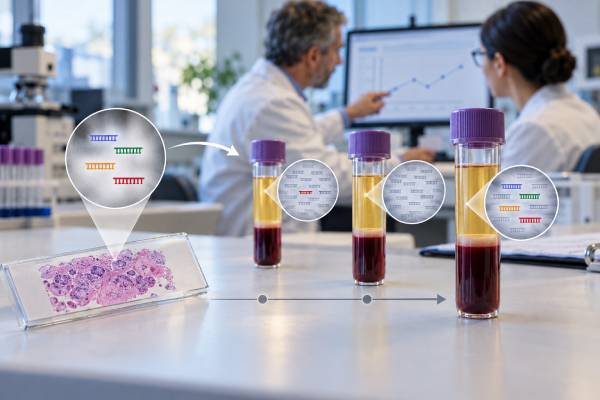
Signatera is a personalized circulating tumor DNA (ctDNA) blood test used to look for molecular residual disease (MRD) and to monitor cancer over time. Instead of using one fixed panel for everyone, the assay is built from genetic changes found in a patient’s own tumor. After that personalized tumor signature is created, later blood samples are checked for the same cancer-specific DNA signals. A positive Signatera result means tumor-derived DNA was detected and, after curative-intent treatment, is generally associated with a much higher risk of recurrence. A negative result means ctDNA was not detected in that sample, but it cannot prove that every cancer cell is gone. Signatera is used across several solid-tumor settings, and evidence is strongest for particular cancers and clinical scenarios. The result should therefore be interpreted with pathology, stage, treatment, imaging, symptoms, and the timing and pattern of serial tests—not as a stand-alone diagnosis or treatment order.
- What Signatera measures: Patient-specific tumor DNA fragments in blood for MRD, recurrence, and treatment monitoring.
- Positive result: ctDNA is detected; after definitive treatment this usually signals a substantially increased risk of recurrence.
- Negative result: No ctDNA is detected at that time, but disease can still be present below the test’s detection limit.
- What is needed first: Tumor tissue plus a matched normal sample are used to design the personalized assay.
- Why repeat tests matter: Serial results can show persistent negativity, molecular clearance, or a new positive signal before recurrence is visible on routine imaging.
Table of Contents
- What Signatera is and what it is designed to detect
- How the personalized Signatera assay works
- When Signatera may be used
- What positive, negative, and changing results mean
- What studies show about recurrence and lead time
- Limits, false negatives, and common misunderstandings
- How Signatera differs from other liquid biopsies and surveillance tests
What Signatera is and what it is designed to detect
Signatera is a tumor-informed molecular residual disease assay. Its main job is to detect very small amounts of cancer-derived DNA in the blood after a person has already been diagnosed with cancer. It can also be used for longitudinal monitoring in selected treatment settings.
That makes it different from a cancer-screening blood test and different from a broad ctDNA mutation panel used mainly to identify actionable mutations. Signatera is not primarily designed to discover which drug target is present. It is designed to answer questions such as:
- Is tumor-specific DNA still detectable after surgery or other definitive treatment?
- Has ctDNA appeared during surveillance before standard testing shows recurrence?
- Is ctDNA clearing or persisting during treatment?
- Does the molecular pattern suggest a higher or lower recurrence risk?
The term MRD can be confusing in solid tumors because there may be no visible mass remaining. Molecular residual disease means evidence of residual cancer is detectable at the DNA level even when imaging may show no evidence of disease. A ctDNA MRD test is therefore looking below the resolution of routine scans, not replacing scans.
Signatera’s current product information describes a personalized approach using tumor tissue and a matched normal sample for whole-exome or whole-genome sequencing. Natera’s newer Signatera Genome version uses a curated set of 64 clonal variants with very deep sequencing. Older peer-reviewed Signatera studies used earlier assay designs, so performance numbers from one version or cancer setting should not be assumed to apply identically to every current use.
How the personalized Signatera assay works
The testing process has two phases: personalized assay development and later blood-based monitoring.
1. Build the tumor signature
A sample of the patient’s tumor—often archived tissue from surgery or biopsy—is sequenced. A matched normal blood sample helps the laboratory distinguish tumor-specific mutations from inherited variants and from mutations arising in blood cells.
The laboratory selects mutations that are suitable for tracking. These are usually somatic changes found in the tumor rather than germline variants present throughout the body.
2. Create the personalized assay
The chosen variants become the patient’s individual molecular fingerprint. Current Signatera materials emphasize tracking clonal or truncal variants—changes believed to be broadly represented across the tumor—rather than relying on a single potentially unstable mutation.
This personalized design is one reason tumor-informed ctDNA testing can achieve high specificity. The laboratory is not asking whether any cancer-associated mutation exists in the plasma. It is asking whether a specific set of mutations already shown to belong to that patient’s tumor is present.
3. Test serial blood samples
Once the assay is built, subsequent monitoring generally uses blood samples only. Cell-free DNA is isolated from plasma and deeply sequenced for the selected tumor-specific targets.
Natera’s current patient information lists roughly 3–4 weeks for the initial result and about 7–10 days for subsequent tests. Actual turnaround can vary with specimen quality, logistics, and laboratory workflow.
Serial monitoring matters because ctDNA is dynamic. A single blood sample is a snapshot. Repeated results can show whether a molecular signal is persistent, clearing with treatment, newly emerging, or remaining undetectable over time.
When Signatera may be used
Signatera has been studied across colorectal, breast, lung, bladder, gastroesophageal, ovarian, and other cancers. The exact clinical value depends on cancer type, stage, timing, and what decision the result is expected to inform.
After surgery or definitive treatment
One of the most established uses is postoperative MRD assessment. If ctDNA remains detectable after a tumor has been removed, that can indicate residual microscopic disease and a high risk of recurrence.
In colorectal cancer, large prospective observational programs have shown that postoperative ctDNA status strongly separates patients into different recurrence-risk groups. The 2024 resectable colorectal cancer analysis by Nakamura and colleagues linked ctDNA-based MRD status with disease-free and overall survival and evaluated how ctDNA status interacted with adjuvant treatment.
A positive result does not mean that recurrence is already visible or that it will occur on a fixed schedule. It means the tumor’s molecular fingerprint is detectable in blood at a time when the burden may still be microscopic.
During surveillance
Repeated Signatera testing may detect molecular recurrence before symptoms or imaging. That lead time can create an opportunity for closer evaluation, but it also creates a practical challenge: a blood test can be positive while CT, MRI, or PET imaging is still negative.
The correct response to that situation is cancer-specific. Depending on the evidence and clinical context, a care team may repeat ctDNA, obtain earlier or different imaging, intensify surveillance, consider treatment when supported by data, or discuss a clinical trial.
During treatment
ctDNA trends can also be used to assess molecular response in selected settings. Falling or clearing ctDNA can be consistent with treatment activity, while persistent or rising detection may raise concern for resistant or residual disease.
However, current guidance cautions against treating a raw ctDNA fraction or concentration as a universal measure of tumor burden. ASCO’s 2026 guideline specifically states that fractional, percentage, or concentration-based measures of ctDNA or total cell-free DNA should not be used as a surrogate measure of disease outside validated contexts.
What positive, negative, and changing results mean
Signatera results are most clinically useful when interpreted as a pattern rather than as an isolated laboratory number.
| Result pattern | Typical interpretation | Important caution |
|---|---|---|
| Positive after curative-intent treatment | Tumor-specific ctDNA is present and recurrence risk is generally much higher. | The test does not show the location or size of disease. |
| Negative after treatment | No tracked ctDNA is detected in that blood sample; this is generally favorable. | Microscopic or low-shedding disease can still be present. |
| Repeatedly negative | Serial non-detection usually provides more reassurance than one negative result. | Routine surveillance may still be required. |
| Negative then positive | A newly detectable tumor signal can indicate molecular recurrence or progression. | Confirmation and clinical evaluation are needed before treatment decisions. |
| Positive then negative on therapy | Molecular clearance may be consistent with response. | Clearance does not guarantee permanent remission. |
A positive result
A positive Signatera result means enough evidence from the personalized tumor-variant set was detected for the assay to call ctDNA present. In the postoperative setting, positive ctDNA has repeatedly been associated with substantially worse recurrence-free outcomes than negative ctDNA.
The result should trigger a clinical question, not an automatic treatment. What will be done differently because the test is positive? In some cancers, prospective data or coverage policies support particular uses. In others, the best action may still be enhanced surveillance or participation in an MRD-directed trial.
A positive ctDNA test and a negative scan can both be correct. Imaging needs a lesion large or biologically active enough to detect; ctDNA may detect molecular evidence earlier.
A negative result
A negative result means the assay did not detect the tracked tumor signature in that sample. It is usually associated with a lower recurrence risk than a positive result.
It does not mean the recurrence risk is zero. Reasons for a false-negative result include:
- very low residual tumor burden;
- a tumor that sheds little ctDNA;
- disease confined to a low-shedding location such as the central nervous system;
- insufficient informative DNA molecules in the sampled plasma;
- timing effects after surgery or systemic therapy;
- recurrence driven by tumor biology that is difficult to capture in plasma.
A negative Signatera test should not be used to dismiss new symptoms or skip standard surveillance unless there is strong evidence supporting that change for the specific cancer.
What studies show about recurrence and lead time
Signatera has a large clinical literature, but the most useful way to read it is by cancer type and setting rather than by quoting one “accuracy” figure.
Breast cancer
A 2024 study followed 156 patients with primary breast cancer using serial personalized Signatera testing. Among 34 patients who relapsed, ctDNA detected molecular relapse in 30, for a patient-level sensitivity of 88.2%. The median lead time before clinical or radiologic relapse was 10.5 months, with a reported range from 0 to 38 months.
That result illustrates both the value and the limitation of surveillance ctDNA. Most relapses produced a detectable molecular signal in advance, but not all did. Hormone-receptor-positive breast cancers can also relapse many years after initial treatment, so the useful monitoring window may differ from cancers with earlier recurrence patterns.
Colorectal cancer
In the large 2024 resectable colorectal cancer study, ctDNA MRD status was strongly prognostic. The study is important because it reflects a real-world, multi-institutional setting and links molecular status with survival outcomes and adjuvant treatment exposure.
For a patient, the key lesson is that a postoperative positive result is not a mildly abnormal laboratory value. It identifies a biologically different risk group in which residual tumor DNA remains detectable after treatment.
Non-small cell lung cancer
A 2024 real-world study of 108 patients with resected early-stage NSCLC collected blood at roughly three-month intervals. Twelve patients became ctDNA-positive after surgery; clinical management changed in all 12, often prompting earlier imaging. Of 10 patients with recurrent disease, eight had ctDNA positivity, while the two ctDNA-negative recurrences involved brain-only metastases—an example of how disease location can affect plasma detection.
These studies do not prove that every intervention made because of earlier ctDNA detection improves survival. They show strong clinical validity: ctDNA status predicts recurrence and can precede standard detection. The next layer—clinical utility—requires evidence that a specific ctDNA-guided action improves outcomes or safely reduces unnecessary treatment.
Limits, false negatives, and common misunderstandings
The most common mistake is treating Signatera as a definitive “cancer present/cancer absent” test. It is more accurate to think of it as a very sensitive molecular surveillance tool with a nonzero false-negative rate.
Signatera is not a screening test
It is built from a known tumor and is not intended to tell an otherwise healthy person whether they have an unknown cancer. A multi-cancer early detection blood test is a different category with different validation questions.
It does not replace pathology or staging
Tumor stage, lymph-node involvement, margins, grade, histology, receptor status, and other pathology features still matter. ctDNA adds molecular risk information; it does not erase the established clinical context.
It does not locate recurrence
A positive blood test can indicate molecular disease, but imaging, examination, endoscopy, or biopsy may still be needed to determine where the cancer is and whether a lesion can be treated locally.
Tissue quality can limit assay creation
Because Signatera is tumor-informed, adequate tumor material is needed for personalized design. If tissue is unavailable, exhausted, or of poor quality, a tumor-naive ctDNA test may be considered in settings where an appropriate validated alternative exists.
Clonal hematopoiesis must be separated from tumor DNA
Normal blood-forming cells can acquire mutations as people age. These clones can release mutated DNA into plasma. Matched normal testing and tumor-informed design help reduce this source of false-positive calls, but clonal hematopoiesis remains a major concept in liquid-biopsy interpretation generally.
Test timing affects meaning
Testing too soon after surgery can be complicated by a large release of non-tumor cell-free DNA from tissue injury. Postoperative studies use defined landmark windows, and the timing that is validated for one cancer or protocol should not automatically be transferred to another.
How Signatera differs from other liquid biopsies and surveillance tests
Signatera is one member of a broader ctDNA ecosystem. The test category matters because different assays answer different questions.
| Approach | Main question | Personalized to tumor? |
|---|---|---|
| Signatera | Is patient-specific ctDNA detectable for MRD, recurrence, or monitoring? | Yes |
| RaDaR | Is tumor-informed ctDNA detectable for MRD and longitudinal monitoring? | Yes |
| Broad liquid-biopsy genomic panel | Which actionable or resistance mutations are present now? | Usually no |
| Tumor-naive MRD assay | Is a cancer-associated molecular signal detectable without custom tumor sequencing? | No |
| CT/MRI/PET | Where is visible or metabolically active disease, and how large is it? | No |
A broad liquid biopsy test may be preferred when the immediate goal is therapy selection in advanced disease—for example, identifying an EGFR, ESR1, KRAS, or other actionable alteration. A tumor-informed MRD test may be preferred when the goal is to find a tiny residual signal after treatment.
The distinction also explains why a negative broad mutation panel and a negative MRD test mean different things. A broad panel can be negative because there is too little ctDNA to genotype. A personalized MRD test uses deeper attention on known tumor variants, but it can still be negative when residual disease is below sampling and detection limits.
The most useful Signatera plan therefore includes three things before testing begins: why the test is being ordered, when it will be repeated, and what action a positive or negative result can reasonably change. Without that plan, an extremely sensitive molecular result can create uncertainty rather than improve care.
References
- Circulating Tumor DNA Testing in Solid Tumors and Lymphoma: ASCO Guideline 2026 (Guideline)
- Signatera – Circulating Tumor DNA Blood Test | Natera 2026 (Official Test Information)
- ctDNA-based molecular residual disease and survival in resectable colorectal cancer 2024
- Serial Postoperative Circulating Tumor DNA Assessment Has Strong Prognostic Value During Long-Term Follow-Up in Patients With Breast Cancer 2024
- Early real-world experience monitoring circulating tumor DNA in resected early-stage non-small cell lung cancer 2024
- Clinical application of molecular residual disease detection by circulation tumor DNA in solid cancers and a comparison of technologies: review article 2023 (Review)
Disclaimer
This article provides general educational information and is not a substitute for individualized oncology care. Signatera results must be interpreted in the context of the specific cancer, treatment, timing, imaging, pathology, and available clinical evidence. Do not change cancer treatment or surveillance based on a ctDNA result without discussing it with the treating oncology team.