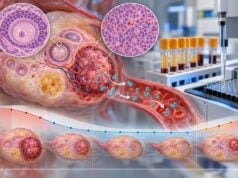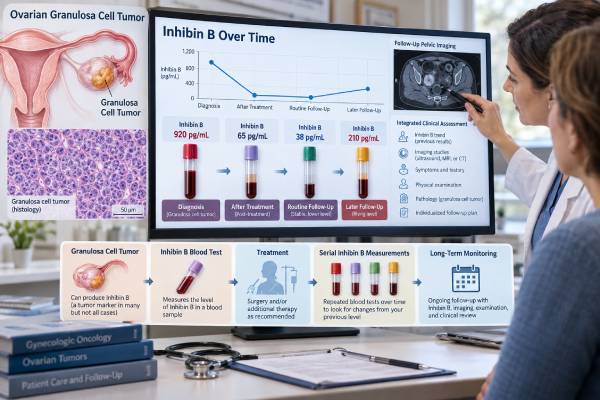
Inhibin B is one of the most useful blood tumor markers for ovarian granulosa cell tumors, especially adult-type granulosa cell tumors. It is a hormone normally produced by ovarian granulosa cells and helps regulate follicle-stimulating hormone. Because granulosa cell tumors arise from these same cells, many of them release abnormally high inhibin B into the bloodstream. A high value can support the diagnosis when an ovarian mass and clinical findings are compatible, but the blood test alone cannot prove cancer. Its strongest role is often long-term monitoring: if inhibin B is elevated before treatment and falls after tumor removal, a later sustained rise can signal recurrent disease and may precede symptoms or imaging findings. Inhibin B is generally more sensitive than inhibin A for adult granulosa cell tumors. Interpretation still depends on menopausal status, ovarian function, assay-specific reference ranges, and the patient’s own baseline trend.
- Inhibin B is a granulosa-cell hormone and a commonly used serum marker for adult ovarian granulosa cell tumors.
- A high inhibin B result supports active granulosa cell tumor in the right clinical setting but is not diagnostic without imaging and pathology.
- Inhibin B is usually more sensitive than inhibin A for detecting adult granulosa cell tumor and recurrence.
- After menopause, inhibin B should be very low on many assays, so a new or rising value can be particularly informative.
- Serial trends are most useful when inhibin B was elevated before treatment and normalized with successful therapy.
Table of Contents
- What Inhibin B Measures
- When Inhibin B Is Ordered
- What High and Normal Results Mean
- Inhibin B and Recurrence Monitoring
- Inhibin B Compared With Other Markers
- Limitations and False Signals
- Next Steps After Inhibin B Testing
What Inhibin B Measures
Inhibin B is a dimeric glycoprotein hormone composed of an alpha subunit and a beta-B subunit. In normal reproductive physiology, granulosa cells in developing ovarian follicles produce inhibin B. The hormone feeds back on the pituitary gland and suppresses FSH secretion.
Because adult-type granulosa cell tumors arise from granulosa cells, they often retain this secretory function. Serum inhibin B can therefore become markedly elevated when tumor is present.
In premenopausal patients, normal inhibin B varies with ovarian activity and menstrual-cycle timing. In postmenopausal patients, follicular activity has ended, so inhibin B is normally very low or undetectable on many assays. This makes a clearly detectable result easier to interpret after menopause, although laboratory-specific ranges still apply.
Inhibin B is not a general marker for epithelial ovarian cancer. A high-grade serous carcinoma may produce CA-125 or HE4, while a dysgerminoma may be associated with LDH and a yolk sac tumor with AFP. The tumor’s histologic family determines which marker is biologically relevant.
The blood test also differs from tissue inhibin-alpha immunohistochemistry. Pathologists commonly stain ovarian tumor tissue for inhibin-alpha when distinguishing sex cord-stromal tumors from mimics. Serum inhibin B measures a circulating hormone; tissue inhibin staining helps classify cells under the microscope.
Adult-type granulosa cell tumors have distinctive pathology and molecular features, most notably a recurrent FOXL2 mutation in the great majority of cases. The blood marker supports the clinical picture but does not replace tissue diagnosis.
When Inhibin B Is Ordered
Inhibin B may be ordered when an ovarian mass has features that raise suspicion for a granulosa cell tumor. Clues can include the patient’s age, imaging appearance, and signs of hormone production.
Because these tumors can secrete estrogen, symptoms may include abnormal uterine bleeding, heavy or irregular periods, postmenopausal bleeding, breast tenderness, or endometrial thickening. Some younger patients can have endocrine symptoms related to hormone secretion.
The test has several practical roles:
- Initial evaluation. A high result can make a granulosa cell tumor more likely when the ovarian mass and clinical context fit.
- Pretreatment baseline. Measuring inhibin B before surgery establishes whether the tumor secretes a useful marker.
- Assessment after treatment. A marked decline can support removal or response of marker-producing tumor.
- Long-term surveillance. A new sustained rise can trigger evaluation for recurrence.
Fasting is generally not required. The laboratory should receive accurate age and menopausal information when relevant to interpretation.
The pretreatment measurement is particularly valuable. If the level is high before surgery and becomes low afterward, clinicians know the marker tracks that individual tumor. If inhibin B is normal before treatment, repeatedly checking it during surveillance may be less useful.
It is also useful to document the exact specimen date relative to surgery. A value drawn after tumor removal cannot serve as a true baseline, and a value obtained during ovarian stimulation or another major hormonal change may not reflect the usual background level. Good longitudinal records make later recurrence assessment more reliable.
Because granulosa cell tumors can produce estrogen, the workup may also include evaluation of the endometrium when abnormal bleeding or endometrial thickening is present. The blood marker does not assess the uterus, and a normal inhibin B result should not delay evaluation of unexplained bleeding.
Clinicians may order inhibin A at the same time, but inhibin B has generally shown better sensitivity for adult-type disease. AMH is another useful granulosa-cell marker and can complement inhibin B.
What High and Normal Results Mean
The correct reference point is the range printed on the laboratory report. There is no universal inhibin B tumor cutoff that applies to every assay and every reproductive stage.
A high inhibin B result can indicate active granulosa cell tumor, residual disease, or recurrence when the clinical context is appropriate. The higher the level, the more likely a marker-producing tumor is contributing, but the number does not directly provide stage or exact tumor size.
In a patient with no known granulosa cell tumor, the clinician also considers normal ovarian physiology. Premenopausal ovaries naturally produce inhibin B, especially in relation to follicular development. Age, ovarian reserve, cycle timing, fertility medications, and other endocrine factors can affect values.
A normal result does not exclude a granulosa cell tumor. Not every tumor secretes inhibin B at a detectable level. Even though inhibin B is more sensitive than inhibin A, no serum marker reaches 100% sensitivity in every clinical population.
The most useful interpretation often comes from a pattern:
- high before surgery;
- substantial fall after tumor removal;
- stable low level during remission;
- reproducible rise if disease returns.
A single mildly abnormal test should usually be confirmed or interpreted with imaging rather than treated as proof of relapse.
In one large single-center cohort, inhibin B was elevated in 89% of patients at diagnosis and 85% at recurrence, compared with 67% and 58% for inhibin A. Those numbers describe one study and should not be used as universal test-performance guarantees, but they help explain why inhibin B is commonly favored.
Inhibin B and Recurrence Monitoring
Long-term surveillance is a major issue in adult granulosa cell tumors because recurrence can occur many years after primary treatment. Serum inhibin B can be useful precisely because it may become abnormal before a recurrence causes symptoms.
Older and newer studies have shown that rising inhibin levels can precede clinically recognized relapse. In a 2021 study of postmenopausal patients with adult-type granulosa cell tumors, an inhibin B cutoff of 7 pg/mL was strongly associated with the presence or absence of disease, with high sensitivity and specificity in that specific cohort. The investigators also found that higher inhibin B concentrations correlated with larger lesions and increasing probability of an abnormal CT scan.
Those study thresholds should not be copied directly into every laboratory report. Assays differ, and the population was specifically postmenopausal. The broader lesson is that serial inhibin B can help decide when imaging is warranted in a patient whose marker is known to track tumor burden.
A rising result may lead the clinician to:
- repeat the blood test to confirm the trend;
- review symptoms and perform an examination;
- obtain pelvic or abdominal imaging;
- compare inhibin B with AMH or other markers used for that patient;
- discuss recurrence management if measurable disease is found.
A marker rise alone usually does not define where recurrence is located. Granulosa cell tumors can recur in the pelvis, abdomen, or other sites, so imaging remains essential.
The surveillance interval is individualized by stage, treatment history, time since diagnosis, age, and local practice. Even after many disease-free years, follow-up remains relevant because late recurrence is a known characteristic of these tumors.
A marker can be especially helpful when repeated imaging would otherwise be frequent. In a patient whose inhibin B has remained stably low for years, clinicians may use the biomarker as one piece of information when deciding when cross-sectional imaging is necessary. This does not mean imaging should be withheld solely because the marker is normal; symptoms, examination findings, and the original tumor pattern still matter.
Patients should report new abdominal or pelvic pain, increasing bloating, early satiety, a new mass sensation, abnormal uterine bleeding, or unexplained bowel or urinary changes rather than waiting for the next scheduled inhibin test.
Inhibin B Compared With Other Markers
Inhibin B is often paired conceptually with inhibin A and AMH, but the markers are not interchangeable.
| Marker | Main strength | Main limitation |
|---|---|---|
| Inhibin B | High sensitivity for many adult granulosa cell tumors and useful recurrence tracking | Normal ovarian function affects levels before menopause |
| Inhibin A | Can be a useful personalized marker when clearly elevated at baseline | Generally less sensitive than inhibin B for adult-type tumors |
| AMH | Often correlates with granulosa-cell tumor burden and can complement inhibin B | Also reflects ovarian reserve in premenopausal patients |
No single marker is automatically best for every patient. If inhibin B was only modestly elevated while AMH was markedly abnormal at diagnosis, the oncology team may rely more heavily on AMH during follow-up. In another patient, inhibin B may be the clearest signal.
CA-125 is not the primary marker for granulosa cell tumors, although it can be measured if the clinical picture includes peritoneal irritation or if the diagnosis is uncertain. HE4 and ROMA are designed mainly for epithelial ovarian malignancy risk assessment, not for monitoring a known sex cord-stromal tumor.
A broader ovarian cancer biomarker profile therefore needs to be matched to tumor type. Using an epithelial marker algorithm for a granulosa cell tumor can create misleading reassurance or concern.
Limitations and False Signals
Inhibin B has important limitations despite its usefulness.
Premenopausal ovarian production
Normal follicles produce inhibin B, so a premenopausal result is more difficult to interpret than a postmenopausal result. Menstrual timing and ovarian reserve can affect the concentration.
Assay-specific reference intervals
Different laboratories may use different immunoassays and cutoffs. A result should be trended with the same method when possible.
Marker-negative tumors exist
A normal inhibin B value cannot rule out a granulosa cell tumor or recurrence. Imaging and clinical assessment remain necessary when symptoms or other findings are concerning.
Other sex cord-stromal tumors can produce inhibin-related markers
Inhibin positivity is not unique to adult granulosa cell tumors. Pathology must establish the exact tumor type.
A genomic or pathology marker is different from a serum marker
FOXL2 mutation testing, SF-1 staining, and inhibin-alpha tissue staining help diagnose and classify the tumor. They do not replace longitudinal serum measurement, and serum inhibin B does not replace histologic diagnosis.
Recurrence biology can change
A recurrent tumor may not secrete markers in exactly the same way as the primary tumor. If imaging and symptoms suggest relapse despite a low inhibin B, the clinical findings take priority.
Next Steps After Inhibin B Testing
If the test is high during initial evaluation of an ovarian mass, the next step is not to “treat the number.” The clinician integrates ultrasound or MRI, symptoms, age, hormone effects, and other markers. Surgery is often required to establish the diagnosis and stage the tumor.
Pathology may include morphology, inhibin-alpha, calretinin, SF-1, and FOXL2-related testing. Once adult granulosa cell tumor is confirmed, stage and surgical findings determine whether observation, further surgery, chemotherapy, or another strategy is appropriate.
If the test rises during surveillance, compare it with the patient’s previous values. A confirmed upward trend is more meaningful than a single minor fluctuation. The clinician may order CT, MRI, or ultrasound based on the pattern and the likely sites of recurrence.
It can be helpful to keep a personal record of inhibin B values with dates and treatment milestones. Because follow-up may extend over decades, older baseline results may become important long after the original surgery.
Patients can ask several practical questions:
- Was inhibin B elevated before my tumor was removed?
- What reference range and assay does this laboratory use?
- Is my current change large enough to be clinically meaningful?
- Should AMH or inhibin A also be tracked?
- At what point would a rising trend trigger imaging?
The central principle is personalization. Inhibin B is most valuable when it behaves as a reproducible marker of disease burden in the individual patient and is interpreted alongside long-term clinical surveillance.
For premenopausal patients who retain an ovary, background production can make very low-level changes harder to interpret than they are after bilateral oophorectomy or menopause. In that setting, clinicians may rely more on a marked change from baseline, persistent upward movement, and agreement with AMH or imaging rather than a single cutoff.
If a value unexpectedly rises after years of stability, repeating it with the same assay before drawing conclusions is often reasonable when the patient is clinically well. If the increase is substantial, persistent, or accompanied by symptoms, earlier imaging is more appropriate. The trend should drive a conversation about risk, not an automatic assumption that recurrence has occurred. For long-term survivors, keeping older pathology reports and marker results is particularly valuable because recurrence may be assessed by a team that did not treat the original tumor. Knowing that inhibin B once closely paralleled disease burden can make a later abnormal result far more informative.
For serial monitoring, consistency improves interpretation. Whenever practical, samples should be measured by the same laboratory method and compared with the patient’s own prior values rather than with a single population cutoff. A small unexpected rise may merit repeat testing before major decisions, while a persistent upward trend is more concerning when it matches symptoms, examination findings, or imaging.
References
- Ovarian Sex Cord-Stromal Neoplasms: An Overview of Molecular Events and How to Correlate Morphology With Molecular Findings. 2025 (Review)
- Sex Cord-Stromal Tumors of the Ovary: An Update and Review. Part II – Pure Sex Cord and Sex Cord-Stromal Tumors. 2024 (Review)
- Immunohistochemical markers of prognosis in adult granulosa cell tumors of the ovary – a review. 2023 (Review)
- Adult-type granulosa cell tumor of the ovary 2022 (Review)
- Role of inhibin B in detecting recurrence of granulosa cell tumors of the ovary in postmenopausal patients. 2021
- Granulosa cell tumors of the ovary: the clinical value of serum inhibin A and B levels in a large single center cohort. 2007
Disclaimer
Inhibin B is a useful serum marker for many granulosa cell tumors but cannot diagnose or exclude ovarian cancer by itself. Results depend on reproductive status, assay, and individual tumor secretion, and rising levels should be evaluated with clinical assessment and imaging. Long-term follow-up should be planned with a gynecologic oncology team familiar with sex cord-stromal tumors.