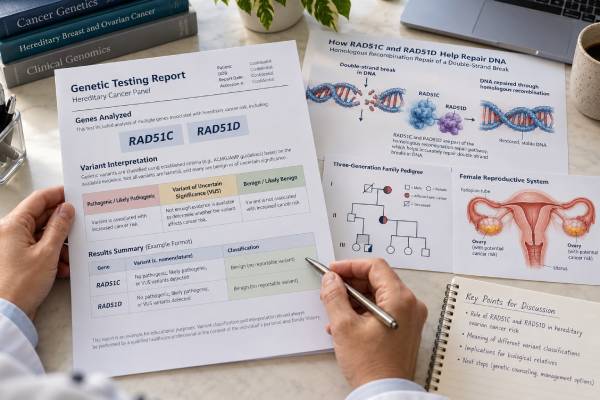
A RAD51C and RAD51D test looks for inherited or tumor-acquired changes in two genes that help repair double-strand DNA breaks through homologous recombination. Pathogenic germline variants in either gene increase the lifetime risk of tubo-ovarian cancer and can also modestly increase breast cancer risk. Testing is usually included in a multigene hereditary cancer panel rather than ordered alone. A positive germline result can affect cancer-risk counseling, timing of risk-reducing surgery, and testing of relatives. A tumor-only result has a different meaning: it may reflect a somatic change confined to the cancer, an inherited variant, or occasionally a technical or biologic finding that needs confirmation. Variants of uncertain significance (VUS) should not be treated as positive results. RAD51C and RAD51D are also part of the homologous recombination repair pathway, so loss of function can contribute to HRD biology in ovarian cancer, but a gene variant by itself does not automatically determine PARP inhibitor eligibility or prove that a specific HRD assay will be positive.
- Pathogenic germline RAD51C or RAD51D variants increase tubo-ovarian cancer risk: published estimates place average cumulative risk to age 80 at roughly 11% for RAD51C and 13% for RAD51D, with family history modifying risk.
- A VUS is not a positive hereditary cancer result: it should not by itself trigger preventive ovary and tube surgery or predictive testing of healthy relatives.
- Blood or saliva testing evaluates inherited risk: tumor-only sequencing cannot reliably tell whether a RAD51C or RAD51D variant is germline without confirmatory normal-tissue testing.
- Risk-reducing salpingo-oophorectomy is individualized: current expert guidance generally discusses surgery around the menopause transition based on age-specific risk, family history, and personal preferences.
- RAD51C/RAD51D loss can contribute to HRD: treatment relevance depends on the tumor’s biology, disease setting, validated biomarker criteria, and current drug indications.
Table of Contents
- What RAD51C and RAD51D Do in DNA Repair
- Hereditary Ovarian Cancer Risk From Pathogenic Variants
- Positive, Negative, and VUS Result Meaning
- Germline Testing vs Tumor Testing
- Risk Reduction, Surgery, and Screening
- HRD Biology and Treatment Relevance
- Family Testing and Practical Next Steps
What RAD51C and RAD51D Do in DNA Repair
RAD51C and RAD51D encode proteins that participate in homologous recombination repair, one of the cell’s most accurate systems for repairing dangerous double-strand DNA breaks. The pathway uses an intact DNA copy as a template so the damaged chromosome can be restored with high fidelity.
The RAD51 protein is central to this repair process. RAD51C and RAD51D work with related proteins to help form and regulate complexes that position RAD51 at damaged DNA and coordinate repair. When both functional copies of one of these genes are lost in a tumor cell, homologous recombination can become defective. The cell then relies more heavily on error-prone repair pathways, which can create chromosome instability and the genomic patterns associated with homologous recombination deficiency, or HRD.
A person who inherits one pathogenic RAD51C or RAD51D variant usually still has one working copy in normal cells. Cancer risk rises because a susceptible cell can later lose or inactivate the remaining normal copy. This “second hit” can create the repair defect that contributes to tumor formation.
RAD51C and RAD51D are not as well known as BRCA1 and BRCA2, but they belong to the same broad DNA-repair network. They are therefore commonly included in a gynecologic hereditary cancer gene panel alongside BRCA1, BRCA2, BRIP1, and other susceptibility genes.
The distinction between gene function and clinical risk is important. Laboratory experiments can show that a variant disrupts homologous recombination, but hereditary risk estimates also require population data, family studies, and variant classification. Likewise, a tumor can show HRD for reasons unrelated to RAD51C or RAD51D.
When a report identifies one of these genes, the first question should be whether the variant is pathogenic or likely pathogenic and whether it was found in germline or tumor testing. Those details determine most of the clinical meaning.
Hereditary Ovarian Cancer Risk From Pathogenic Variants
Pathogenic germline variants in RAD51C and RAD51D are associated with moderate but clinically important increases in tubo-ovarian cancer risk. “Tubo-ovarian” is often used because many cancers historically called ovarian high-grade serous carcinoma are now understood to begin in the fallopian tube.
A large family-based study estimated cumulative tubo-ovarian cancer risk to age 80 at about 11% for RAD51C and 13% for RAD51D. The confidence intervals were broad—approximately 6% to 21% for RAD51C and 7% to 23% for RAD51D—showing that these are population estimates, not precise predictions for one person.
Family history can shift risk substantially. A carrier with several close relatives affected by ovarian cancer may have a higher personalized estimate than a carrier with no ovarian cancer in the family. Age also matters: risk is relatively low in early adulthood and rises later, which is why recommendations for preventive surgery are often timed closer to natural menopause than they are for many BRCA1 carriers.
RAD51C and RAD51D pathogenic variants are also associated with increased breast cancer risk, particularly for some receptor subtypes, although the magnitude is generally lower than the classic high penetrance seen with BRCA1 or BRCA2. Breast screening recommendations therefore depend on the gene, age, family history, and modeled lifetime risk.
These numbers apply to pathogenic or likely pathogenic germline variants. They do not apply to every rare DNA change. A VUS has not been shown to confer the same risk and should not be entered into a risk calculator as if it were disease-causing.
Testing can be appropriate for a person with epithelial ovarian, fallopian tube, or primary peritoneal cancer even without a strong family history, because hereditary predisposition can be present in apparently sporadic cases. A dedicated BRCA1 and BRCA2 ovarian cancer test is important, but multigene testing can identify clinically relevant variants in RAD51C, RAD51D, BRIP1, and other genes that BRCA-only testing would miss.
Positive, Negative, and VUS Result Meaning
Hereditary genetic reports usually classify variants using categories such as pathogenic, likely pathogenic, uncertain significance, likely benign, and benign. The category is more important than whether a DNA spelling change is present.
A pathogenic or likely pathogenic germline result means there is enough evidence that the variant impairs gene function and increases cancer susceptibility. In the right clinical setting, this can support enhanced risk counseling, consideration of risk-reducing salpingo-oophorectomy, and targeted testing of adult relatives.
A negative result means the laboratory did not find a reportable pathogenic variant in the genes and regions tested. It does not reduce ovarian cancer risk to zero. A family may carry a susceptibility variant that current testing cannot detect, a variant in a gene not included on the panel, or a risk pattern caused by multiple common factors rather than one high-impact variant. Personal and family history still matter after a negative test.
A variant of uncertain significance (VUS) means the evidence is not sufficient to classify the change as disease-causing or benign. This is not a “weak positive.” Most clinical genetics guidelines recommend that medical management be based on the person’s history and established risk factors rather than on a VUS.
A VUS should generally not be used by itself to:
- recommend preventive removal of the ovaries and fallopian tubes;
- test healthy relatives as if the variant were known to cause disease;
- determine cancer treatment eligibility;
- label a family as having a hereditary cancer syndrome.
RAD51C in particular has been the focus of laboratory functional studies designed to reclassify uncertain missense variants. High-throughput assays can measure how strongly a variant disrupts gene function, but clinical classification still combines functional evidence with population frequency, segregation, computational, and case data.
Variant interpretation can change. A laboratory may later reclassify a VUS as benign or pathogenic as evidence grows. Patients can ask how they will be contacted if a clinically meaningful reclassification occurs.
Germline Testing vs Tumor Testing
Germline testing analyzes constitutional DNA, usually from blood or saliva. A pathogenic result is expected to be present throughout the body and can therefore have implications for relatives.
Tumor testing analyzes DNA from the cancer. A RAD51C or RAD51D variant found only in tumor tissue may have developed after the cancer formed. Such a somatic variant can affect tumor biology without being inherited.
Tumor-only sequencing creates an important ambiguity: when a pathogenic variant is found, the test may not be able to tell whether it is somatic or germline. Variant allele fraction can provide a clue but is not definitive because tumor purity, copy-number changes, loss of heterozygosity, and normal-cell contamination all affect the percentage.
If tumor sequencing detects a potentially germline pathogenic RAD51C or RAD51D variant, confirmatory blood or saliva testing may be recommended. That confirmation determines whether family members need counseling and predictive testing.
The reverse situation also occurs. A person may carry a germline pathogenic variant, but the tumor may not show complete loss of the remaining normal allele or may not have a strong HRD phenotype. Inherited susceptibility and tumor treatment biology overlap, but they are not identical.
This distinction is particularly important when patients read a broad tumor profile. A report may list “RAD51C pathogenic variant” under potentially actionable alterations. That statement does not by itself establish hereditary risk. Conversely, a negative tumor panel is not always a substitute for dedicated germline testing because tumor assays vary in gene coverage, variant detection, and ability to identify large rearrangements.
A complete ovarian cancer biomarker strategy often uses both germline and tumor information because each answers a different question: what did the person inherit, and what molecular defects does the cancer actually have?
Risk Reduction, Surgery, and Screening
For women with a confirmed pathogenic germline RAD51C or RAD51D variant, the most effective ovarian cancer risk-reduction strategy is discussion of risk-reducing salpingo-oophorectomy (RRSO)—surgical removal of both fallopian tubes and ovaries—at an age appropriate to the gene-specific risk profile.
Recent expert guidance emphasizes individualized timing rather than one rigid age for everyone. Because RAD51C- and RAD51D-associated tubo-ovarian cancer risk rises mainly later in adulthood, many recommendations discuss RRSO near the natural menopause transition, often around the mid-to-late 40s or around age 50 depending on the gene, family history, estimated five-year risk, childbearing plans, and national guideline. A family with unusually early ovarian cancers may justify earlier discussion.
The benefits must be weighed against the consequences of premature menopause. Removing the ovaries before natural menopause can cause hot flashes, sexual symptoms, bone loss, and cardiovascular effects. Hormone-replacement therapy may be appropriate for some carriers without contraindications, especially when surgery occurs well before natural menopause. These decisions should be individualized.
Routine ovarian cancer screening with CA-125 and transvaginal ultrasound has not been proven to reduce ovarian cancer mortality in high-risk carriers. Some specialist programs may offer surveillance when surgery is deferred, often in a research or individualized setting, but surveillance should not be presented as equivalent to proven risk reduction.
This is a critical counseling point. A normal ultrasound or normal CA-125 level cannot guarantee that an early tubo-ovarian cancer is absent.
Risk management also includes breast cancer assessment. Depending on estimated lifetime breast cancer risk, a carrier may qualify for earlier mammography and/or breast MRI. The exact plan differs between health systems and should be based on current gene-specific guidance rather than a generic BRCA protocol.
Family planning may also be relevant. RAD51C and RAD51D follow autosomal-dominant inheritance for cancer susceptibility, so each child of a carrier has a 50% chance of inheriting the familial variant. Reproductive options can be discussed if desired, but testing decisions remain personal.
HRD Biology and Treatment Relevance
RAD51C and RAD51D sit within the same homologous recombination pathway as BRCA1 and BRCA2. Loss of function can make tumor cells less able to repair double-strand DNA breaks accurately, potentially creating homologous recombination deficiency.
HRD matters in ovarian cancer because tumors with defective homologous recombination can be particularly sensitive to platinum chemotherapy and, in defined settings, PARP inhibitors. PARP inhibition exploits a repair vulnerability that can become lethal when homologous recombination is already impaired.
However, a RAD51C or RAD51D variant should not be interpreted as a universal PARP prescription. Several layers matter:
- Is the variant pathogenic or merely uncertain?
- Is it germline or somatic?
- Has the tumor lost the remaining functional allele?
- Does the tumor meet the validated HRD definition for the assay used?
- What line of therapy and disease setting is being considered?
- What do current regulatory indications and treatment guidelines require?
An HRD test for ovarian cancer may measure broader genomic scarring rather than only individual repair-gene mutations. A RAD51C/D pathogenic variant can help explain an HRD-positive result, but HRD can also arise through BRCA alterations, other repair genes, or epigenetic mechanisms.
Tumors can evolve resistance. Restoration of homologous recombination through secondary changes may reduce sensitivity to platinum or PARP inhibitors even though the original gene alteration is still visible in the medical record. This is another reason treatment biology cannot always be inferred from hereditary status alone.
For a newly diagnosed patient, the hereditary result remains important even if it does not immediately change the drug choice because it can guide family risk management and may become relevant to future treatment or clinical-trial options.
Family Testing and Practical Next Steps
A confirmed pathogenic germline RAD51C or RAD51D result should usually trigger a discussion with a genetics professional. The goals are to explain the estimated cancer risks, build a three-generation family history, discuss prevention, and identify relatives who may benefit from cascade testing.
Cascade testing is most efficient when relatives are tested for the exact familial pathogenic variant rather than repeating a broad panel without a reason. Adult first-degree relatives—parents, siblings, and children—each have a 50% chance of carrying an autosomal-dominant familial variant. More distant relatives may also be at risk depending on which side of the family the variant came from.
A negative result in a relative who is tested specifically for a known familial variant is called a true negative. That person generally does not carry the gene-specific excess risk from that family variant, although ordinary population risk and risk from the other side of the family still apply.
Practical questions to ask after testing include:
- Is my result pathogenic/likely pathogenic or a VUS?
- Was the test germline, tumor-only, or paired tumor-normal testing?
- What is my estimated ovarian and breast cancer risk given my family history?
- At what age should I discuss risk-reducing salpingo-oophorectomy?
- What are the consequences of surgical menopause, and is hormone therapy an option?
- Which relatives should receive targeted testing?
- Does my ovarian tumor need separate HRD or somatic profiling for treatment decisions?
If the result is negative but the family history is striking, genetics follow-up can still be useful. The panel may need updating in the future, or risk may be managed from family history even without an identified gene.
If the result is a VUS, the safest next step is usually to avoid irreversible decisions based on uncertainty. Continue risk management according to personal and family history and allow the laboratory evidence to mature.
RAD51C and RAD51D testing is most valuable when the result is placed in the correct lane: hereditary risk for the person and family, tumor biology for the cancer, and treatment prediction only when validated evidence links the specific finding to a therapy.
References
- Management of individuals with heterozygous germline pathogenic variants in RAD51C, RAD51D, and BRIP1: A clinical practice resource of the American College of Medical Genetics and Genomics (ACMG) 2025 (Clinical Practice Resource)
- UK consensus recommendations for clinical management of cancer risk for women with germline pathogenic variants in cancer predisposition genes: RAD51C, RAD51D, BRIP1 and PALB2 2023 (Consensus)
- High-resolution functional mapping of RAD51C by saturation genome editing 2024
- Functional and Clinical Characterization of Variants of Uncertain Significance Identifies a Hotspot for Inactivating Missense Variants in RAD51C 2023
- Comprehensive RAD51C ovarian cancer variant analysis uncouples homologous recombination and replicative functions 2025
- Ovarian and Breast Cancer Risks Associated With Pathogenic Variants in RAD51C and RAD51D 2020
Disclaimer
This article provides general genetic and cancer-risk information and cannot estimate an individual carrier’s exact risk or recommend preventive surgery. RAD51C and RAD51D results should be interpreted by qualified genetics and oncology professionals using the variant classification, test type, family history, age, and current guidance. A VUS should not be treated as a confirmed hereditary cancer finding.